
Netherlands Biometrics Market: Privacy-First Innovation, Border Modernisation & Digital Identity Integration
How e gate deployment, GDPR compliant authentication and an 80% mobile ID penetration are driving a €2.3bn biometrics economy

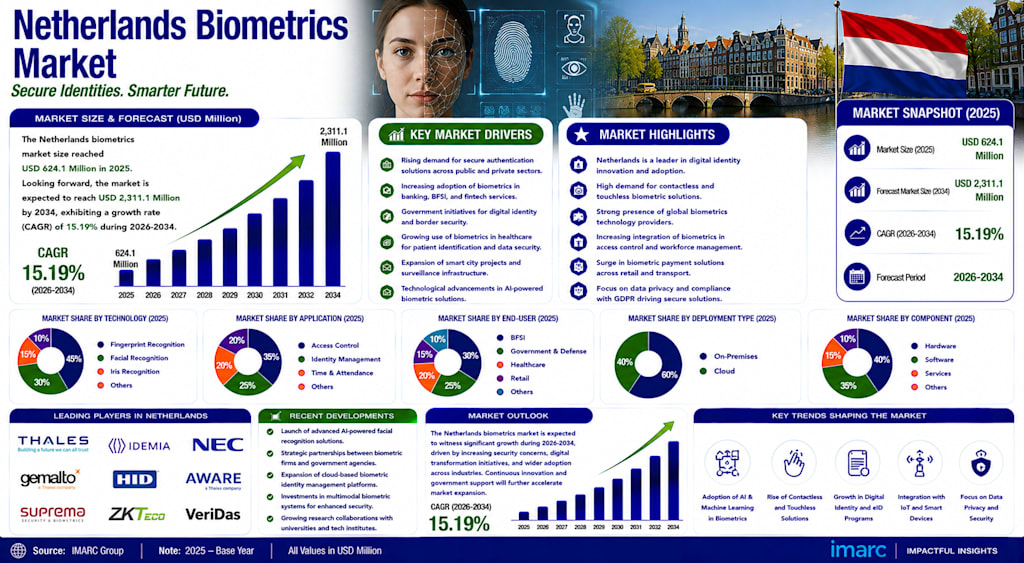
The Netherlands biometrics market is undergoing a profound transformation as government agencies, financial institutions and private enterprises increasingly deploy consent driven, privacy preserving identity verification technologies. Biometrics — encompassing fingerprint recognition, facial recognition, iris scanning, voice recognition and emerging behavioural modalities — are deployed across border control e gates, digital payment authentication, healthcare access management and enterprise security systems to deliver frictionless user experiences while meeting Europe's most stringent data protection standards. According to IMARC Group, the market size reached USD 624.1 Million in 2025 and is projected to reach USD 2,311.1 Million by 2034, exhibiting a robust compound annual growth rate (CAGR) of 15.19% during 2026–2034. As the Netherlands reinforces its status as a tech leading nation with a world class digital identity ecosystem, biometrics have moved from optional security enhancements to essential components of sovereign identity infrastructure, cross border travel facilitation and fraud resistant payment systems.
What's Driving Market Growth?
Government Led Biometric Integration and e Gate Expansion. The Dutch government is accelerating biometric adoption across immigration, identity documentation and public service delivery. Foreign nationals applying for residence permits are required to provide biometric information — fingerprints and passport photographs — which are stored both centrally and on smart document chips, enabling robust fraud prevention and seamless verification across law enforcement, immigration and social services. At major airports, e gates using facial recognition technology now expedite entry and exit for authorised travellers, dramatically reducing wait times while enhancing border security. In April 2026, the Dutch Immigration and Naturalisation Service (IND) launched a new vertically oriented identity document for asylum applicants — among the first worldwide to adopt the ICAO compliant vertical format — featuring a larger laser engraved portrait for improved face biometrics matching, a 2D barcode for quick data access, and Lasink Helios optically variable security technology previously deployed in Dutch passports and national ID cards. These state led infrastructure investments commit biometric adoption to being firmly founded in public service modernisation and regulatory trust frameworks.
Privacy First Deployment and GDPR Compliance as Market Differentiator. The Netherlands' strong culture of privacy consciousness and stringent enforcement of the General Data Protection Regulation (GDPR) fundamentally shapes how biometric systems are deployed. The Dutch Data Protection Authority (DPA) has published clear guidance stating that facial recognition is generally prohibited, with narrow exceptions for purely personal or domestic purposes. Employers seeking to implement fingerprint or facial scanning for attendance or access control have been pressed to demonstrate valid legal bases, highlighting the fine line between workplace surveillance and employee freedom. Meanwhile, public sector initiatives — including smart city applications and biometric payment systems — are built with transparency, opt in platforms and privacy first architecture. GenKey, a Netherlands headquartered biometric provider, exemplifies this approach with its ISO 24745 compliant PET (Privacy Enhancing Technology), which stores and matches fingerprint information using irreversible binary hash codes — the same hash technology used to secure PIN codes in financial transactions. The privacy minded culture, while restraining unfettered market expansion, stimulates prudent innovation as organisations focus on ethical deployment and user confidence.
Fintech, Digital Identity and Bank Driven Verification Ecosystems. Dutch financial institutions are at the forefront of biometric authentication for payments and mobile security. De Nederlandsche Bank (DNB) has confirmed that two factor authentication — requiring something the customer has, something the customer knows and/or biometric data such as a fingerprint — is a statutory requirement for electronic payments and bank transfers. In April 2025, Dutch payment service provider Buckaroo launched Click to Pay, enabling biometric authentication (fingerprint or facial recognition) to reduce 3DS authorisation requirements for fraud prevention, accelerating online checkout conversion. The digital identity landscape is consolidating: in December 2025, Belgian identity app itsme acquired Dutch banking verification service iDIN, which leverages users' bank apps for identity verification and age assurance across some 300 local Dutch websites. From mid 2026, all current iDIN users will gain access to itsme, including new functionalities such as qualified electronic signatures, and the transition is expected to be finalised by 2028. Itsme is now the largest provider of mobile identification services in Belgium, with over 80 percent of the adult population (approximately 7 million users) completing more than 1 million actions daily.
Enterprise Security, Access Control and Technological Convergence. Growing security threats — including cyberattacks, unauthorised access and physical intrusions — are driving adoption of biometric authentication across commercial, residential and government sectors. Contemporary access control systems now offer cloud based management, mobile credentials, artificial intelligence (AI) analytics and seamless IoT connectivity, enabling centralised monitoring and automated security responses. IoT integration allows smart buildings to link access control with lighting, HVAC and surveillance systems, delivering a complete security ecosystem. Further development in biometric technologies — including facial recognition and mobile access apps — is fostering mass adoption across commercial, industrial and residential segments, particularly relevant in the post pandemic environment where contactless solutions are increasingly preferred. Additionally, compliance with GDPR and sector specific regulations compels organisations to deploy effective access control systems that provide valid authorisation, audit trails and accountability required for regulatory reporting across critical infrastructure, healthcare, banking and government sectors.
Market Segmentation & Key Insights
By Technology Type, the market includes fingerprint recognition, facial recognition, iris recognition, voice recognition and behavioural biometrics. Fingerprint modules are experiencing steady growth driven by increasing adoption in security systems, payment applications and smart devices across banking, healthcare and government sectors. Facial recognition is a major growth segment, particularly for border control e gates and identity document verification. Behavioural biometrics — analysing patterns in how users interact with devices — are experiencing rapid growth, driven by increasing adoption across financial, healthcare, e commerce and government sectors for fraud prevention and seamless authentication.
By Functionality, the market covers physical access control, logical access control and mobile biometrics. By Component, the market is segmented into hardware (scanners, sensors, readers), software (biometric matching algorithms, identity management platforms) and services (integration, consulting, managed services). By Authentication Type, the market includes single factor, multi factor and continuous authentication.
By End User Industry, key segments include government and defence (e gates, national ID, border management), banking, financial services and insurance (payment authentication, eKYC, fraud prevention), healthcare (patient identification, access control), retail and e commerce, transportation and logistics, automotive (fingerprint, facial and voice recognition for vehicle security and personalisation), and enterprise security. Government and defence currently dominate, but banking and finance is the fastest growing segment as digital payment volumes surge.
By Region, the market is concentrated in Noord Holland, Zuid Holland, Noord Brabant, Gelderland, Utrecht and others. The Randstad metropolitan region — encompassing Amsterdam, Rotterdam, The Hague and Utrecht — accounts for the majority of biometric deployments due to the concentration of government institutions, financial services headquarters, technology firms and major international airports.
What the Opportunities Are?
Privacy Enhancing Biometric Solutions and Zero Knowledge Proofs. The Dutch DPA's restrictive guidance on facial recognition and the GDPR's stringent requirements create significant opportunity for providers of privacy preserving biometric technologies. GenKey's BioHASH solution — which stores and matches fingerprint information using irreversible binary hash codes — demonstrates the commercial viability of PET compliant systems. TrustStamp offers a privacy first biometric identity solution that replaces vulnerable passcodes with irreversible IT2 tokens, securing high risk transactions in milliseconds while reducing fraud. The broader movement toward decentralised identity models — where biometric templates never leave user devices — aligns perfectly with Dutch privacy culture and GDPR requirements, opening substantial opportunities for vendors with proven privacy by design architectures.
Digital Identity Consolidation and eIDAS 2.0 Compliance. The acquisition of iDIN by itsme signals a broader consolidation trend toward pan European digital identity wallets compliant with eIDAS 2.0 regulations. The Dutch government's initiatives to promote digital identity adoption and the eIDAS framework have propelled market growth. In July 2025, Signicat — a leading European digital identity provider — acquired Inverid, the Enschede based developer of ReadID NFC based mobile identity verification technology, in a deal creating a "European identity powerhouse". Inverid's ReadID technology, which leverages government issued identity documents with contactless NFC chips and smartphones, is used by banking institutions including ING, Rabobank and ASB, trust service providers such as SK ID Solutions, itsme and Digidentity, and has proven to work with over 2,600 smartphone models. Vendors offering interoperable, wallet ready biometric authentication solutions for cross border identity verification are positioned to capture substantial market share as the EU Digital Identity Wallet framework rolls out across member states.
Behavioural Biometrics for Continuous Authentication. As remote work and online transactions become entrenched, organisations are moving beyond one time authentication to continuous, risk based verification. Behavioural biometrics — analysing keystroke dynamics, mouse movements, touchscreen gestures and navigation patterns — provide frictionless, ongoing authentication that cannot be stolen or replayed. The behavioural biometric market in the Netherlands is expanding rapidly due to increasing digitalisation, rising concerns over cybersecurity and a strong push for secure and seamless authentication systems across financial, healthcare, e commerce and government sectors. Platforms offering real time risk scoring based on behavioural analytics, integrated with existing identity access management (IAM) infrastructure, will capture the premium segment of enterprise security spending.
Automotive Biometrics for Personalised Driving Experiences. The Netherlands automotive biometric market is experiencing steady growth, driven by rising demand for advanced vehicle security and personalised in car experiences. Biometrics such as fingerprint, facial and voice recognition are increasingly integrated into vehicles for authentication, driver monitoring and infotainment personalisation. As the Dutch EV market expands and premium vehicle manufacturers target the Netherlands as a key European market, suppliers of driver facing cameras, fingerprint ignition systems and voice recognition platforms will find receptive automotive OEMs.
Healthcare Biometrics for Patient Identification and Access Control. Dutch healthcare institutions are increasingly adopting biometric solutions to reduce medical identity fraud, ensure correct patient record matching and secure access to electronic health records. BPI Services, a Dutch technology company, specialises in identification applications for healthcare institutions alongside government services, the National Police and border control, working with clients including KPN, Kuehne+Nagel and Secure Logistics. The Netherlands' aging population and the expansion of digital health services create sustained demand for biometric patient identification systems that integrate with existing electronic health record platforms while meeting GDPR requirements for sensitive health data processing.
Contactless Border Management and the Entry/Exit System (EES). The Netherlands is actively exploring new automated border control systems to manage passenger flows at Schiphol Airport and other entry points. The Ministry of Defence has surveyed the market for border control technologies — including facial recognition, fingerprint scanning and other biometric solutions — to enhance security and efficiency at border crossings while reducing wait times. The EU's Entry/Exit System (EES), which aims to introduce mandatory fingerprint and facial recognition registration at borders for non EU travellers, will drive substantial investment in biometric capture and verification infrastructure at Dutch ports of entry. The Netherlands was one of the countries that lobbied for postponing the EES system, but its eventual implementation will create a multi year procurement cycle for biometric hardware, software and integration services.
AI Powered Edge Biometrics and Liveness Detection. The Scailable Edge platform — developed by a Dutch company — enables plug and play edge AI deployment on selected hardware, allowing efficient AI and machine learning model deployment, monitoring and governance on edge devices. As presentation attacks (spoofing, deepfakes, synthetic identities) become more sophisticated, there is strong demand for liveness detection and anti spoofing technologies that can distinguish genuine biometric traits from artefacts. The Netherlands' ecosystem of research institutions (including TNO, the Netherlands Organisation for Applied Scientific Research) and startups positions the country as a development hub for advanced biometric analytics.
Recent News and Developments in Netherlands Biometrics Market
April 2026: The Dutch Immigration and Naturalisation Service (IND) launched a new ICAO compliant vertical identity document for asylum applicants — the Type W card. Developed by IN Groupe, the card features a larger laser engraved portrait for improved face biometrics matching, a 2D barcode for quick data access, and Lasink Helios optically variable security technology, making the Netherlands among the first countries to adopt the vertical format for this document category.
December 2025: Itsme, Belgium's leading mobile identification app, acquired Dutch banking verification service iDIN. The deal reinforces itsme's position as "the European reference for digital identity," with the transition from iDIN to itsme commencing in spring 2026 and expected to be completed by 2028. From mid 2026, all current iDIN users will have access to itsme, including new functionalities such as qualified electronic signatures.
July 2025: Signicat, a leading European digital identity provider, acquired Inverid, the Enschede based developer of ReadID NFC based mobile identity verification technology. The deal was described by Co founder and CEO Maarten Wegdam as creating a "European identity powerhouse". Inverid's ReadID technology leverages government issued identity documents with contactless NFC chips and smartphones, and is used by banking institutions including ING, Rabobank and ASB.
March 2025: The Dutch Data Protection Authority (AP) published its general framework for facial recognition, clarifying the legal basis for processing biometric data under the GDPR, confirming that facial recognition is generally prohibited with narrow exceptions, and setting out requirements for explicit consent and public interest exceptions. The Chamber of Commerce (KVK) reinforced that while biometrics can be useful for security, use is restricted under Dutch law without explicit justification.
2025: The Netherlands continued to be identified by digital identity research firm Trinsic as a market where the opportunity for businesses to use digital ID is "exceptional," alongside Lithuania, Brazil and the Philippines. TNO, the independent research organisation employing approximately 3,000 specialists, continued to work on innovations connecting people and knowledge to advance biometric and digital identity technologies.
2025: The Netherlands enterprise biometrics market grew steadily, with increasing adoption of fingerprint modules in banking, healthcare and government sectors for enhanced security measures. The automotive biometric market also experienced steady growth driven by rising demand for advanced vehicle security and personalised in car experiences.
Why Should You Know About Netherlands Biometrics Market?
You should know about this market because it captures how privacy regulation, digital identity consolidation and government led infrastructure modernisation intersect to create one of Europe's most sophisticated and rapidly growing biometrics economies. The Netherlands is not simply adopting biometrics as a security measure — it is building a consent driven, privacy preserving identity ecosystem that balances innovation with the strongest data protection standards on the continent. From the 7 million users of itsme and the 80% adult penetration of mobile identity apps, to the ICAO compliant vertical ID cards and e gates at Schiphol that process millions of international travellers annually, the Dutch approach to biometrics is defined by transparency, user control and technological excellence.
For investors, the Netherlands biometrics market offers exposure to a high growth security technology category anchored in enforceable GDPR compliance, the €1.6 billion Dutch digital identity market, and the structural shift toward passwordless, frictionless authentication across banking, healthcare and government services. The projected CAGR of 15.19% — among the highest in Western Europe — reflects strong confidence in adoption trends, technological differentiation and recurring software and service revenue opportunities tied to identity verification platforms, biometric access control subscriptions and eKYC compliance solutions.
For technology vendors, financial services executives, government IT planners and security integrators, understanding biometric segmentation between fingerprint, facial, iris and behavioural modalities, the privacy by design architecture required by Dutch regulators, and the competitive landscape of homegrown champions (GenKey, Inverid, TNO) alongside international providers helps shape intelligent investment decisions, product development roadmaps and procurement strategies that deliver measurable security, compliance and user trust outcomes.
In essence, the Netherlands biometrics market captures how digital sovereignty, privacy engineering and cross border interoperability converge — making it a compelling area for innovators, investors and security strategists seeking smarter approaches to identity assurance, fraud prevention and citizen centric digital services in one of Europe's most digitally advanced and privacy conscious nations.
About the Creator
Thomas
Market Research Analyst | Industry Trends & Forecasting | Turning market data into clear, actionable business insights across global sectors.
Enjoyed the story? Support the Creator.
Subscribe for free to receive all their stories in your feed.
Comments
There are no comments for this story
Be the first to respond and start the conversation.