
Nano Robotics Market Poised for Rapid Growth as Precision Medicine and Advanced Nanotechnology Transform Industries
From targeted drug delivery and cancer treatment to precision manufacturing and environmental monitoring, nano robotics is emerging as one of the most promising technologies of the next decade.

Introduction: Tiny Robots, Massive Potential
The future of technology is getting smaller—much smaller. While robotics has traditionally focused on machines visible to the human eye, a new frontier is emerging at the nanoscale. Nano robotics, once considered science fiction, is rapidly becoming a reality with applications ranging from cancer treatment and drug delivery to advanced manufacturing and environmental monitoring.
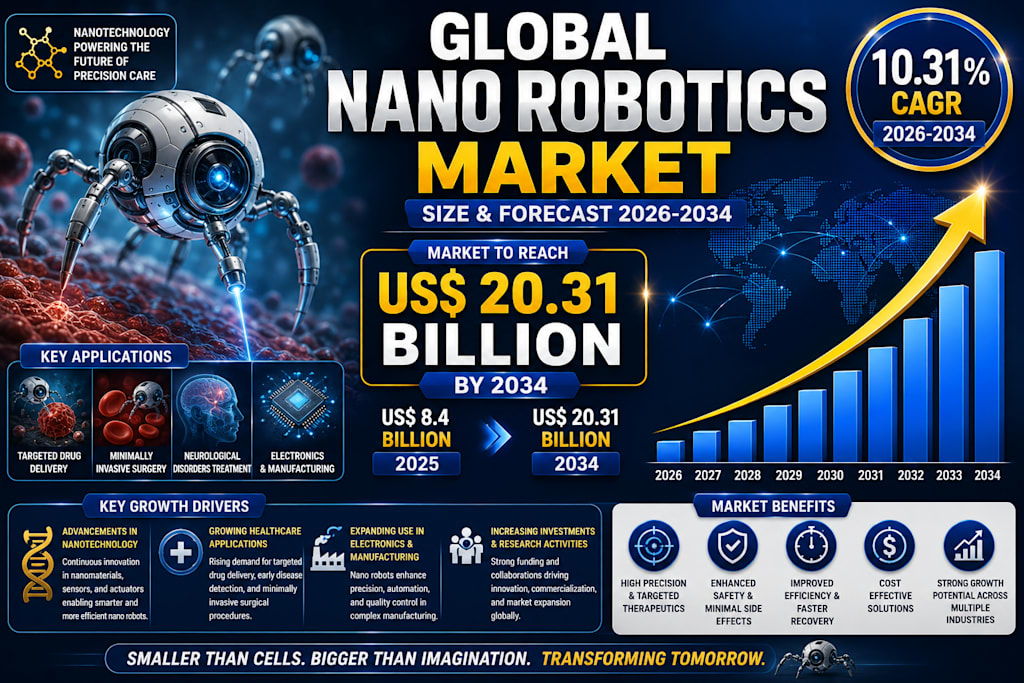
According to Renub Research, the Global Nano Robotics Market is expected to grow from US$ 8.4 billion in 2025 to US$ 20.31 billion by 2034, registering a compound annual growth rate (CAGR) of 10.31% between 2026 and 2034. The market's expansion is being driven by breakthroughs in nanotechnology, increasing demand for precision medicine, growing applications in healthcare, and expanding use across industrial sectors.
Although still in its early stages compared to conventional robotics, nano robotics is attracting significant investment from governments, research institutions, healthcare organizations, and technology companies worldwide. The ability to perform tasks at the molecular and cellular level could fundamentally transform multiple industries in the years ahead.
What Is Nano Robotics?
Nano robotics is a specialized branch of nanotechnology focused on designing, developing, and applying microscopic robots that operate at the nanometer scale. These robots are so small that they can interact directly with cells, tissues, molecules, and microscopic environments.
Unlike traditional robots, nanorobots are engineered using advanced materials, nanosensors, and sophisticated control systems that allow them to perform highly precise functions. Their ability to work at the molecular level makes them particularly valuable in healthcare applications where accuracy and targeted treatment are essential.
Researchers envision a future where nanorobots can travel through the human bloodstream, detect diseases before symptoms appear, deliver medication directly to affected cells, repair damaged tissues, and even assist in microscopic surgical procedures.
Beyond healthcare, nano robotics is also finding applications in electronics manufacturing, precision engineering, environmental monitoring, and industrial automation.
Healthcare Remains the Primary Growth Engine
One of the biggest drivers behind the nano robotics market is the growing demand for advanced healthcare solutions.
Modern medicine increasingly focuses on personalized treatment, precision therapies, and minimally invasive procedures. Nano robots align perfectly with these goals because they can perform highly targeted interventions while minimizing damage to healthy tissues.
One of the most promising applications involves targeted drug delivery. Traditional medications often affect both healthy and diseased cells, leading to unwanted side effects. Nano robots, however, can potentially deliver therapeutic agents directly to specific cells, increasing treatment effectiveness while reducing complications.
This capability is particularly important in cancer treatment, cardiovascular disease management, and neurological care, where precision can significantly influence patient outcomes.
As healthcare systems continue prioritizing personalized medicine and improved treatment efficiency, demand for nano robotic technologies is expected to increase substantially.
Targeted Drug Delivery Is Revolutionizing Treatment
Among all healthcare applications, targeted drug delivery represents one of the most transformative opportunities within the nano robotics market.
Drug delivery nanorobots are designed to transport medications directly to affected tissues or cells. This highly targeted approach allows healthcare professionals to administer treatments more effectively while minimizing exposure to healthy organs and tissues.
In cancer therapy, for example, targeted delivery systems could significantly reduce the side effects associated with chemotherapy by concentrating treatment only where it is needed. These systems also enable controlled drug release, ensuring that medications are delivered at optimal times and dosages.
As pharmaceutical companies continue investing in advanced therapies and precision medicine solutions, drug delivery applications are expected to remain one of the most important growth segments within the nano robotics industry.
Nanotechnology Advancements Are Accelerating Innovation
Rapid advances in nanotechnology, materials science, artificial intelligence, and robotics engineering are creating new possibilities for nano robotics development.
Researchers are continuously improving nanomaterials, nanosensors, and microscopic control mechanisms, enabling nanorobots to become more intelligent, efficient, and capable of performing complex tasks.
Artificial intelligence is also playing an increasingly important role. AI-powered nano robots could eventually make autonomous decisions based on environmental conditions, biological signals, and patient-specific data.
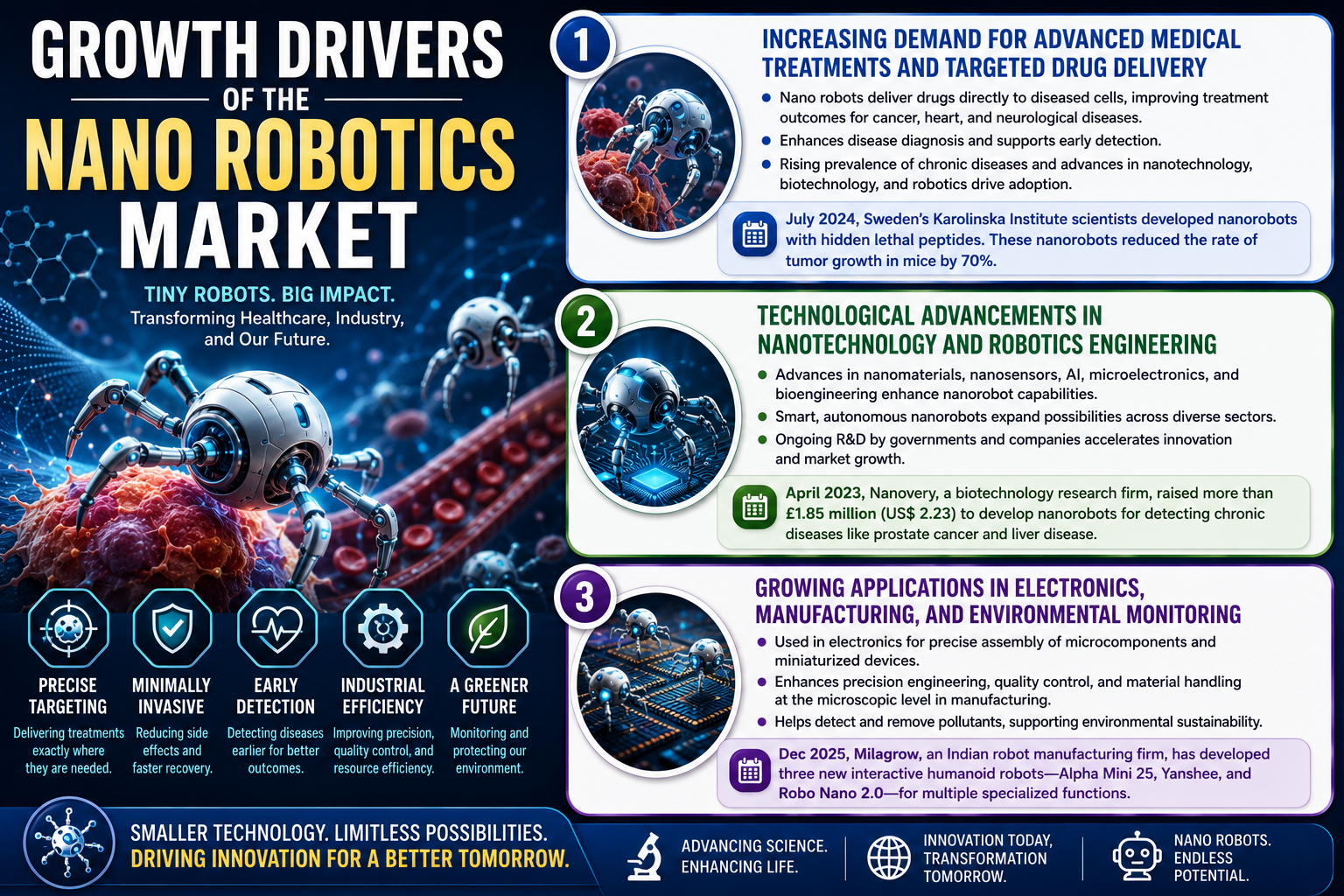
The report highlights growing investment activity in the sector. One example includes Nanovery, a biotechnology company that secured funding to advance nanorobot-based diagnostic technologies capable of detecting diseases such as prostate cancer and liver disorders with greater precision.
As innovation continues to accelerate, nano robotics is moving steadily from laboratory research toward practical commercial applications.
Cancer Treatment Is Emerging as a Major Opportunity
Cancer remains one of the world's most challenging healthcare problems, creating enormous demand for innovative treatment technologies.
Nano robotics offers the potential to improve cancer care through early detection, targeted drug delivery, and precise tumor destruction. Because nanorobots can interact directly with diseased cells, they may help improve treatment outcomes while reducing harmful side effects associated with traditional therapies.
The report highlights a significant breakthrough achieved by researchers at Sweden's Karolinska Institute. Scientists developed nanorobots equipped with hidden lethal peptides capable of targeting and eliminating cancer cells while minimizing damage to healthy tissue. In experimental studies, these nanorobots reduced tumor growth in mice by approximately 70%.
Although widespread clinical adoption may still be years away, such developments demonstrate the transformative potential of nano robotics in oncology.
Nano Surgery Could Redefine Minimally Invasive Procedures
Nano surgery robotics represents another rapidly developing segment within the market.
Unlike traditional surgical robots, nano surgical systems are designed to operate at the cellular and molecular levels. These microscopic robots may eventually assist in procedures involving tumor removal, vascular repair, neurological interventions, and tissue regeneration.
The key advantage of nano surgery lies in its precision. By operating directly at microscopic levels, these systems could reduce complications, shorten recovery times, and improve overall treatment outcomes.
As demand for minimally invasive procedures continues growing worldwide, nano surgical robotics is expected to become an increasingly important area of research and commercial development.
DNA-Based Nanorobots Open New Possibilities
One of the most fascinating developments in the field is the emergence of DNA-based nano robotics.
Using DNA origami techniques, researchers can design nanorobots capable of folding into highly specific structures that perform predetermined biological functions. These programmable systems can be engineered to identify diseased cells, deliver medication, and support diagnostic procedures.
Because DNA-based nanorobots are highly precise and biocompatible, they hold significant promise for future medical applications. Research institutions, biotechnology firms, and pharmaceutical companies are actively investing in this technology as part of broader efforts to advance personalized medicine.
The continued development of DNA-based nano robotics could dramatically expand treatment possibilities over the coming decade.
Bacteria-Based Nanorobots Are Expanding Medical Capabilities
Another innovative segment involves bacteria-based nano robotics.
These systems utilize naturally mobile bacteria as microscopic transportation mechanisms capable of navigating through the human body. Researchers are exploring how bacteria-based nanorobots can be used for targeted drug delivery, cancer treatment, tissue repair, and regenerative medicine.
One of their greatest advantages is the ability to reach areas that are difficult to access using conventional medical techniques. Their responsiveness to environmental changes also allows for highly customized treatment approaches.
Advances in microbiology, genetic engineering, and biotechnology are helping accelerate development within this promising area of nano robotics.
Applications Beyond Healthcare Continue to Expand
While healthcare remains the dominant application area, nano robotics is increasingly finding value across other industries.
In electronics manufacturing, nanorobots can assist in assembling microscopic components used in advanced devices. Their precision allows manufacturers to produce smaller, more sophisticated products with greater efficiency.
Within industrial manufacturing, nano robotics supports precision engineering, quality control, and microscopic material handling. These capabilities help improve productivity while reducing waste and manufacturing errors.
Environmental monitoring is another emerging application. Nanorobots may eventually be used to detect pollutants, monitor water quality, and support environmental cleanup initiatives.
As technology matures, these non-medical applications are expected to create additional revenue opportunities for industry participants.
Regional Markets Continue to Gain Momentum
United States
The United States remains one of the most advanced nano robotics markets globally. Strong research institutions, substantial healthcare spending, robust biotechnology ecosystems, and government support for nanotechnology research continue to drive innovation.
The report notes that in February 2026, the U.S. National Science Foundation announced plans to invest US$100 million in quantum and nanoscale research infrastructure to accelerate technological breakthroughs.
United Kingdom
The United Kingdom benefits from a strong academic research environment and growing collaboration between universities, healthcare organizations, and technology companies. Increasing focus on precision medicine and advanced healthcare technologies is supporting market expansion.
India
India's nano robotics market is still developing but shows significant potential. Growing healthcare investments, strong pharmaceutical capabilities, and increasing research activity are creating favorable conditions for future growth.
The report highlights a notable achievement by researchers at the Indian Institute of Science and Theranautilus, who developed magnetic nanobots known as "CalBots" to treat tooth sensitivity through highly targeted intervention.
Saudi Arabia
Saudi Arabia is investing heavily in advanced technologies as part of its long-term national development strategy. Increasing healthcare spending, growing research initiatives, and government support for innovation are creating opportunities for nano robotics adoption across multiple sectors.
Challenges Still Limit Commercial Adoption
Despite its enormous potential, the nano robotics industry faces several important challenges.
One of the most significant barriers is cost. Research, development, testing, and manufacturing processes remain extremely expensive due to the complexity of working at the nanoscale. Small companies often struggle to secure the resources necessary to develop commercial products.
Regulatory approval also remains a major hurdle, particularly for healthcare applications. Because nanorobots interact directly with biological systems, extensive testing is required to ensure safety, effectiveness, and biocompatibility.
Ethical concerns surrounding the use of microscopic technologies inside the human body continue to generate debate among researchers, regulators, and policymakers. Addressing these concerns will be essential for gaining public trust and encouraging widespread adoption.
Leading Companies Shaping the Future
Several organizations are actively contributing to advancements in nano robotics through research, development, and commercialization efforts.
Key companies highlighted in the report include Oxford Instruments, Thermo Fisher Scientific, Bruker Corporation, JEOL Ltd., Agilent Technologies, Ginkgo Bioworks, Park Systems, and Imina Technologies. These organizations continue investing in technologies that support nanoscale research, precision engineering, and advanced medical applications.
As innovation accelerates, collaboration between technology companies, healthcare providers, academic institutions, and government agencies is expected to play a crucial role in shaping the industry's future.
Final Thoughts
Nano robotics represents one of the most exciting frontiers in science and technology. What was once considered a futuristic concept is steadily moving toward real-world applications capable of transforming healthcare, manufacturing, electronics, and environmental management.
With the market projected to grow from US$ 8.4 billion in 2025 to US$ 20.31 billion by 2034, the industry is positioned for significant expansion over the coming decade. Advances in targeted drug delivery, cancer treatment, nano surgery, DNA-based robotics, and precision medicine are creating opportunities that could fundamentally change how diseases are diagnosed and treated.
While challenges related to cost, regulation, and safety remain, continued investment in research and technological innovation suggests a promising future. As nano robotics moves closer to mainstream adoption, its impact could extend far beyond healthcare, influencing industries and improving lives in ways that are only beginning to be understood.
About the Creator
Enjoyed the story? Support the Creator.
Subscribe for free to receive all their stories in your feed.
Comments
There are no comments for this story
Be the first to respond and start the conversation.