
Nano Fertilizer Market Set to Reach US$ 8.77 Billion by 2033 as Sustainable Agriculture Gains Momentum
Innovative nutrient delivery systems, precision farming, and global food security concerns are accelerating the adoption of nano fertilizers worldwide

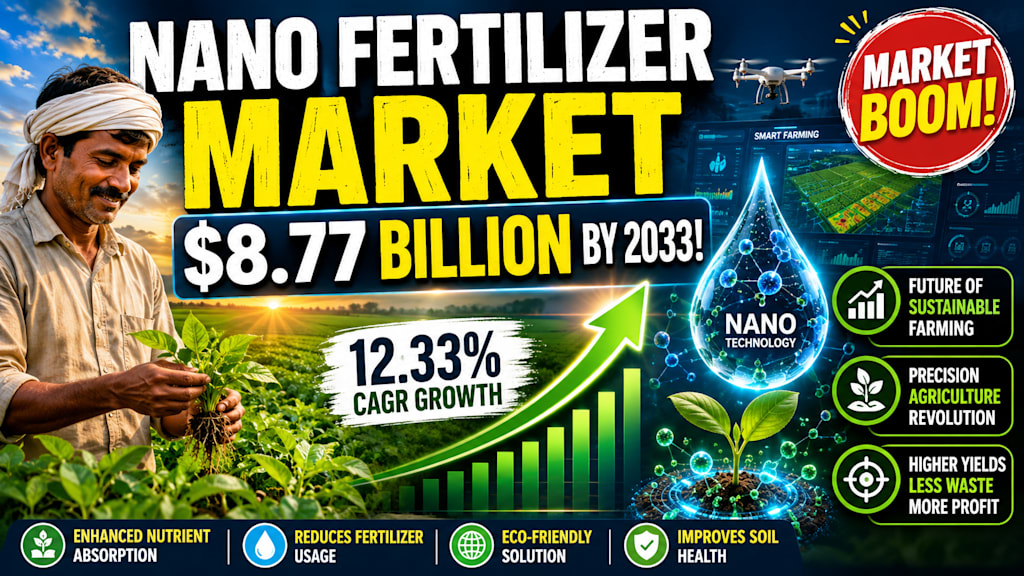
Nano Fertilizer Market Size and Forecast 2025–2033
The global Nano Fertilizer Market is entering a transformative growth phase as agriculture increasingly embraces advanced technologies to improve productivity while reducing environmental impact. According to Renub Research, the Nano Fertilizer Market is projected to grow from US$ 3.08 Billion in 2024 to US$ 8.77 Billion by 2033, expanding at a CAGR of 12.33% during 2025–2033.
As global populations continue to rise and arable land becomes increasingly limited, agricultural systems face unprecedented pressure to produce more food sustainably. Nano fertilizers have emerged as one of the most promising innovations capable of addressing these challenges by improving nutrient-use efficiency, minimizing wastage, and supporting environmentally responsible farming practices.
The market's expansion is fueled by increasing awareness regarding soil health, the growing popularity of precision agriculture, and government initiatives promoting sustainable farming technologies across both developed and developing economies.
Understanding Nano Fertilizers
Nano fertilizers are advanced agricultural inputs engineered using nanotechnology to deliver nutrients more effectively to crops. Unlike conventional fertilizers, which often suffer from nutrient losses through leaching, runoff, evaporation, or soil fixation, nano fertilizers are designed to provide controlled and targeted nutrient release.
These products utilize nanoparticles or nano-scale carriers to transport essential nutrients such as nitrogen, zinc, and carbon directly to plants. Their small size enables better penetration and absorption, ensuring that crops receive nutrients when and where they are needed most.
The result is improved crop productivity, reduced fertilizer consumption, lower environmental pollution, and enhanced resource efficiency.
As global agriculture shifts toward sustainability and smart farming practices, nano fertilizers are increasingly being recognized as a key component of future crop nutrition strategies.
Rising Food Demand is Driving Market Growth
One of the most significant drivers of the nano fertilizer market is the growing global demand for food.
According to projections from the Food and Agriculture Organization (FAO), the global population is expected to reach approximately 9.7 billion by 2050. To feed this expanding population, agricultural production must increase substantially over the coming decades.
Traditional farming methods face multiple limitations, including soil degradation, declining water availability, and excessive chemical fertilizer use. Nano fertilizers offer a practical solution by maximizing nutrient efficiency while minimizing resource consumption.
By delivering nutrients more precisely and reducing wastage, nano fertilizers help farmers achieve higher yields without significantly increasing fertilizer application rates. This makes them an attractive option for governments, agribusinesses, and farmers seeking sustainable productivity improvements.
Sustainable Agriculture Trends Support Adoption
Environmental sustainability has become a central focus of agricultural policy worldwide.
Conventional fertilizers often contribute to groundwater contamination, greenhouse gas emissions, and nutrient runoff that damages ecosystems. Excessive fertilizer use can also reduce soil fertility over time.
Nano fertilizers address many of these concerns through controlled-release mechanisms that reduce nutrient losses and improve uptake efficiency.
The environmental benefits include:
Reduced fertilizer runoff
Lower greenhouse gas emissions
Improved soil health
Better water-use efficiency
Reduced nutrient leaching
Enhanced crop nutrient absorption
As countries strengthen environmental regulations and promote green farming initiatives, nano fertilizers are becoming an important tool for achieving agricultural sustainability targets.
Precision Agriculture Creates New Opportunities
Precision agriculture is transforming farming by combining technology, data analytics, automation, and scientific crop management.
Modern farms increasingly rely on:
GPS-guided machinery
Soil monitoring systems
Drone-based crop surveillance
Artificial intelligence platforms
Smart irrigation systems
Nano fertilizers fit naturally into this ecosystem because they support highly targeted nutrient management.
Their compatibility with precision farming techniques allows farmers to optimize nutrient application according to crop requirements, soil conditions, and environmental factors.
This integration helps improve yield outcomes while lowering operational costs and environmental impact, making nano fertilizers a valuable component of next-generation agricultural systems.
Government Support Accelerates Market Expansion
Governments worldwide are actively supporting nano fertilizer research, development, and commercialization.
National agricultural policies increasingly encourage innovative solutions capable of improving productivity while reducing dependence on conventional chemical fertilizers.
Public funding is being directed toward:
Research institutions
Pilot farming programs
Product validation studies
Farmer awareness initiatives
Local manufacturing capabilities
Such support has significantly increased confidence in nano fertilizers and encouraged broader market participation from both public and private stakeholders.
Countries facing food security challenges are particularly interested in adopting technologies that can increase agricultural output while conserving natural resources.
Technological Advancements Fuel Product Innovation
Rapid advancements in nanotechnology are enabling the development of more sophisticated fertilizer products.
Manufacturers are investing heavily in creating formulations that offer:
Controlled nutrient release
Enhanced nutrient stability
Improved crop-specific performance
Longer shelf life
Greater environmental safety
Emerging technologies such as smart nano-carriers and stimuli-responsive delivery systems are expected to redefine crop nutrition over the next decade.
These innovations allow nutrients to be released in response to specific environmental triggers, improving efficiency and minimizing losses.
As research continues, the market is likely to witness a growing portfolio of highly specialized nano fertilizer products tailored to different crops and climatic conditions.
Market Challenges Remain
Despite strong growth prospects, the nano fertilizer industry faces several challenges that could slow adoption rates.
Limited Farmer Awareness
Many farmers, especially in rural and developing regions, remain unfamiliar with nano fertilizer technologies.
A lack of education regarding application methods, economic benefits, and long-term performance often discourages adoption.
Without adequate demonstration programs and field trials, many producers continue relying on traditional fertilizers.
Greater collaboration between governments, agricultural extension agencies, and private companies will be essential to improve awareness and confidence.
Regulatory and Safety Concerns
The regulatory landscape surrounding nano fertilizers is still evolving.
Because nanomaterials can behave differently than conventional materials, governments and regulatory agencies are conducting extensive assessments regarding:
Environmental impact
Human health implications
Soil microbiology effects
Water contamination risks
The absence of harmonized global standards creates uncertainty for manufacturers and investors.
Establishing clear regulatory frameworks will be critical for accelerating commercialization and ensuring safe market growth.
Regional Market Analysis
Asia-Pacific Leads Global Adoption
Asia-Pacific currently represents one of the fastest-growing markets for nano fertilizers.
Large agricultural populations, increasing food demand, and government support programs have contributed to widespread adoption across several countries.
Growing awareness of sustainable agriculture and the need to improve fertilizer efficiency are expected to maintain strong regional growth throughout the forecast period.
United States
The United States remains a key innovation hub for nano fertilizer development.
Advanced precision farming practices, strong research capabilities, and sustainability-focused agricultural policies are encouraging adoption.
American farmers are increasingly exploring nano fertilizer solutions to improve nutrient management while complying with stricter environmental regulations.
Ongoing investments from universities, agritech startups, and agricultural corporations continue to support market expansion.
Germany
Germany's commitment to sustainable agriculture is driving interest in nano fertilizer technologies.
Research institutions and agritech companies are actively developing advanced formulations capable of reducing nutrient losses and supporting environmentally responsible farming.
Although regulatory requirements remain strict, growing demand for sustainable inputs is expected to strengthen market opportunities in the coming years.
India
India has emerged as one of the most promising nano fertilizer markets globally.
Government-backed initiatives promoting nano urea and other nano-based nutrient solutions have accelerated adoption among farmers.
The country's focus on improving food security, reducing fertilizer subsidies, and enhancing resource efficiency has created favorable conditions for market growth.
Local manufacturing capabilities and extensive field trials are further supporting commercialization efforts.
United Arab Emirates
The UAE is increasingly investing in agricultural innovation to address food security challenges associated with limited arable land and water scarcity.
Nano fertilizers are gaining attention due to their ability to deliver nutrients efficiently while minimizing resource consumption.
Growing adoption of hydroponics, indoor farming, and precision agriculture is expected to create additional opportunities for nano fertilizer providers throughout the region.
Market Segmentation Overview
By Raw Material
Nitrogen
Silver
Carbon
Zinc
Other Raw Materials
By Application Method
Foliar Spray
Soil Treatment
Seed/Root Dipping
Fertigation
By Crop Type
Cereals and Grains
Oilseeds and Pulses
Fruits and Vegetables
Plantation and Cash Crops
By Formulation Form
Liquid
Powder and Granule
Gel and Hydrogel
By Release Mechanism
Conventional Nano-Suspension
Controlled-Release Nanoshell
Stimuli-Responsive Smart Nano-Carrier
10 Recent Developments in the Nano Fertilizer Industry
1. IFFCO Expands Nano Urea Capacity (May 2025)
Indian Farmers Fertiliser Cooperative Ltd. inaugurated a new nano urea manufacturing facility in Kandla, Gujarat, increasing annual production capacity to approximately 2.5 billion bottles.
2. Coromandel-IARI Partnership (December 2024)
Coromandel International partnered with the Indian Agricultural Research Institute to commercialize rice-husk-based nanocarrier technologies.
3. Geolife Launches NanoGel (November 2024)
Geolife Agritech introduced NanoGel, a hydrogel-based nano fertilizer capable of reducing irrigation requirements by nearly 25% during vegetable crop trials.
4. Increased Government Promotion of Nano Urea in India
Multiple awareness campaigns and field demonstrations were expanded to encourage large-scale farmer adoption.
5. Growth in Precision Agriculture Integration
Agritech companies increasingly integrated nano fertilizer solutions into digital farming platforms and smart nutrient management systems.
6. Expansion of Controlled-Release Technologies
Manufacturers accelerated development of nanoshell-based nutrient delivery systems to improve nutrient efficiency.
7. Rising Private Sector Investment
Global agribusinesses increased funding for nano fertilizer research and product development programs.
8. Enhanced Crop-Specific Formulations
Companies introduced specialized formulations designed for cereals, vegetables, and cash crops.
9. Expansion of Nano Zinc Products
Nano zinc fertilizers gained traction due to their effectiveness in correcting micronutrient deficiencies.
10. Growing International Collaborations
Research institutions and commercial producers expanded partnerships focused on commercialization and field validation of nano fertilizer technologies.
Key Companies Shaping the Market
The competitive landscape includes several established agricultural and nanotechnology-focused companies:
Indian Farmers Fertiliser Cooperative Ltd. (IFFCO)
Lazuriton Nano Biotechnology Co., Ltd.
EuroChem Group
AG CHEMI GROUP s.r.o.
Aqua-Yield Operations LLC (Nano Yield)
Geolife Agritech India Pvt. Ltd.
Indogulf BioAg LLC
Coromandel International Ltd.
Ray Nano Fertilizer
Shan Maw Myae Co., Ltd.
These organizations continue investing in product innovation, manufacturing expansion, strategic partnerships, and research initiatives aimed at strengthening their market positions.
Final Thoughts
The global nano fertilizer market is rapidly evolving into one of the most promising segments within modern agriculture. As concerns surrounding food security, environmental sustainability, and resource efficiency intensify, nano fertilizers offer a compelling solution capable of transforming crop nutrition practices worldwide.
With the market expected to grow from US$ 3.08 billion in 2024 to US$ 8.77 billion by 2033, stakeholders across the agricultural value chain are recognizing the technology's long-term potential. Continuous innovation, government support, precision agriculture adoption, and growing farmer awareness are expected to create substantial opportunities throughout the forecast period.
Although regulatory uncertainties and educational barriers remain, the industry's trajectory points toward broader acceptance and commercialization. As agriculture moves toward a smarter and greener future, nano fertilizers are poised to play a pivotal role in delivering higher productivity while preserving the planet's natural resources.
About the Creator
Enjoyed the story? Support the Creator.
Subscribe for free to receive all their stories in your feed.
Comments
There are no comments for this story
Be the first to respond and start the conversation.