
Molecular Diagnostic Market Accelerates as Precision Medicine, PCR Innovation, and Rapid Testing Transform Global Healthcare
Rising infectious disease burden, rapid advances in PCR and sequencing technologies, and growing demand for decentralized diagnostics are fueling strong growth in the molecular diagnostics industry.

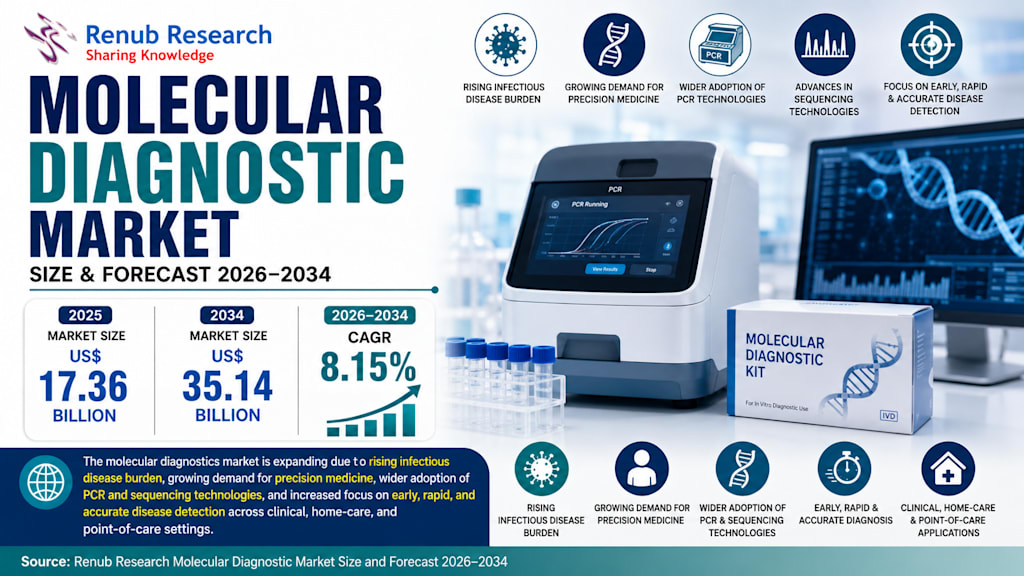
Market Overview
The global molecular diagnostic market is experiencing rapid expansion as healthcare systems increasingly prioritize precision medicine, early disease detection, and advanced laboratory technologies. Molecular diagnostics has emerged as one of the most important areas within modern healthcare because it enables highly accurate identification of diseases, infections, and genetic abnormalities using DNA, RNA, and protein-based analysis. According to Renub Research, the molecular diagnostic market is expected to grow from US$ 17.36 billion in 2025 to US$ 35.14 billion by 2034, expanding at a strong CAGR of 8.15% during 2026–2034.
The market’s growth reflects the increasing importance of rapid and reliable testing across hospitals, laboratories, clinics, home-care settings, and point-of-care environments. Technologies such as polymerase chain reaction (PCR), next-generation sequencing (NGS), molecular imaging, and digital PCR are transforming how diseases are diagnosed and monitored. Molecular diagnostics can identify infectious pathogens, detect cancer biomarkers, predict treatment responses, and support personalized therapies with a level of speed and precision that traditional diagnostic methods often cannot achieve.
Healthcare providers worldwide are increasingly adopting molecular testing because of rising infectious disease cases, growing cancer prevalence, and the need for faster clinical decision-making. The demand for highly sensitive and specific diagnostics has accelerated following global health emergencies and the growing acceptance of decentralized testing solutions. Hospitals and laboratories now rely heavily on molecular tools to improve patient outcomes, reduce diagnostic errors, and strengthen disease surveillance systems.
Another key factor driving the market is the growing shift toward precision medicine. Personalized treatment strategies depend heavily on molecular analysis to identify genetic mutations, biomarkers, and patient-specific disease characteristics. This has made molecular diagnostics an essential part of oncology, pharmacogenomics, infectious disease management, and hereditary disease screening. As healthcare systems continue moving toward individualized care, demand for advanced molecular platforms is expected to rise significantly over the next decade.
Growth Drivers
One of the strongest growth drivers in the molecular diagnostics market is the rising adoption of automated and high-throughput diagnostic systems. Laboratories today face growing pressure to deliver rapid, accurate, and scalable testing services while managing increasing sample volumes. Automated molecular platforms streamline workflows, reduce manual errors, improve traceability, and shorten turnaround times. These capabilities are especially important for large hospitals, public health laboratories, and reference diagnostic centers handling large-scale testing operations.
In August 2024, Seegene Inc. showcased its STARlet-AIOS platform, a fully modular system capable of automating the entire diagnostic workflow from nucleic acid extraction to result interpretation. This kind of innovation highlights how automation is becoming central to modern molecular diagnostics. Automated systems help healthcare providers improve operational efficiency while maintaining consistent testing quality, particularly during disease outbreaks or seasonal epidemics when testing demand surges dramatically.
Technological advancements in multiplex PCR and novel detection technologies are also significantly strengthening market growth. Multiplex PCR assays allow healthcare professionals to detect multiple pathogens simultaneously within a single test. This reduces testing time, conserves laboratory resources, and improves clinical decision-making, especially for respiratory illnesses and infectious diseases with overlapping symptoms.
In September 2024, Roche introduced the cobas Respiratory flex test, a multiplex PCR assay powered by TAGS technology, or Temperature-Activated Generation of Signal. This advanced technology improves both sensitivity and specificity, helping clinicians identify respiratory pathogens more accurately. Such innovations are particularly valuable because they enhance differential diagnosis and improve treatment decisions in complex clinical settings.
Another major growth driver is the expansion of point-of-care and home-based molecular testing. Healthcare systems and consumers are increasingly seeking convenient diagnostic solutions capable of delivering laboratory-quality results outside traditional centralized facilities. Portable molecular platforms allow faster detection, improve outbreak management, and reduce pressure on hospitals and laboratories.
In February 2025, Aptitude Medical Systems received Emergency Use Authorization for its Metrix COVID/Flu multiplex test, designed for both home and clinical use. The approval reflects the growing demand for decentralized molecular testing that combines convenience with high diagnostic accuracy. As these technologies become more affordable and user-friendly, they are expected to play a critical role in infectious disease screening, chronic disease monitoring, and remote healthcare delivery.
Market Challenges
Despite strong growth momentum, the molecular diagnostics industry continues to face several important challenges. One of the biggest barriers is the high cost associated with molecular testing equipment, reagents, software systems, and laboratory infrastructure. Advanced automated PCR and sequencing platforms require significant investment, making adoption difficult for smaller clinics, public healthcare centers, and low-income regions.
Molecular diagnostic laboratories also require highly controlled environments, strict biosafety standards, quality assurance systems, and trained personnel. These operational demands further increase overall costs and limit accessibility in resource-constrained healthcare systems. As a result, affordability remains one of the major factors slowing wider market penetration, especially in developing countries where healthcare budgets remain limited.
Regulatory complexity represents another major challenge for the industry. Molecular diagnostic technologies often require extensive clinical validation before approval, and regulatory requirements can vary significantly across countries and healthcare systems. Companies developing PCR assays, NGS-based diagnostics, or companion tests must invest heavily in documentation, clinical trials, and post-market monitoring. These lengthy approval processes can delay commercialization and slow patient access to innovative diagnostic technologies.
Rapidly evolving disease patterns and emerging pathogens also complicate regulatory frameworks because healthcare authorities must balance urgent diagnostic needs with safety and accuracy standards. Manufacturers therefore face constant pressure to innovate quickly while maintaining compliance with evolving regulations worldwide.
United States Molecular Diagnostic Market
The United States remains one of the largest and most technologically advanced molecular diagnostics markets globally. Strong healthcare spending, advanced laboratory infrastructure, and widespread adoption of PCR and NGS technologies continue to drive market leadership. Rising cases of cancer, infectious diseases, and genetic disorders are fueling demand for rapid and accurate molecular testing solutions.
The country also serves as a global innovation hub where major companies frequently launch advanced molecular assays, companion diagnostics, and decentralized testing platforms. Regulatory flexibility for emergency authorizations and increasing consumer acceptance of home-based testing solutions further support rapid market growth. Strong insurance coverage and growing investments in precision medicine continue to strengthen the U.S. market outlook.
Germany Molecular Diagnostic Market
Germany’s molecular diagnostics market benefits from advanced healthcare systems, high-quality laboratory networks, and strong emphasis on early disease detection. The country has extensive adoption of PCR and sequencing technologies across infectious disease management, oncology, and genetic screening applications. Demand for molecular diagnostics is also supported by growing investments in personalized medicine and EU-wide biotechnology research collaborations.
German healthcare providers place strong focus on clinical accuracy and evidence-based diagnostics, encouraging adoption of advanced molecular platforms. Favorable reimbursement policies for diagnostic testing additionally support the use of premium molecular systems and innovative assays.
China Molecular Diagnostic Market
China is emerging as one of the fastest-growing molecular diagnostics markets due to rising disease burdens, expanding healthcare infrastructure, and strong government support for biotechnology development. The country is rapidly increasing adoption of PCR, NGS, and point-of-care testing technologies to improve infectious disease surveillance and cancer diagnostics.
Domestic biotechnology companies are becoming increasingly competitive, launching innovative and cost-effective molecular systems tailored to local healthcare needs. Urbanization, pollution-related illnesses, and rising healthcare awareness are further increasing testing demand. Telemedicine services and online healthcare platforms are also improving access to diagnostics across remote regions.
Saudi Arabia Molecular Diagnostic Market
Saudi Arabia’s molecular diagnostics market is growing steadily due to healthcare modernization, rising chronic disease prevalence, and stronger investment in laboratory infrastructure. Government healthcare reforms and diversification strategies are supporting higher adoption of PCR assays and molecular testing technologies across hospitals and diagnostic centers.
Infectious disease management remains a key focus due to regional health challenges and international travel exposure. The country is also increasingly adopting point-of-care molecular platforms to improve healthcare access in remote areas. Growing awareness of genetic testing and personalized medicine is expected to strengthen long-term market growth further.
Recent Developments in the Molecular Diagnostic Market
The molecular diagnostics industry continues to witness major strategic investments, partnerships, and technological breakthroughs from leading healthcare companies.
In November 2025, Abbott announced a US$ 21 billion agreement to acquire Exact Sciences, significantly strengthening its position in cancer diagnostics and precision oncology. The acquisition expands Abbott’s early-detection capabilities and enhances its molecular diagnostic portfolio.
In the same month, Roche entered a collaboration with Sapphiros, securing access to one billion lateral flow tests and future molecular point-of-care platforms. This partnership is expected to strengthen Roche’s ability to scale decentralized diagnostics worldwide.
Also in November 2025, Hologic introduced its AI-powered 3DQuorum mammography technology, improving detection accuracy and workflow efficiency in breast imaging. While primarily an imaging advancement, the integration of AI supports precision diagnostics and complements molecular diagnostic capabilities.
Additionally, the World Health Organization (WHO) granted prequalification to the BD Onclarity HPV assay, improving global confidence in HPV molecular testing and supporting broader cervical cancer screening initiatives across low- and middle-income countries.
Recent Developments Companies in Vocal Format
Abbott announced a US$ 21 billion acquisition agreement with Exact Sciences to strengthen cancer diagnostics capabilities.
Roche partnered with Sapphiros to expand rapid molecular point-of-care testing worldwide.
Seegene Inc. introduced the STARlet-AIOS fully automated molecular diagnostic platform.
Roche launched the cobas Respiratory flex multiplex PCR assay powered by TAGS technology.
Aptitude Medical Systems received EUA approval for the Metrix COVID/Flu home molecular test.
Hologic unveiled AI-powered 3DQuorum mammography technology to improve diagnostic efficiency.
WHO granted prequalification to the BD Onclarity HPV molecular assay for global screening support.
Illumina Ltd continues advancing next-generation sequencing technologies for precision medicine applications.
Qiagen NV remains focused on expanding molecular testing workflows and sample preparation technologies.
Bio-Rad Laboratories Inc. continues strengthening digital PCR and advanced molecular analysis solutions.
Segment Outlook
The molecular diagnostics market is segmented by technology into PCR, Sequencing, Mass Spectrometry, Chips and Microarrays, In Situ Hybridization, and other advanced technologies. PCR remains one of the most widely used technologies because of its speed, sensitivity, and broad clinical applications. Sequencing technologies are increasingly important for oncology, pharmacogenomics, and hereditary disease analysis.
By application, the market serves pharmacogenomics, infectious disease testing, genetic disease screening, oncology, blood screening, microbiology, and human leukocyte antigen typing. Infectious disease diagnostics and oncology remain among the fastest-growing segments because of increasing disease prevalence and the growing importance of precision medicine.
Products include instruments, reagents, and other supporting technologies, while key end users include hospitals, laboratories, and specialized diagnostic centers. Rising laboratory automation and growing investment in decentralized healthcare infrastructure are expected to strengthen adoption across all segments.
Final Thoughts
The molecular diagnostics market is becoming one of the most transformative sectors within modern healthcare. Rapid advances in PCR, sequencing, automation, AI integration, and decentralized testing are fundamentally changing how diseases are detected and managed worldwide. Renub Research’s forecast of US$ 35.14 billion by 2034 highlights the enormous long-term opportunity within the industry as healthcare systems increasingly rely on precise, fast, and data-driven diagnostics. Companies that focus on automation, affordability, innovation, and accessible point-of-care technologies are expected to lead the next phase of growth in the global molecular diagnostics market.
About the Creator
Enjoyed the story? Support the Creator.
Subscribe for free to receive all their stories in your feed.
Comments
There are no comments for this story
Be the first to respond and start the conversation.