
Modified Starch Market Forecast 2026–2034: Food Innovation and Industrial Demand Drive Global Growth
Rising Demand for Processed Foods, Clean-Label Ingredients, and Industrial Applications Is Accelerating the Modified Starch Industry Worldwide

The global modified starch market is witnessing strong and steady growth as industries increasingly rely on functional, plant-based, and cost-effective ingredients to improve product performance. From processed foods and pharmaceuticals to paper manufacturing and textiles, modified starch has become an essential ingredient across multiple sectors.
The growing demand for convenience foods, advances in food processing technologies, and increasing interest in sustainable and biodegradable ingredients are all contributing to the expansion of the industry.
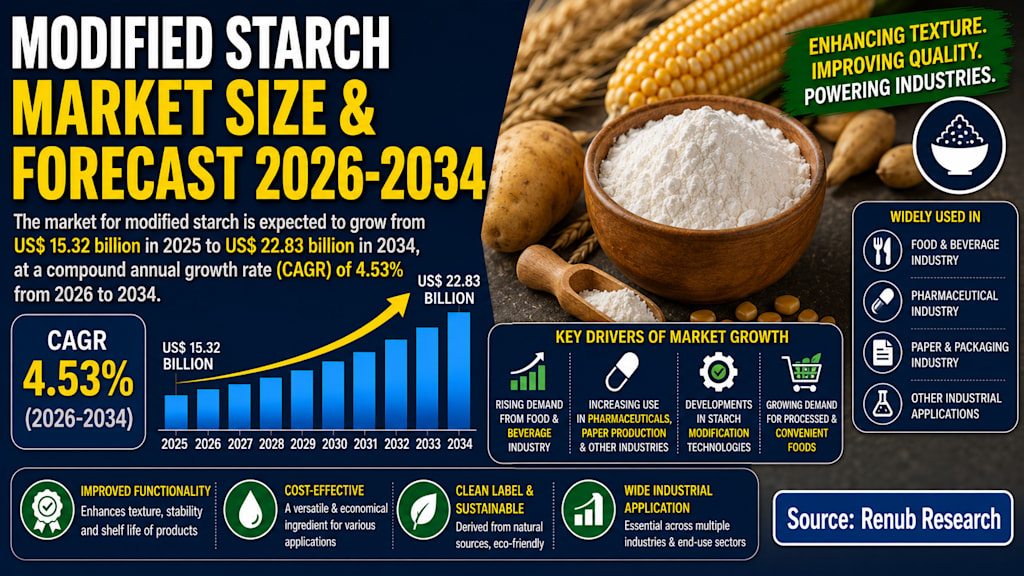
According to Renub Research, the Modified Starch Market is expected to grow from US$ 15.32 billion in 2025 to US$ 22.83 billion by 2034, expanding at a compound annual growth rate (CAGR) of 4.53% during 2026–2034. The market is being driven by rising demand from the food and beverage sector, expanding pharmaceutical applications, paper production growth, and technological advancements in starch modification processes.
Modified Starch Is Becoming a Critical Ingredient Across Industries
Modified starch refers to starch that has been physically, chemically, or enzymatically altered to improve its functional characteristics. It is typically produced using raw materials such as corn, potato, wheat, and cassava.
The modification process enhances important properties including:
- Heat resistance
- Stability
- Thickening capability
- Texture improvement
- Freeze-thaw stability
- Shelf-life extension
- Acid resistance
Because of these capabilities, modified starch has become highly versatile across both food and non-food industries.
Its growing popularity is also linked to rising demand for plant-based and clean-label ingredients, particularly in modern food manufacturing.
Food and Beverage Industry Remains the Biggest Growth Driver
The food and beverage industry continues to be the largest consumer of modified starch globally.
Modified starch is widely used as:
- A thickener
- Stabilizer
- Emulsifier
- Texture enhancer
It is commonly found in soups, sauces, bakery products, dairy items, snacks, frozen foods, and ready-to-eat meals.
The increasing popularity of convenience foods and packaged meals is significantly boosting demand for modified starch products worldwide.
Urban lifestyles, busy schedules, and changing consumer eating habits are pushing food manufacturers to develop products with longer shelf life and improved texture, creating strong demand for starch-based functional ingredients.
The report also highlights that in November 2024, Tate & Lyle completed the acquisition of CP Kelco from J.M. Huber to strengthen its specialty food and beverage ingredients platform.
This reflects the growing strategic importance of specialty ingredients within the global food industry.
Non-Food Industries Are Expanding Demand Rapidly
Beyond food applications, modified starch is increasingly being used in pharmaceuticals, paper production, textiles, adhesives, and packaging materials.
The report explains that modified starch improves paper strength, enhances textile quality, supports tablet production in pharmaceuticals, and acts as a binding agent in adhesives.
The shift toward environmentally friendly and biodegradable industrial materials is further increasing adoption.
Industries seeking sustainable alternatives to synthetic chemicals are increasingly incorporating starch-based ingredients into manufacturing processes.
Technological Innovation Is Reshaping the Industry
Technological advancements are playing a major role in expanding the capabilities of modified starch products.
Manufacturers are investing heavily in research and development to create starches with:
- Better freeze-thaw stability
- Improved heat resistance
- Enhanced acid tolerance
- Greater process efficiency
These innovations allow modified starch to be used in increasingly complex food formulations and industrial applications.
Advanced manufacturing technologies are also helping reduce production costs while improving product consistency and customization.
The industry is increasingly focusing on clean-label and minimally processed starch solutions that align with changing consumer preferences.
Raw Material Price Volatility Remains a Major Challenge
One of the biggest obstacles facing the modified starch industry is fluctuating raw material prices.
The production of modified starch depends heavily on agricultural commodities such as:
- Corn
- Wheat
- Potato
- Tapioca
Because these crops are vulnerable to seasonal conditions, climate fluctuations, and supply-chain disruptions, raw material costs can fluctuate significantly.
Competition from sectors such as biofuels and food production further increases pricing pressure on starch manufacturers.
To reduce dependency risks, many companies are exploring alternative feedstocks and diversified sourcing strategies.
Clean-Label Trends Are Creating Regulatory Pressure
Another major challenge is increasing consumer demand for natural and minimally processed ingredients.
Many consumers perceive modified starch as overly processed, which can create concerns in clean-label food formulations.
At the same time, food safety authorities in various countries maintain strict regulations regarding food additives and ingredient labeling. Compliance with these regulations requires extensive testing and documentation, increasing operational costs for manufacturers.
As a result, companies are investing in natural starch modification technologies and transparent ingredient labeling to meet evolving market expectations.
Corn-Based Modified Starch Continues to Dominate
Corn-based modified starch remains the largest segment within the market because of its abundant availability and cost efficiency.
Corn starch is widely used in food products such as soups, sauces, processed meals, and bakery products because of its excellent temperature resistance and functional stability.
The strong agricultural base in major corn-producing countries further supports segment growth.
Corn-derived starch is also widely utilized in paper manufacturing, adhesives, and textile production, strengthening its industrial relevance.
Cassava Modified Starch Is Gaining Popularity
Cassava, also known as tapioca, is becoming increasingly important due to its natural origin and gluten-free properties.
The report notes that cassava modified starch is highly valued for:
- Neutral flavor
- Smooth texture
- Excellent thickening properties
- Clean-label compatibility
As demand for allergen-free and gluten-free products rises globally, cassava-based starches are gaining significant traction in food manufacturing.
The material is also being adopted in paper, textile, and packaging applications.
Cationic Modified Starch Supports Industrial Expansion
Cationic modified starch is becoming increasingly important within the paper and textile industries.
Its positive charge allows it to bind effectively with negatively charged materials such as paper fibers, significantly improving paper quality and durability.
Because cationic starch is biodegradable and environmentally friendly, it is increasingly preferred as industries seek sustainable manufacturing solutions.
Modified Starch Binders Are Growing Across Multiple Sectors
Modified starch binders are witnessing increasing demand in:
- Food processing
- Pharmaceuticals
- Construction
- Adhesives
- Paper manufacturing
These binders improve ingredient stability and structural performance in a wide range of industrial and food applications.
The growing demand for biodegradable and eco-friendly binding materials is expected to continue driving this segment forward.
Pharmaceutical Applications Are Expanding Rapidly
Modified starch is playing a growing role in pharmaceutical manufacturing, particularly as an excipient in tablet formulations.
The report explains that modified starch functions as:
- A binder
- Filler
- Disintegrant
within pharmaceutical products, helping improve drug delivery and tablet stability.
As global healthcare and pharmaceutical industries expand, demand for starch-based excipients is expected to increase significantly.
United States Leads the Global Market
The United States remains one of the largest and most mature modified starch markets globally.
Strong demand from food processing, pharmaceuticals, paper manufacturing, and industrial applications continues to support market expansion.
The country also benefits from advanced food-processing technologies, strong agricultural production, and growing interest in plant-based and clean-label ingredients.
India Emerges as a High-Growth Market
India’s modified starch market is expanding rapidly due to urbanization, increasing processed food consumption, and strong demand from pharmaceutical and textile industries.
The report highlights that raw material availability, especially corn, cassava, and potato, is supporting market growth across the country.
The pharmaceutical sector is also driving demand as modified starch becomes increasingly important in drug formulation technologies.
Recent Developments in the Modified Starch Industry
Tate & Lyle acquired CP Kelco in November 2024 to expand its specialty food ingredient capabilities.
AGRANA and Ingredion received full regulatory clearance in June 2025 for a joint venture focused on starch and ingredient expansion.
Cargill inaugurated a new corn milling plant in partnership with Saatvik Agro Processors in March 2025 to strengthen starch ingredient production.
Cargill expanded its US starch business in March 2025 by opening a new corn milling facility focused on dairy and confectionery applications.
KMC entered a new UK distribution agreement with Daymer Ingredients in May 2025 to increase clean-label starch availability.
Cargill established a new corn milling plant in Gwalior, India, supporting starch derivative production for growing industrial demand.
Ingredion expanded specialty starch innovation programs focused on clean-label and plant-based food formulations.
ADM strengthened starch sourcing and sustainability initiatives to improve agricultural supply-chain resilience.
Südzucker AG increased investments in bio-based ingredient technologies supporting sustainable industrial applications.
Tereos Group accelerated research into natural starch modification technologies aligned with clean-label food trends.
Final Thoughts
The modified starch market is entering a period of sustained growth fueled by expanding food applications, industrial diversification, and increasing demand for sustainable ingredients.
Convenience foods, pharmaceutical innovation, biodegradable industrial materials, and clean-label consumer preferences are all reshaping the future of the industry.
Although raw material volatility and regulatory pressures remain important challenges, ongoing technological advancements and product innovation are expected to support long-term market expansion.
With the market projected to reach US$ 22.83 billion by 2034, modified starch is expected to remain one of the most important functional ingredient categories across global food and industrial manufacturing sectors.
About the Creator
Enjoyed the story? Support the Creator.
Subscribe for free to receive all their stories in your feed.
Comments
There are no comments for this story
Be the first to respond and start the conversation.