
Middle East & Africa Non-Lethal Weapons Market to Reach US$ 348.71 Million by 2033 Amid Rising Security Modernization
Governments Across the Middle East and Africa Accelerate Investment in Ethical Crowd Control, Counter-Terrorism Technologies, and Advanced Law Enforcement Systems

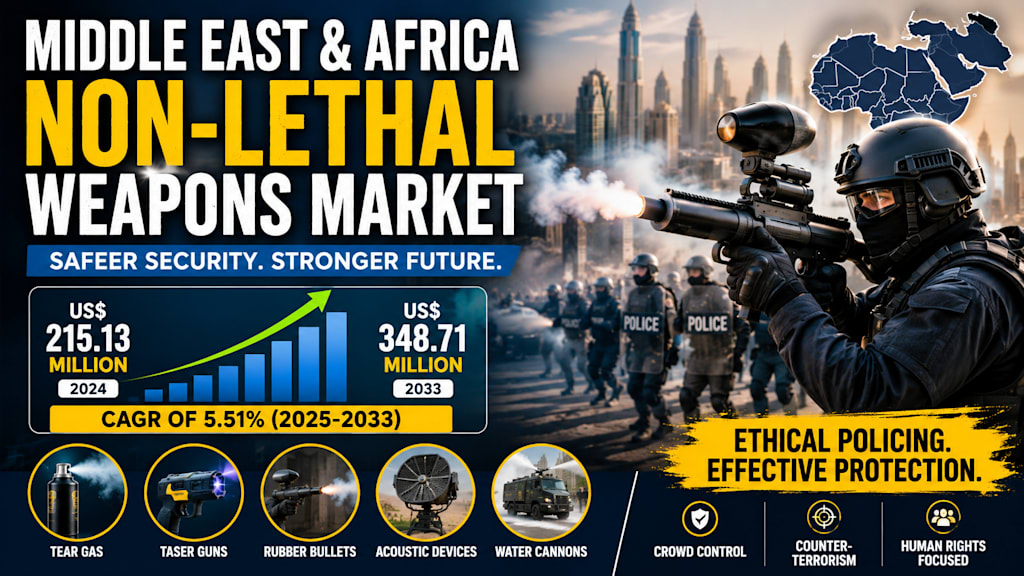
The Middle East and Africa are entering a new era of security modernization, where governments are increasingly prioritizing public safety without relying solely on lethal force. As political unrest, terrorism concerns, border disputes, and urban protests continue to shape the region’s security environment, demand for non-lethal weapons is expanding rapidly across military and law enforcement sectors.
According to Renub Research, the Middle East & Africa Non-Lethal Weapons Market is projected to grow from US$ 215.13 million in 2024 to US$ 348.71 million by 2033, registering a CAGR of 5.51% during the forecast period from 2025 to 2033.
Non-lethal weapons are designed to incapacitate, deter, or control individuals while minimizing fatalities and long-term injuries. These technologies are becoming increasingly important for governments attempting to balance national security priorities with international human rights standards and ethical policing frameworks.
The market includes a broad range of products such as tear gas systems, rubber bullets, taser guns, acoustic devices, water cannons, and directed-energy systems. These tools are now widely adopted for riot management, anti-terror operations, crowd dispersal, and tactical law enforcement missions throughout the region.
Political Instability and Civil Unrest Continue to Fuel Market Demand
Several countries across the Middle East and Africa continue to face periods of political instability, civil demonstrations, and security tensions. Governments are therefore under pressure to maintain law and order while reducing casualties during public confrontations.
Non-lethal technologies are increasingly viewed as the preferred solution for controlling riots and demonstrations without escalating violence. Security personnel now rely heavily on rubber bullets, smoke grenades, stun guns, and chemical sprays to manage tense public situations.
In major urban centers, law enforcement agencies are investing in upgraded riot-control systems that allow for faster response times and improved operational efficiency. Authorities are also attempting to avoid global criticism associated with excessive use of force by implementing safer crowd-management methods.
The growing frequency of large-scale protests and social demonstrations has further accelerated adoption across police forces and military support units. Governments recognize that non-lethal systems help preserve public trust while still maintaining security dominance during emergencies.
Counter-Terrorism Operations Driving Advanced Technology Adoption
Counter-terrorism remains one of the strongest growth drivers in the regional non-lethal weapons industry. Several Middle Eastern and African nations continue to battle extremist organizations, insurgencies, and cross-border threats.
Security agencies are increasingly deploying non-lethal systems to neutralize threats without causing widespread civilian casualties. Tools such as acoustic devices, electroshock weapons, directed-energy systems, and flash-bang grenades are becoming essential in tactical operations.
Unlike conventional firearms, non-lethal solutions allow authorities to immobilize suspects, secure infrastructure, and conduct hostage or anti-terror operations with reduced collateral damage.
Governments are also integrating these technologies into border patrol systems and airport security frameworks. The emphasis on minimizing civilian harm during counter-terror activities aligns with evolving international operational standards and military doctrines.
As terrorism threats continue to evolve, regional governments are expected to increase procurement budgets for modern crowd-control and tactical defense equipment.
Security Force Modernization Programs Expanding Across the Region
The modernization of security forces across the Middle East and Africa is creating strong long-term opportunities for market players. Governments are heavily investing in advanced policing infrastructure, surveillance systems, and tactical defense technologies.
Saudi Arabia remains one of the region’s largest defense spenders. According to the report, the Saudi Ministry of Finance allocated approximately US$ 69 billion for military expenditure in 2023, accounting for nearly 23% of the national budget.
The country’s Vision 2030 initiative is also encouraging domestic defense production and technology localization. As a result, demand for advanced non-lethal systems is increasing among Saudi security forces.
Similarly, the United Arab Emirates is investing heavily in smart policing and next-generation security technologies. UAE authorities are integrating non-lethal tools into crowd-control strategies, airport security operations, and public-event management systems.
South Africa also continues to be a significant regional market due to rising urban crime, protests, and public safety concerns. Local police agencies and private security firms are expanding procurement of riot-control equipment and electroshock systems.
Modernization efforts across the region are expected to strengthen procurement activity for the next decade.
Human Rights Awareness Reshaping Law Enforcement Practices
Human rights considerations are becoming increasingly important in law enforcement policies throughout the Middle East and Africa. Governments are facing international pressure to reduce excessive force and implement ethical policing standards.
Non-lethal weapons offer authorities an effective alternative to deadly force during demonstrations, riots, and civilian disturbances. These technologies help minimize fatalities while maintaining operational control in highly volatile situations.
Tools such as tasers, tear gas systems, bean bag rounds, and stun grenades allow officers to subdue individuals without causing permanent harm. As a result, many governments are introducing stricter operational guidelines centered around proportional force usage.
The shift toward humane policing strategies is expected to remain a major catalyst for industry expansion over the coming years.
Technological Advancements Improving Market Potential
Innovation is rapidly transforming the global non-lethal weapons landscape, and the Middle East & Africa region is beginning to adopt many of these advanced technologies.
Modern systems now include precision-guided electroshock weapons, long-range acoustic devices, directed-energy tools, and smart crowd-dispersal systems. These innovations improve accuracy, reduce unintended injuries, and enhance operational control for security personnel.
Artificial intelligence and sensor technologies are also being integrated into next-generation defense platforms. Smart systems can now analyze crowd behavior, assess threats, and optimize tactical deployment during complex operations.
As governments pursue more sophisticated security infrastructure, manufacturers are focusing on lightweight, portable, and highly efficient non-lethal technologies tailored for regional conditions.
Budget Constraints Continue to Challenge Market Expansion
Despite positive growth projections, the market still faces several challenges. Budget limitations remain a significant barrier, particularly in lower-income African nations.
Many governments continue prioritizing conventional military spending and anti-terror operations over investment in non-lethal technologies. Smaller police agencies often struggle with procurement costs, maintenance requirements, and training expenses.
Economic volatility, inflation pressures, and currency fluctuations also impact purchasing power across several countries in the region.
As a result, adoption rates vary considerably between wealthier Gulf nations and developing African economies.
Lack of Infrastructure and Training Slows Deployment
The absence of proper training programs and operational infrastructure remains another major challenge.
Non-lethal systems require specialized handling to ensure effectiveness and prevent misuse. Inadequate training may lead to improper deployment, operational failures, or unnecessary injuries during critical situations.
Several regions also lack maintenance facilities, secure storage systems, and logistical support networks required for advanced defense technologies.
Without sufficient investment in training and infrastructure, many law enforcement agencies may struggle to fully utilize modern non-lethal systems.
Saudi Arabia Emerging as a Strategic Growth Hub
Saudi Arabia is rapidly becoming one of the region’s most important non-lethal weapons markets. Rising security concerns, large public gatherings, and national modernization programs are fueling demand for crowd-control technologies.
The kingdom is increasingly adopting tasers, rubber bullets, tear gas launchers, and advanced riot-control systems for police and military applications.
Saudi Arabia’s strategic investments in domestic defense manufacturing are also encouraging partnerships with global security technology providers.
With continued infrastructure expansion and increasing focus on public safety, Saudi Arabia is expected to remain a dominant regional market throughout the forecast period.
UAE Strengthening Smart Security Initiatives
The UAE continues to strengthen its position as a regional leader in smart security innovation.
Authorities are investing in non-lethal technologies to improve public-event security, border protection, and urban policing operations. The country’s emphasis on technology-driven law enforcement is creating opportunities for advanced electroshock and directed-energy systems.
Global defense companies are actively partnering with UAE security agencies to develop modern tactical solutions tailored to regional operational needs.
The UAE’s commitment to innovation and security modernization is expected to accelerate market growth significantly over the next decade.
Competitive Landscape and Key Industry Players
The Middle East & Africa non-lethal weapons market features a mix of international defense manufacturers and specialized security technology providers.
Major companies operating in the market include:
Byrna Technologies Inc.
General Dynamics Corporation
Moog Inc.
RTX Corporation
Rheinmetall AG
Textron Inc.
Combined Systems Inc.
These companies are focusing on product innovation, strategic defense partnerships, regional expansion, and advanced crowd-control technologies.
10 Recent Developments in the Non-Lethal Weapons Industry
Rheinmetall AG expanded development of next-generation crowd-control technologies for military and police applications.
Byrna Technologies increased international distribution of handheld self-defense launchers across emerging security markets.
RTX Corporation continued investment in directed-energy defense technologies for tactical operations.
Textron Inc. strengthened research initiatives involving advanced battlefield security systems.
Combined Systems Inc. expanded riot-control equipment manufacturing capabilities for international law enforcement agencies.
Moog Inc. enhanced defense mobility and precision-control technologies integrated into security platforms.
Saudi Arabia accelerated domestic defense localization initiatives under Vision 2030.
UAE security agencies increased deployment of smart policing and advanced tactical control systems.
African police forces expanded procurement of tasers and riot-control equipment amid rising urban protests.
Governments across the Middle East introduced stronger ethical policing frameworks emphasizing reduced lethal-force dependency.
Market Segmentation Overview
By Product Type
Gases and Sprays
Grenades
Bullets
Taser Guns
Others
By Technology
Chemical
Electroshock
Mechanical and Kinetic
Acoustic/Light
Others
By End Use
Law Enforcement
Military
Others
By Country
South Africa
Saudi Arabia
UAE
Final Thoughts
The Middle East & Africa Non-Lethal Weapons Market is entering a significant growth phase as governments seek safer, smarter, and more ethical security solutions.
Political instability, terrorism threats, rising urbanization, and modernization of law enforcement agencies are collectively driving strong regional demand. At the same time, growing awareness surrounding human rights and proportional-force policing is accelerating adoption of non-lethal technologies.
While budget limitations and infrastructure challenges remain barriers in several developing economies, long-term growth prospects remain highly promising. Countries such as Saudi Arabia and the UAE are expected to lead regional innovation and procurement activity over the coming decade.
As security strategies continue evolving, non-lethal weapons will play an increasingly central role in maintaining public safety while reducing the human cost of conflict and civil unrest.
About the Creator
Enjoyed the story? Support the Creator.
Subscribe for free to receive all their stories in your feed.
Comments
There are no comments for this story
Be the first to respond and start the conversation.