
Middle East and Africa CGM Market Expands as Diabetes Management Enters the Digital Era
Rising diabetes prevalence, growing adoption of digital healthcare technologies, and expanding healthcare infrastructure are accelerating demand for continuous glucose monitoring systems across the Middle East and Africa.

Diabetes has become one of the most pressing public health challenges of the 21st century. Across the Middle East and Africa (MEA), the burden of diabetes continues to rise at an alarming pace, driven by urbanization, sedentary lifestyles, changing dietary habits, and increasing obesity rates. As healthcare systems seek more effective ways to manage this growing epidemic, continuous glucose monitoring (CGM) technology is emerging as a transformative solution.
Unlike traditional finger-prick testing methods that provide only occasional glucose readings, CGM systems offer real-time monitoring throughout the day and night. This allows patients and healthcare professionals to gain a comprehensive understanding of glucose trends, enabling more informed decisions regarding medication, diet, and lifestyle management.
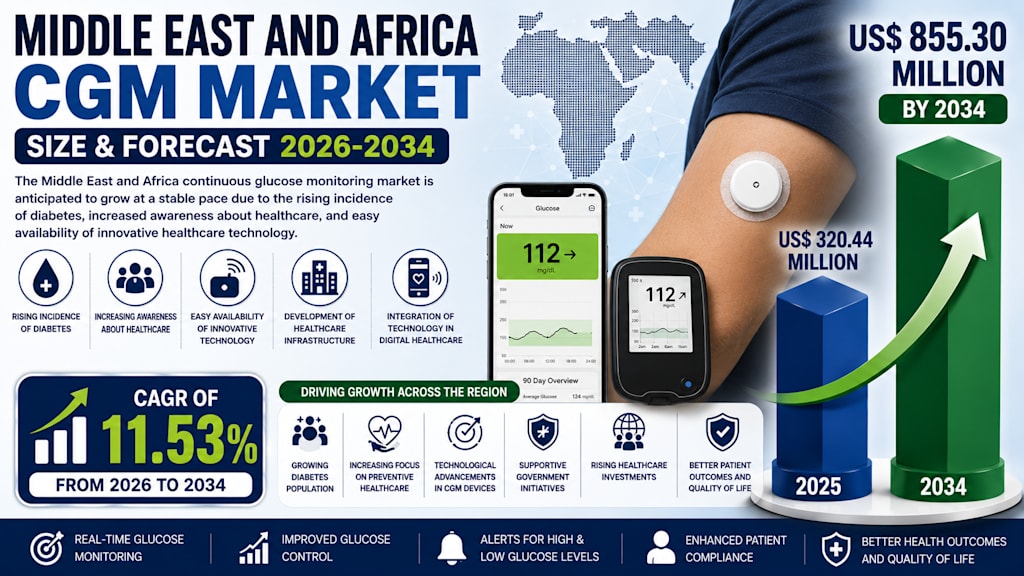
The increasing need for effective diabetes management is creating substantial opportunities for the CGM industry throughout the region. The Middle East and Africa continuous glucose monitoring market is expected to grow from US$ 320.44 million in 2025 to US$ 855.30 million by 2034, registering a compound annual growth rate (CAGR) of 11.53% during the forecast period. Rising diabetes prevalence, advancements in healthcare infrastructure, growing awareness of preventive healthcare, and expanding digital health ecosystems are contributing to this strong market outlook.
As healthcare providers focus on improving patient outcomes and reducing long-term complications, CGM technology is becoming an increasingly important component of diabetes management across the region.

Understanding Continuous Glucose Monitoring
Continuous glucose monitoring is a medical technology designed to track glucose levels continuously rather than relying on periodic measurements.
A typical CGM system consists of a small sensor placed beneath the skin, a transmitter that sends glucose data, and a receiver or smartphone application that displays readings in real time. The sensor measures glucose levels in interstitial fluid and provides ongoing updates throughout the day.
One of the greatest advantages of CGM technology is its ability to provide trend data and alerts for rising or falling glucose levels. Patients can receive notifications before glucose levels become dangerously high or low, allowing them to take preventive action.
Healthcare professionals also benefit from access to detailed glucose patterns, which support more accurate treatment adjustments and improved long-term disease management.
This continuous flow of information helps reduce complications, improve glycemic control, and enhance overall quality of life for individuals living with diabetes.
Diabetes Prevalence Is Fueling Demand
The most significant growth driver for the CGM market in the Middle East and Africa is the rapidly increasing prevalence of diabetes.
Many countries throughout the region have experienced substantial economic development and urbanization over recent decades. While these changes have improved living standards, they have also contributed to lifestyle-related health challenges.
Sedentary behavior, unhealthy dietary habits, rising obesity rates, and reduced physical activity have increased the incidence of both Type 1 and Type 2 diabetes.
The Middle East and North Africa region currently records one of the highest diabetes prevalence rates globally. According to industry data referenced in the report, the region recorded a diabetes prevalence rate of 12.2% in 2021 and is expected to experience significant growth in diabetes cases over the coming decades.
Countries within the Gulf Cooperation Council (GCC) are among those most heavily affected. As diabetes cases continue to rise, healthcare providers are increasingly adopting advanced monitoring technologies capable of supporting better disease management.
Continuous glucose monitoring systems offer an attractive solution because they provide greater accuracy, convenience, and clinical insight compared to traditional monitoring methods.
Digital Healthcare Is Accelerating Adoption
The growing integration of digital technologies within healthcare systems is playing a crucial role in expanding the CGM market.
Governments across the Middle East and Africa are investing heavily in healthcare modernization initiatives aimed at improving service delivery, expanding access, and enhancing patient outcomes.
Digital health platforms, telemedicine services, electronic health records, cloud-based data systems, and artificial intelligence applications are becoming increasingly common throughout the region.
CGM technology aligns naturally with these developments.
Modern CGM systems often integrate directly with smartphones, cloud platforms, and healthcare applications. Patients can monitor their glucose levels remotely while healthcare professionals gain access to real-time data that supports more proactive disease management.
Telemedicine has further strengthened the value proposition of CGM systems by enabling remote consultations and ongoing monitoring without requiring frequent clinic visits.
The combination of digital health infrastructure and continuous monitoring technology is helping transform diabetes care into a more connected and patient-centered experience.
Government Support Is Strengthening Market Growth
Government initiatives aimed at addressing diabetes and promoting preventive healthcare are creating favorable conditions for CGM adoption.
Many countries throughout the Middle East have launched national programs focused on diabetes awareness, early detection, and disease management.
These initiatives often include public education campaigns, screening programs, healthcare infrastructure investments, and efforts to improve access to advanced treatment technologies.
Insurance coverage and reimbursement policies for diabetes management solutions are also gradually improving in several markets. While reimbursement remains inconsistent across the broader region, progress is being made in wealthier healthcare systems where governments recognize the long-term value of preventive care.
Public health authorities increasingly understand that effective glucose management can reduce complications, lower hospitalization rates, and decrease overall healthcare expenditures.
As preventive healthcare becomes a greater priority, demand for CGM systems is expected to continue growing.
The Rise of Home-Based Diabetes Management
One of the most important trends shaping the CGM market is the growing shift toward home-based healthcare.
Patients increasingly prefer solutions that allow them to manage chronic conditions independently while maintaining close communication with healthcare providers.
Continuous glucose monitoring supports this trend by providing real-time data without requiring frequent clinic visits or manual testing.
Users can monitor glucose levels throughout daily activities, receive alerts when intervention is needed, and share information directly with physicians through digital platforms.
This level of convenience is particularly valuable for individuals managing complex diabetes regimens that require frequent monitoring and treatment adjustments.
The increasing popularity of telehealth services has further strengthened the role of home-based CGM systems in long-term diabetes care.
As healthcare systems emphasize patient empowerment and remote monitoring, homecare settings are expected to become one of the fastest-growing end-user segments within the market.
Technological Innovation Continues to Improve Accessibility
Advances in CGM technology are helping improve usability, accuracy, and patient adoption.
Modern sensors are becoming smaller, more comfortable, and capable of operating for longer periods before replacement is required. Enhanced sensor accuracy reduces the need for calibration and improves user confidence.
Battery performance, wireless connectivity, smartphone integration, and cloud-based analytics continue to evolve, creating more seamless user experiences.
Artificial intelligence is also beginning to play a larger role in diabetes management. Predictive algorithms can identify glucose trends, anticipate potential issues, and provide personalized recommendations based on individual patient data.
These innovations not only improve clinical outcomes but also make CGM systems more attractive to a broader range of users.
As technology advances and manufacturing scales increase, affordability is expected to improve, supporting wider adoption throughout the region.
Challenges Continue to Affect Market Expansion
Despite its strong growth potential, the Middle East and Africa CGM market faces several challenges.
One of the most significant barriers remains cost.
Continuous glucose monitoring systems require sensors, transmitters, receivers, and ongoing replacement supplies. For many patients, particularly those in lower-income markets, these costs can be difficult to manage without reimbursement support.
While adoption remains relatively strong in wealthier Gulf countries, affordability continues to limit penetration in many African nations.
Awareness also presents a challenge.
Although healthcare professionals increasingly recognize the benefits of CGM technology, many patients remain unfamiliar with advanced diabetes management solutions. Traditional glucose monitoring methods continue to dominate in areas where healthcare education and access remain limited.
Infrastructure limitations create additional obstacles. Rural and underserved communities often lack the healthcare facilities, trained professionals, and internet connectivity necessary to fully support advanced monitoring technologies.
Addressing these challenges will be essential for maximizing long-term market growth and improving access to diabetes care.
Component Segments Supporting Growth
CGM sensors represent the largest and most important component segment within the market.
Because sensors require regular replacement, they generate recurring demand and account for a substantial portion of market revenue. Advances in sensor durability, accuracy, and comfort continue to drive adoption among patients and healthcare providers.
Receivers also remain important, particularly in regions where smartphone penetration varies. These devices provide a dedicated platform for viewing glucose data and managing alerts.
Transmitters complete the ecosystem by enabling communication between sensors and monitoring devices. Improvements in wireless connectivity and battery performance continue to enhance functionality across all system components.
Together, these technologies form the foundation of modern continuous glucose monitoring systems.
Key Country Markets Driving Expansion
Saudi Arabia represents one of the largest CGM markets in the region due to its high diabetes prevalence, advanced healthcare infrastructure, and strong government focus on healthcare modernization. Rising awareness and increasing physician recommendations continue to support adoption.
The United Arab Emirates benefits from high healthcare spending, advanced medical facilities, and strong digital health initiatives. Government support for smart healthcare solutions has created favorable conditions for CGM adoption across hospitals and homecare settings.
South Africa remains one of Africa's most important CGM markets. Growing awareness of diabetes management technologies and increasing adoption among private healthcare providers are supporting gradual market expansion despite reimbursement challenges.
Other countries throughout the Gulf region, including Qatar, Bahrain, and Oman, are also contributing to growth through investments in healthcare infrastructure and preventive care initiatives.
These markets collectively demonstrate the region's growing commitment to improving diabetes management and healthcare outcomes.
Looking Toward the Future
The future of the Middle East and Africa CGM market appears highly promising.
Rising diabetes prevalence, expanding healthcare infrastructure, increasing digital health adoption, and growing awareness of preventive care will continue to drive demand for advanced glucose monitoring solutions.
Technological innovation is expected to improve affordability, accuracy, and accessibility while supporting broader integration with telemedicine and remote patient monitoring platforms.
Governments, healthcare providers, and technology companies are likely to play increasingly important roles in expanding access and improving diabetes outcomes across the region.
Organizations that focus on innovation, affordability, and patient education will be well-positioned to capitalize on future opportunities.
Final Thoughts
Continuous glucose monitoring is transforming diabetes care throughout the Middle East and Africa by providing patients and healthcare professionals with real-time insights that support better disease management and improved outcomes.
With the regional CGM market projected to grow from US$ 320.44 million in 2025 to US$ 855.30 million by 2034, the industry is entering a period of significant expansion. Rising diabetes prevalence, healthcare modernization efforts, digital health adoption, and growing awareness of preventive care will continue to fuel demand across the region.
As healthcare systems increasingly prioritize patient-centered and technology-driven solutions, continuous glucose monitoring is expected to become a cornerstone of modern diabetes management throughout the Middle East and Africa.
About the Creator
Enjoyed the story? Support the Creator.
Subscribe for free to receive all their stories in your feed.
Comments
There are no comments for this story
Be the first to respond and start the conversation.