
Microgrid Market Set to Reach US$88.27 Billion by 2034 as Renewable Energy, Grid Resilience, and Energy Independence Accelerate Adoption
Growing demand for reliable electricity, increasing renewable energy integration, and government-backed electrification programs are driving strong growth across the global microgrid industry.

Introduction: Decentralized Energy Takes Center Stage
The global energy sector is undergoing a significant transformation as countries, businesses, and communities seek more reliable, sustainable, and resilient power solutions. Traditional centralized electricity grids have served as the backbone of modern economies for decades, but increasing power demand, aging infrastructure, climate-related disruptions, and energy security concerns are encouraging the adoption of alternative approaches.
Among the most promising solutions is the microgrid, a localized energy network capable of generating, storing, and distributing electricity independently or alongside the main utility grid. Microgrids are becoming increasingly important for ensuring uninterrupted power supply, integrating renewable energy sources, and supporting critical infrastructure during emergencies.
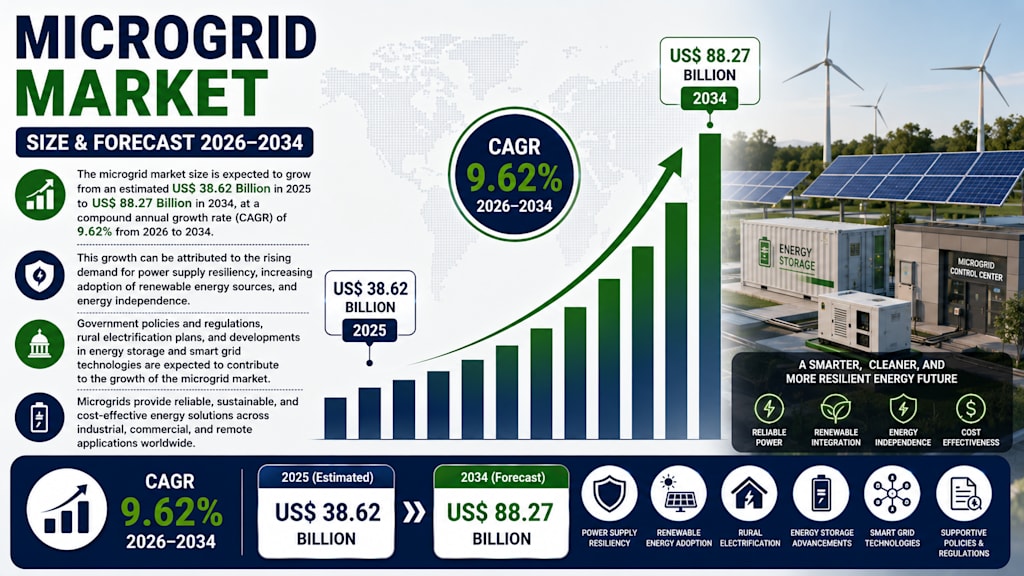
According to Renub Research, the Global Microgrid Market is expected to grow from US$ 38.62 billion in 2025 to US$ 88.27 billion by 2034, expanding at a compound annual growth rate (CAGR) of 9.62% from 2026 to 2034. Rising demand for energy resilience, growing renewable energy adoption, rural electrification initiatives, and advancements in smart grid technologies are expected to drive market expansion throughout the forecast period.
As governments and industries prioritize cleaner and more reliable energy systems, microgrids are emerging as a key component of the future global power infrastructure.
Understanding the Role of Microgrids
A microgrid is a localized energy system that can generate, distribute, and manage electricity either independently or in coordination with a larger utility grid. Unlike traditional centralized power systems, microgrids can continue operating even when the main grid experiences outages or disruptions.
These systems typically combine multiple energy sources, including solar power, wind energy, natural gas generators, fuel cells, and battery storage systems. Advanced energy management technologies continuously balance electricity supply and demand to ensure optimal performance and efficiency.
Microgrids are commonly deployed in hospitals, military installations, universities, industrial facilities, commercial campuses, remote communities, and critical infrastructure locations.
Their ability to provide reliable, flexible, and sustainable energy has made them increasingly attractive across a wide range of applications.
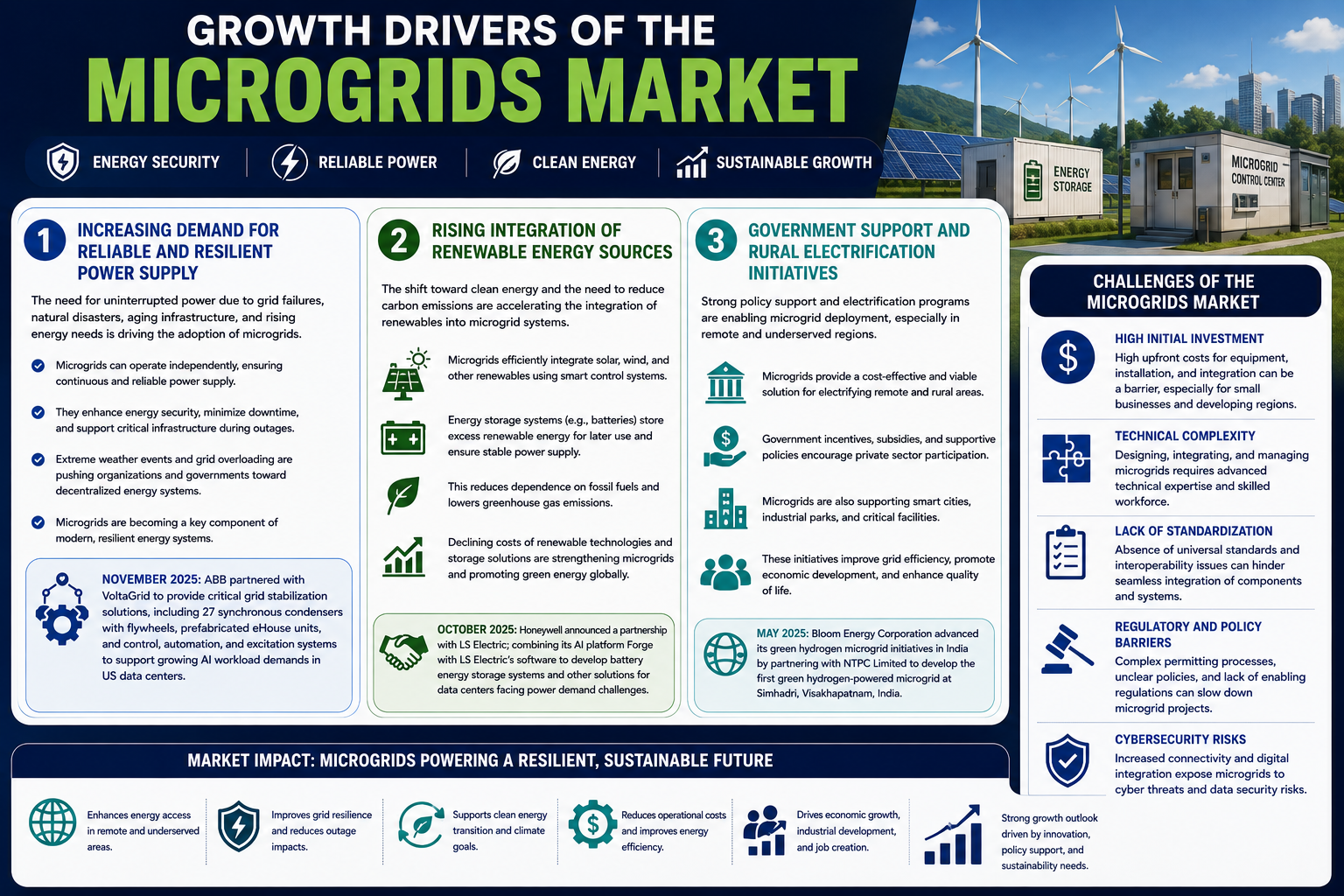
Reliable Power Supply Remains a Major Growth Driver
One of the strongest factors driving microgrid adoption is the growing need for uninterrupted and resilient electricity supply.
Conventional power grids are vulnerable to failures caused by natural disasters, equipment breakdowns, cyber threats, and rising energy demand. For many organizations, even short-term power outages can result in substantial financial losses and operational disruptions.
Microgrids provide a solution by operating independently when necessary, ensuring that critical facilities continue receiving electricity during emergencies.
Healthcare facilities, military bases, data centers, manufacturing plants, and government buildings increasingly rely on microgrids to enhance operational resilience and reduce dependence on centralized infrastructure.
The report highlights ABB's partnership with VoltaGrid to provide advanced grid stabilization solutions designed to address rising electricity demand from artificial intelligence-driven data centers in the United States.
As power reliability becomes increasingly important worldwide, microgrids are expected to play a central role in modern energy systems.
Renewable Energy Integration Is Creating New Opportunities
The rapid expansion of renewable energy generation is another major factor supporting market growth.
Governments and businesses are increasingly investing in solar and wind energy to reduce carbon emissions and meet sustainability goals. However, renewable energy generation can fluctuate due to weather conditions and resource availability, creating challenges for grid stability.
Microgrids help address these challenges by combining renewable energy sources with advanced control systems and energy storage technologies.
Battery storage systems allow excess renewable energy to be stored and used when generation levels decline, ensuring a more consistent electricity supply.
The report notes Honeywell's collaboration with LS Electric to develop battery energy storage and energy management solutions aimed at supporting growing power demands in data centers.
As renewable energy deployment continues accelerating globally, microgrids are expected to become increasingly important for supporting clean energy infrastructure.
Government Policies Continue Supporting Market Expansion
Government initiatives and rural electrification programs are playing a crucial role in advancing microgrid adoption.
Many developing regions still face challenges related to limited access to centralized electricity networks. Extending traditional grid infrastructure to remote communities is often expensive and technically challenging. Microgrids offer a practical and cost-effective alternative for delivering reliable electricity to underserved populations.
Governments and international organizations are investing heavily in microgrid projects to improve energy access, support economic development, and enhance living standards.
Subsidies, financial incentives, and supportive regulatory frameworks are encouraging greater private-sector participation in microgrid development.
The report highlights Bloom Energy's partnership with NTPC Limited in India to develop the country's first green hydrogen-powered microgrid at Simhadri in Visakhapatnam.
These initiatives are expected to remain important contributors to market growth in the coming years.
Natural Gas Microgrids Maintain Strong Demand
Natural gas microgrids continue to represent a significant segment of the market due to their reliability and operational flexibility.
These systems utilize natural gas-powered generators to provide stable electricity generation and are often deployed in areas where natural gas infrastructure already exists. Compared with coal and diesel-based systems, natural gas offers lower emissions and improved environmental performance.
Natural gas microgrids can also work alongside renewable energy sources, creating hybrid energy systems that balance sustainability and reliability.
Their ability to respond quickly to changing energy demands makes them particularly valuable for critical facilities and industrial operations.
As organizations continue prioritizing energy security, natural gas microgrids are expected to remain an important part of the broader microgrid ecosystem.
Solar Photovoltaic Microgrids Gain Momentum Worldwide
Solar photovoltaic (PV) microgrids are among the fastest-growing segments within the market.
These systems generate electricity using solar panels and often incorporate battery storage solutions that allow energy to be used during nighttime hours or periods of reduced sunlight. Solar microgrids are particularly valuable in remote regions where access to conventional electricity infrastructure is limited.
The declining cost of solar technology has significantly improved project economics, encouraging broader adoption among governments, businesses, and communities.
Solar microgrids reduce dependence on fossil fuels while helping organizations achieve sustainability objectives.
As countries continue pursuing renewable energy targets, solar PV microgrids are expected to play an increasingly important role in future energy systems.
Government Applications Continue Expanding
Government facilities remain a key application area for microgrid technologies.
Critical infrastructure such as military installations, emergency response centers, hospitals, and government offices require uninterrupted power to maintain essential services during emergencies and grid failures. Microgrids provide the resilience needed to support these operations under challenging conditions.
Many governments are investing directly in microgrid projects to strengthen national energy security and disaster preparedness capabilities.
The integration of renewable energy resources further supports environmental and sustainability objectives.
As public-sector organizations continue modernizing infrastructure, government applications are expected to remain a major source of market demand.
Grid-Connected Microgrids Offer Greater Flexibility
Grid-connected microgrids have become increasingly popular because they combine the benefits of local energy generation with access to the broader utility network.
These systems can operate alongside the main grid during normal conditions while retaining the ability to disconnect and function independently when necessary. This flexibility allows users to improve reliability, reduce energy costs, and optimize renewable energy utilization.
Grid-connected microgrids are widely used in universities, commercial campuses, industrial facilities, and business parks.
Organizations benefit from lower transmission losses, enhanced operational efficiency, and greater control over energy consumption.
As distributed energy resources continue expanding, grid-connected microgrids are expected to remain a critical segment of the market.
DC Microgrids Support Modern Energy Applications
Direct current (DC) microgrids are emerging as highly efficient solutions for modern energy systems.
Many renewable energy technologies, including solar panels and battery storage systems, naturally generate and store electricity in DC form. By reducing the need for energy conversion between alternating current (AC) and direct current, DC microgrids can improve overall system efficiency.
These systems are increasingly being deployed in data centers, telecommunications networks, commercial buildings, and electric vehicle charging infrastructure.
Their efficiency advantages make them particularly attractive for organizations focused on reducing energy losses and improving sustainability.
As electrification trends continue accelerating, DC microgrids are expected to become an increasingly important part of future energy networks.
United States Leads Global Microgrid Development
The United States remains one of the most advanced and active microgrid markets in the world.
Growing concerns regarding hurricanes, wildfires, grid reliability, and energy resilience have accelerated microgrid adoption across hospitals, military facilities, universities, and commercial campuses. Strong government support and advanced energy infrastructure continue driving innovation.
The report notes that the U.S. Department of Energy received more than US$1.5 billion in funding applications from states, tribal nations, nonprofits, and rural electric cooperatives seeking support for clean energy microgrid projects.
The country's leadership in technology development and renewable energy integration positions it as a major force within the global market.
United Kingdom Advances Grid Modernization Efforts
The United Kingdom is experiencing increasing microgrid adoption as part of its broader strategy to reduce carbon emissions and modernize energy infrastructure.
Universities, industrial facilities, and commercial organizations are deploying microgrids to improve energy efficiency, enhance resilience, and support renewable energy integration. Government policies encouraging clean energy adoption continue creating favorable market conditions.
Investments in battery storage and smart grid technologies are further supporting market growth.
As the country progresses toward its net-zero goals, microgrids are expected to play a larger role in the national energy transition.
Saudi Arabia Emerges as a Major Growth Market
Saudi Arabia is rapidly becoming an important market for microgrid development.
The country's efforts to diversify its economy, reduce dependence on fossil fuels, and expand renewable energy capacity have created significant opportunities for advanced energy infrastructure projects. Solar-powered microgrids are particularly attractive given the country's abundant solar resources.
The report highlights Huawei's development of a large-scale renewable energy-powered microgrid supporting Saudi Arabia's Red Sea Project, one of the world's most ambitious sustainable development initiatives.
Such projects demonstrate the growing role of microgrids in supporting future smart cities and sustainable infrastructure developments.
Challenges Continue to Affect Market Growth
Despite strong growth prospects, the microgrid market faces several challenges.
One of the most significant barriers is the high upfront cost associated with system installation and infrastructure development. Energy generation equipment, battery storage systems, control technologies, and distribution networks require substantial investment, which can limit adoption in certain regions.
Regulatory complexity also remains a challenge. Developers must comply with varying grid interconnection standards, safety requirements, and permitting processes across different jurisdictions.
Technical integration challenges involving multiple energy sources and advanced control systems can further complicate project implementation.
Addressing these issues will be important for ensuring continued market expansion.
Leading Companies Driving Innovation
The global microgrid market includes several major energy and technology companies focused on developing advanced distributed energy solutions.
Key players highlighted in the report include **ABB, Siemens AG, General Electric, Eaton Corporation, Exelon Corporation, Honeywell International, Schneider Electric, and Hitachi Energy. These organizations continue investing in renewable energy integration, energy storage systems, automation technologies, and smart grid solutions.
Final Thoughts
The global microgrid market is entering a period of significant expansion driven by the growing need for energy resilience, renewable energy integration, and decentralized electricity generation.
With the market projected to increase from US$ 38.62 billion in 2025 to US$ 88.27 billion by 2034, microgrids are becoming an increasingly important component of modern energy infrastructure. Their ability to deliver reliable, sustainable, and flexible power solutions positions them at the center of future energy strategies worldwide.
Although challenges related to investment costs and regulatory requirements remain, the long-term outlook remains highly positive. As governments, businesses, and communities continue seeking cleaner and more resilient energy systems, microgrids are expected to play a transformative role in shaping the future of global electricity generation and distribution.
About the Creator
Enjoyed the story? Support the Creator.
Subscribe for free to receive all their stories in your feed.
Comments
There are no comments for this story
Be the first to respond and start the conversation.