
Microcarrier Market Set for Steady Expansion as Biopharmaceutical Innovation Accelerates Worldwide
Growing demand for biologics, vaccines, and cell therapies is fueling the adoption of advanced microcarrier technologies, with the global market expected to reach US$3.49 billion by 2034.


The future of medicine is increasingly being shaped inside laboratories rather than traditional pharmaceutical factories. From personalized treatments and regenerative medicine to advanced vaccines and cell therapies, the healthcare industry is undergoing a transformation driven by biological innovation.
Behind many of these breakthroughs lies a technology that rarely receives public attention but plays a critical role in modern biomanufacturing: microcarriers.
Microcarriers are specialized materials that enable the large-scale cultivation of cells used in the production of vaccines, biologic drugs, monoclonal antibodies, and regenerative therapies. As global demand for advanced medical treatments continues to rise, these tiny platforms are becoming indispensable to pharmaceutical and biotechnology companies worldwide.
According to industry forecasts, the global microcarrier market is expected to grow from US$2.06 billion in 2025 to US$3.49 billion by 2034, representing a compound annual growth rate (CAGR) of 6.03% between 2026 and 2034. The market's expansion is being driven by rising demand for large-scale cell culture production, increasing vaccine manufacturing activities, and rapid advancements in regenerative medicine.
What Are Microcarriers and Why Are They Important?
Microcarriers are small beads or matrices designed to support the growth of anchorage-dependent cells in suspension culture systems. These cells require a surface to attach to before they can grow and multiply effectively.
Manufactured from materials such as dextran, polystyrene, gelatin, or glass, microcarriers provide the necessary environment for cell expansion within large bioreactors. By maximizing available growth surfaces inside production systems, they enable researchers and manufacturers to cultivate high-density cell populations efficiently.
Their importance extends across numerous areas of modern biotechnology.
Microcarriers are widely used in the production of vaccines, monoclonal antibodies, recombinant proteins, and cell-based therapies. They also play an increasingly important role in regenerative medicine and tissue engineering applications, where large quantities of viable cells are required.
Without scalable cell culture technologies such as microcarriers, many of today's most advanced biological treatments would be significantly more difficult and expensive to manufacture.
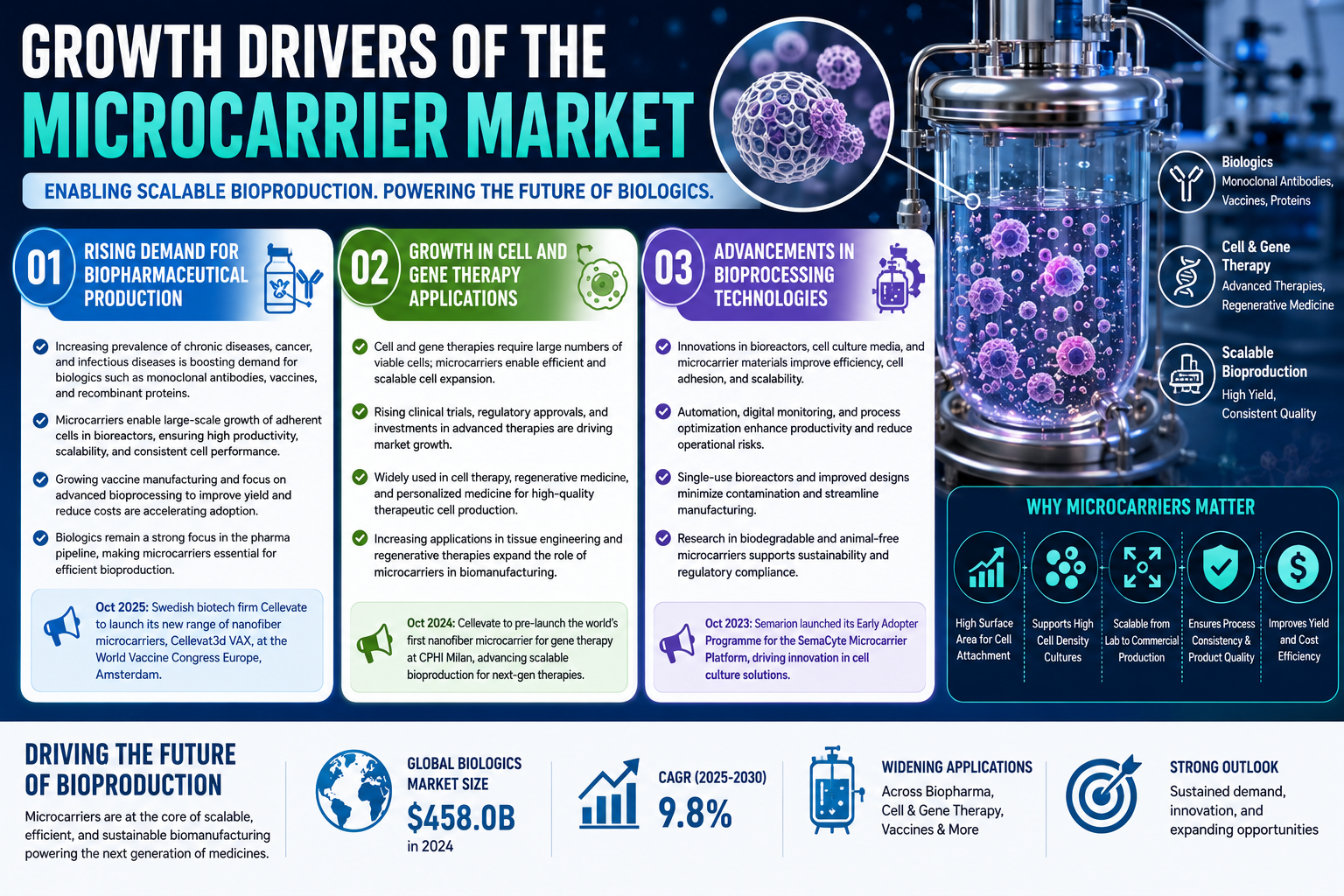
Biopharmaceutical Growth Creates Massive Demand
One of the strongest drivers behind the microcarrier market is the continued growth of the global biopharmaceutical industry.
Biologic medicines have become a major focus for healthcare providers and pharmaceutical companies because they offer highly targeted treatment options for complex diseases. Monoclonal antibodies, vaccines, and recombinant proteins are increasingly used to treat cancer, autoimmune disorders, infectious diseases, and numerous chronic conditions.
Producing these therapies requires large-scale cell cultivation processes, making efficient bioprocessing technologies essential. Microcarriers provide a practical solution by supporting high-density cell growth while maintaining consistency and scalability throughout production.
The increasing prevalence of chronic diseases and the continued development of advanced biologics are creating sustained demand for manufacturing platforms capable of supporting commercial-scale production.
At the same time, pharmaceutical companies are seeking ways to reduce production costs while maintaining product quality. Microcarrier systems help achieve these objectives by improving cell yields and optimizing manufacturing efficiency.
As biologics continue to dominate pharmaceutical pipelines globally, demand for microcarrier technology is expected to remain strong.
Cell and Gene Therapy Are Transforming the Industry
Few areas of healthcare have generated as much excitement as cell and gene therapy.
These emerging treatment approaches aim to address diseases at their biological roots by modifying cells or genetic material. Applications range from cancer immunotherapy and stem cell treatments to regenerative medicine and personalized healthcare solutions.
However, producing these therapies requires the cultivation of large quantities of living cells, creating significant manufacturing challenges.
Microcarriers have become a critical technology for overcoming these challenges. They provide scalable platforms that allow researchers and manufacturers to expand therapeutic cell populations efficiently while maintaining quality and viability.
The growing number of clinical trials and regulatory approvals in cell and gene therapy is further increasing demand for advanced cell culture systems.
As healthcare moves toward more personalized treatment approaches, microcarriers are expected to play an even greater role in enabling commercial-scale production of innovative therapies.
Technology Is Making Bioprocessing Smarter
Advances in bioprocessing technology are reshaping the microcarrier landscape.
Modern microcarriers feature enhanced surface properties that improve cell attachment, growth, and productivity. These innovations help manufacturers achieve higher yields while reducing production variability.
At the same time, improvements in bioreactor design are making large-scale cell culture operations more efficient. Advanced monitoring systems, automation technologies, and digital process controls allow operators to optimize cultivation conditions in real time.
Single-use bioreactor systems are becoming particularly popular because they reduce contamination risks and simplify manufacturing workflows. These disposable systems eliminate many of the cleaning and sterilization requirements associated with traditional equipment, helping companies improve operational efficiency.
Researchers are also developing biodegradable and animal-component-free microcarriers that align with evolving regulatory requirements and sustainability goals.
As innovation continues, next-generation microcarrier technologies are expected to deliver even greater performance and flexibility for biopharmaceutical manufacturers.
Recent Industry Developments Highlight Growing Momentum
The microcarrier industry has witnessed several important developments that demonstrate its increasing importance within biotechnology.
In May 2025, Nexture Bio introduced a comprehensive range of custom research and development services focused on enhancing cell culture performance and scaling adherent cell culture processes using animal-component-free microcarriers and scaffolds.
Just two months later, Smart MCs received an AUD 900,000 grant from the Australian Research Council to advance microcarrier technologies for cell manufacturing. The project aims to develop xeno-free microcarriers that improve scalability, reduce production costs, and enhance product quality.
In April 2025, Shineco acquired a majority stake in InfiniClone, a biotechnology company specializing in stem cell culture technologies utilizing microcarriers. The acquisition reflects growing commercial interest in regenerative medicine and advanced cell expansion platforms.
Meanwhile, Cellevate continues to push technological boundaries through the development of nanofiber microcarriers capable of providing up to 60 times more surface area than conventional alternatives, potentially revolutionizing gene therapy manufacturing processes.
These developments underscore the industry's commitment to innovation and its growing strategic importance within modern healthcare.
Vaccine Manufacturing Continues to Expand
The global vaccine market remains one of the most important application areas for microcarrier technology.
Microcarriers are commonly used to cultivate virus-producing cells at high densities, enabling large-scale vaccine production. Their ability to support efficient and consistent cell growth makes them particularly valuable for manufacturing viral vaccines such as influenza and rabies vaccines.
The COVID-19 pandemic highlighted the importance of scalable vaccine production infrastructure and accelerated investment in advanced bioprocessing technologies worldwide.
Governments and pharmaceutical companies have increased funding for vaccine manufacturing capacity, creating new opportunities for microcarrier suppliers and technology developers.
As global preparedness for future health emergencies becomes a higher priority, demand for technologies that support rapid vaccine production is expected to remain strong.
Consumables Drive Recurring Revenue Growth
Within the microcarrier market, consumables represent one of the most important segments.
This category includes microcarrier beads, culture media, reagents, buffers, and disposable materials required during bioproduction processes. Because these products must be replenished regularly, they generate recurring demand and stable revenue streams for suppliers.
The increasing adoption of single-use technologies in pharmaceutical manufacturing is further supporting growth in this segment.
Additionally, advances in chemically defined and animal-component-free media are improving cell culture performance while helping manufacturers meet strict regulatory requirements.
As production volumes increase across biologics, vaccines, and cell therapies, demand for consumable products is expected to grow steadily.
Equipment Investments Reflect Industry Expansion
The equipment segment is also benefiting from the expansion of biopharmaceutical manufacturing capacity.
This category includes bioreactors, mixing systems, filtration equipment, monitoring devices, and other technologies used in large-scale cell cultivation.
Biopharmaceutical companies are investing heavily in modern facilities capable of supporting both clinical and commercial production. Automation and digitalization are becoming increasingly important as manufacturers seek to improve process control, reduce costs, and increase productivity.
The growing popularity of modular and scalable manufacturing systems is creating additional opportunities for equipment providers serving the microcarrier market.
The United States Leads Global Adoption
The United States remains the largest and most advanced market for microcarrier technologies.
Its leadership position is supported by a highly developed biopharmaceutical industry, substantial research and development investments, and strong demand for biologics, vaccines, and cell-based therapies.
American pharmaceutical and biotechnology companies continue expanding manufacturing capacity to meet growing global demand for advanced medical treatments.
Government funding for biomedical research, combined with a robust ecosystem of universities, research institutions, and private companies, creates favorable conditions for continued innovation.
The country is also a leader in advanced bioprocessing technologies, including single-use bioreactors and next-generation microcarrier systems.
As personalized medicine gains momentum, the United States is expected to remain a key driver of market growth.
Emerging Markets Gain Momentum
While developed markets continue to dominate, emerging economies are becoming increasingly important contributors to industry expansion.
United Kingdom
The UK benefits from a strong biotechnology ecosystem supported by research institutions, clinical trial activity, and government-backed innovation initiatives. Growth in precision medicine, regenerative therapies, and biologics manufacturing is driving demand for advanced cell culture technologies.
India
India's position as a major vaccine manufacturing hub is creating strong demand for scalable cell culture platforms. Government support for biotechnology development, increasing investment in research infrastructure, and growth in biosimilar production are accelerating market expansion.
Saudi Arabia
Saudi Arabia's Vision 2030 strategy is encouraging investment in healthcare, biotechnology, and local biomanufacturing capabilities. These efforts are supporting adoption of advanced technologies, including microcarrier-based cell culture systems.
Challenges Remain
Despite promising growth prospects, several challenges continue to affect the market.
One major concern is the high cost associated with implementing and operating microcarrier systems. Specialized materials, sophisticated bioreactors, culture media, and technical expertise all contribute to significant capital and operational expenses.
Technical complexity presents another challenge. Successful microcarrier-based cultivation requires precise control of variables such as oxygen transfer, agitation rates, nutrient distribution, and pH levels. Failure to maintain optimal conditions can negatively affect cell growth and product quality.
Additionally, scaling production from laboratory settings to commercial manufacturing remains a complex process requiring specialized knowledge and advanced monitoring systems.
Addressing these challenges will be essential for maximizing adoption and unlocking the market's full potential.
Looking Ahead
The future of the microcarrier market appears increasingly promising.
Growing demand for biologics, vaccines, regenerative therapies, and personalized medicine is creating a strong foundation for sustained growth. At the same time, technological advancements in bioprocessing, automation, and materials science are making microcarrier systems more efficient, scalable, and accessible.
With the market projected to grow from US$2.06 billion in 2025 to US$3.49 billion by 2034, microcarriers are becoming a critical component of modern biomanufacturing infrastructure.
Final Thoughts
While microcarriers may not receive the same public attention as groundbreaking therapies or blockbuster drugs, their role in enabling medical innovation is undeniable.
From life-saving vaccines and cancer treatments to regenerative medicine and personalized healthcare, many of tomorrow's most transformative therapies depend on efficient cell culture technologies. Microcarriers provide the foundation that makes large-scale biological production possible.
As the biotechnology industry continues to evolve, these small but powerful tools will remain at the center of scientific progress, helping researchers and manufacturers bring the next generation of medical breakthroughs to patients around the world.
About the Creator
Enjoyed the story? Support the Creator.
Subscribe for free to receive all their stories in your feed.
Comments
There are no comments for this story
Be the first to respond and start the conversation.