
Mexico Residential Real Estate Market Size and Forecast 2025–2033: Urban Growth, Nearshoring, and Housing Demand Reshape Mexico’s Property Landscape
Rising urbanization, expanding middle-class housing demand, foreign investment, and nearshoring trends are transforming Mexico’s residential real estate market, which is projected to reach US$ 21.1 billion by 2033.

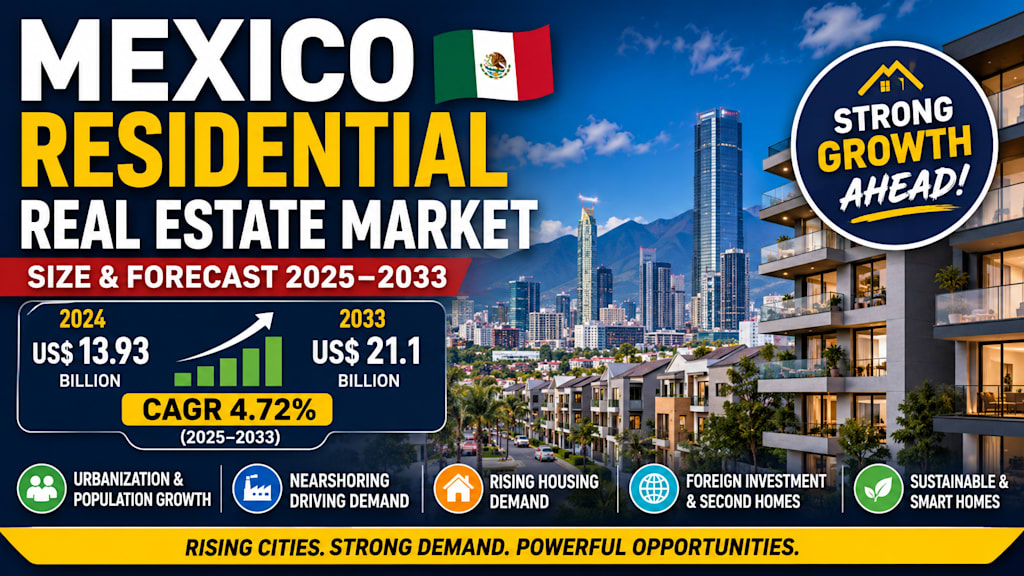
Mexico Residential Real Estate Market Set for Strong Growth Through 2033
Mexico’s residential real estate sector is entering a new phase of expansion driven by urbanization, population growth, rising household formation, infrastructure development, and increasing foreign investment. As one of Latin America's largest economies, Mexico continues to attract both domestic and international homebuyers, creating favorable conditions for long-term residential market growth.
According to Renub Research, the Mexico Residential Real Estate Market is expected to grow from US$ 13.93 billion in 2024 to US$ 21.1 billion by 2033, registering a CAGR of 4.72% from 2025 to 2033.
The demand for housing continues to increase as more people migrate to urban centers in search of employment opportunities. Additionally, Mexico’s appeal as a destination for expatriates, retirees, and second-home buyers is creating new growth opportunities across coastal and metropolitan regions.
As developers adapt to evolving consumer preferences and economic trends, the market is witnessing significant transformation in housing formats, smart home integration, sustainable construction practices, and mixed-use developments.
A Residential Market Driven by Demographic Expansion
Mexico's population growth remains one of the most important drivers of housing demand. With over 80% of citizens living in urban areas, cities continue to absorb new residents at a rapid pace.
Major metropolitan centers such as Mexico City, Monterrey, and Guadalajara are experiencing continuous residential expansion. Young professionals, newly formed families, and first-time buyers are fueling demand for apartments, condominiums, and affordable housing projects.
The country's relatively young population creates a steady pipeline of future homebuyers. Every year, thousands of households enter the housing market, generating demand across multiple price segments.
Urban migration from rural regions further intensifies this trend. As individuals relocate for better employment opportunities, educational access, and healthcare services, developers are increasingly investing in suburban communities and vertical housing projects.
This demographic advantage provides a strong foundation for sustained residential real estate growth throughout the forecast period.
Strong Housing Demand Supports Property Value Growth
Mexico's housing market has demonstrated impressive resilience over the past decade.
Property prices have steadily increased due to growing demand and limited supply in key urban centers. The national housing price index recorded strong annual gains in recent years, reflecting healthy market fundamentals.
The post-pandemic recovery has also accelerated buyer activity, particularly in desirable urban neighborhoods where access to services, transportation, and employment centers remains a priority.
In Mexico City, premium districts such as Polanco, Roma, and Condesa continue attracting affluent buyers seeking luxury residences and investment properties. These neighborhoods are renowned for their architecture, cultural attractions, lifestyle amenities, and strong rental demand.
At the same time, affordable housing remains a critical component of the market, encouraging developers to launch projects targeting middle-income households across expanding suburban corridors.
Nearshoring Creates New Real Estate Opportunities
One of the most significant developments shaping Mexico’s residential property market is the rapid rise of nearshoring.
As global companies relocate manufacturing operations closer to North American markets, Mexico has emerged as a preferred destination due to its strategic location, competitive labor costs, and trade agreements.
Northern states such as Nuevo León, Chihuahua, Baja California, and Coahuila are experiencing substantial industrial investment. New factories, logistics facilities, and industrial parks are creating thousands of jobs.
This industrial expansion directly influences residential real estate demand. Employees, managers, and executives require housing near employment centers, encouraging developers to build new residential communities around manufacturing hubs.
The resulting population influx is boosting demand for:
- Apartments
- Townhouses
- Gated communities
- Mid-range family housing
- Premium executive housing
As nearshoring continues gaining momentum, Northern Mexico is expected to remain one of the fastest-growing residential real estate regions in the country.
Government Policies Improve Housing Accessibility
Government-backed housing initiatives continue playing a crucial role in expanding homeownership opportunities.
Programs designed to improve mortgage accessibility have helped more families enter the property market. Financial institutions have also introduced flexible financing options aimed at first-time buyers.
Mortgage penetration remains relatively low compared with many developed markets, creating substantial room for future expansion.
Lower borrowing barriers encourage residential purchases while supporting broader economic development through construction activity, employment creation, and infrastructure investment.
Public-private partnerships are also helping improve urban planning and housing availability in rapidly growing metropolitan regions.
Sustainability and Smart Housing Gain Momentum
Modern homebuyers increasingly prioritize sustainability, energy efficiency, and technology integration when purchasing residential properties.
Developers are responding by incorporating environmentally friendly construction techniques and smart-home features into new projects.
Popular sustainability initiatives include:
- Solar energy systems
- Water conservation technologies
- Energy-efficient appliances
- Green building materials
- Smart security systems
- Automated lighting controls
These innovations not only reduce operating costs for homeowners but also increase property value and market appeal.
As environmental awareness grows among consumers, sustainable housing is expected to become a key competitive differentiator across Mexico’s residential real estate market.
Foreign Buyers Continue Strengthening Market Demand
Mexico remains one of the most attractive real estate destinations for international buyers.
Its favorable climate, affordable property prices, proximity to the United States, and rich cultural heritage continue attracting foreign investors and retirees.
Popular destinations include:
- Cancun
- Playa del Carmen
- Tulum
- Puerto Vallarta
- Los Cabos
- Mérida
Many international buyers purchase second homes for vacation purposes while others acquire rental properties to capitalize on Mexico's thriving tourism industry.
The growing popularity of remote work has further accelerated demand from foreign professionals seeking lifestyle-oriented housing in attractive coastal and urban locations.
This influx of international capital contributes significantly to residential development and market expansion.
Challenges Facing Mexico’s Residential Real Estate Market
Despite strong growth prospects, several challenges continue affecting the market.
Regulatory Complexity and Land Ownership Issues
Developers frequently face administrative hurdles when acquiring land and obtaining permits.
Complex zoning regulations, environmental approvals, and overlapping jurisdictional requirements can delay projects and increase development costs.
Land tenure issues, particularly involving ejido lands, create additional legal complexities that may discourage investment.
Improving transparency and streamlining regulatory procedures will be essential for supporting future residential development.
Economic Volatility and Interest Rate Risks
Macroeconomic uncertainty remains another concern.
Inflationary pressures can reduce purchasing power and affect affordability for middle-income households. Rising interest rates may also increase mortgage costs, making homeownership less accessible.
Currency fluctuations and global economic instability can influence foreign investment flows and impact overall market confidence.
Nevertheless, Mexico’s strong demographic fundamentals continue providing resilience against economic cycles.
Regional Analysis
Northern Mexico Residential Real Estate Market
Northern Mexico has become a major residential growth engine due to industrialization and nearshoring.
Cities such as Monterrey, Tijuana, and Ciudad Juárez are attracting significant domestic and international investment.
The resulting job creation is increasing demand for housing across multiple income segments. Developers are expanding suburban communities while also constructing vertical residential projects to optimize land use.
Improved infrastructure and proximity to the U.S. border further strengthen the region’s attractiveness.
Although rapid growth places pressure on transportation and public services, Northern Mexico remains one of the country's most promising residential markets.
Central Mexico Residential Real Estate Market
Central Mexico continues to dominate the national residential landscape.
Mexico City remains the country’s largest and most influential housing market, supported by economic activity, employment opportunities, and population density.
Demand spans every housing category, from affordable apartments to luxury condominiums and gated communities.
Surrounding cities such as Querétaro, Puebla, and Toluca are benefiting from suburban expansion as residents seek more affordable alternatives outside the capital.
Infrastructure projects, including transportation improvements and highway development, are enhancing connectivity and supporting regional growth.
Despite elevated land prices and regulatory challenges, Central Mexico remains a focal point for residential investment.
Southern Mexico and Emerging Regions
Southern Mexico is gradually gaining attention as infrastructure investments improve regional connectivity.
Tourism-related development, government infrastructure initiatives, and increasing interest from second-home buyers are encouraging residential construction in select markets.
While growth remains slower than in northern and central regions, long-term opportunities are emerging in cities benefiting from transportation upgrades and economic diversification efforts.
Market Segmentation
By Property Type
- Apartments
- Villas
- Condominiums
- Towns
- Gated Communities
Among these segments, apartments and condominiums are expected to witness strong demand due to urbanization and changing lifestyle preferences. Gated communities and villas continue attracting affluent buyers seeking enhanced security and premium amenities.
By End User
- First-Time Home Buyers
- Second Home Buyers
- Rental Investors
- Institutional Investors
First-time homebuyers represent a major demand driver, supported by favorable demographics and financing availability. Meanwhile, rental investors and institutional investors are increasingly targeting high-demand urban and tourism markets.
By Region
- Northern Mexico
- Central Mexico
- Southern Mexico
- Others
Recent Developments Among Major Companies
1. Ruba
Ruba expanded residential projects across Northern Mexico to capitalize on growing housing demand generated by nearshoring and industrial expansion.
2. Consorcio Ara, S.A.B. de C.V.
The company increased investments in affordable and middle-income housing developments while incorporating sustainable building practices.
3. Grupo Garza Ponce
Grupo Garza Ponce strengthened its mixed-use development portfolio, combining residential, commercial, and lifestyle amenities.
4. Grupo Lar
The firm expanded urban residential projects focused on modern apartment living and community-oriented environments.
5. Grupo Jomer
Grupo Jomer continued developing premium residential communities designed to serve growing middle- and upper-income populations.
6. Grupo HIR
Grupo HIR enhanced financing solutions and property investment offerings to improve accessibility for homebuyers and investors.
7. Inmobilia
Inmobilia accelerated luxury residential developments in high-demand urban and tourism destinations.
8. Grupo Sordo Madaleno
The company advanced integrated mixed-use projects featuring residential, retail, and entertainment components.
9. Aleatica
Aleatica’s infrastructure investments improved regional connectivity, indirectly supporting residential development in emerging growth corridors.
10. IDEAL Impulsora del Desarrollo
The company continued investing in transportation and urban infrastructure projects that facilitate residential expansion and real estate development.
Competitive Landscape
The Mexico residential real estate market remains highly competitive and fragmented. Developers are focusing on strategic land acquisitions, smart housing technologies, sustainable construction, and mixed-use communities to differentiate themselves.
Companies are increasingly targeting emerging suburban markets where affordability, infrastructure development, and population growth create attractive investment opportunities.
Foreign investment, technological innovation, and changing consumer preferences will continue shaping competitive strategies through 2033.
Final Thoughts
Mexico’s residential real estate market is entering a period of sustained and diversified growth. Urbanization, population expansion, nearshoring-driven industrialization, and increasing foreign investment are creating powerful demand drivers across the country.
With the market projected to rise from US$ 13.93 billion in 2024 to US$ 21.1 billion by 2033, the sector offers substantial opportunities for developers, investors, financial institutions, and homebuyers alike.
While regulatory complexity and economic volatility remain challenges, the long-term fundamentals remain highly favorable. As infrastructure improves, sustainability gains prominence, and housing demand continues to expand, Mexico is poised to strengthen its position as one of Latin America's most dynamic residential real estate markets throughout the coming decade.
About the Creator
Enjoyed the story? Support the Creator.
Subscribe for free to receive all their stories in your feed.
Comments
There are no comments for this story
Be the first to respond and start the conversation.