
Mexico Real Estate Market Size Growth Share Industry Demand & Forecast 2034
Mexico Real Estate Market Size Trends, Growth Demand & Forecast 2026-2034

Mexico Real Estate Market Size, Share, and Forecast (2026–2034)
The Mexico real estate market has become an important part of the country's economic development. Real estate activities support residential construction, commercial expansion, industrial development, tourism projects, and infrastructure growth across different regions. The sector continues to attract attention from developers, investors, businesses, and homebuyers due to rising urbanization, expanding industrial activities, and changing property requirements.
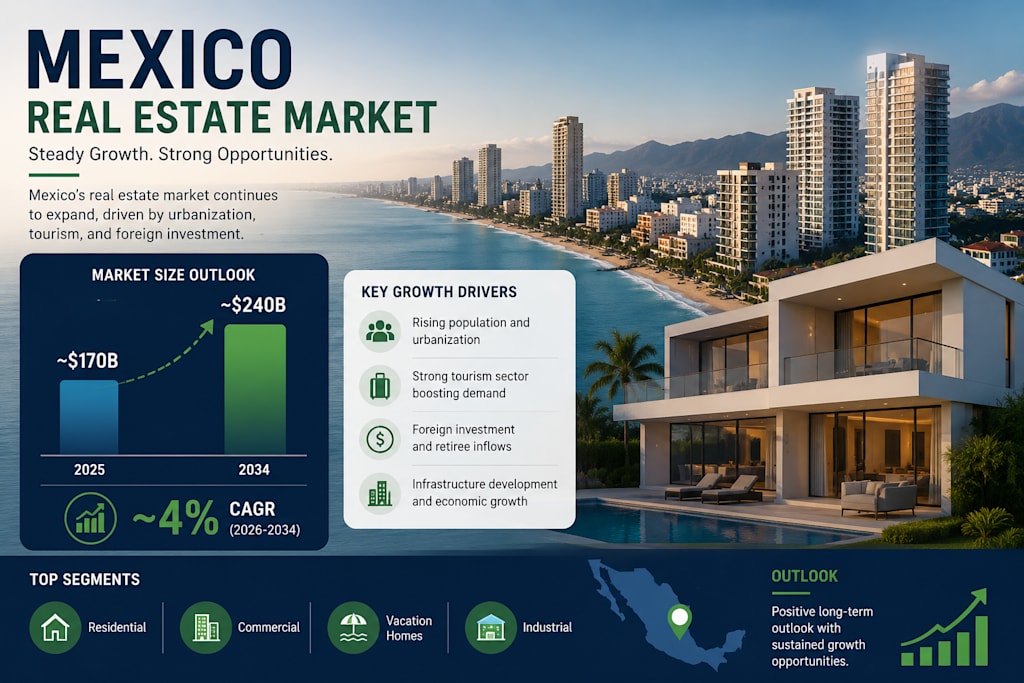
Mexico real estate market reached a value of USD 168.9 billion in 2025. The market is projected to reach USD 238.9 billion by 2034, growing at a CAGR of 3.93% during 2026–2034. Technological advancements, increasing adoption of smart building solutions, changing workplace requirements, and sustainability initiatives are among the factors supporting market growth.
Why the Mexico Real Estate Market Is Attracting Domestic and Foreign Investment
Mexico continues to attract both domestic and international investors due to its strategic location, growing urban population, and expanding industrial base. The country serves as a major manufacturing and export hub, creating demand for different types of real estate assets including residential properties, industrial facilities, office spaces, and logistics centers.
Foreign investors are increasingly evaluating opportunities in major cities and industrial corridors. Economic integration with North American supply chains has strengthened business activity in several regions, supporting long-term demand for commercial and industrial properties.
The tourism sector also contributes to investment activity. Popular destinations continue to witness development of hotels, mixed-use projects, vacation properties, and residential communities. These developments create opportunities for construction companies, developers, and property management firms.
At the same time, government infrastructure projects and transportation improvements are enhancing connectivity between cities and industrial zones, making new locations attractive for real estate development.
Commercial Real Estate Development Trends in the Mexico Real Estate Market
Commercial real estate remains an important segment of the market. Businesses are adapting their space requirements based on changing work models, technological integration, and operational efficiency goals.
Office developers are increasingly focusing on flexible layouts, energy-efficient buildings, and technology-enabled facilities. Companies seeking modern workspaces often prioritize properties that offer sustainability features, digital infrastructure, and employee-friendly environments.
Retail real estate is also evolving. Shopping centers and mixed-use developments are integrating entertainment, dining, and service-based offerings to attract visitors. Developers are adjusting project designs to meet changing consumer preferences and support long-term occupancy.
Another notable trend is the growing use of smart building technologies. Property owners are implementing automation systems, energy management tools, security solutions, and digital monitoring platforms to improve operational performance and tenant experience.
Sustainability has become an important consideration across commercial projects. Developers are incorporating environmentally responsible construction practices and energy-efficient systems to meet evolving market expectations.
Industrial Property Demand and Nearshoring Opportunities in the Mexico Real Estate Market
Industrial real estate has emerged as one of the strongest segments within the Mexican property sector. The growing trend of nearshoring has increased demand for manufacturing facilities, warehouses, and logistics centers.
Many companies are establishing or expanding operations closer to North American markets. Mexico's proximity to the United States, established manufacturing ecosystem, and trade relationships have contributed to rising industrial investment.
Industrial parks in key manufacturing regions are experiencing increased demand from automotive, electronics, consumer goods, and logistics companies. Modern facilities equipped with advanced infrastructure are becoming increasingly important for businesses seeking efficient operations.
Warehouse demand is also expanding due to growth in e-commerce activities and supply chain modernization. Companies require strategically located distribution centers to improve inventory management and delivery efficiency.
As industrial activity continues to expand, supporting real estate segments such as employee housing, commercial services, and transportation infrastructure may also experience additional growth.
Residential Housing Demand and Urban Expansion Across the Mexico Real Estate Market
Residential real estate continues to play a significant role in overall market development. Population growth, urbanization, and changing household requirements are supporting housing demand across multiple regions.
Major cities continue to attract people seeking employment, education, and business opportunities. This migration contributes to demand for apartments, single-family homes, and mixed-use residential developments.
Developers are focusing on projects that address diverse income levels and lifestyle preferences. Affordable housing remains an important segment, while demand for middle-income and premium residential properties is also present in key urban markets.
Technology is influencing residential development as well. Smart home features, energy-efficient systems, and digital connectivity solutions are becoming increasingly common in new projects.
Urban expansion is creating opportunities in suburban and emerging areas where infrastructure improvements support new residential communities. These locations often provide additional development potential while helping accommodate growing population needs.
Key Investment Hotspots and Emerging Regions in the Mexico Real Estate Market
Several regions across Mexico continue to attract significant real estate investment. Major metropolitan areas remain important centers for residential, commercial, and industrial development due to their economic activity and population concentration.
Industrial regions connected to manufacturing and export activities are witnessing strong demand for logistics and warehouse facilities. These locations benefit from transportation networks and proximity to key markets.
Tourism-focused destinations also remain attractive for hospitality and residential investments. Continued visitor demand supports development of hotels, vacation properties, and mixed-use projects.
In addition, emerging regional markets are gaining attention as infrastructure improvements and economic diversification create new opportunities. Investors are increasingly evaluating secondary cities that offer growth potential, lower development costs, and expanding business activity.
The combination of industrial growth, urban development, and infrastructure investment is helping broaden the range of attractive real estate opportunities across the country.
Challenges, Regulations, and Market Risks in the Mexico Real Estate Market
Despite positive growth prospects, the market faces several challenges. Economic fluctuations can influence property demand, financing conditions, and investment decisions.
Construction costs remain an important consideration for developers. Changes in material prices, labor expenses, and project timelines can affect overall development feasibility.
Regulatory compliance is another factor that requires attention. Real estate projects often involve permitting processes, zoning requirements, environmental regulations, and local administrative procedures that may influence project schedules.
Infrastructure limitations in certain regions can also impact development activity. Adequate transportation networks, utilities, and public services are important for supporting long-term property value and occupancy.
Additionally, market participants must evaluate potential risks related to changing consumer preferences, interest rate movements, and broader economic conditions when making investment decisions.
Competitive Landscape and Key Players in the Mexico Real Estate Market
The Mexico real estate market features a mix of established developers, construction companies, property management firms, real estate investment groups, and industrial property operators. Competition is driven by project quality, location selection, infrastructure integration, and long-term asset performance.
Many companies are investing in modern construction techniques, sustainable building practices, and technology-enabled property solutions to strengthen their market position. Strategic partnerships, land acquisitions, and portfolio diversification remain common approaches for supporting growth.
Industrial real estate developers continue to expand logistics and manufacturing facilities in response to nearshoring demand, while residential developers focus on addressing housing requirements across different income segments. Commercial property operators are also adapting their offerings to meet changing tenant expectations.
As urbanization, industrial expansion, and infrastructure development continue across Mexico, market participants are expected to pursue opportunities that align with evolving economic and demographic trends.
Conclusion
The Mexico real estate market is expected to maintain steady growth through 2034, supported by urban development, industrial expansion, technological advancements, and infrastructure investments. Residential, commercial, and industrial segments each contribute to the market's development, creating opportunities across a wide range of property types.
While challenges related to regulations, construction costs, and economic conditions remain important considerations, ongoing investment activity and evolving real estate requirements are expected to support the sector's long-term growth trajectory.
About the Creator
Kim Soo hyun
My name is Kim Soo hyun, and I am a research analyst at IMARC Group, specializing in market trends and data analysis to provide insights and support strategic decision-making.
Enjoyed the story? Support the Creator.
Subscribe for free to receive all their stories in your feed.
Comments
There are no comments for this story
Be the first to respond and start the conversation.