
Mexico Logistics Market Size & Outlook 2026-2034
The Mexico logistics market size was valued at USD 91.47 Billion in 2025 and is projected to reach USD 142.03 Billion by 2034, growing at a compound annual growth rate of 5.01% from 2026-2034.

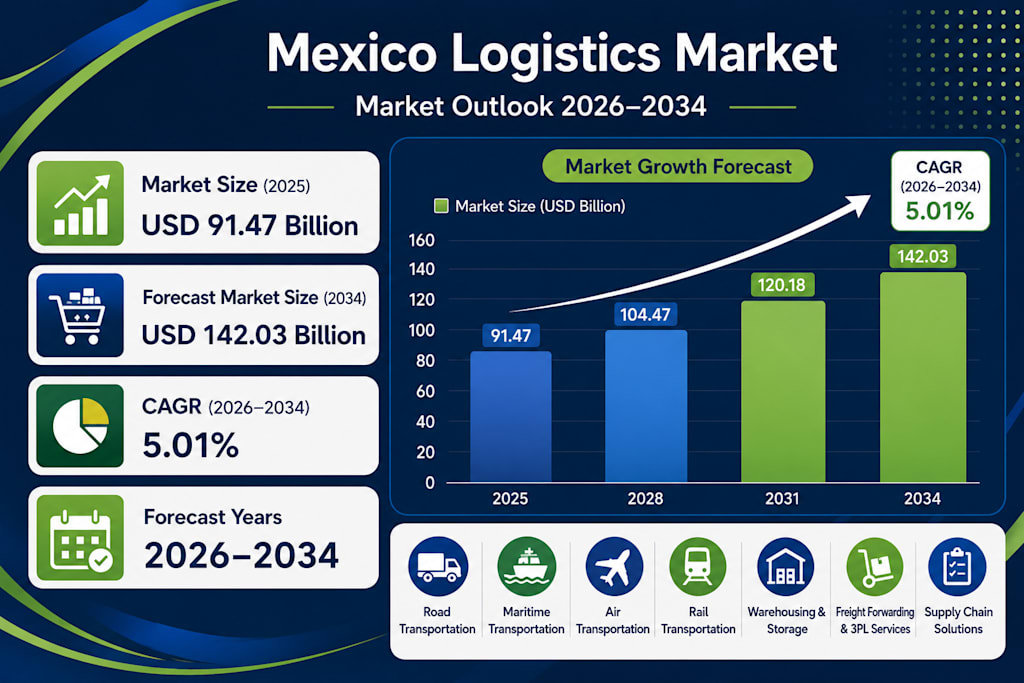
Mexico Logistics Market Size, Growth, and Forecast (2026–2034)
Logistics plays a critical role in supporting economic growth, international trade, and business competitiveness. From transporting raw materials to delivering finished products, efficient logistics networks help connect manufacturers, retailers, and consumers. As global supply chains become increasingly complex and customer expectations continue evolving, logistics providers are investing in new technologies and infrastructure to improve efficiency and reliability.
In 2026, Mexico is strengthening its position as one of the most important logistics hubs in the Americas. Its strategic location, extensive trade relationships, and growing manufacturing sector make the country a key link in regional and global supply chains. As businesses seek faster and more efficient transportation solutions, the logistics industry is becoming increasingly important to Mexico's economic development.
The Mexico logistics market was valued at USD 91.47 Billion in 2025 and is projected to reach USD 142.03 Billion by 2034, growing at a compound annual growth rate (CAGR) of 5.01% during 2026–2034. This growth reflects rising trade activity, expanding e-commerce operations, and ongoing investments in transportation and supply chain infrastructure.
Request a Sample Report with Latest 2026 Data & Forecasts:
Key Trends Shaping the Mexico Logistics Market
Several important trends are influencing market development:
- Rapid growth of e-commerce and online retail
- Increasing adoption of digital logistics technologies
- Expansion of warehousing and distribution facilities
- Rising demand for faster delivery services
- Growing investment in transportation infrastructure
- These trends are helping modernize supply chains while improving operational efficiency.
E-Commerce Is Transforming Logistics Operations
The rise of online shopping has fundamentally changed logistics requirements.
Consumers increasingly expect fast deliveries, real-time shipment tracking, and seamless purchasing experiences. To meet these expectations, logistics providers are expanding fulfillment networks and investing in advanced delivery capabilities.
Warehousing facilities are becoming more sophisticated, utilizing automation and digital tools to improve inventory management and order processing speeds.
As e-commerce continues growing throughout the forecast period, logistics providers will play a critical role in supporting digital commerce ecosystems.
Technology Is Driving Supply Chain Innovation
Digital transformation is becoming a major priority across the logistics industry.
Companies are increasingly using technologies such as:
- Artificial intelligence (AI)
- Internet of Things (IoT) sensors
- Cloud-based logistics platforms
- Real-time tracking systems
- Predictive analytics tools
These technologies help improve route planning, inventory visibility, and operational decision-making.
AI-powered systems can identify inefficiencies and optimize transportation networks, while IoT devices provide valuable data about shipments and equipment performance.
Technology-driven logistics solutions are expected to remain a key growth driver through 2034.
Warehousing and Distribution Networks Are Expanding
Modern supply chains require efficient storage and distribution infrastructure.
As demand for faster delivery grows, businesses are investing in strategically located warehouses and fulfillment centers. These facilities help reduce delivery times while improving inventory management capabilities.
Many warehouses now incorporate automation technologies that streamline operations and increase productivity.
The expansion of warehousing infrastructure is helping strengthen logistics capabilities across both domestic and international markets.
Infrastructure Development Supports Industry Growth
Transportation infrastructure remains a critical component of logistics efficiency.
Investments in highways, ports, rail networks, airports, and intermodal transportation facilities help improve connectivity and reduce transportation bottlenecks.
Infrastructure modernization supports the movement of goods across regions while enhancing competitiveness and trade efficiency.
Continued investment in transportation systems is expected to play a significant role in supporting logistics growth during 2026–2034.
Sustainability Is Becoming More Important
Environmental considerations are increasingly influencing logistics strategies.
Companies are exploring ways to reduce emissions, improve fuel efficiency, and optimize transportation routes. Sustainable logistics practices can help lower operational costs while supporting broader environmental objectives.
Electric delivery vehicles, alternative fuels, and energy-efficient warehouse operations are gaining attention across the industry.
As sustainability becomes a greater priority for businesses and consumers, environmentally responsible logistics practices are expected to become more widespread.
Investment Opportunities in the Market
The expanding logistics sector presents attractive opportunities for investors and businesses.
Key investment areas include:
- Warehouse automation technologies
- Transportation infrastructure projects
- Supply chain software platforms
- Last-mile delivery solutions
- Sustainable logistics initiatives
Companies that focus on efficiency, innovation, and customer service are well positioned to benefit from long-term market growth.
Partnerships between logistics providers, technology companies, and retailers are also creating new opportunities throughout the supply chain ecosystem.
Challenges Facing the Industry
Despite strong growth prospects, several challenges remain.
Supply chain disruptions, rising transportation costs, and labor shortages can affect operational performance. Businesses must also adapt to changing customer expectations and increasing demand for faster deliveries.
Infrastructure limitations in certain regions may create bottlenecks, while cybersecurity concerns continue growing as logistics systems become more digitally connected.
Addressing these challenges will be essential for maintaining operational resilience and supporting future growth.
Future Outlook (2026–2034)
Looking ahead, the Mexico logistics market is expected to continue expanding as trade activity, e-commerce adoption, and digital transformation accelerate.
Between 2026 and 2034, demand for efficient transportation services, advanced warehousing solutions, and technology-enabled supply chain management is likely to increase significantly. Businesses will continue investing in innovation to improve service quality and operational efficiency.
Future developments may include autonomous transportation technologies, AI-driven logistics planning, smart warehouses, and greater integration of digital supply chain platforms.
These innovations are expected to reshape how goods move across domestic and international markets.
Conclusion
The Mexico logistics market is undergoing significant transformation as businesses adapt to changing trade patterns, consumer expectations, and technological advancements. Supported by e-commerce growth, infrastructure investments, and supply chain modernization efforts, the industry is positioned for continued expansion through 2026–2034.
While challenges such as rising costs and operational complexity remain, ongoing innovation and strategic investment are helping strengthen the sector's long-term prospects. As Mexico continues to enhance its role in global commerce, logistics will remain a critical driver of economic growth, connectivity, and business success.
About the Creator
Jackson Watson
I'm a market research analyst at Imarc group company delivering data-driven insights, industry analysis, and customized research solutions. We support businesses with market sizing, competitive analysis, and strategic decision-making.
Enjoyed the story? Support the Creator.
Subscribe for free to receive all their stories in your feed.
Comments
There are no comments for this story
Be the first to respond and start the conversation.