
Mexico Logistics Automation Market Size & Forecast 2034
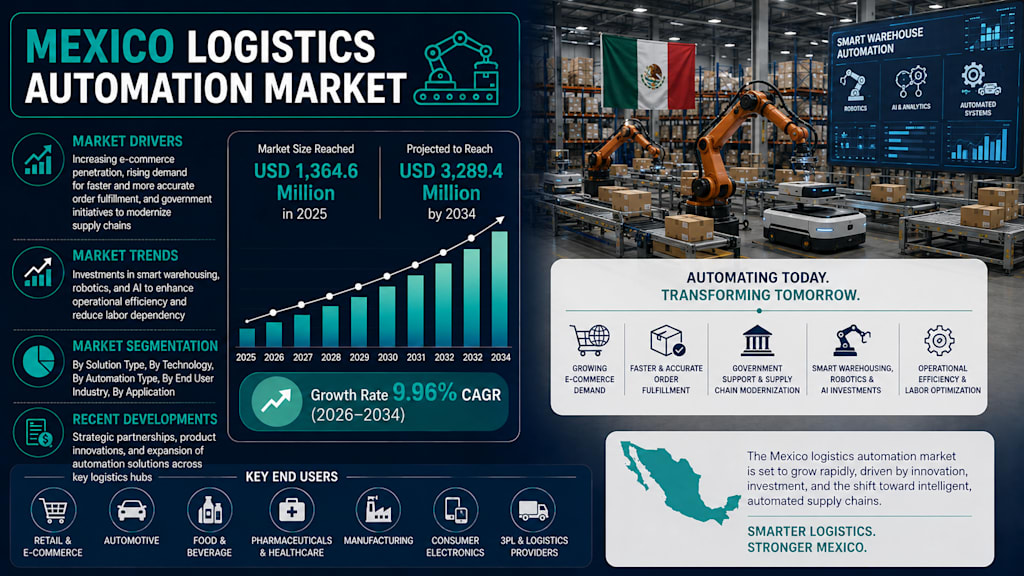
The Mexico logistics automation market size reached USD 1,364.6 Million in 2025. Looking forward, IMARC Group expects the market to reach USD 3,289.4 Million by 2034, exhibiting a growth rate (CAGR) of 9.96% during 2026-2034.

Why the Mexico Logistics Automation Market Is Growing: Trends & Future Outlook (2026–2034)
The logistics industry is undergoing one of the most significant technological transformations in its history. Businesses today face increasing pressure to deliver products faster, improve supply chain visibility, reduce operational costs, and meet rising customer expectations. As a result, automation is becoming a critical component of modern logistics operations.
In 2026, Mexico is emerging as an important hub for logistics innovation, driven by the growth of e-commerce, manufacturing, international trade, and digital transformation initiatives. Companies are increasingly investing in automation technologies to streamline warehouse operations, optimize inventory management, and improve order fulfillment capabilities.
The Mexico logistics automation market reached USD 1,364.6 Million in 2025 and is projected to grow to USD 3,289.4 Million by 2034, exhibiting a compound annual growth rate (CAGR) of 9.96% during 2026–2034. This strong growth reflects the rising importance of automation in building faster, more resilient, and efficient supply chains.
Request a Sample Report with Latest 2026 Data & Forecasts:
Key Trends Shaping the Mexico Logistics Automation Market
Several important trends are driving the adoption of automation technologies:
• Rapid growth of e-commerce and online retail
• Increasing use of warehouse robotics
• Expansion of artificial intelligence in supply chain management
• Rising demand for real-time inventory visibility
• Growing investment in smart warehousing solutions
These developments are helping businesses modernize operations and remain competitive in an increasingly digital economy.
E-Commerce Is Accelerating Automation Demand
One of the biggest factors influencing logistics automation is the rapid expansion of e-commerce.
Consumers now expect fast shipping, accurate order fulfillment, and seamless delivery experiences. Meeting these expectations requires logistics providers to process large volumes of orders efficiently and reliably.
Automated warehouses, robotic picking systems, and intelligent sorting technologies help businesses improve speed and accuracy while managing growing order volumes.
As online shopping continues expanding throughout 2026–2034, automation will remain a critical enabler of supply chain performance.
Smart Warehousing Is Becoming the New Standard
Warehouses are evolving from simple storage facilities into highly sophisticated operational centers.
Modern warehouses increasingly utilize automation technologies that can monitor inventory, manage storage locations, and optimize workflows in real time. Automated guided vehicles, robotic arms, and intelligent conveyor systems are helping reduce manual workloads while improving efficiency.
These technologies allow businesses to handle larger volumes of goods without proportionally increasing labor requirements.
The growing adoption of smart warehousing solutions is expected to remain a major driver of market growth.
Artificial Intelligence Is Transforming Supply Chains
Artificial intelligence is playing an increasingly important role in logistics management.
AI-powered systems can analyze large volumes of operational data to identify patterns, forecast demand, and optimize transportation routes. This helps businesses improve inventory planning and reduce unnecessary costs.
Machine learning algorithms can also predict potential disruptions and recommend corrective actions before problems impact operations.
As AI capabilities continue advancing, companies are expected to integrate these technologies more deeply into logistics and supply chain strategies.
Robotics Is Improving Efficiency and Accuracy
Robotics has become one of the most visible aspects of logistics automation.
Robotic systems are increasingly used for tasks such as sorting, picking, packaging, and moving products within warehouses. These technologies improve operational consistency while reducing the risk of human error.
Robots can also operate continuously, helping organizations increase productivity and meet demanding fulfillment schedules.
As technology becomes more affordable and accessible, robotics adoption is expected to accelerate across logistics facilities in Mexico.
Government Support and Infrastructure Development
Government initiatives aimed at modernizing supply chains and improving infrastructure are also contributing to market expansion.
Investments in transportation networks, trade facilitation, and digital infrastructure create favorable conditions for automation adoption. Businesses benefit from improved connectivity and more efficient movement of goods across domestic and international markets.
As supply chains become increasingly digitalized, public and private sector collaboration will play an important role in supporting long-term growth.
Investment Opportunities in the Market
The rapid growth of logistics automation presents attractive opportunities for investors and businesses.
Key areas attracting investment include:
• Warehouse automation technologies
• Artificial intelligence and analytics platforms
• Robotics and autonomous systems
• Inventory management software
• Supply chain visibility solutions
Companies that help improve efficiency, speed, and operational resilience are likely to benefit from rising demand throughout the forecast period.
Strategic partnerships and technological innovation are also creating new opportunities across the logistics ecosystem.
Challenges Facing the Industry
Despite strong growth prospects, several challenges remain.
The initial cost of implementing advanced automation systems can be significant, particularly for smaller organizations. Integrating new technologies with existing infrastructure may also require substantial planning and investment.
Workforce training remains important as employees adapt to increasingly automated environments. In addition, cybersecurity concerns continue growing as supply chains become more digitally connected.
Addressing these challenges will be essential for maximizing the benefits of automation.
Future Outlook (2026–2034)
Looking ahead, the Mexico logistics automation market is expected to experience robust growth as businesses continue modernizing supply chains and adopting advanced technologies.
Between 2026 and 2034, demand for robotics, artificial intelligence, smart warehousing, and real-time supply chain management solutions is likely to increase significantly. Organizations will continue prioritizing technologies that improve efficiency, accuracy, and customer satisfaction.
Future innovations may include autonomous warehouse operations, predictive logistics systems, AI-driven demand forecasting, and greater integration of connected technologies across supply chain networks.
These advancements are expected to reshape logistics operations and strengthen Mexico's position within regional and global supply chains.
Conclusion
The Mexico logistics automation market is entering a period of rapid transformation driven by e-commerce growth, technological innovation, and increasing demand for operational efficiency. Automation technologies are helping businesses build smarter, faster, and more resilient supply chains capable of meeting modern market expectations.
While challenges such as implementation costs and workforce adaptation remain, continued investment and technological progress are expected to support long-term market expansion. As logistics operations become increasingly automated throughout 2026–2034, automation will play a central role in shaping the future of supply chain management in Mexico.
About the Creator
Jackson Watson
I'm a market research analyst at Imarc group company delivering data-driven insights, industry analysis, and customized research solutions. We support businesses with market sizing, competitive analysis, and strategic decision-making.
Enjoyed the story? Support the Creator.
Subscribe for free to receive all their stories in your feed.
Comments
There are no comments for this story
Be the first to respond and start the conversation.