
Mexico Language Service Market Set for Strong Growth as Global Trade, Digitalization, and Multilingual Communication Reshape Business
Mexico's language services industry is gaining momentum as international trade, e-commerce expansion, and digital transformation fuel demand for translation, interpretation, and localization solutions across industries.

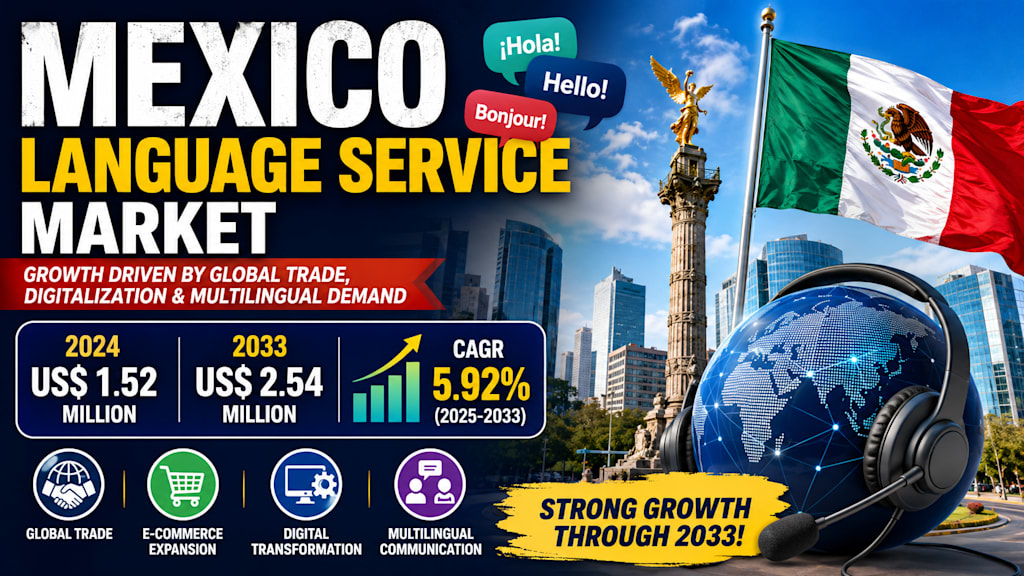
Mexico Language Service Market Forecast Signals New Opportunities Through 2033
Communication has become one of the most valuable assets in the global economy. As businesses expand beyond borders and digital platforms connect consumers from every corner of the world, language barriers can quickly become business barriers. This reality is creating unprecedented demand for professional language services across Mexico.
According to Renub Research, the Mexico Language Service Market is projected to increase from US$ 1.52 million in 2024 to US$ 2.54 million by 2033, growing at a CAGR of 5.92% between 2025 and 2033. The industry's growth reflects broader economic trends including globalization, foreign investment, cross-border trade, e-commerce expansion, digital transformation, and increasing demand for multilingual content.
As organizations seek to connect with diverse audiences, language services are becoming an essential component of business strategy rather than a supplementary service.
Understanding the Role of Language Services in Modern Business
Language services encompass a broad range of solutions designed to facilitate communication across linguistic and cultural boundaries.
These services typically include:
Translation
Interpretation
Localization
Transcription
Language training
Multilingual content management
Translation focuses on converting written content from one language to another, while interpretation enables real-time communication between speakers of different languages. Localization goes even further by adapting content to suit the cultural and linguistic preferences of a specific market.
Today, multinational corporations, government agencies, healthcare providers, educational institutions, and technology companies rely heavily on these services to communicate effectively with customers, partners, and stakeholders worldwide.
In a country as diverse and internationally connected as Mexico, the value of language services continues to rise.
Globalization Continues to Drive Market Expansion
Mexico's strategic location and extensive trade relationships have significantly contributed to the growing demand for language services.
The implementation of the United States-Mexico-Canada Agreement (USMCA) has strengthened economic ties throughout North America, encouraging companies to engage in cross-border transactions and international collaborations.
Businesses involved in international trade require accurate translation of:
Legal contracts
Regulatory documents
Technical manuals
Marketing materials
Product documentation
Customer support content
As more Mexican companies expand internationally and foreign firms establish operations within Mexico, professional language services have become indispensable.
Globalization has transformed multilingual communication from a competitive advantage into a business necessity.
E-Commerce Revolution Creates New Language Requirements
Mexico has emerged as one of Latin America's fastest-growing digital commerce markets.
Increasing smartphone penetration, improved internet accessibility, and changing consumer behavior have accelerated online shopping across the country. However, successful e-commerce expansion requires more than simply launching a website.
Consumers prefer interacting with content in their native language. Product descriptions, payment instructions, customer service interactions, and marketing campaigns must be linguistically and culturally relevant.
Localization services help businesses:
Improve customer trust
Enhance user experience
Increase conversion rates
Reduce misunderstandings
Strengthen brand loyalty
As domestic and international retailers compete for online consumers, demand for professional translation and localization solutions is expected to grow substantially.
Digital Transformation Accelerates Demand for Multilingual Content
Digital transformation is reshaping virtually every industry in Mexico.
Organizations are increasingly adopting digital platforms for communication, customer engagement, healthcare delivery, education, and government services. This transition requires massive amounts of multilingual content.
Businesses now require translation and localization for:
Corporate websites
Mobile applications
Software platforms
Digital marketing campaigns
Customer support systems
Online learning resources
At the same time, advancements in artificial intelligence and machine translation technologies are helping language service providers deliver faster and more scalable solutions.
While AI-powered tools are improving efficiency, human expertise remains critical for maintaining accuracy, cultural sensitivity, and contextual understanding.
The combination of human linguists and advanced technology is creating a more sophisticated language services ecosystem.
Mexico's Cultural and Linguistic Diversity Creates Long-Term Demand
Mexico is home to significant linguistic diversity, including numerous indigenous languages alongside Spanish.
Government institutions, educational organizations, healthcare providers, and social service agencies increasingly recognize the importance of delivering inclusive communication that reaches all communities.
Multilingual initiatives are supporting:
Educational accessibility
Healthcare communication
Government outreach programs
Social inclusion efforts
Public information campaigns
As policymakers continue emphasizing linguistic inclusion, demand for specialized language services is expected to remain strong.
This trend highlights the social as well as economic importance of the language services industry.
Translation Services Remain the Largest Revenue Contributor
Among all service categories, translation services continue to represent a substantial portion of market demand.
Organizations regularly require translation of:
Corporate communications
Financial reports
Product information
Technical documentation
Regulatory filings
Legal contracts
The increasing volume of digital content being produced every day creates a continuous need for translation expertise.
Industries such as technology, healthcare, manufacturing, and finance rely heavily on professional translators to ensure accuracy and compliance across multiple markets.
As global business activity expands, translation services are expected to maintain their dominant market position.
Interpretation Services Gain Importance Across Industries
Interpretation services are becoming increasingly valuable in both public and private sectors.
Businesses conducting international negotiations, conferences, and client meetings require skilled interpreters capable of facilitating seamless communication.
Healthcare providers also depend on interpretation services to improve patient outcomes and ensure accurate communication with diverse populations.
Government agencies, educational institutions, and legal organizations frequently utilize interpretation services for public engagement and official proceedings.
Growing international interaction continues to strengthen demand for qualified interpreters throughout Mexico.
IT and Telecommunications Sector Leads Market Adoption
The IT and telecommunications sector represents one of the most significant application areas for language services.
Technology companies frequently localize software, mobile applications, websites, and customer support resources for international markets.
As digital services become increasingly global, technology firms must ensure their products can be understood and used effectively by customers in multiple regions.
Language services play a vital role in helping technology providers achieve this objective while maintaining consistency and quality across languages.
Challenges Facing the Mexico Language Service Industry
Despite positive growth prospects, the industry faces several important challenges.
Regulatory and Compliance Requirements
Certain sectors such as healthcare, government, and legal services require certified and highly accurate translations.
Compliance standards often vary across jurisdictions, creating complexity for language service providers.
Failure to meet regulatory requirements can result in:
Legal complications
Document rejection
Financial losses
Reputational damage
Providers must invest in training, certifications, and quality assurance systems to maintain compliance.
Cost Sensitivity Among Clients
Many businesses, particularly small and medium-sized enterprises, prioritize affordability when purchasing language services.
Price pressure can affect profitability and create challenges for providers attempting to maintain high-quality standards.
Additionally, some organizations choose low-cost automated solutions despite their limitations, creating competition for professional providers.
Balancing affordability with quality remains one of the industry's most significant challenges.
Artificial Intelligence Is Transforming Language Services
Artificial intelligence is rapidly changing how language services are delivered.
Machine translation tools, natural language processing systems, and AI-powered localization platforms are improving efficiency and reducing turnaround times.
However, human expertise remains essential for:
Contextual accuracy
Cultural adaptation
Brand consistency
Industry-specific terminology
Creative content localization
Rather than replacing human linguists, AI is increasingly serving as a productivity-enhancing tool that supports professional language experts.
The future of the industry will likely be defined by successful human-AI collaboration.
10 Recent Developments and Strategic Moves by Major Industry Players
1. Lionbridge Technologies
Expanded AI-enabled localization capabilities to support multilingual digital content and enterprise customers worldwide.
2. LanguageLine Solutions
Enhanced remote interpretation services through video and cloud-based communication platforms.
3. TransPerfect Solutions
Continued investing in AI-driven translation technologies and global language management solutions.
4. Keywords Studios
Strengthened multilingual gaming localization services amid rising global demand for localized entertainment content.
5. Hogarth Worldwide
Expanded content adaptation and localization offerings for multinational marketing campaigns.
6. SDI Media Group
Increased focus on multilingual media localization, dubbing, and subtitling solutions.
7. Mission Essential Personnel
Enhanced language support services for government and specialized institutional clients.
8. Global Linguist Solutions
Expanded multilingual workforce capabilities to meet growing public-sector communication requirements.
9. Teleperformance (LanguageLine Solutions)
Integrated advanced digital customer experience tools with interpretation and multilingual support services.
10. Mitsubishi TransPerfect Solutions
Strengthened language technology offerings to support international business communication and localization initiatives.
Competitive Landscape
Key companies operating in the Mexico Language Service Market include:
Global Linguist Solutions, LLC
Hogarth Worldwide
Keywords Studios plc
LanguageLine Solutions (Teleperformance)
Lionbridge Technologies, Inc.
Mission Essential Personnel
SDI Media Group Inc.
Mitsubishi TransPerfect Solutions
These organizations continue investing in technology, localization expertise, and multilingual communication platforms to capture growing demand across industries.
Final Thoughts
The Mexico Language Service Market is entering an exciting period of growth driven by globalization, international trade, digital transformation, and expanding e-commerce activity. As organizations increasingly recognize the importance of effective multilingual communication, professional language services are becoming a critical component of business success.
With the market projected to grow from US$ 1.52 million in 2024 to US$ 2.54 million by 2033, opportunities are emerging for language service providers that can combine technological innovation with human expertise. Companies capable of delivering accurate, culturally relevant, and scalable language solutions will be best positioned to benefit from Mexico's evolving digital and international business landscape.
As communication becomes more global and audiences become more diverse, the importance of language services will only continue to increase, making this one of the most strategically significant sectors supporting modern commerce and connectivity.
About the Creator
Enjoyed the story? Support the Creator.
Subscribe for free to receive all their stories in your feed.
Comments
There are no comments for this story
Be the first to respond and start the conversation.