
Mexico Freight and Logistics Market Size Growth, Industry Trends & Outlook 2034
Mexico Freight and Logistics Market Size, Share, Growth, and Forecast (2026–2034)

Mexico Freight and Logistics Market Size, Share, Growth, and Forecast (2026–2034)
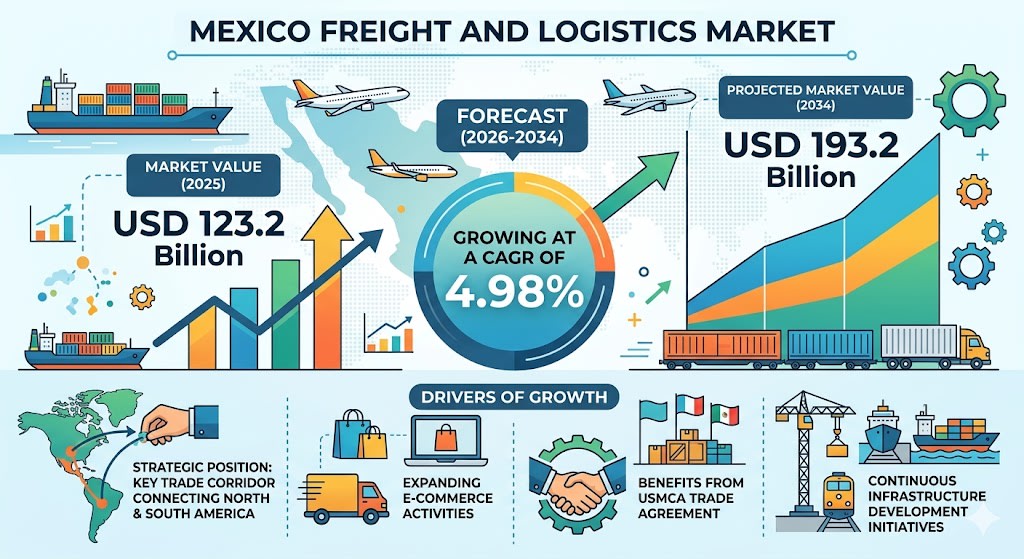
The Mexico freight and logistics market is emerging as a critical backbone of regional trade and supply chain integration, supported by its strategic geographic positioning and strong trade relationships. The market reached a value of USD 123.2 billion in 2025 and is projected to grow to USD 193.2 billion by 2034, expanding at a CAGR of 4.98% during the forecast period. This steady growth reflects the country’s increasing importance as a logistics hub connecting North and South America.
Mexico’s logistics ecosystem benefits significantly from cross-border trade with the United States under the United States-Mexico-Canada Agreement (USMCA). The agreement has streamlined trade flows, reduced tariffs, and enhanced customs efficiency, all of which contribute to higher freight volumes. Additionally, the expansion of e-commerce and manufacturing sectors is creating consistent demand for warehousing, last-mile delivery, and integrated logistics solutions.
Request the Latest Mexico Freight and Logistics Market Report with 2026 Insights
Key Trends Shaping the Mexico Freight and Logistics Market
Several transformative trends are influencing the evolution of the Mexico freight and logistics market. One of the most prominent is the rapid digitalization of logistics operations. Companies are increasingly adopting technologies such as real-time tracking, warehouse automation, and transportation management systems to improve efficiency and visibility across supply chains.
Another key trend is the growing demand for integrated logistics services. Businesses are seeking end-to-end solutions that combine transportation, warehousing, and inventory management under a single provider. This shift is encouraging logistics companies to expand their service portfolios and invest in advanced infrastructure.
Sustainability is also becoming a priority, with companies focusing on reducing carbon emissions through route optimization, fuel-efficient vehicles, and alternative energy solutions. This trend is particularly relevant for multinational corporations operating in Mexico, as they align their logistics strategies with global sustainability goals.
Impact of Nearshoring on Mexico Freight and Logistics Demand
Nearshoring is playing a pivotal role in reshaping Mexico’s freight and logistics landscape. As companies look to reduce supply chain risks and improve operational resilience, many are relocating manufacturing operations closer to the U.S. market. Mexico has emerged as a top destination for nearshoring due to its proximity, skilled workforce, and favorable trade agreements.
This shift is significantly increasing demand for freight transportation, warehousing, and cross-border logistics services. Industrial hubs in northern and central Mexico are witnessing a surge in logistics activity as manufacturers establish new facilities and expand existing operations.
For logistics providers, nearshoring presents opportunities to develop specialized services tailored to the needs of manufacturing clients, including just-in-time delivery, inventory optimization, and cross-border compliance solutions. It also drives the need for enhanced infrastructure and capacity to handle increased cargo volumes efficiently.
Major Growth Drivers in the Mexico Freight and Logistics Market
The growth of the Mexico freight and logistics market is supported by several key drivers. First, the country’s strategic location continues to attract global trade flows, making it a vital link in international supply chains. Its extensive network of ports, highways, and railways enables efficient movement of goods across regions.
Second, the rise of e-commerce is fueling demand for logistics services, particularly in urban areas. Businesses require fast and reliable delivery solutions to meet customer expectations, leading to increased investment in last-mile delivery networks and fulfillment centers.
Third, government initiatives aimed at infrastructure development are enhancing the efficiency of logistics operations. Projects focused on port modernization, rail connectivity, and highway expansion are improving transit times and reducing operational costs.
Lastly, the growing manufacturing sector, particularly in automotive, electronics, and consumer goods, is driving consistent demand for freight and logistics services, creating long-term growth opportunities for industry players.
Challenges in Mexico Freight and Logistics Market
Despite its growth potential, the Mexico freight and logistics market faces several challenges that businesses must navigate. Infrastructure gaps in certain regions can lead to inefficiencies and increased transportation costs, particularly in remote or less-developed areas.
Security concerns, including cargo theft and supply chain disruptions, remain a significant issue for logistics providers. Companies are investing in advanced security measures and risk management strategies to mitigate these challenges.
Regulatory complexities and customs procedures can also create delays in cross-border shipments, impacting overall supply chain performance. While trade agreements like USMCA have improved processes, further optimization is needed to ensure seamless operations.
Additionally, rising fuel costs and labor shortages are putting pressure on profit margins, prompting companies to explore cost optimization strategies and technological solutions to maintain competitiveness.
Investment Opportunities in Mexico Freight and Logistics Industry
The Mexico freight and logistics industry offers a wide range of investment opportunities for B2B stakeholders. The increasing demand for modern warehousing facilities, particularly in key industrial corridors, presents significant potential for real estate developers and logistics companies.
Technology-driven solutions such as automation, artificial intelligence, and data analytics are also attracting investments, as businesses seek to enhance operational efficiency and gain a competitive edge. Companies that invest in digital transformation are better positioned to meet evolving customer demands and optimize supply chain performance.
Another area of opportunity lies in sustainable logistics. Investments in electric vehicles, renewable energy-powered warehouses, and green transportation solutions are gaining traction as companies prioritize environmental responsibility.
Furthermore, the expansion of multimodal transportation networks, combining road, rail, and maritime transport, is creating opportunities for infrastructure development and service innovation.
Competitive Landscape and Key Players
The Mexico freight and logistics market is highly competitive, with a mix of global and regional players offering diverse services. Companies are focusing on strategic partnerships, mergers, and acquisitions to strengthen their market presence and expand their capabilities.
Leading players are investing in advanced technologies, expanding their distribution networks, and enhancing service offerings to meet the evolving needs of B2B clients. The competitive environment is driving innovation and efficiency, benefiting businesses that rely on logistics services for their operations.
In addition, local players are leveraging their regional expertise and cost advantages to compete effectively with international firms. This dynamic landscape creates a healthy level of competition, encouraging continuous improvement and service differentiation across the industry.
About the Creator
Kim Soo hyun
My name is Kim Soo hyun, and I am a research analyst at IMARC Group, specializing in market trends and data analysis to provide insights and support strategic decision-making.
Enjoyed the story? Support the Creator.
Subscribe for free to receive all their stories in your feed.
Comments
There are no comments for this story
Be the first to respond and start the conversation.