
Mexico Fintech Market: Size, Share and Forecast 2026-2034
Mexico fintech market size reached USD 22.5 Billion in 2025. Looking forward, IMARC Group expects the market to reach USD 67.2 Billion by 2034, exhibiting a growth rate (CAGR) of 12.93% during 2026-2034.

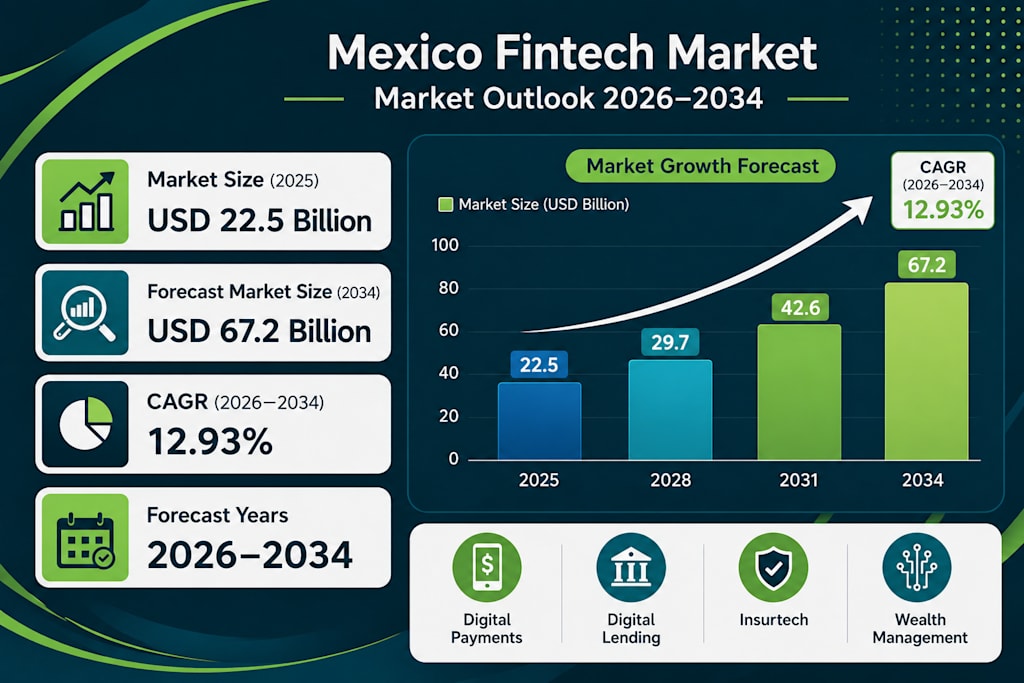
Mexico Fintech Market Size, Growth, and Forecast (2026–2034)
The financial services industry is undergoing a major transformation as digital technologies reshape how individuals and businesses manage money. From mobile banking and digital wallets to online lending platforms and investment applications, fintech solutions are making financial services more accessible and efficient than ever before. In 2026, Mexico continues to emerge as one of Latin America's most dynamic fintech markets.
The Mexico fintech market reached USD 22.5 Billion in 2025 and is projected to grow to USD 67.2 Billion by 2034, exhibiting a compound annual growth rate (CAGR) of 12.93% during 2026–2034. This remarkable growth highlights the increasing adoption of digital financial solutions across consumers, businesses, and institutions.
Fintech, or financial technology, refers to innovative digital solutions that improve financial services, including payments, banking, lending, insurance, wealth management, and financial planning.
Request a Sample Report with Latest 2026 Data & Forecasts:
Key Trends Shaping the Mexico Fintech Market
Several important trends are influencing market development:
• Growing adoption of mobile banking and digital payment platforms
• Rising popularity of digital wallets and contactless transactions
• Increasing use of artificial intelligence in financial services
• Expansion of online lending and alternative financing platforms
• Growing focus on financial inclusion and accessibility
These trends demonstrate how technology is transforming traditional financial systems and consumer behavior.
Major Growth Drivers in the Mexico Fintech Industry
Several factors continue supporting market expansion.
One of the primary growth drivers is the increasing number of tech-savvy individuals across the country. As smartphone usage and internet penetration continue growing, more consumers are embracing digital financial services.
Another important factor is the demand for convenient and accessible financial solutions. Many consumers prefer managing finances through mobile applications instead of visiting physical branches.
The rise of e-commerce and digital commerce is also contributing significantly to fintech adoption. Online transactions require efficient and secure payment systems, creating opportunities for fintech providers.
Small and medium-sized businesses are increasingly using fintech platforms to access financing, payment processing, and financial management tools.
Additionally, growing awareness regarding digital financial services continues encouraging adoption among previously underserved populations.
How Digital Payments Are Transforming Financial Services
Digital payments have become one of the most visible areas of fintech innovation.
Consumers increasingly use mobile wallets, QR-code payments, and online banking platforms to conduct daily transactions.
Businesses benefit from faster payment processing, improved operational efficiency, and enhanced customer experiences.
The growing preference for cashless transactions is helping accelerate the transition toward a more digital economy.
As payment technologies continue evolving, they are expected to play an even greater role in financial inclusion and economic development throughout 2026–2034.
Role of Technology in Fintech Innovation
Technology continues driving fintech growth across multiple segments.
Artificial intelligence helps improve fraud detection, customer support, and financial decision-making.
Machine learning algorithms enable personalized financial recommendations and risk assessments.
Cloud computing allows fintech companies to scale operations efficiently while improving service accessibility.
Blockchain technology is also creating opportunities for secure transactions and innovative financial products.
These advancements are helping create more efficient, transparent, and customer-focused financial ecosystems.
Investment Opportunities in the Mexico Fintech Market
The rapid growth of the market creates numerous opportunities for investors and businesses.
Companies are investing in digital banking platforms, payment technologies, lending solutions, and AI-powered financial tools to strengthen market competitiveness.
There is also increasing interest in financial inclusion initiatives aimed at expanding access to underserved communities.
Investments in cybersecurity, compliance technologies, and digital infrastructure continue supporting market development.
Partnerships between traditional financial institutions and fintech startups are also accelerating innovation.
With strong expansion expected through 2034, the market presents attractive long-term investment opportunities.
Challenges Impacting the Mexico Fintech Industry
Despite positive growth prospects, several challenges remain.
One challenge is cybersecurity risks, as increasing digital transactions require stronger protection against fraud and data breaches.
Another issue is regulatory compliance, which requires fintech companies to adapt to evolving financial regulations.
Digital literacy gaps in certain regions may also affect adoption rates.
Additionally, maintaining customer trust and ensuring data privacy remain critical priorities for industry participants.
Future Outlook (2026–2034)
Looking ahead, the Mexico fintech market is expected to continue its strong growth trajectory.
Between 2026 and 2034, demand for digital payments, mobile banking, online lending, and AI-powered financial services is likely to increase significantly. Consumers and businesses are expected to prioritize convenience, speed, and accessibility when choosing financial solutions.
Future developments may focus on advanced automation, personalized financial services, embedded finance, and greater integration between fintech platforms and traditional banking systems.
The continued expansion of digital connectivity and increasing financial awareness are also expected to support market growth.
Overall, the market appears positioned for sustained development driven by technological innovation, financial inclusion, and changing consumer expectations.
Conclusion
The Mexico fintech market is rapidly transforming the way individuals and businesses access financial services. Supported by growing digital adoption, increasing smartphone usage, and rising demand for convenient financial solutions, the market is expected to experience substantial growth during 2026–2034.
Although challenges such as cybersecurity concerns and regulatory requirements remain, ongoing innovation and investment are likely to support long-term development. As technology continues reshaping financial services, fintech will play an increasingly important role in Mexico's economic and digital future.
About the Creator
Jackson Watson
I'm a market research analyst at Imarc group company delivering data-driven insights, industry analysis, and customized research solutions. We support businesses with market sizing, competitive analysis, and strategic decision-making.
Enjoyed the story? Support the Creator.
Subscribe for free to receive all their stories in your feed.
Comments
There are no comments for this story
Be the first to respond and start the conversation.