
Mexico Electric Truck Market Size Growth & Industry Trends Forecast to 2034
Mexico Electric Truck Market Size Trends, Growth Demand & Forecast 2026-2034

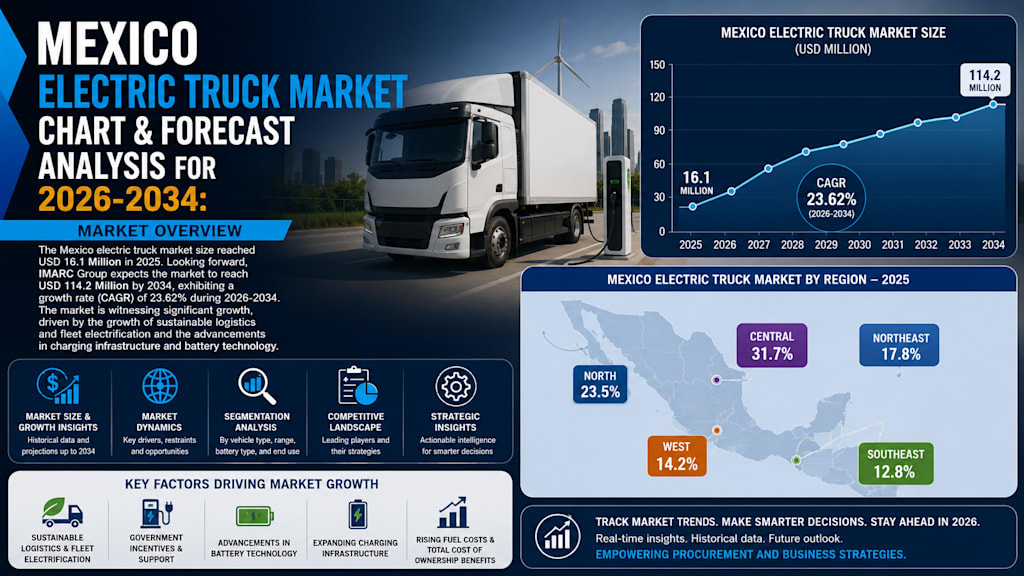
Mexico Electric Truck Market Size Growth And Industry Outlook 2026-2034
The conversation around electric trucks in Mexico is no longer limited to sustainability goals or pilot projects. It is increasingly becoming a business discussion about fleet costs, delivery efficiency, urban transport, and long-term logistics planning. For transport companies, manufacturers, retailers, and third-party logistics providers, electric trucks are starting to move from a future concept to a practical area of investment.
According to IMARC Group, the Mexico electric truck market size reached USD 16.1 million in 2025 and is expected to reach USD 114.2 million by 2034, growing at a CAGR of 23.62% during 2026–2034. That is a strong growth pace for a market that is still in the early stage of adoption. More importantly, it shows that commercial vehicle electrification is beginning to gain business relevance in Mexico, especially as fleet operators look for ways to lower fuel costs, improve environmental performance, and prepare for changing transport requirements.
Why the Mexico Electric Truck Market Is Gaining Momentum in 2026
The growing interest in electric trucks is closely tied to how commercial transportation is changing in Mexico. Logistics companies are facing rising expectations from customers who want faster delivery, better service reliability, and lower environmental impact. Retailers and manufacturers are also putting more pressure on supply chain partners to modernize their transport operations. As a result, fleet decisions are no longer based only on vehicle purchase price. Companies are paying more attention to lifetime operating cost, route efficiency, fuel exposure, and long-term compliance with sustainability targets.
Electric trucks are gaining momentum because they offer a different operating model. They reduce dependence on diesel, can lower maintenance requirements, and fit well into delivery routes where vehicles return to a central depot. That makes them especially relevant for last-mile delivery, short-distance urban freight, municipal transport, and controlled distribution routes. Businesses in these areas are beginning to see electric trucks as a practical way to improve efficiency while also responding to environmental expectations from clients and regulators.
Another reason for the growing momentum is that the supporting ecosystem is improving. Vehicle manufacturers are expanding electric commercial vehicle offerings, battery technology is becoming more capable, and charging infrastructure is slowly moving from concept to deployment. This does not mean adoption barriers have disappeared, but it does mean that fleet operators now have a more realistic basis for evaluating electric trucks as part of future procurement planning.
Key Trends Reshaping the Mexico Electric Truck Market 2026
One of the most important changes in the market is the growing focus on fleet electrification in urban delivery networks. Companies involved in parcel delivery, food distribution, consumer goods supply, and city-based freight movement are among the first to test electric trucks because their routes are shorter and easier to manage. In these settings, the ability to charge vehicles at a depot overnight makes electrification more practical than it might be for long-haul transport.
A second trend is the shift in how businesses evaluate commercial vehicles. Instead of focusing only on upfront cost, fleet operators are increasingly looking at total cost of ownership. That includes fuel savings, maintenance patterns, downtime, charging costs, and expected vehicle life. This is an important shift because electric trucks still carry a higher purchase price, but they may offer a better cost structure over time when used in the right operating conditions.
Technology is also shaping the direction of the industry. Better battery performance, longer driving range, improved telematics, and fleet monitoring tools are making electric trucks more attractive for commercial use. Operators want visibility into energy use, charging schedules, route efficiency, and maintenance needs. As a result, the electric truck discussion is expanding beyond vehicles alone and into software, fleet management, and infrastructure planning.
Mexico Electric Truck Market: Growth Drivers, Trends, and Future Outlook
The long-term outlook for the market is being shaped by a mix of business pressure and technology progress. One of the clearest drivers is the rise of sustainable logistics strategies. Large companies are setting emissions targets across their supply chains, and transportation is one of the most visible areas where those targets can be addressed. Electric trucks offer a practical option for reducing emissions in delivery fleets, especially when vehicles operate within defined local or regional routes.
Another growth driver is the expansion of e-commerce and organized retail distribution. As online orders increase, businesses need delivery systems that are efficient, reliable, and scalable. This is creating more interest in electric trucks for last-mile and intra-city transport, where stop-and-go driving patterns can work well with electric vehicle performance.
Mexico’s position as a manufacturing and logistics hub also supports the long-term opportunity. The country plays a key role in regional trade and supply chain activity, which means transport modernization has wider strategic importance. As more manufacturers, warehouse operators, and distribution companies review their transport footprint, electric commercial vehicles are likely to become a bigger part of future fleet planning.
The future outlook will still depend on infrastructure readiness, financing availability, and the speed at which fleet operators gain confidence in the technology. But the direction of travel is clear: electric trucks are becoming part of mainstream transport planning rather than remaining a niche sustainability experiment.
What Is Powering the Growth of the Mexico Electric Truck Market?
At the center of this market is the search for better fleet economics. Diesel prices, maintenance costs, and the pressure to improve operating efficiency are pushing transport businesses to look at alternatives. Electric trucks are not the right solution for every use case, but they are becoming more relevant in operations where mileage is predictable and charging can be planned.
Battery and charging improvements are also making the business case stronger. Range limitations are still a concern in some applications, but vehicle capabilities are improving. For operators with local delivery routes, warehouse-to-store transport, or municipal service fleets, these improvements can make the difference between a pilot program and a real commercial rollout.
There is also a reputational and customer-facing element to adoption. Large shippers, retailers, and consumer brands increasingly want logistics partners that can support sustainability targets. That creates an incentive for transport providers to invest in cleaner fleets, not only to reduce emissions but also to stay competitive in contract discussions with major commercial clients.
Mexico Electric Truck Market Size, Demand, and Opportunity Analysis
From a business perspective, the opportunity is wider than truck sales alone. Vehicle manufacturers can benefit from rising demand for electric commercial vehicles suited to local operating conditions. But the market also creates room for battery suppliers, charging equipment providers, fleet software companies, maintenance specialists, and logistics technology firms.
Charging infrastructure is one of the clearest areas of opportunity. Depot charging, warehouse charging, and commercial fleet energy management will all become more important if electric truck adoption accelerates. This creates potential for infrastructure developers, utilities, and service providers that can support fleet charging at scale.
Fleet advisory and financing services may also become more relevant. Many businesses are interested in electrification but need support in route planning, vehicle selection, charging strategy, and cost analysis before making a large capital commitment. Companies that can help transport operators manage that transition will be in a stronger position as adoption grows.
Overall, the Mexico electric truck market is still developing, but it is already attracting attention from businesses that see transportation as both a cost center and a strategic differentiator. For B2B players across logistics, vehicle manufacturing, charging infrastructure, and fleet services, the market represents a growing commercial opportunity tied to cleaner mobility, smarter delivery systems, and long-term operational efficiency.
About the Creator
Kim Soo hyun
My name is Kim Soo hyun, and I am a research analyst at IMARC Group, specializing in market trends and data analysis to provide insights and support strategic decision-making.
Enjoyed the story? Support the Creator.
Subscribe for free to receive all their stories in your feed.
Comments
There are no comments for this story
Be the first to respond and start the conversation.