
Mexico E-KYC Market Size Growth Share Trends Demand & Forecast 2034
The Mexico e-KYC market reached USD 14.2 million in 2025 and is projected to grow to USD 57.9 million by 2034, at a CAGR of 16.36%.

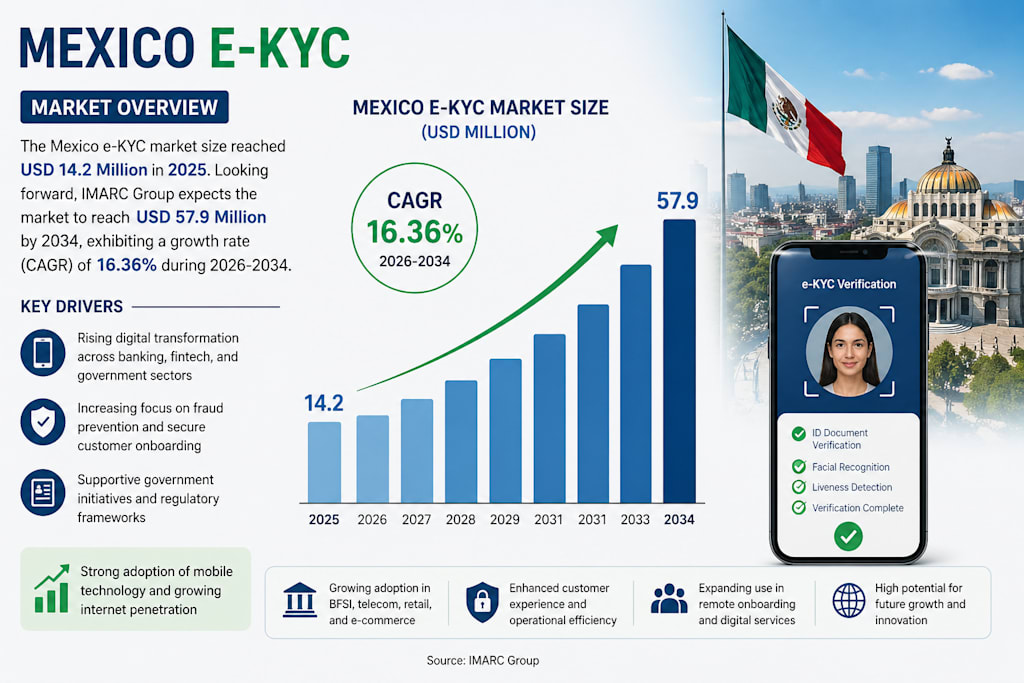
Mexico E-KYC Market Size, Share, and Growth Forecast (2026–2034)
The Mexico e-KYC market is moving into a high-growth phase as financial institutions and digital platforms prioritize secure and scalable onboarding processes. The market reached USD 14.2 million in 2025 and is projected to grow to USD 57.9 million by 2034, at a CAGR of 16.36%.
This expansion is closely linked to rising digital adoption across banking, payments, and telecom services. As more users shift toward mobile-first financial services, the need for remote identity verification is increasing. For businesses, e-KYC is no longer just a compliance requirement—it is becoming a core operational capability that supports faster onboarding, reduced fraud risk, and improved customer experience.
Request a Sample Report with Latest 2026 Data & Forecasts:
Adoption Trends Driving the Mexico E-KYC Market Across Banking and Fintech
Adoption of e-KYC solutions in Mexico is being driven by both traditional banks and fintech companies. Financial institutions are investing in digital onboarding systems to reduce processing time and improve customer acquisition efficiency. At the same time, fintech firms are leveraging e-KYC to scale operations quickly without relying on physical verification processes.
The growth of mobile wallets and digital banking platforms is further accelerating demand. Consumers expect seamless account opening experiences, often completed within minutes. This shift is pushing organizations to adopt automated verification systems that can handle large volumes without compromising accuracy.
Government initiatives supporting financial inclusion are also playing a role, particularly in expanding access to banking services in underserved and rural areas.
Key Use Cases of E-KYC in Mexico: Banking, Payments, Telecom, and Digital Platforms
E-KYC is being applied across multiple sectors, each with distinct operational needs. In banking, it enables faster account opening and compliance with regulatory requirements. Financial institutions are using digital verification tools to onboard customers remotely while maintaining security standards.
In the payments sector, e-KYC supports user verification for mobile wallets and digital transactions. This is critical for preventing fraud and ensuring compliance with anti-money laundering guidelines.
Telecom companies are also adopting e-KYC for SIM registration and customer verification, improving efficiency and reducing manual processes. Additionally, digital platforms such as e-commerce and online service providers are using e-KYC to verify user identities and build trust in their ecosystems.
Regulatory Framework and Compliance Requirements in the Mexico E-KYC Market
Regulation is a key factor shaping the e-KYC market in Mexico. Financial authorities have introduced frameworks that encourage digital onboarding while maintaining strict compliance standards. These regulations are designed to balance innovation with security, ensuring that customer data is protected and fraud risks are minimized.
For businesses, navigating compliance requirements is essential. Companies must ensure that their e-KYC systems align with local regulations related to data protection, identity verification, and financial transactions. This often requires continuous updates to systems and processes as regulatory guidelines evolve.
Compliance is not just a legal requirement—it also builds trust with customers and partners, making it a critical component of long-term growth.
Technology Trends in Mexico E-KYC: AI, Biometrics, and Digital Identity Verification
Technology is at the center of e-KYC adoption. Artificial intelligence is being used to automate identity verification processes, analyze documents, and detect anomalies in real time. This reduces manual effort and improves accuracy.
Biometric technologies, including facial recognition and fingerprint verification, are becoming standard features in e-KYC systems. These tools enhance security while enabling faster onboarding.
Document scanning and optical character recognition (OCR) technologies are also improving the efficiency of data extraction and verification. Combined with AI, these tools enable end-to-end digital onboarding processes that are both reliable and scalable.
Challenges in E-KYC Implementation: Data Security, Fraud Prevention, and Integration
Despite strong growth, e-KYC implementation comes with challenges. Data security remains a top concern, as companies handle sensitive personal information. Ensuring secure storage and transmission of data is critical to maintaining user trust.
Fraud prevention is another key challenge. As digital systems expand, fraud tactics are becoming more sophisticated. Businesses must continuously update their verification systems to detect and prevent new types of fraud.
Integration with existing systems can also be complex. Many organizations operate with legacy infrastructure, making it difficult to implement new technologies without significant investment. Addressing these challenges requires a combination of technology upgrades and strategic planning.
Investment Opportunities in the Mexico E-KYC Market for Fintech and RegTech Providers
The Mexico e-KYC market offers strong opportunities for fintech and regtech companies. As demand for digital onboarding grows, businesses are looking for solutions that are scalable, secure, and easy to integrate.
Opportunities exist in developing AI-driven verification tools, biometric solutions, and cloud-based platforms that can support high transaction volumes. Companies that offer flexible solutions tailored to different industries are likely to see increased demand.
Partnerships are also becoming a key growth strategy. Collaboration between technology providers, financial institutions, and telecom companies is enabling faster adoption and innovation.
As the market continues to expand, organizations that focus on reliability, compliance, and user experience will be better positioned to capture long-term value in Mexico’s evolving digital ecosystem.
About the Creator
Kim Soo hyun
My name is Kim Soo hyun, and I am a research analyst at IMARC Group, specializing in market trends and data analysis to provide insights and support strategic decision-making.
Enjoyed the story? Support the Creator.
Subscribe for free to receive all their stories in your feed.
Comments
There are no comments for this story
Be the first to respond and start the conversation.