
Mexico B2B E-Commerce Market Size, Share and Industry Report 2034
The Mexico B2B e-commerce market size reached USD 16.6 Billion in 2025. Looking forward, IMARC Group expects the market to reach USD 133.0 Billion by 2034, exhibiting a growth rate (CAGR) of 26.00% during 2026-2034.

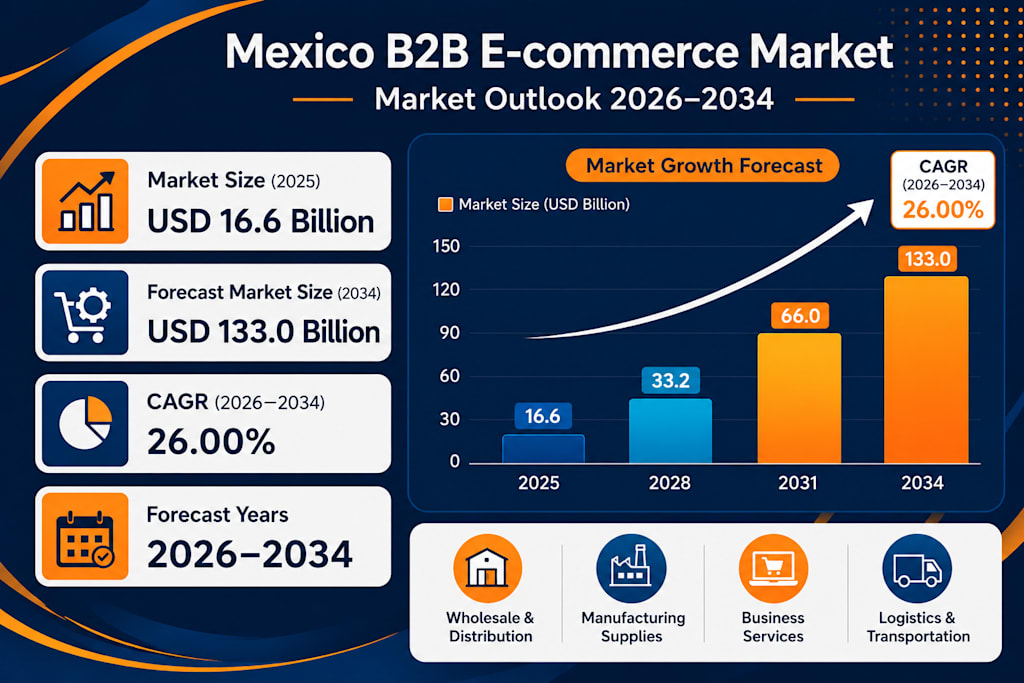
Mexico B2B E-Commerce Market Size, Growth, and Forecast (2026–2034)
The way businesses buy and sell products is changing rapidly. Traditional procurement methods that relied on lengthy negotiations, paperwork, and manual processes are increasingly being replaced by digital platforms that offer speed, transparency, and efficiency. In 2026, Mexico's business-to-business (B2B) e-commerce sector is emerging as one of the most dynamic areas of the country's digital economy.
The Mexico B2B e-commerce market reached USD 16.6 Billion in 2025 and is projected to grow significantly to USD 133.0 Billion by 2034, exhibiting a remarkable compound annual growth rate (CAGR) of 26.00% during 2026–2034. This rapid expansion reflects the growing adoption of digital technologies by businesses across multiple industries.
B2B e-commerce refers to online transactions conducted between businesses, including manufacturers, wholesalers, distributors, and retailers. These platforms simplify procurement, inventory management, supplier interactions, and purchasing processes.
Request a Sample Report with Latest 2026 Data & Forecasts:
Key Trends Shaping the Mexico B2B E-Commerce Market
Several important trends are influencing market development:
• Growing adoption of digital procurement platforms
• Rising demand for automated supply chain management solutions
• Increasing use of cloud-based business applications
• Expansion of cross-border digital trade and international marketplaces
• Growing integration of mobile commerce in business operations
These trends highlight the ongoing digital transformation occurring across Mexico's commercial sector.
Major Growth Drivers in the Mexico B2B E-Commerce Industry
Several factors continue supporting market expansion.
One of the primary growth drivers is the increasing internet penetration and digital adoption among businesses. Companies are becoming more comfortable using digital platforms to manage purchasing activities and supplier relationships.
Another important factor is the growing need for efficient supply chain management. Businesses seek solutions that reduce procurement costs, improve transparency, and streamline operations.
The expansion of cross-border trade is also contributing significantly to growth. Digital platforms make it easier for Mexican businesses to connect with international suppliers and customers, creating new commercial opportunities.
Additionally, the increasing adoption of mobile technologies allows decision-makers to manage transactions and business activities from virtually anywhere.
The growing importance of operational efficiency and cost optimization further encourages organizations to invest in digital commerce solutions.
How Digital Transformation Is Reshaping Business Commerce
Digital transformation has become a strategic priority for organizations across industries.
Businesses increasingly rely on online platforms to automate procurement processes, compare suppliers, and manage inventory more effectively.
Cloud-based solutions provide real-time access to purchasing data, helping companies make faster and more informed decisions.
Digital commerce platforms also improve communication between buyers and suppliers, reducing delays and increasing transparency.
These improvements are helping businesses remain competitive in a rapidly evolving marketplace.
Role of Technology in B2B E-Commerce Growth
Technology continues driving innovation throughout the B2B e-commerce ecosystem.
Artificial intelligence is helping businesses optimize purchasing decisions and forecast demand more accurately.
Data analytics provides valuable insights into customer behavior, supplier performance, and market trends.
Cloud computing allows businesses to scale operations while improving flexibility and accessibility.
Automation tools reduce administrative workloads and improve transaction efficiency.
These technological advancements continue strengthening the value proposition of digital commerce platforms.
Investment Opportunities in the Mexico B2B E-Commerce Market
The rapid growth of the market presents numerous opportunities for investors and businesses.
Companies are investing in digital marketplaces, supply chain technologies, cloud infrastructure, and business automation platforms to strengthen market competitiveness.
There is also increasing interest in logistics solutions that support efficient order fulfillment and inventory management.
Investments in cybersecurity and digital payment technologies continue supporting market development.
Partnerships between technology providers and commercial enterprises are also accelerating innovation.
With substantial growth expected through 2034, the market offers attractive long-term opportunities.
Challenges Impacting the Mexico B2B E-Commerce Industry
Despite strong growth prospects, several challenges remain.
One challenge is cybersecurity concerns, as businesses increasingly rely on digital systems to conduct transactions and manage sensitive information.
Another issue is technology integration, particularly for organizations transitioning from traditional procurement systems.
Digital skills gaps within certain sectors may also affect adoption rates.
Additionally, maintaining regulatory compliance and data security remains an important consideration for businesses operating online.
Future Outlook (2026–2034)
Looking ahead, the Mexico B2B e-commerce market is expected to maintain its impressive growth trajectory.
Between 2026 and 2034, demand for digital procurement platforms, automated business solutions, and cloud-based commerce systems is likely to increase significantly. Companies are expected to prioritize technologies that improve efficiency, reduce costs, and enhance supply chain visibility.
Future developments may focus on artificial intelligence, predictive analytics, digital payments, and greater integration of business systems.
The continued growth of international trade and digital business ecosystems is also expected to support market expansion.
Overall, the market appears positioned for sustained development driven by digital transformation, technological innovation, and evolving business requirements.
Conclusion
The Mexico B2B e-commerce market is experiencing remarkable growth as businesses increasingly embrace digital technologies to improve procurement, supply chain management, and commercial operations. Supported by rising internet adoption, expanding cross-border trade, and ongoing technological innovation, the market is expected to experience substantial expansion during 2026–2034.
Although challenges such as cybersecurity and technology integration remain, continued investment in digital infrastructure and business automation is likely to support long-term development. As organizations continue modernizing their operations, B2B e-commerce will play an increasingly important role in Mexico's digital economy.
About the Creator
Jackson Watson
I'm a market research analyst at Imarc group company delivering data-driven insights, industry analysis, and customized research solutions. We support businesses with market sizing, competitive analysis, and strategic decision-making.
Enjoyed the story? Support the Creator.
Subscribe for free to receive all their stories in your feed.
Comments
There are no comments for this story
Be the first to respond and start the conversation.