
Medical Ceramics Market Outlook 2026–2034: How Advanced Biomaterials Are Transforming Modern Healthcare
Growing demand for orthopedic implants, dental restorations, and regenerative medicine solutions is accelerating the adoption of advanced medical ceramics across global healthcare systems.

Modern healthcare continues to evolve through innovations that improve patient outcomes, enhance surgical precision, and extend the lifespan of medical implants. Among the many materials driving this transformation, medical ceramics have emerged as one of the most important biomaterial categories in contemporary medicine.
From hip replacements and dental crowns to bone graft substitutes and regenerative medicine applications, medical ceramics play a critical role in restoring function, improving quality of life, and supporting long-term patient health. Their exceptional biocompatibility, durability, corrosion resistance, and ability to integrate with human tissue have made them indispensable in numerous medical specialties.
As populations age and demand for advanced healthcare solutions continues to rise, medical ceramics are becoming increasingly important across orthopedic, dental, cardiovascular, and regenerative medicine applications.
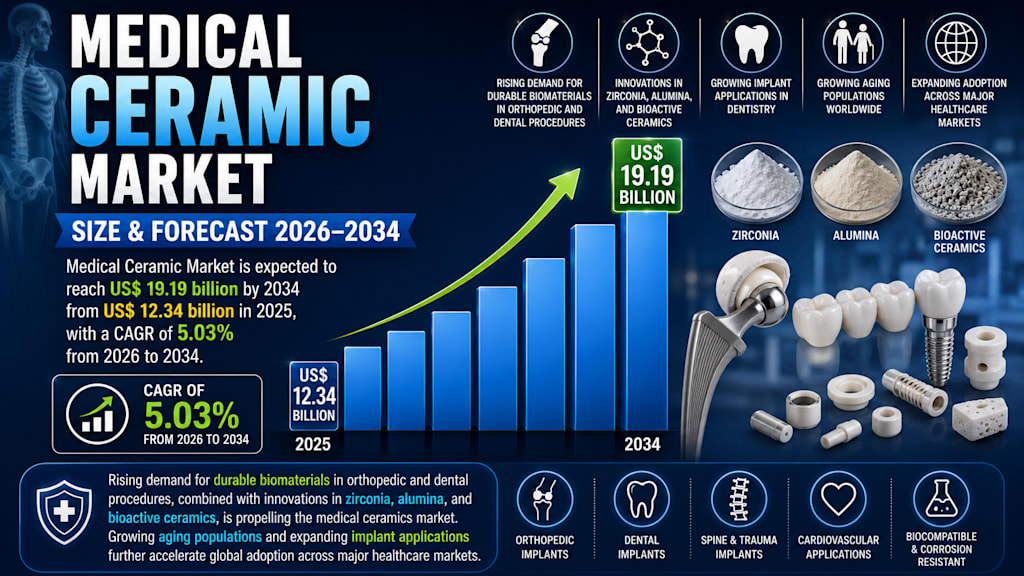
According to Renub Research, the global Medical Ceramics Market is expected to grow from US$ 12.34 billion in 2025 to US$ 19.19 billion by 2034, expanding at a compound annual growth rate (CAGR) of 5.03% from 2026 to 2034. Rising demand for durable biomaterials, continuous innovation in zirconia and alumina technologies, and expanding applications in implantable medical devices are among the key factors driving market growth.
As healthcare providers increasingly seek long-lasting, high-performance materials that support patient recovery and long-term treatment success, medical ceramics are positioned to remain a cornerstone of modern biomedical innovation.
Understanding the Role of Medical Ceramics in Healthcare
Medical ceramics are highly specialized biomaterials engineered specifically for healthcare applications. Unlike conventional ceramics used in industrial or consumer products, medical ceramics are designed to function safely within the human body while maintaining exceptional mechanical performance and biological compatibility.
These materials are generally categorized into bioinert ceramics, bioactive ceramics, biodegradable ceramics, and piezoelectric ceramics. Each category serves distinct clinical purposes depending on the medical application.
Bioinert ceramics are valued for their stability and resistance to biological reactions, making them suitable for long-term implants. Bioactive ceramics actively interact with surrounding tissues and promote healing, while biodegradable ceramics gradually dissolve as natural tissue regenerates.
Medical ceramics are commonly used in orthopedic implants, dental restorations, prosthetic devices, bone graft substitutes, pacemaker components, and various surgical instruments. Their resistance to corrosion and wear makes them particularly valuable for applications requiring long-term implantation.
Over the years, advances in ceramic engineering have significantly improved strength, durability, and aesthetic qualities, expanding their use across an increasingly broad range of medical applications.
Rising Demand for Orthopedic Implants Is Driving Market Growth
One of the strongest growth drivers within the medical ceramics market is the increasing demand for orthopedic implants.
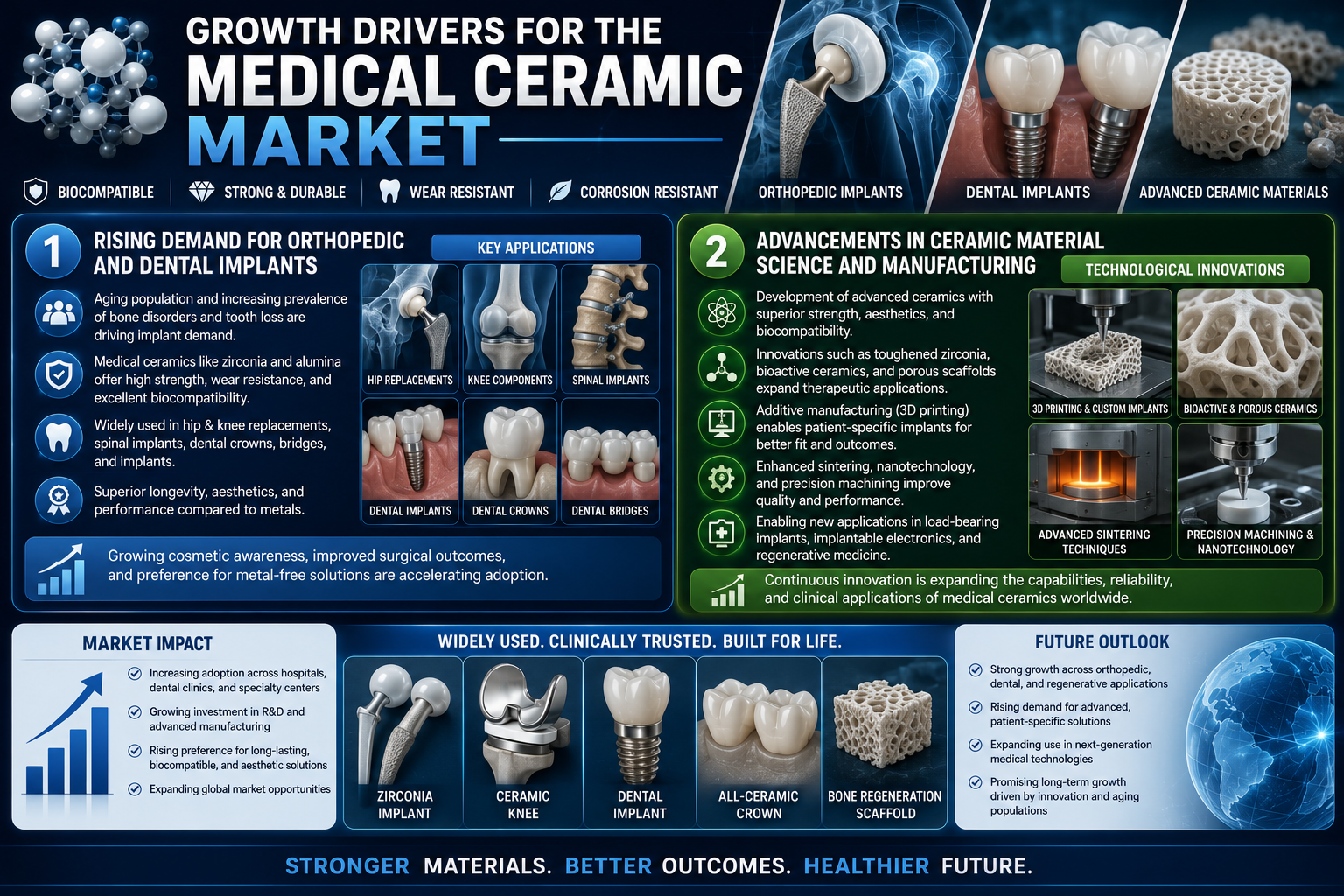
Aging populations around the world are experiencing higher rates of osteoarthritis, osteoporosis, bone degeneration, and joint-related disorders. These conditions frequently require surgical intervention involving hip replacements, knee replacements, spinal implants, and other orthopedic procedures.
Medical ceramics such as zirconia and alumina have become preferred materials for many orthopedic applications because they offer exceptional strength, wear resistance, and biological compatibility.
Unlike certain metal-based implants, ceramic components generate minimal wear particles and demonstrate excellent long-term performance. These characteristics contribute to improved implant longevity and reduced complication rates.
Advancements in surgical techniques have also increased the success rates of orthopedic procedures, encouraging greater adoption of ceramic-based implant solutions.
As life expectancy continues increasing globally, demand for joint replacement surgeries and related orthopedic interventions is expected to remain a major driver of market expansion.
The Growing Popularity of Ceramic-Based Dental Solutions
Dental applications represent another major contributor to the growth of the medical ceramics industry.
Patients increasingly seek dental restorations that combine durability with natural aesthetics. Ceramic materials have become particularly popular because they closely resemble natural tooth structures while offering excellent strength and biocompatibility.
Zirconia-based crowns, bridges, veneers, and dental implants are now widely used in restorative and cosmetic dentistry. These materials provide highly attractive results while maintaining long-term functionality and resistance to wear.
Growing awareness of oral health and increasing demand for cosmetic dental procedures continue driving adoption worldwide. Patients are placing greater emphasis on both appearance and functionality, encouraging dentists to recommend ceramic-based treatment options.
The expansion of digital dentistry, including computer-aided design and manufacturing technologies, has further improved the precision and customization of ceramic dental restorations.
As aesthetic dentistry continues growing in popularity, demand for advanced ceramic solutions is expected to remain strong throughout the forecast period.
Advances in Material Science Are Expanding Applications
Technological innovation has played a crucial role in advancing the medical ceramics market.
Researchers and manufacturers continue developing new ceramic formulations with enhanced mechanical properties, improved biological performance, and expanded clinical utility. Innovations in zirconia, alumina, bioactive glass, and composite ceramics are creating new possibilities across multiple healthcare disciplines.
Toughened zirconia materials provide greater fracture resistance while maintaining aesthetic qualities, making them highly suitable for both orthopedic and dental applications.
Bioactive ceramics such as hydroxyapatite and bioactive glass actively promote bone growth and tissue integration, helping improve healing outcomes following surgery or injury.
Nanotechnology is also contributing to material improvements by enabling greater control over surface characteristics and biological interactions.
These advancements continue expanding the role of medical ceramics in increasingly sophisticated healthcare applications.
Regenerative Medicine Is Creating New Opportunities
Regenerative medicine represents one of the most exciting growth areas for medical ceramics.
Rather than simply replacing damaged tissues, regenerative medicine seeks to stimulate the body's natural healing processes and restore biological function. Medical ceramics play a critical role within this emerging field due to their ability to support tissue regeneration and cellular growth.
Bioactive ceramic materials are widely used in bone graft substitutes, tissue-engineering scaffolds, and regenerative implants. These materials encourage osteoconduction and osteointegration, allowing new bone tissue to develop and integrate naturally with implanted structures.
Growing rates of trauma injuries, sports injuries, osteoporosis, and degenerative conditions have increased demand for advanced regenerative solutions.
Researchers are also exploring combinations of ceramics, stem-cell therapies, biologics, and advanced scaffold technologies to develop next-generation treatment approaches.
As regenerative medicine continues advancing, medical ceramics are expected to become increasingly important components of innovative healthcare therapies.
The Impact of 3D Printing and Personalized Medicine
Additive manufacturing technologies are transforming the production of medical ceramic devices.
Three-dimensional printing enables manufacturers to create patient-specific implants tailored precisely to individual anatomical requirements. This level of customization improves implant fit, functionality, and clinical outcomes.
Medical professionals increasingly recognize the value of personalized healthcare solutions that address unique patient needs. Ceramic 3D printing supports this trend by enabling highly customized designs that would be difficult or impossible to produce using traditional manufacturing methods.
Advancements in precision machining, sintering technologies, and digital design software have further improved the quality and reliability of ceramic products.
As personalized medicine continues expanding across healthcare systems worldwide, additive manufacturing is expected to become an increasingly important driver of innovation within the medical ceramics industry.
Challenges Facing the Medical Ceramics Market
Despite strong growth potential, several challenges continue affecting the industry.
One of the most significant obstacles is the high cost associated with manufacturing advanced ceramic materials. Production requires specialized equipment, high-temperature processing, strict quality-control procedures, and highly skilled personnel.
These factors contribute to elevated product costs that can limit adoption in price-sensitive healthcare environments and developing economies.
Smaller healthcare facilities may find it difficult to justify investments in premium ceramic-based solutions when lower-cost alternatives are available.
The expense of research, development, and regulatory compliance further adds to overall industry costs and can slow product commercialization efforts.
Brittleness Remains an Engineering Challenge
While medical ceramics offer exceptional strength and wear resistance, brittleness remains a technical limitation.
Unlike metals, ceramics can be susceptible to fracture when exposed to excessive stress, impact forces, or improper placement. This concern is particularly relevant for load-bearing orthopedic applications where mechanical reliability is critical.
Although advances in material science have significantly improved toughness and fracture resistance, manufacturers continue working to overcome these challenges through new formulations and design approaches.
Ensuring long-term durability remains essential for maintaining confidence among surgeons, healthcare providers, and patients.
Continued research and engineering improvements are expected to further enhance ceramic performance and reduce concerns related to brittleness.
Regional Market Insights
The United States remains one of the largest markets for medical ceramics due to high healthcare spending, advanced surgical capabilities, and strong demand for orthopedic and dental implants. The country's well-established medical device industry and extensive research infrastructure continue supporting innovation and adoption of ceramic-based technologies.
Germany plays a leading role within Europe thanks to its engineering expertise, advanced healthcare system, and commitment to biomaterials research. The country's aging population and strong medical technology sector continue driving demand for high-performance ceramic implants and regenerative medicine solutions.
China is rapidly emerging as a major market supported by healthcare modernization, urbanization, and growing demand for orthopedic and dental procedures. Significant investments in biomaterials research and manufacturing capabilities continue strengthening the country's position within the global industry.
Saudi Arabia is experiencing increasing adoption of advanced medical technologies as part of broader healthcare transformation initiatives. Rising rates of orthopedic conditions, dental disorders, and trauma injuries are creating growing demand for ceramic-based healthcare solutions throughout the region.
Recent Industry Developments
The medical ceramics industry continues to experience significant innovation and investment.
In October 2024, KYOCERA Fineceramics Medical GmbH announced plans to establish a new production facility in Stuttgart, Germany. The facility is designed to meet growing global demand for medical-grade ceramics used in orthopedic implants and other implantable medical devices. Operations are expected to focus heavily on ceramic ball heads for hip prostheses and related applications.
In September 2024, Austrian 3D-printing specialist Lithoz introduced the CeraFab System S320, an advanced ceramic 3D printer capable of producing mid-sized medical implants and industrial components. This development highlights the growing importance of additive manufacturing within the medical ceramics sector and demonstrates ongoing innovation in personalized healthcare technologies.
Market Segmentation and Competitive Landscape
The medical ceramics market includes several material categories, including bioinert, bioactive, bioresorbable, and piezoelectric ceramics. These materials serve diverse applications ranging from surgical instruments and plastic surgery procedures to orthopedic and dental treatments.
Orthopedic applications remain among the largest segments due to growing demand for joint replacement procedures and bone repair solutions. Dental applications continue expanding as cosmetic dentistry and implant adoption increase worldwide.
Leading companies operating within the global medical ceramics industry include CeramTec GmbH, Kyocera Corporation, Morgan Advanced Materials, 3M, DSM, NGK Spark Plug Co., Ltd., DePuy Synthes, Zimmer Biomet Holding, Straumann, and BioMérieux. These organizations continue investing in research, advanced manufacturing technologies, and innovative biomaterial solutions to strengthen their competitive positions and expand market opportunities.
Final Thoughts
Medical ceramics have become essential components of modern healthcare, supporting advancements in orthopedics, dentistry, regenerative medicine, and implantable medical devices. Their unique combination of durability, biocompatibility, and long-term performance makes them invaluable for restoring function and improving patient outcomes.
As healthcare systems increasingly prioritize personalized treatments, advanced biomaterials, and regenerative therapies, demand for medical ceramics is expected to continue rising. Innovations in material science, additive manufacturing, and tissue engineering are creating new opportunities that extend far beyond traditional implant applications.
With the global market projected to grow from US$ 12.34 billion in 2025 to US$ 19.19 billion by 2034, medical ceramics are poised to remain at the forefront of healthcare innovation and play a critical role in shaping the future of restorative and regenerative medicine.
About the Creator
Enjoyed the story? Support the Creator.
Subscribe for free to receive all their stories in your feed.
Comments
There are no comments for this story
Be the first to respond and start the conversation.