
Maritime Patrol Aircraft Market Set for Takeoff as Global Naval Security Priorities Intensify
Rising geopolitical tensions, technological innovation, and naval modernization programs are fueling unprecedented demand for advanced maritime surveillance aircraft worldwide.

n an era where maritime security has become a strategic priority for nations around the world, the demand for Maritime Patrol Aircraft (MPAs) is rising at a remarkable pace. From monitoring contested sea routes to tracking submarines and combating illegal maritime activities, these sophisticated aircraft are becoming an indispensable component of modern defense infrastructure.
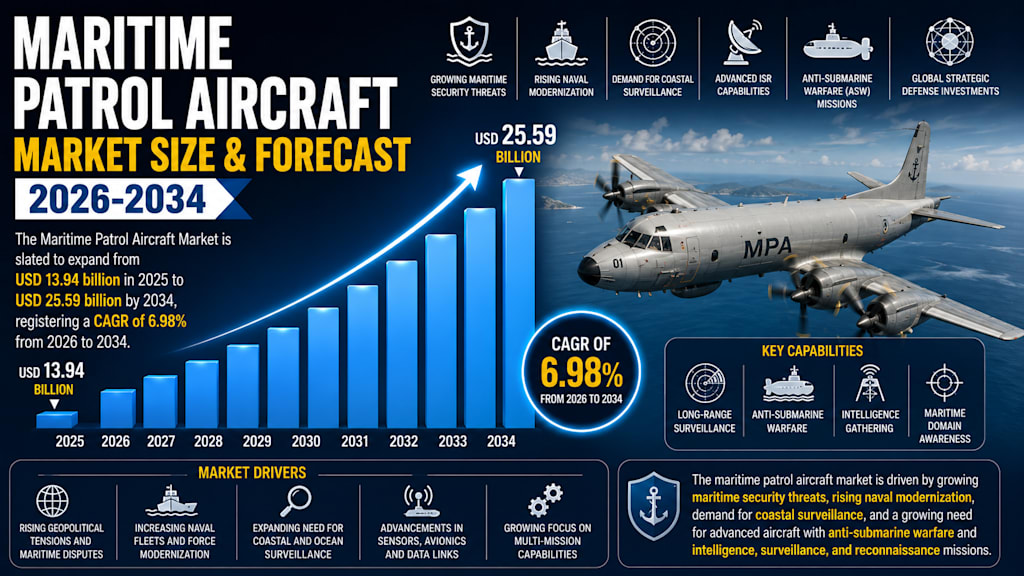
According to Renub Research, the global Maritime Patrol Aircraft Market is expected to grow from USD 13.94 billion in 2025 to USD 25.59 billion by 2034, expanding at a compound annual growth rate (CAGR) of 6.98% between 2026 and 2034. The growth is being driven by increasing maritime security threats, large-scale naval modernization initiatives, advancements in surveillance technology, and the need for enhanced intelligence, surveillance, and reconnaissance capabilities.
As oceans become increasingly important for trade, energy transportation, and national security, maritime patrol aircraft are emerging as critical tools for protecting national interests.
Why Maritime Patrol Aircraft Matter More Than Ever
Nearly 90% of global trade is transported by sea. This enormous dependence on maritime routes makes oceans vital economic lifelines for nations worldwide. However, growing geopolitical tensions, territorial disputes, piracy, illegal fishing, smuggling operations, and submarine activities have significantly increased security concerns across international waters.
Maritime Patrol Aircraft are designed specifically to address these challenges.
Unlike conventional military aircraft, MPAs can remain airborne for extended periods while monitoring vast oceanic regions. They are equipped with advanced radar systems, electro-optical sensors, infrared imaging technology, sonobuoys, communication networks, and magnetic anomaly detection systems that enable them to identify and track surface vessels as well as underwater threats.
Modern MPAs serve multiple purposes, including:
- Maritime surveillance
- Anti-submarine warfare (ASW)
- Anti-surface warfare (ASuW)
- Search and rescue missions
- Intelligence gathering
- Reconnaissance operations
- Border protection
- Environmental monitoring
Because a single platform can perform numerous critical missions, governments increasingly view MPAs as cost-effective force multipliers.
Maritime Security Threats Are Driving Market Growth
One of the most significant factors supporting market expansion is the rising complexity of maritime security threats.
Across many regions, governments are strengthening efforts to protect Exclusive Economic Zones (EEZs), offshore energy infrastructure, and strategic shipping lanes. The Indo-Pacific, the South China Sea, the Arctic region, and parts of the Middle East have become focal points for military and geopolitical competition.
Maritime patrol aircraft provide an effective solution because they can monitor enormous areas in real time and respond rapidly to emerging threats.
Illegal fishing operations alone cost countries billions of dollars annually. Meanwhile, smuggling networks continue to exploit maritime routes for trafficking activities. In addition, the growing sophistication of submarine fleets worldwide has intensified the need for airborne anti-submarine capabilities.
As a result, many nations are increasing investments in aircraft capable of delivering persistent surveillance and rapid response capabilities.
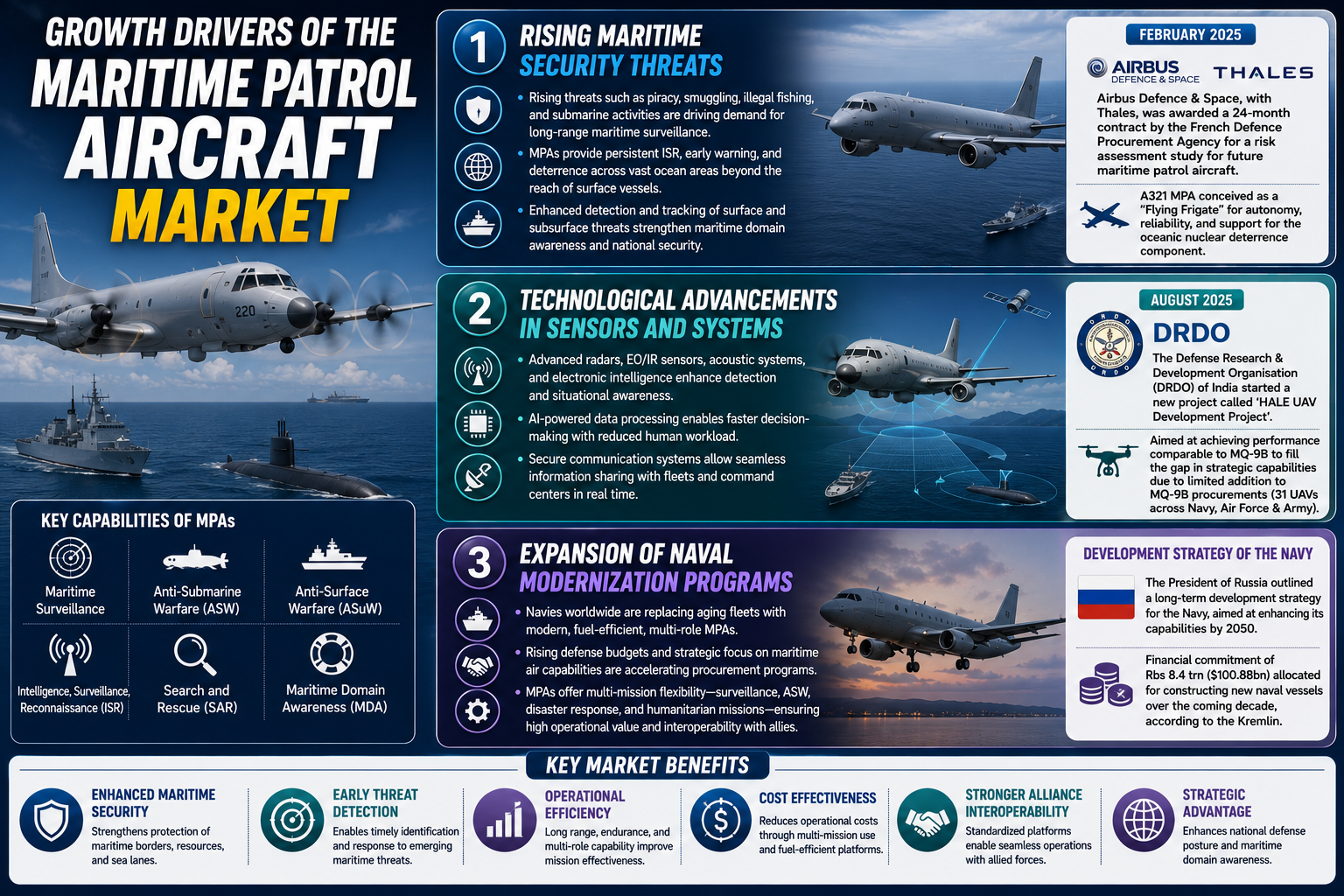
A notable example came in 2025 when Airbus Defence & Space and Thales secured a contract from France's defense procurement agency to conduct risk assessment studies for future maritime patrol aircraft. The proposed A321 MPA platform has been described as a “Flying Frigate,” highlighting its ambition to combine endurance, reliability, and advanced mission capabilities.
Technology Is Transforming Maritime Surveillance
Another major catalyst behind market growth is the rapid advancement of surveillance and mission technologies.
Today's maritime patrol aircraft are dramatically more capable than earlier generations. Artificial intelligence, machine learning, advanced radar systems, and enhanced communication networks are revolutionizing how these platforms collect and process information.
Modern sensor suites can identify, classify, and track multiple targets simultaneously across vast maritime environments. High-resolution imaging systems provide detailed situational awareness even under challenging weather conditions.
Artificial intelligence is becoming particularly important because it allows aircraft operators to analyze enormous volumes of surveillance data more efficiently. Automated target recognition systems can significantly reduce response times while improving mission effectiveness.
Data-sharing capabilities are also evolving rapidly. Modern MPAs can seamlessly communicate with naval fleets, satellites, coastal defense systems, and command centers, creating integrated surveillance networks that enhance operational effectiveness.
The integration of emerging technologies ensures that maritime patrol aircraft remain at the forefront of defense modernization strategies worldwide.
Naval Modernization Programs Are Expanding Procurement Opportunities
Governments across developed and emerging economies are undertaking extensive naval modernization initiatives.
Many existing maritime patrol fleets were acquired decades ago and are approaching the end of their operational lifecycles. Aging aircraft often require expensive maintenance and lack the advanced capabilities necessary for modern missions.
Consequently, defense organizations are increasingly replacing legacy systems with fuel-efficient, multi-role aircraft that can address evolving operational requirements.
Russia, for example, recently announced a long-term naval development strategy extending through 2050. The initiative includes substantial investment in maritime defense infrastructure and naval capabilities.
Similarly, several Asia-Pacific nations are significantly expanding defense spending to improve maritime awareness and strengthen regional deterrence.
These modernization efforts create substantial opportunities for aerospace manufacturers, defense contractors, and technology providers involved in maritime patrol programs.
Challenges Facing the Industry
Despite strong growth prospects, the maritime patrol aircraft market faces several important challenges.
High Acquisition Costs
One of the most significant obstacles is the substantial financial investment required to procure and maintain these aircraft.
MPAs are highly sophisticated platforms that integrate advanced sensors, weapons systems, mission computers, and communication technologies. Acquisition costs can be extremely high, particularly for smaller defense budgets.
Beyond procurement, governments must also account for maintenance, upgrades, training programs, infrastructure requirements, and operational expenses throughout the aircraft's lifecycle.
For some nations, these costs can limit fleet expansion plans or delay procurement decisions.
Competition from Unmanned Systems
The growing adoption of unmanned aerial vehicles (UAVs) presents another challenge.
Long-endurance drones can provide persistent surveillance capabilities at significantly lower operational costs while eliminating risks to flight crews.
Advances in sensor miniaturization, satellite communications, and autonomous operations continue to expand drone capabilities in maritime environments.
While manned maritime patrol aircraft still offer superior versatility and mission flexibility, many governments are exploring mixed fleets that combine crewed and uncrewed platforms.
Future success may depend on how effectively manufacturers integrate manned-unmanned teaming concepts into maritime operations.
Key Market Segments Showing Strong Potential
The maritime patrol aircraft market encompasses several specialized segments, each serving distinct operational requirements.
Armoured Maritime Patrol Aircraft
Armoured MPAs are gaining attention due to increasing security risks in contested maritime environments.
These aircraft feature enhanced survivability measures, including ballistic protection, reinforced structures, and defensive countermeasure systems. They are particularly valuable in regions where military threats or hostile activities are common.
As naval operations move closer to conflict-prone areas, demand for protected aircraft is expected to increase steadily.
Turbofan Maritime Patrol Aircraft
Turbofan-powered MPAs are becoming increasingly attractive because they offer faster transit speeds, greater operational flexibility, and improved range.
These platforms are ideal for large-area surveillance missions, rapid deployment requirements, and multinational military operations.
Although they generally involve higher acquisition and maintenance costs, their superior performance capabilities continue to attract military buyers.
Surveillance Aircraft
Surveillance-focused MPAs remain among the most widely deployed variants.
Their primary mission involves monitoring maritime activity, identifying suspicious behavior, and supporting law enforcement operations. Coastal nations frequently use these aircraft to combat illegal fishing, piracy, and smuggling activities.
Growing maritime traffic and increasing economic activity at sea are expected to sustain demand for surveillance platforms.
Reconnaissance Aircraft
Reconnaissance MPAs specialize in intelligence collection and threat assessment.
Equipped with sophisticated imaging, signals intelligence, and electronic surveillance systems, these aircraft provide valuable information for military planning and strategic decision-making.
As geopolitical competition intensifies globally, reconnaissance capabilities are becoming increasingly important for national security organizations.
Regional Markets Leading the Expansion
United States
The United States remains the world's largest and most technologically advanced maritime patrol aircraft market.
Strong naval capabilities, extensive maritime interests, and global military commitments continue to support investment in next-generation MPA platforms.
American defense priorities emphasize anti-submarine warfare, intelligence gathering, and integrated multi-domain operations.
Boeing's military aircraft deliveries throughout 2025 demonstrate the ongoing strength of defense aviation demand both domestically and internationally.
United Kingdom
The United Kingdom has renewed its focus on maritime patrol capabilities in response to evolving security requirements and NATO commitments.
Protecting North Atlantic sea routes, supporting carrier strike groups, and strengthening anti-submarine operations remain key strategic priorities.
The deployment of Royal Air Force P-8A Poseidon aircraft to Iceland in late 2025 highlighted the growing importance of maritime surveillance within British defense planning.
India
India's maritime patrol aircraft market is experiencing rapid growth due to increasing security concerns throughout the Indo-Pacific region.
With one of the world's longest coastlines and expanding strategic interests at sea, India is investing heavily in maritime domain awareness, surveillance, and anti-submarine warfare capabilities.
Collaborations between domestic defense companies and international aerospace leaders are accelerating indigenous capability development.
Recent cooperation among Tata Advanced Systems, Airbus, and DRDO demonstrates India's commitment to strengthening its aerospace and defense ecosystem.
Saudi Arabia
Saudi Arabia continues to expand maritime surveillance capabilities to protect critical infrastructure along the Red Sea and Arabian Gulf.
Regional security concerns and broader defense modernization initiatives are supporting investments in advanced surveillance platforms.
Although fleet sizes remain relatively modest compared to larger military powers, Saudi Arabia represents an important high-value market for aerospace manufacturers.
The Future of Maritime Patrol Aircraft
Looking ahead, the maritime patrol aircraft industry is poised for sustained growth.
Several long-term trends are expected to shape the market over the coming decade:
- Greater integration of artificial intelligence
- Enhanced sensor fusion capabilities
- Expanded use of autonomous systems
- Improved satellite connectivity
- Increased interoperability among allied nations
- Greater emphasis on multi-role mission platforms
Manufacturers that successfully combine advanced technology, operational flexibility, and lifecycle affordability will be best positioned to capture future opportunities.
As maritime competition intensifies and governments prioritize ocean security, demand for sophisticated surveillance and reconnaissance platforms is expected to remain strong.
Final Thoughts
The maritime patrol aircraft market is entering a period of significant expansion driven by evolving security threats, technological innovation, and ambitious naval modernization programs worldwide.
With Renub Research forecasting market growth from USD 13.94 billion in 2025 to USD 25.59 billion by 2034, the sector is becoming one of the most strategically important segments within the global aerospace and defense industry.
In a world where control of maritime domains increasingly influences economic stability, national security, and geopolitical power, maritime patrol aircraft are no longer optional assets—they are becoming essential guardians of the world's oceans.
About the Creator
Enjoyed the story? Support the Creator.
Subscribe for free to receive all their stories in your feed.
Comments
There are no comments for this story
Be the first to respond and start the conversation.