
Lung Cancer Diagnostics Market Outlook 2026–2034: How Early Detection Technologies Are Transforming Cancer Care
Advances in imaging, molecular testing, artificial intelligence, and precision medicine are reshaping lung cancer diagnostics and improving survival outcomes worldwide.

Lung cancer remains one of the most serious public health challenges worldwide. Despite major advancements in cancer treatment and medical research, lung cancer continues to account for a significant share of cancer-related deaths each year. One of the primary reasons for this high mortality rate is that many patients are diagnosed only after the disease has progressed to advanced stages, limiting treatment options and reducing survival rates.
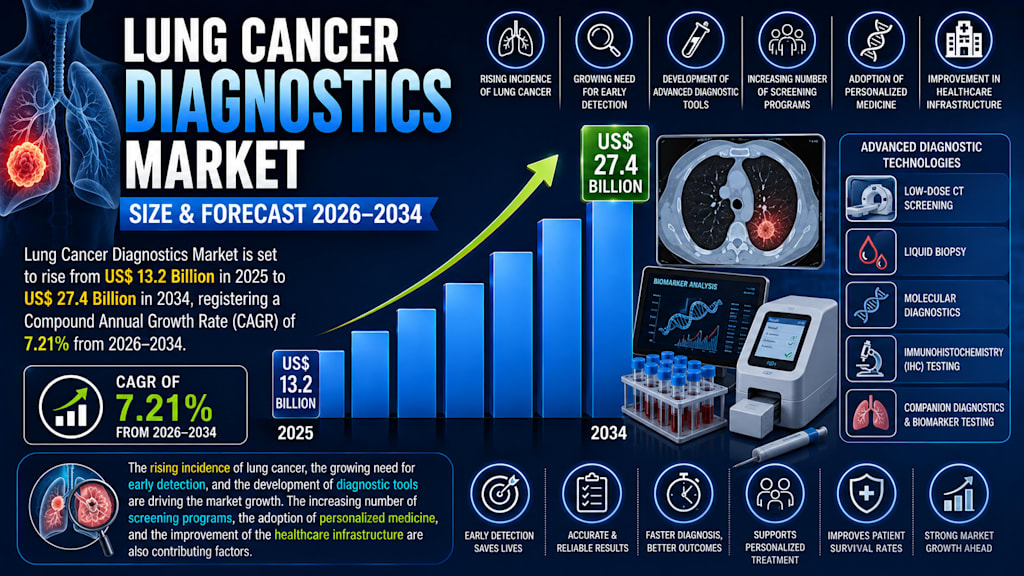
Fortunately, significant progress in diagnostic technologies is changing this reality. Modern imaging systems, molecular diagnostics, liquid biopsies, and artificial intelligence-powered screening tools are helping healthcare professionals identify lung cancer earlier than ever before. Early diagnosis dramatically improves treatment outcomes, allowing patients to access targeted therapies and personalized treatment strategies before the disease becomes more difficult to manage.
As governments, healthcare organizations, and medical institutions increasingly emphasize preventive healthcare and cancer screening, the demand for advanced lung cancer diagnostic solutions continues to rise.
According to Renub Research, the global Lung Cancer Diagnostics Market is expected to grow from US$ 13.2 billion in 2025 to US$ 27.4 billion by 2034, registering a compound annual growth rate (CAGR) of 7.21% between 2026 and 2034. Rising lung cancer prevalence, growing awareness regarding early detection, technological innovation, and expanding screening initiatives are among the primary factors driving market growth.
As healthcare systems around the world focus increasingly on early intervention and precision medicine, lung cancer diagnostics are becoming a cornerstone of modern oncology care.
Understanding Lung Cancer Diagnostics
Lung cancer diagnostics encompass the various medical procedures, laboratory tests, and imaging technologies used to identify, confirm, classify, and monitor lung cancer.
Diagnosis often begins with imaging studies that allow healthcare professionals to visualize abnormalities within the lungs. Common imaging techniques include chest X-rays, computed tomography (CT) scans, positron emission tomography (PET) scans, and magnetic resonance imaging (MRI).
When suspicious lesions are detected, additional procedures such as biopsies, sputum cytology tests, molecular diagnostics, and genetic analyses may be performed to confirm the diagnosis and determine the specific characteristics of the cancer.
Modern diagnostic approaches increasingly incorporate advanced technologies such as liquid biopsy and next-generation sequencing. These tools enable clinicians to detect genetic mutations and molecular markers that influence treatment decisions.
Accurate diagnosis is essential because different lung cancer subtypes respond differently to treatment. Early and precise identification allows physicians to select the most effective therapeutic strategies and improve patient outcomes.
As cancer care becomes increasingly personalized, diagnostic technologies are playing an ever more important role in guiding clinical decisions.
Rising Global Lung Cancer Burden Is Fueling Market Growth
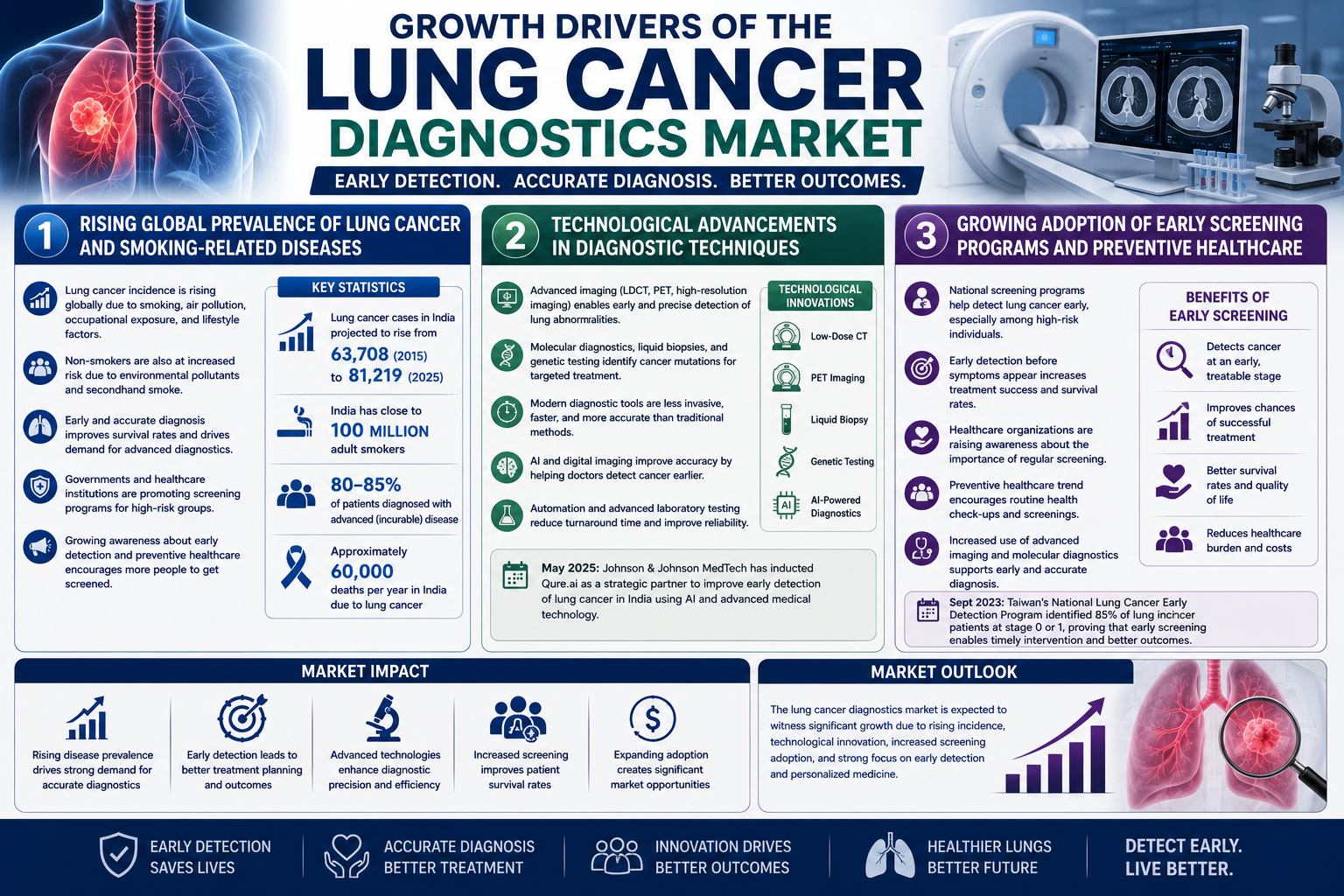
One of the strongest drivers of the lung cancer diagnostics market is the growing incidence of lung cancer worldwide.
Smoking remains the most significant risk factor, but environmental pollution, occupational exposure to hazardous substances, secondhand smoke, and genetic predisposition also contribute to disease development. Additionally, increasing urbanization and declining air quality have raised concerns regarding lung cancer risk among non-smokers.
Healthcare systems are witnessing rising numbers of patients requiring diagnostic evaluation, particularly among aging populations and high-risk groups.
The increasing prevalence of lung cancer has intensified demand for screening programs and early detection initiatives. Medical professionals increasingly recognize that diagnosing lung cancer during its earliest stages significantly improves survival rates and treatment effectiveness.
As awareness grows regarding the importance of preventive healthcare and routine cancer screening, more individuals are undergoing diagnostic testing before symptoms become severe.
This shift toward earlier diagnosis is expected to remain a major factor supporting long-term market expansion.
Technological Innovation Is Revolutionizing Cancer Detection
Advances in diagnostic technology are transforming the way lung cancer is detected and evaluated.
Traditional diagnostic methods have been enhanced by the introduction of high-resolution imaging systems, molecular diagnostics, genetic testing, and digital health solutions. These innovations improve diagnostic accuracy while reducing delays in treatment initiation.
Low-dose computed tomography (LDCT) has emerged as one of the most effective screening tools for high-risk populations. LDCT can identify small lung abnormalities that might otherwise go undetected using conventional imaging methods.
Positron emission tomography and advanced imaging platforms provide detailed information regarding tumor location, size, and disease progression.
Artificial intelligence is becoming increasingly important in diagnostic workflows. AI-powered algorithms assist radiologists by identifying suspicious lesions, improving image interpretation, and reducing the risk of missed diagnoses.
Automation and digital pathology systems are also helping laboratories process diagnostic information more efficiently and accurately.
In May 2025, Johnson & Johnson MedTech partnered with Qure.ai to improve early detection of lung cancer in India by combining advanced medical technologies with artificial intelligence-driven diagnostic solutions. This collaboration highlights the growing role of AI in transforming cancer diagnostics.
Molecular Diagnostics Are Supporting Precision Medicine
One of the most significant developments in lung cancer care is the growing adoption of molecular diagnostics.
Unlike traditional diagnostic approaches that focus primarily on identifying tumors, molecular testing examines the genetic characteristics of cancer cells. These tests can detect specific mutations and biomarkers that influence treatment selection.
Mutations involving genes such as EGFR, ALK, ROS1, and others have become important targets for modern cancer therapies. By identifying these genetic changes, healthcare providers can select treatments that are more likely to produce favorable outcomes while minimizing unnecessary side effects.
Molecular diagnostics have become central to the rise of precision medicine, an approach that tailors treatment according to the unique biological characteristics of each patient's disease.
Many molecular tests can now be performed through liquid biopsy technologies, which analyze cancer-related biomarkers in blood samples. These procedures are less invasive than traditional tissue biopsies and often provide faster results.
As targeted therapies continue expanding across oncology, demand for molecular diagnostic solutions is expected to grow substantially.
Early Screening Programs Are Improving Outcomes
Healthcare organizations around the world increasingly recognize that early detection remains one of the most effective tools for reducing lung cancer mortality.
Many countries have launched screening initiatives targeting individuals at elevated risk, particularly long-term smokers and older adults.
Screening programs enable healthcare professionals to identify cancer before symptoms appear, significantly increasing the likelihood of successful treatment.
Public awareness campaigns are also encouraging individuals to participate in routine health assessments and preventive screening programs.
The benefits of these initiatives have become increasingly evident. In September 2023, Taiwan's National Lung Cancer Early Detection Program demonstrated that approximately 85 percent of lung cancer cases were detected during Stage 0 or Stage 1, highlighting the life-saving potential of early diagnosis.
As awareness and accessibility continue improving, participation in lung cancer screening programs is expected to increase globally.
Biopsy Diagnostics Remain Essential
Although imaging technologies provide valuable information, biopsy procedures remain one of the most important tools for confirming lung cancer diagnoses.
Biopsy diagnostics involve obtaining tissue samples from suspicious lesions and analyzing them in laboratory settings. Different biopsy techniques are available depending on tumor location, patient condition, and clinical objectives.
Common approaches include needle biopsies, bronchoscopy-guided biopsies, and surgical biopsies.
These procedures allow pathologists to confirm the presence of cancer, determine tumor subtype, and identify characteristics that influence treatment planning.
Advancements in biopsy techniques have improved safety, reduced complications, and enhanced diagnostic precision.
As healthcare providers continue emphasizing personalized treatment approaches, biopsy diagnostics will remain an essential component of comprehensive cancer evaluation.
Diagnostic Imaging Centers Play a Growing Role
Diagnostic imaging centers have become increasingly important within the lung cancer diagnostic ecosystem.
These facilities provide specialized imaging services that support early detection, diagnosis, treatment planning, and ongoing disease monitoring.
The growing popularity of imaging centers reflects increasing demand for accessible, high-quality diagnostic services outside traditional hospital environments.
Modern imaging centers utilize advanced CT scanners, PET systems, MRI technologies, and digital imaging platforms to provide comprehensive diagnostic evaluations.
High-risk populations, including smokers and elderly individuals, frequently rely on imaging centers for routine lung cancer screening and follow-up examinations.
As healthcare systems continue expanding access to preventive services, diagnostic imaging centers are expected to play an increasingly significant role in supporting early detection initiatives.
Hospital Laboratories Support Comprehensive Cancer Diagnosis
Hospital-associated laboratories remain central to lung cancer diagnosis and management.
These laboratories perform a wide range of diagnostic tests, including pathology analysis, molecular testing, genetic sequencing, and biomarker evaluation.
Close collaboration between laboratory professionals and clinical teams enables faster communication and more coordinated patient care.
Advances in laboratory automation and digital pathology have improved testing efficiency, reduced turnaround times, and enhanced diagnostic accuracy.
Hospital laboratories are also helping advance precision medicine by supporting genomic testing and targeted treatment selection.
As personalized oncology continues evolving, hospital-based diagnostic services will remain essential to comprehensive cancer care.
Challenges Facing the Lung Cancer Diagnostics Market
Despite strong growth prospects, the industry continues to face several important challenges.
One of the most significant obstacles is the high cost associated with advanced diagnostic technologies. CT scanners, PET systems, molecular testing platforms, and genetic sequencing tools require substantial financial investment.
Patients may also face considerable expenses related to imaging studies, biopsies, and laboratory testing, particularly in regions where insurance coverage is limited.
These costs can create barriers to early diagnosis and restrict access to advanced diagnostic services in certain healthcare settings.
Reducing costs while maintaining diagnostic quality will remain an important priority for healthcare systems and industry stakeholders.
Access to Diagnostic Services Remains Uneven
Many developing regions continue facing challenges related to healthcare infrastructure and access to advanced diagnostic technologies.
Limited availability of imaging equipment, laboratory facilities, trained specialists, and cancer screening programs can delay diagnosis and treatment.
Patients in underserved areas often seek medical attention only after symptoms become severe, reducing the effectiveness of available therapies.
Workforce shortages involving radiologists, pathologists, laboratory technicians, and oncology specialists further complicate service delivery.
Addressing these disparities through infrastructure development, training initiatives, and healthcare investment will be essential for improving global cancer outcomes.
Regional Market Insights
The United States remains one of the most advanced markets for lung cancer diagnostics due to its strong healthcare infrastructure, widespread adoption of molecular testing, and emphasis on precision medicine. Advanced imaging technologies, genomic testing platforms, and national screening initiatives continue supporting market growth. In July 2025, the U.S. FDA approved the Oncomine Dx Express Test, a next-generation sequencing companion diagnostic designed to identify EGFR exon 20 insertion mutations in patients with non-small cell lung cancer.
The United Kingdom continues expanding diagnostic capabilities through government-supported healthcare programs and early detection initiatives. In January 2026, Optellum was selected for an innovative NHS project integrating artificial intelligence-driven risk assessment with robotic-assisted bronchoscopy, supporting faster and more accurate lung cancer diagnosis.
India is experiencing rapid market growth due to increasing awareness, healthcare modernization, and rising demand for advanced diagnostic technologies. In November 2025, Yashoda Hospital collaborated with Qure.ai and AstraZeneca to launch an AI-powered Lung Nodule Clinic focused on early detection and timely management of lung cancer.
Saudi Arabia continues investing heavily in healthcare modernization and cancer care infrastructure. Growing adoption of advanced imaging technologies and molecular diagnostics is improving access to high-quality cancer services across the country.
Competitive Landscape
Competition within the lung cancer diagnostics industry remains intense as companies invest heavily in innovation, precision medicine, artificial intelligence, and molecular testing technologies.
Leading industry participants include Illumina, Abbott Laboratories, Thermo Fisher Scientific, QIAGEN, Roche Holding AG, Sanofi, Agilent Technologies, and bioMérieux.
These organizations continue developing advanced diagnostic solutions that improve early detection, enhance molecular profiling capabilities, and support personalized treatment strategies.
Their investments in research and development are expected to drive continued innovation throughout the forecast period.
Final Thoughts
The global lung cancer diagnostics market is undergoing rapid transformation as healthcare systems increasingly prioritize early detection, precision medicine, and patient-centered cancer care. Advances in imaging technologies, molecular diagnostics, artificial intelligence, and genetic testing are enabling earlier diagnosis and more effective treatment planning than ever before.
As awareness of preventive healthcare continues to grow and screening programs expand worldwide, demand for advanced diagnostic solutions is expected to rise significantly. With the market projected to increase from US$ 13.2 billion in 2025 to US$ 27.4 billion by 2034, lung cancer diagnostics will remain one of the most critical and innovative segments within modern oncology, helping improve survival rates and transform the future of cancer care.
About the Creator
Enjoyed the story? Support the Creator.
Subscribe for free to receive all their stories in your feed.
Comments
There are no comments for this story
Be the first to respond and start the conversation.