
Low Taxes, Long Queues, and Grey Markets: Three Ways Governments Ration Freedom
Hong Kong, Britain, and mainland China’s informal economy show that low tax does not mean light rule. Each place chooses different checkpoints.
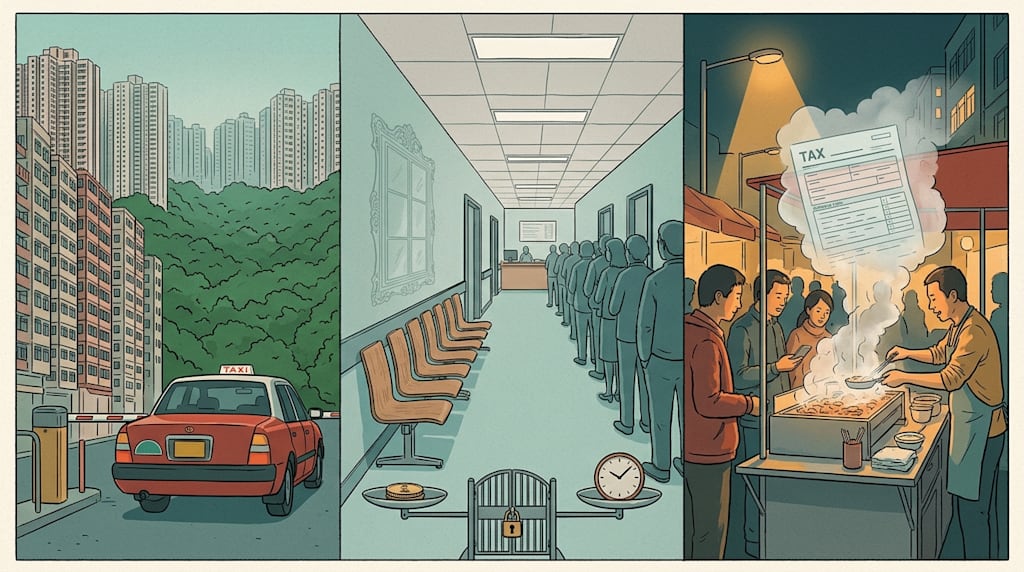
1. Hong Kong’s low tax comes with high barriers
Hong Kong’s standard profits tax rate is 16.5%. Its top salaries tax rate is 17%. It has no VAT, no capital gains tax, and no inheritance tax. By the usual formula that links low tax to small government and small government to freedom, Hong Kong should be a place where the state barely touches the economy.
The same Hong Kong has residential land at only 7% of total land. Country parks and special areas cover nearly 37% of its territory and are protected from development under the Country Parks Ordinance. Developed urban land is about 24%. From 2003 to 2010, new residential land supply averaged only 53,700 square metres a year. Taxi licences have been frozen since the 1990s at about 18,163. Licence prices once reached millions of Hong Kong dollars, and drivers pay vehicle rents to licence holders. Hawker licences have essentially not been issued since the 1970s. The number of licensed hawkers fell from about 20,000 in the 1980s to about 5,300 in 2023. Only two universities run medical schools. The UGC-funded medical intake was 250 in 2008/09 and rose to 590 by 2022/23. Median waits for stable new specialist cases were 66 weeks in ophthalmology, 49 weeks in internal medicine, and 45 weeks in orthopaedics.
Low tax is real. Strong rationing is also real. The two have coexisted for decades. Land premia have long been a major revenue source. Tight land supply and low income tax are two parts of one fiscal arrangement.
The first habit to drop is the idea that “how much the government collects” and “how much the government manages” are the same variable. They are not. Hong Kong can be restrained on income tax and assertive at the gates of land, licensing, professional registration, and public healthcare. Low tax does not mean no checkpoints. It means the checkpoints do not collect money through tax.
2. Britain’s NHS clears demand with time
The NHS is often sold in two ways. One story calls it the civilised benchmark of free healthcare. The other calls it inefficient and queue-ridden. Both skip a basic point. The NHS is a public monopoly rationing system. It is tax-funded and state-provided. General practitioners guard the referral entrance. Specialist care enters a queue.
In 2024, the NHS England elective waiting list passed 7 million. The referral stage matters more than the headline number. A Healthwatch-commissioned YouGov survey found that about 14% of GP referrals never entered the hospital waiting list. Patients were stuck in the gaps. Three-quarters of them saw their health worsen. “Long queues” does not capture this. The system filters demand before patients reach the queue. Patients think they have entered. Many have not.
Underinvestment and population ageing matter. So does the design. When a system is tax-funded, limits private alternatives, and gives GPs a monopoly on referrals, waiting time becomes the price. It clears demand with time rather than money. People who can pay turn to private care. Everyone else waits in the public queue or disappears into the referral gap.
Britain’s window tax is an old example of administrative intrusion into daily life. It began in 1696, taxed windows, pushed people to brick up openings, and ended in 1851. The NHS is another form of strong governance. It does not use fines and licences. It uses public monopoly to decide who gets care and when. The form changed. The rationing logic did not.
3. Mainland China’s informal economy has low tax and weak protection
Mainland China has a large economic sector that is almost invisible to tax. Small-scale VAT taxpayers with monthly sales below 100,000 yuan are exempt from VAT through 2027. Individual income tax on business income for individual industrial and commercial households is halved up to 2 million yuan. The “six taxes and two fees” are also halved. Street vendors, night-market stalls, small shops, daily-wage workers, delivery riders, and ride-hailing drivers often sit outside effective tax administration. The system cannot easily find them, map their income, or manage them. Many small businesses pay little or no tax, and compliance costs are low.
Calling this “freedom” takes care.
First, it is largely a product of tax-administration capacity and governance tolerance. It is not a stable, predictable, universally applied low-tax rule. The same activity can be treated differently across cities, periods, and enforcement campaigns. Street-vendor governance has long shifted between formal space and informal space, repression and selective tolerance. Low tax and low regulation in the informal economy come with uncertainty. Not being taxed today does not mean not being cleared tomorrow. Being tolerated today does not mean being legal tomorrow.
Second, low tax and low protection often arrive together. Many flexible workers, vendors, and daily-wage workers are invisible to tax and also at the edge of healthcare, pension, and work-injury coverage. A roadside stall may not declare VAT. Its operator also has no employer-paid social insurance, no paid sick leave, and no secure property right over the stall site. Low tax is real. Low protection is also real.
Third, the informal low-tax sector sits beside a formal sector with nominal taxes and compliance costs. A roadside stall may not declare VAT. A registered company must handle VAT, corporate income tax, social insurance, and compliance. “Mainland tax is light” is true in the informal sector. “Mainland tax is heavy” is true in the formal sector. Mixing the two produces slogans such as “the most free” or “the heaviest tax.” Each slogan can find local evidence. Neither explains the whole.
4. Freedom has three separate dimensions
The useful question is not who is freer. It is which dimension of freedom is being defined. Three dimensions matter here.
Fiscal extraction: how much the government takes. Hong Kong is striking on this measure. Low profits tax, low salaries tax, no VAT, no capital gains tax. This dimension describes the extraction rate. It says nothing about the number of gates at the entrance. An economy can be low-tax and still place high administrative barriers around land, medical practice, and licences.
Access: how many gates stand at the entrance. Hong Kong’s barriers in land development, medical practice, optometry, taxi operation, and hawking are far higher than the “low-tax free port” label suggests. Mainland China’s informal economy has low entry barriers, but those barriers are unstable because they depend on enforcement tolerance. The NHS uses a public monopoly as its gate. Entry is free. Time after entry is rationed.
Predictability: whether tomorrow’s rules match today’s. A street vendor pays no tax but cannot know if the same spot will be available tomorrow. A Hong Kong taxi licence holder enjoys a permanent transferable licence. New entrants are locked out. An NHS patient has a right to free care. A referral can vanish into a gap. Low tax, low entry barriers, and free provision do not automatically produce predictable freedom.
Once the dimensions are separate, the positions are clear. Hong Kong has low fiscal extraction, high access barriers, and relatively predictable rules for people already inside. Britain has high fiscal extraction, public-monopoly access, and predictable rationing outcomes with high waiting costs. Mainland China’s informal sector has low fiscal extraction, low access barriers, and weak rule predictability. None of them wins on all three.
5. Compare institutions, not labels
Hong Kong’s low tax and strong rationing do not conflict. Tax and rationing are different tools. The NHS’s free care and long queues do not conflict. Free care is the financing method. Queues are the rationing method. Mainland China’s low tax and low protection in the informal economy do not conflict. Enforcement flexibility and thin institutional coverage come from the same governance logic.
The danger is using one dimension to deny another. Hong Kong’s low tax becomes “small government.” Mainland street vendors not paying tax becomes “the most free.” Free NHS care becomes “civilised benchmark.” Each phrase uses the bright side of one dimension to hide the dark side of another.
Compare specific trade-offs instead. Who pays tax. Who faces a gate. Who can predict the rules. Whether rationing works through money, time, or grey tolerance. These four questions explain more than an argument about who is freer.
Hong Kong’s country parks, mainland night markets, NHS queues, and Hong Kong taxi licences do not belong under one “freedom” label. Taken apart, each is an institutional choice under constraints. Each has costs, beneficiaries, and people left outside. The useful work is to show those choices clearly, not to hand out prizes or verdicts.
About the Creator
Jin
Writer of reamstories
https://reamstories.com/jin
Enjoyed the story? Support the Creator.
Subscribe for free to receive all their stories in your feed. You could also become a paid subscriber, letting them know you appreciate their work.
Comments
There are no comments for this story
Be the first to respond and start the conversation.