
Lipid Nanoparticle Market to Cross US$ 1.85 Billion by 2033 as mRNA Therapies and Precision Medicine Accelerate
Global Lipid Nanoparticle Industry Witnesses Rapid Expansion Driven by RNA Therapeutics, Cancer Research, and Advanced Drug Delivery Innovations

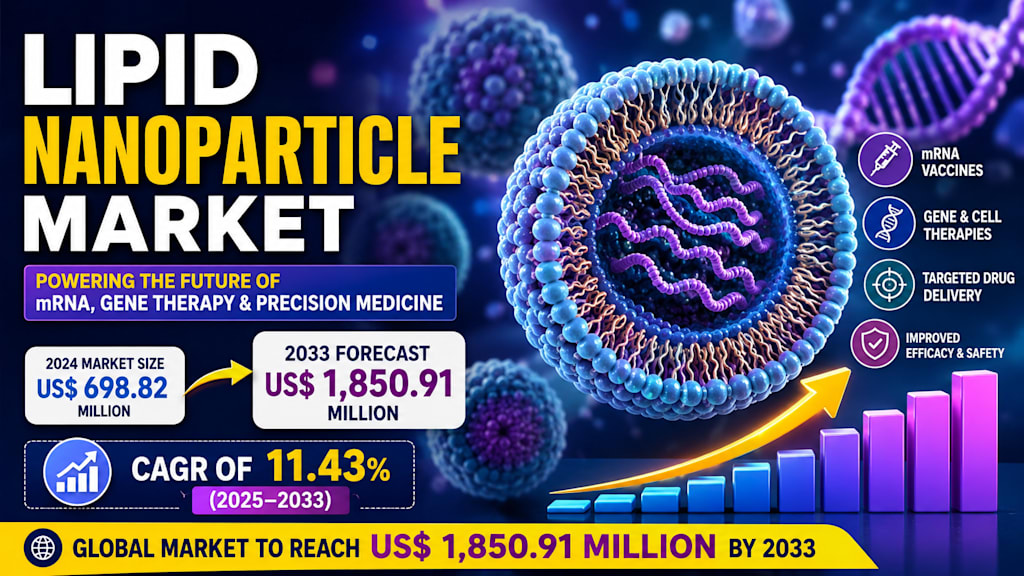
The global healthcare industry is entering a new era where precision medicine, RNA therapeutics, and targeted drug delivery systems are transforming how diseases are treated. At the center of this transformation lies one rapidly expanding technology: lipid nanoparticles (LNPs). These microscopic carriers have become essential in modern medicine, especially after their critical role in delivering mRNA-based COVID-19 vaccines to millions of people worldwide.
According to recent industry analysis, the Global Lipid Nanoparticle Market is projected to rise from US$ 698.82 million in 2024 to an impressive US$ 1,850.91 million by 2033, growing at a CAGR of 11.43% during the forecast period from 2025 to 2033. This substantial growth reflects increasing investments in biotechnology, breakthroughs in nanomedicine, and the rising adoption of gene and cell therapies worldwide.
Lipid nanoparticles are no longer limited to vaccine applications. They are now being widely explored for cancer treatment, autoimmune disorders, rare diseases, neurological conditions, and advanced drug delivery systems. As pharmaceutical companies continue to pursue more effective and personalized treatments, the importance of LNP technology is expanding rapidly.
Why Lipid Nanoparticles Matter in Modern Medicine
Lipid nanoparticles are tiny spherical structures made primarily of lipids that can safely transport therapeutic substances into the body. Their ability to encapsulate both hydrophilic and hydrophobic molecules makes them highly versatile in pharmaceutical applications.
One of the biggest advantages of LNPs is their ability to protect fragile therapeutic materials such as mRNA, DNA, and proteins from degradation. Once delivered into the body, these nanoparticles help transport therapeutic compounds directly into target cells, significantly improving treatment efficiency while reducing unwanted side effects.
The success of mRNA vaccines during the COVID-19 pandemic dramatically elevated the global awareness and adoption of lipid nanoparticle technologies. Pharmaceutical companies realized that LNPs could become the foundation for a broad range of future therapies beyond infectious diseases.
Today, LNPs are being integrated into therapies involving:
Cancer immunotherapy
Gene editing technologies
RNA therapeutics
Personalized medicine
Rare genetic disorder treatments
Autoimmune disease therapies
This expanding scope is creating lucrative opportunities for biotechnology companies, pharmaceutical manufacturers, and research institutions globally.
Rising Demand for Advanced Drug Delivery Systems
One of the primary factors driving the lipid nanoparticle market is the increasing need for sophisticated drug delivery technologies. Traditional drug delivery methods often struggle with poor bioavailability, instability, and limited targeting capabilities. Lipid nanoparticles address many of these issues effectively.
Modern therapies, especially biologics and nucleic acid-based treatments, require delivery systems capable of protecting therapeutic molecules while ensuring precise targeting. LNPs provide a highly efficient mechanism for this purpose.
The pharmaceutical industry is increasingly shifting toward targeted therapies because they offer improved clinical outcomes with fewer adverse effects. Lipid nanoparticles play a crucial role in enabling this transition.
As chronic diseases such as cancer, cardiovascular disorders, and autoimmune conditions continue to rise globally, healthcare providers are seeking more efficient treatment methods. This trend is expected to sustain long-term demand for LNP-based solutions.
mRNA Vaccines Continue to Fuel Market Growth
The COVID-19 pandemic fundamentally changed the trajectory of the lipid nanoparticle industry. The success of mRNA vaccines developed using LNP technology demonstrated the enormous potential of this drug delivery platform.
LNPs became indispensable because they protected the delicate mRNA molecules and enabled them to enter human cells efficiently. Without lipid nanoparticles, the rapid development and global distribution of mRNA vaccines would have been far more difficult.
Following this success, pharmaceutical and biotechnology companies dramatically increased investments in RNA therapeutics and next-generation vaccines. Researchers are now investigating mRNA-based treatments for:
Cancer vaccines
Personalized immunotherapies
Influenza vaccines
HIV vaccines
Rare genetic disorders
Autoimmune diseases
This growing pipeline of mRNA therapies is expected to generate sustained demand for advanced lipid nanoparticle formulations over the next decade.
Gene and Cell Therapies Expand Opportunities
Gene and cell therapies represent another major growth engine for the lipid nanoparticle market. As healthcare moves toward precision medicine, the ability to safely deliver genetic material into cells has become increasingly important.
Lipid nanoparticles offer several advantages over traditional viral vectors, including lower immunogenicity, improved scalability, and easier manufacturing processes. This makes them highly attractive for gene-editing technologies such as CRISPR and RNA interference therapies.
Biotechnology companies are actively exploring LNPs for applications in:
CRISPR gene editing
siRNA therapeutics
DNA delivery systems
Regenerative medicine
Stem cell therapies
As clinical trials continue to show promising results, the role of lipid nanoparticles in advanced therapeutics is expected to strengthen significantly.
Technological Innovations Accelerating Industry Development
Continuous innovation in nanoparticle formulation technologies is also driving market growth. Researchers are developing advanced LNP structures with improved stability, enhanced targeting efficiency, and reduced toxicity.
In recent years, universities, biotech startups, and pharmaceutical companies have intensified their research efforts to create next-generation LNP systems capable of overcoming existing limitations.
For example, researchers at the University of Toronto developed a novel ionizable lipid nanoparticle capable of delivering mRNA to muscle tissues while minimizing side effects. Such breakthroughs highlight how rapidly the technology is evolving.
At the same time, companies are investing heavily in manufacturing capabilities to support growing demand. Large-scale lipid production facilities are being established across North America and Europe to strengthen supply chains and accelerate commercialization efforts.
North America Maintains Market Leadership
North America currently dominates the global lipid nanoparticle market due to its strong pharmaceutical ecosystem, advanced biotechnology infrastructure, and high R&D spending.
The United States remains the largest contributor to regional growth. Major pharmaceutical and biotech companies continue to invest aggressively in LNP research, particularly for mRNA therapeutics and personalized medicine applications.
Government support has also played a significant role. Funding programs designed to accelerate vaccine and drug development have encouraged rapid expansion of lipid nanoparticle manufacturing capabilities across the country.
The presence of leading market players, sophisticated clinical research infrastructure, and favorable regulatory support positions North America as the leading regional market for LNP technologies.
Europe Emerges as a Strong Innovation Hub
Europe is rapidly strengthening its position in the lipid nanoparticle industry. Countries such as Germany are becoming important centers for LNP innovation and production.
German pharmaceutical and biotechnology companies are heavily involved in developing advanced nanoparticle systems for therapeutic applications. Research collaborations between universities, biotech firms, and healthcare institutions are accelerating innovation throughout the region.
The European healthcare sector’s strong focus on precision medicine and advanced therapeutics is expected to support long-term market growth.
Additionally, regulatory agencies across Europe are gradually refining frameworks for RNA therapies and nanoparticle-based medicines, helping create a more stable environment for industry expansion.
Asia-Pacific Becomes a Fast-Growing Market
Asia-Pacific is expected to witness some of the fastest growth rates in the global lipid nanoparticle market over the coming years.
Countries such as China, Japan, India, and South Korea are increasing investments in biotechnology research, pharmaceutical manufacturing, and nanotechnology development.
Japan, in particular, has emerged as a major contributor due to its advanced pharmaceutical industry and strong research capabilities. Japanese companies are actively developing lipid-based delivery systems for gene therapies and mRNA applications.
Meanwhile, growing healthcare expenditures, rising chronic disease prevalence, and expanding clinical research activities are supporting rapid market development across the broader Asia-Pacific region.
Key Challenges Facing the Industry
Despite its strong growth outlook, the lipid nanoparticle market still faces several challenges.
Complex Manufacturing Processes
Producing high-quality lipid nanoparticles requires highly specialized technologies and precise control over formulation parameters. Maintaining consistency during large-scale manufacturing can be technically demanding and expensive.
Minor variations in particle size, lipid composition, or encapsulation efficiency can significantly impact therapeutic performance and safety.
These technical complexities may create barriers for smaller companies attempting to enter the market.
Regulatory Uncertainty
Because lipid nanoparticle technologies are relatively new, regulatory frameworks continue to evolve globally. Companies developing LNP-based therapeutics often face lengthy approval processes and uncertain compliance requirements.
Differences in international regulations may also complicate global commercialization strategies.
However, as more LNP-based products enter the market, regulatory agencies are expected to establish clearer guidelines that support industry growth.
Competitive Landscape Intensifies
Competition within the lipid nanoparticle market is becoming increasingly intense as pharmaceutical companies race to strengthen their positions in RNA therapeutics and advanced drug delivery.
Several major players are actively investing in research partnerships, manufacturing expansion, and proprietary LNP technologies.
Some leading companies shaping the competitive landscape include:
Merck KGaA
Evonik Industries AG
Genevant Sciences Corporation
CordenPharma
Arcturus Therapeutics, Inc.
Ascendia Pharmaceuticals
Acuitas Therapeutics
Croda International Plc
These companies are focusing on expanding production capabilities, improving nanoparticle formulations, and supporting next-generation therapeutic development.
10 Recent Developments in the Lipid Nanoparticle Industry
Evonik Industries AG announced major investments in pharmaceutical lipid manufacturing facilities in the United States to support mRNA therapeutics production.
Acuitas Therapeutics continued expanding partnerships related to next-generation RNA delivery systems.
Arcturus Therapeutics, Inc. advanced self-amplifying mRNA vaccine technologies utilizing proprietary LNP platforms.
Merck KGaA strengthened its life sciences division with enhanced lipid manufacturing capabilities.
CordenPharma expanded GMP lipid production services for pharmaceutical clients.
Croda International Plc increased investments in high-purity excipients and lipid solutions for RNA therapies.
Genevant Sciences Corporation accelerated licensing agreements related to RNA delivery technologies.
Ascendia Pharmaceuticals expanded research into nanoparticle-enabled drug delivery systems.
Academic researchers globally introduced new ionizable lipid formulations designed to improve tissue targeting and reduce toxicity.
Governments and healthcare agencies increased funding support for mRNA and gene therapy infrastructure worldwide.
Final Thoughts
The lipid nanoparticle market is rapidly evolving into one of the most critical sectors within modern biotechnology and pharmaceutical innovation. From enabling mRNA vaccines to advancing gene therapies and precision medicine, LNPs are reshaping the future of healthcare.
As investments in RNA therapeutics continue to rise and personalized medicine becomes more mainstream, lipid nanoparticles are expected to play an increasingly vital role in drug development and delivery.
Although challenges related to manufacturing complexity and regulatory uncertainty remain, the industry’s long-term outlook appears exceptionally promising. Companies capable of developing scalable, efficient, and safe LNP technologies are likely to emerge as major leaders in the next generation of global healthcare innovation.
With the market projected to surpass US$ 1.85 billion by 2033, lipid nanoparticles are no longer a niche technology — they are becoming a foundational pillar of the future pharmaceutical landscape.
About the Creator
Enjoyed the story? Support the Creator.
Subscribe for free to receive all their stories in your feed.
Comments
There are no comments for this story
Be the first to respond and start the conversation.