
Limestone Market Is Becoming a Foundation Stone of Global Infrastructure Growth
Rising demand from construction, cement, steel, and environmental sectors is driving steady expansion in the global limestone industry.

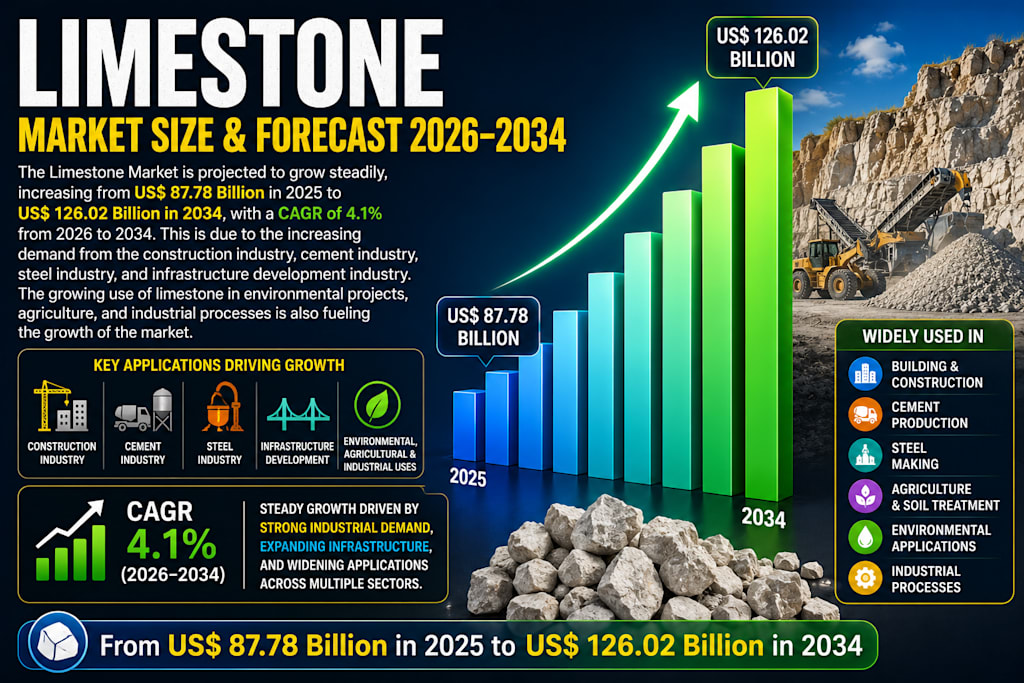
Limestone Market Is Growing Alongside Global Infrastructure Expansion
The global limestone market is witnessing steady growth as infrastructure development and industrialization continue accelerating across both developed and emerging economies. According to Renub Research, the limestone market is projected to grow from US$ 87.78 billion in 2025 to US$ 126.02 billion by 2034, registering a CAGR of 4.1% from 2026 to 2034. Rising demand from the construction, cement, steel, and environmental sectors remains the primary driver behind this expansion.
Limestone has become one of the most essential raw materials in the global economy because of its versatility, affordability, and widespread industrial applications. From highways and bridges to steel manufacturing and water treatment systems, limestone continues to play a foundational role in modern infrastructure and industrial growth.
Limestone Remains One of the World’s Most Important Industrial Materials
Limestone is a sedimentary rock primarily composed of calcium carbonate and formed naturally over millions of years. It is widely used in the production of cement, lime, concrete, aggregates, and road base materials. Beyond construction, limestone is also heavily utilized in steel manufacturing, glass production, water treatment, agriculture, and pollution control applications.
Its broad functionality makes limestone indispensable across multiple sectors. In agriculture, limestone helps improve soil quality by reducing acidity. In environmental applications, it is used for flue gas desulfurization and wastewater treatment. In industrial manufacturing, it supports essential chemical and metallurgical processes.
As governments and industries continue prioritizing infrastructure modernization and sustainability initiatives, limestone demand is expected to remain strong over the long term.
Infrastructure Development Is Driving Massive Demand
One of the biggest factors fueling the limestone market is the rapid pace of global construction and infrastructure development. Limestone is a critical raw material in cement, concrete, road bases, and construction aggregates, making it essential for residential, commercial, and industrial building projects.
The report highlights how growing urbanization, population expansion, and large-scale government investment in transportation and infrastructure projects are increasing global demand for limestone. Major international projects such as highways, airports, railways, smart cities, and industrial corridors require massive quantities of cement and aggregates, directly boosting limestone consumption.
Developing economies are experiencing particularly strong infrastructure growth, while developed countries continue investing in the renovation and modernization of aging infrastructure systems. As construction remains closely tied to economic growth, limestone demand is expected to remain stable and consistent globally.
Cement and Steel Industries Continue to Fuel Market Expansion
The cement and steel industries are among the largest consumers of limestone worldwide. Limestone is a key ingredient in cement manufacturing and also serves as an essential flux material in steel production, helping remove impurities during the smelting process.
As industrialization accelerates globally, demand for cement and steel continues rising alongside housing, transportation, energy, and manufacturing development. This directly strengthens demand for high-quality limestone supplies.
Emerging economies with expanding construction and manufacturing sectors are expected to contribute significantly to future growth. The continued increase in steel production capacity and cement consumption ensures limestone remains a vital industrial raw material.
Environmental and Agricultural Applications Are Expanding
Limestone is also becoming increasingly important in environmental protection and sustainable agricultural practices. In power plants and industrial facilities, limestone is widely used in flue gas desulfurization systems to reduce sulfur dioxide emissions and support cleaner industrial operations.
Water treatment and wastewater management systems also rely heavily on limestone to regulate pH levels and remove impurities. In agriculture, limestone improves soil productivity by neutralizing acidic conditions and supporting healthier crop growth.
As governments strengthen environmental regulations and industries adopt cleaner operational practices, demand for limestone in sustainability-focused applications is expected to grow steadily.
Environmental Regulations Remain a Major Industry Challenge
Despite strong market demand, the limestone industry faces several environmental and regulatory challenges. Quarrying and mining operations can contribute to land degradation, habitat destruction, dust pollution, and water contamination if not managed responsibly.
Governments and environmental agencies are implementing stricter mining regulations to reduce ecological impact. Compliance with these regulations often increases operational costs for mining companies due to permitting requirements, rehabilitation obligations, and environmental monitoring standards.
These regulatory pressures may particularly affect small and medium-sized mining operators that face higher compliance burdens and limited operational flexibility.
Transportation Costs Continue to Pressure the Industry
Transportation remains another major challenge within the limestone market. Limestone is a heavy and relatively low-value commodity, meaning transportation costs represent a significant portion of total product pricing.
Rising fuel prices and supply chain disruptions can therefore directly affect profitability and competitiveness. Mining companies often need to establish quarry operations close to end-use markets in order to minimize transportation expenses and maintain efficient supply chains.
This logistical challenge continues shaping regional market dynamics and influencing investment decisions within the industry.
Magnesian Limestone Is Gaining Industrial Importance
The magnesian limestone segment is gaining attention because of its unique chemical composition, which contains both calcium carbonate and magnesium carbonate. This type of limestone offers greater durability and resistance to weathering, making it valuable for road construction, building stone applications, and metallurgical industries.
Magnesian limestone also plays an important role in steel manufacturing and environmental applications due to its specialized chemical properties. As industries increasingly seek materials with enhanced performance characteristics, demand for magnesian limestone is expected to continue growing.
Construction Limestone Remains the Largest Application Segment
The construction limestone segment remains one of the largest and most important parts of the market. Limestone is widely used in cement production, concrete manufacturing, road construction, and infrastructure development because of its durability, strength, and workability.
It is also commonly used as decorative and architectural stone in commercial and residential projects. Rapid urbanization, population growth, and government-supported infrastructure initiatives are expected to keep construction limestone demand strong for years to come.
Emerging markets in particular are experiencing rapid growth in housing, transportation, and industrial development, which directly supports higher limestone consumption.
Refractory and Chemical Applications Are Expanding
Refractory limestone is increasingly used in high-temperature industrial applications such as furnaces, kilns, reactors, cement plants, and metal production facilities. High-purity limestone is essential in these environments because of its ability to withstand extreme heat and harsh industrial conditions.
Chemical-grade limestone is also widely used in water treatment, flue gas desulfurization, plastics, paper manufacturing, and glass production. As environmental regulations and industrial production continue expanding globally, demand for chemical limestone remains strong.
Iron and Steel Industries Depend Heavily on Limestone
The iron and steel segment represents another major application area for limestone. During steel manufacturing, limestone acts as a flux material that removes impurities such as sulfur and silica from molten metal.
As global demand for steel continues increasing across automotive, construction, infrastructure, and manufacturing sectors, limestone consumption within steel production is expected to remain robust.
Countries expanding their steel manufacturing capacity are likely to become major drivers of future limestone demand.
The United States Leads While India Emerges Rapidly
The United States limestone market remains highly developed because of strong demand from construction, cement, steel, and environmental sectors. Infrastructure repair, highway construction, bridge modernization, and industrial production continue driving market growth.
The United Kingdom market is supported by construction activity, sustainable quarrying practices, and environmental applications. India is emerging as one of the fastest-growing limestone markets due to large-scale infrastructure development, rising cement production, and rapid industrialization. Government-led housing and transportation projects are especially important growth drivers in the Indian market.
Saudi Arabia is also experiencing steady growth as infrastructure projects, urbanization, cement production, and industrial diversification continue expanding across the country.
Sustainability Is Becoming a Bigger Industry Focus
Sustainability is increasingly shaping the future of the limestone market. Cement producers and construction material companies are investing in lower-carbon production technologies, recycled materials, and environmentally friendly manufacturing practices.
The report highlights several examples of innovation focused on reducing carbon emissions within cement manufacturing and improving quarry waste utilization. As governments and industries pursue decarbonization goals, limestone producers will likely continue adapting operations to align with environmental standards and sustainability expectations.
Competition Is Intensifying Across the Global Market
The market includes major companies such as Imerys SA, CEMEX S.A.B. de C.V., GCCP Resources Limited, Holcim Limited, Mineral Technologies Inc., RSMM Limited, United States Lime & Minerals Inc., and Gujarat Mineral Development Corporation Limited. These companies are investing in sustainable mining practices, advanced quarry technologies, and environmentally responsible production methods to strengthen their competitive positions.
As infrastructure investment and industrial production continue growing globally, competition within the limestone sector is expected to intensify further.
Final Thoughts
The limestone market continues to serve as a critical foundation for construction, infrastructure, steel manufacturing, agriculture, and environmental management worldwide. According to Renub Research, the market is projected to grow from US$ 87.78 billion in 2025 to US$ 126.02 billion by 2034, supported by rising infrastructure investment, urbanization, and industrial demand. As sustainability, modernization, and global development initiatives continue expanding, limestone will remain one of the world’s most important industrial materials for decades to come.
About the Creator
Enjoyed the story? Support the Creator.
Subscribe for free to receive all their stories in your feed.
Comments
There are no comments for this story
Be the first to respond and start the conversation.