
Learning Without Limits: How Digital Education Is Transforming the United States E-Learning Market
Artificial intelligence, virtual classrooms, corporate upskilling, and technology-driven learning platforms are reshaping education and workforce development across America.

Education is no longer confined to classrooms, lecture halls, or traditional school schedules. Over the last decade, digital technologies have fundamentally changed how Americans learn, teach, train, and develop professional skills.
What began as a supplementary educational tool has evolved into a central component of modern learning. Today, students attend virtual classrooms, professionals earn certifications online, corporations conduct workforce training through digital platforms, and universities offer fully accredited degree programs that can be completed from anywhere.
This transformation has positioned e-learning as one of the fastest-growing segments within the broader education and technology industries.
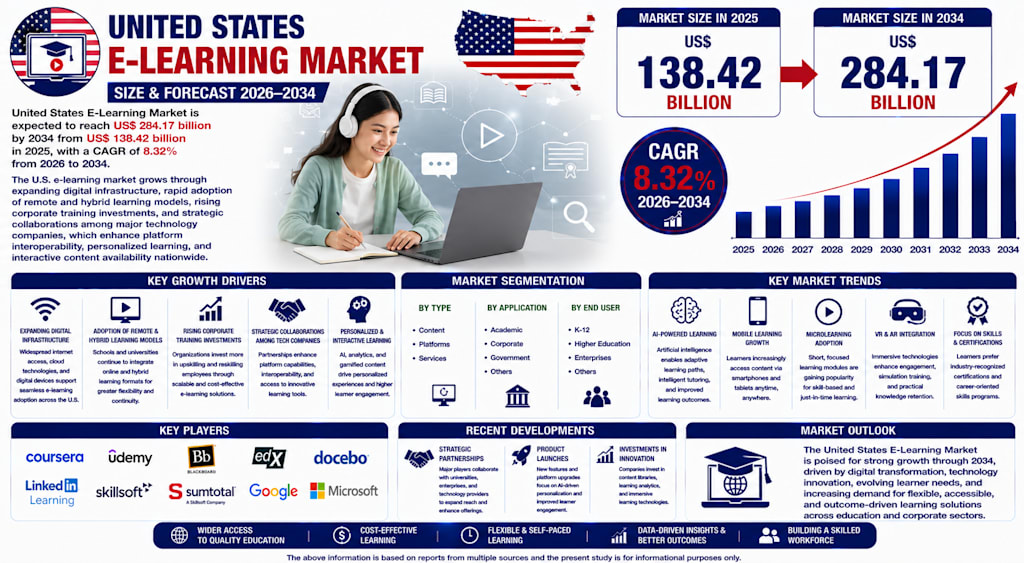
According to Renub Research, the United States E-Learning Market is expected to expand from US$ 138.42 billion in 2025 to US$ 284.17 billion by 2034, growing at a compound annual growth rate (CAGR) of 8.32% from 2026 to 2034. The market's growth is supported by expanding digital infrastructure, rising adoption of remote and hybrid learning models, increasing investments in workforce training, and continuous innovation by leading technology companies.
As digital transformation continues reshaping education and workforce development, e-learning is becoming a permanent fixture of the American learning landscape.
Understanding the Modern E-Learning Ecosystem
E-learning refers to the delivery of education, training, and professional development through digital technologies.
Unlike traditional learning models that require physical attendance, e-learning enables students and professionals to access educational content anytime and from virtually any location.
Modern e-learning solutions include:
Online courses, virtual classrooms, mobile learning applications, learning management systems (LMS), interactive multimedia modules, live video instruction, assessments, discussion forums, and collaborative learning tools.
These technologies support personalized learning experiences while allowing institutions to scale educational delivery efficiently.
The flexibility, accessibility, and cost-effectiveness of e-learning have made it an attractive option for students, employers, educators, and lifelong learners alike.
Remote and Hybrid Learning Are Here to Stay
One of the most significant shifts in recent years has been the widespread adoption of remote and hybrid learning models.
Educational institutions across the United States have integrated digital tools into daily instruction, creating more flexible and accessible learning environments.
Hybrid learning combines traditional classroom experiences with digital coursework, allowing students to benefit from both in-person interaction and online convenience.
This approach offers several advantages:
Greater flexibility, improved accessibility, personalized pacing, and enhanced resource availability.
Universities, community colleges, K–12 schools, and training organizations increasingly view hybrid education as a long-term strategy rather than a temporary solution.
As learners continue demanding greater flexibility, remote and hybrid models are expected to remain major drivers of market growth.
Technology Companies Are Accelerating Innovation
Major technology firms are playing an increasingly influential role in shaping the future of digital education.
Strategic acquisitions, partnerships, and platform enhancements are expanding the capabilities of modern e-learning ecosystems.
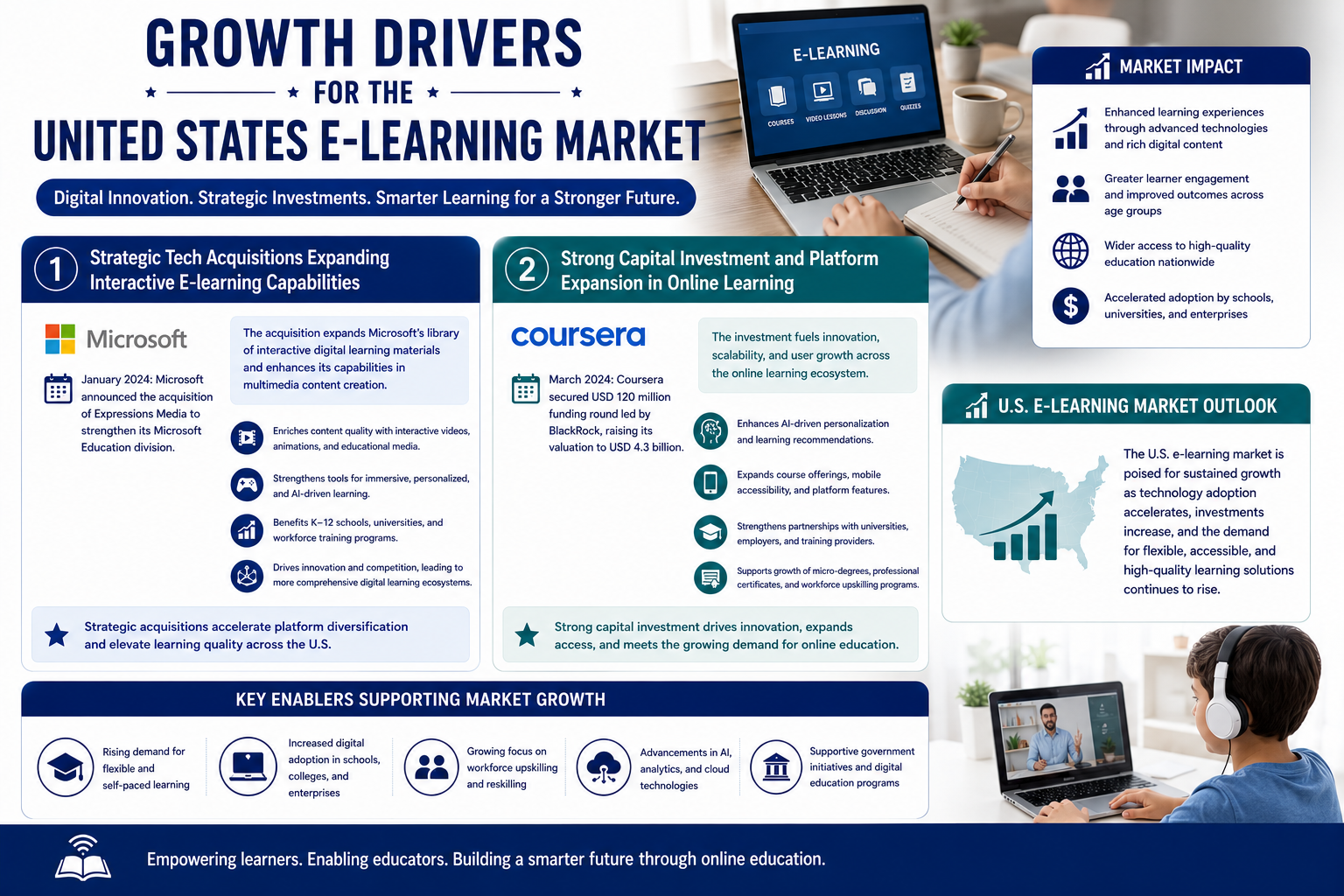
A notable example occurred in January 2024 when Microsoft announced the acquisition of Expressions Media to strengthen its Microsoft Education division and expand its portfolio of interactive digital learning resources. The acquisition supports development of richer multimedia experiences, advanced content creation tools, and more engaging educational environments.
These investments reflect growing competition among technology providers seeking to improve educational outcomes through innovation.
As artificial intelligence, analytics, and immersive learning technologies continue advancing, the quality and sophistication of digital education platforms will likely improve significantly.
Massive Investment Is Fueling Platform Expansion
Strong investor confidence continues driving innovation throughout the e-learning industry.
Large-scale funding rounds are enabling online learning providers to expand content libraries, enhance technology platforms, and improve learner experiences.
In March 2024, Coursera secured a US$120 million funding round led by BlackRock, increasing the company's valuation to approximately US$4.3 billion. The investment supports expanded course offerings, artificial intelligence integration, mobile learning improvements, and deeper partnerships with educational institutions and employers.
Investment activity is particularly important as workforce development becomes a national priority.
Companies increasingly seek platforms capable of delivering scalable training solutions in areas such as technology, healthcare, business management, and digital skills.
This ongoing flow of capital is accelerating innovation and helping expand access to high-quality educational content nationwide.
Artificial Intelligence Is Personalizing Learning
Artificial intelligence has emerged as one of the most transformative technologies within the e-learning market.
Traditional education often relies on standardized approaches that may not meet the unique needs of individual learners.
AI-powered systems help address this challenge by providing personalized learning experiences.
These technologies can:
Analyze learner behavior, recommend content, identify knowledge gaps, customize learning paths, automate assessments, and provide real-time feedback.
Personalized learning helps improve engagement, retention, and overall educational outcomes.
AI also assists educators by reducing administrative workloads and providing actionable insights regarding student performance.
As AI capabilities continue evolving, personalized learning experiences are expected to become increasingly sophisticated and widely adopted.
Platform Integration Is Creating Seamless Learning Experiences
Educational institutions often rely on multiple software platforms to manage instruction, communication, assignments, and assessments.
Cross-platform integration is helping simplify these environments.
In May 2024, Google Workspace for Education and Microsoft Education announced an integration enabling Google Classroom and Microsoft Teams to function more seamlessly together. This collaboration allows educators greater flexibility in managing assignments, communication, and classroom activities across platforms.
Integrated systems provide several benefits:
Improved efficiency, reduced administrative complexity, enhanced collaboration, and more consistent user experiences.
As schools and universities increasingly adopt diverse digital tools, interoperability will remain a key factor influencing technology adoption.
Corporate Training Is Becoming a Major Growth Engine
Corporate learning and workforce development represent one of the fastest-growing segments of the U.S. e-learning market.
Organizations across industries face constant pressure to adapt to technological change, evolving regulations, and shifting workforce requirements.
Digital learning platforms provide scalable and cost-effective solutions for:
Employee onboarding, compliance training, leadership development, technical skills training, cybersecurity education, and professional certification programs.
Employers increasingly prefer online learning because it allows employees to access training without disrupting daily operations.
Microlearning, modular certifications, and self-paced programs have become especially popular because they accommodate busy schedules while improving knowledge retention.
As workforce upskilling becomes increasingly important, corporate e-learning demand is expected to continue rising.
Learning Management Systems Remain Critical Infrastructure
Learning Management Systems (LMS) continue serving as the foundation of modern e-learning environments.
These platforms enable institutions and organizations to:
Create courses, distribute content, monitor learner progress, manage assessments, facilitate communication, and generate performance analytics.
The growing complexity of digital learning programs has increased demand for robust LMS solutions capable of supporting large-scale deployments.
Modern LMS platforms increasingly incorporate artificial intelligence, mobile compatibility, analytics dashboards, and collaborative features.
As educational institutions continue digitizing operations, LMS adoption will remain central to market growth.
Mobile Learning Expands Accessibility
Smartphones and tablets have dramatically increased access to educational content.
Mobile e-learning allows users to study anytime and anywhere, making education more accessible than ever before.
Mobile platforms support:
Video lessons, quizzes, interactive modules, discussion forums, and microlearning experiences.
This flexibility is particularly valuable for working professionals, adult learners, and individuals balancing education with other responsibilities.
Improved device accessibility and widespread broadband connectivity continue supporting mobile learning adoption across the United States.
Online Credentials Are Gaining Mainstream Acceptance
Employers increasingly recognize the value of online certifications, micro-credentials, and professional development programs.
This shift has expanded opportunities for learners seeking career advancement without committing to traditional degree programs.
Online credentials provide targeted training in areas such as:
Data analytics, cybersecurity, project management, cloud computing, artificial intelligence, healthcare administration, and business leadership.
The growing acceptance of digital credentials is encouraging more professionals to invest in continuous learning and skills development.
As labor markets evolve, credential-based education is expected to remain a major growth area within e-learning.
California Leads Digital Education Innovation
California remains one of the most influential e-learning markets in the United States.
Several factors contribute to its leadership position.
The state benefits from:
Advanced digital infrastructure, a large student population, strong university systems, significant venture capital investment, and a concentration of educational technology companies.
Educational institutions throughout California increasingly utilize artificial intelligence, adaptive learning systems, virtual classrooms, and digital assessment tools.
The state's innovation ecosystem continues shaping national trends in educational technology and online learning.
Texas and Florida Accelerate Market Growth
Texas has emerged as a major growth market due to its large student population, expanding digital infrastructure, and growing demand for workforce training.
Universities, schools, and employers throughout the state increasingly rely on online learning solutions to improve accessibility and flexibility.
Florida also plays a significant role in the national market.
The state has long been recognized for its leadership in virtual education through initiatives such as Florida Virtual School (FLVS).
Strong support for digital learning and expanding broadband access continue driving adoption throughout Florida's education system.
Recent Developments Highlight Industry Momentum
The U.S. e-learning market continues experiencing rapid innovation.
In May 2025, Udemy launched Innovation Studio, a new initiative focused on creating immersive, personalized, and AI-powered learning experiences. Its first program, AI for Business Leaders, targets executive-level workforce reskilling and reflects growing demand for outcome-based education.
Another significant development occurred in April 2025 when the U.S. Department of Education announced a US$1 billion grant program supporting adoption of Open Educational Resources (OER) across K–12 schools. The initiative aims to increase access to affordable educational materials while promoting more equitable digital learning opportunities nationwide.
These developments demonstrate continued commitment to expanding access, affordability, and educational quality.
Challenges Facing the Industry
Despite impressive growth, several challenges remain.
Digital inequality continues affecting many communities.
Students in low-income households and rural regions may lack reliable broadband access, appropriate devices, or supportive learning environments. These barriers can limit participation and contribute to educational disparities.
Another challenge involves content quality.
The rapid growth of online education has created a highly fragmented market containing thousands of courses and providers.
While many platforms offer excellent educational experiences, others lack rigorous instructional design, credible assessments, or recognized credentials. This oversaturation can make it difficult for learners and institutions to identify high-quality programs.
Addressing these challenges will be essential for ensuring sustainable long-term growth.
Final Thoughts
The United States e-learning market is undergoing a remarkable transformation driven by technological innovation, changing educational preferences, and growing demand for lifelong learning.
From AI-powered personalization and virtual classrooms to corporate upskilling and online credential programs, digital education is expanding opportunities for learners of all ages.
The combination of strong investment, platform innovation, government support, and increasing workforce development needs continues creating favorable conditions for growth.
With the market projected to expand from US$ 138.42 billion in 2025 to US$ 284.17 billion by 2034, e-learning is no longer simply an alternative to traditional education—it is becoming a central pillar of how Americans learn, develop skills, and prepare for the future.
As technology continues reshaping education, the ability to learn anytime, anywhere, and at any stage of life will remain one of the defining advantages of the digital age.
About the Creator
Enjoyed the story? Support the Creator.
Subscribe for free to receive all their stories in your feed.
Comments
There are no comments for this story
Be the first to respond and start the conversation.