
Lead Acid Battery Market Poised to Surpass $53 Billion by 2034 Despite Rising Competition from Lithium-Ion Technology
Automotive demand, industrial backup power, and high recyclability continue to strengthen the future of one of the world's oldest battery technologies.

For years, conversations about battery technology have been dominated by lithium-ion innovations, electric vehicles, and the race toward cleaner energy storage solutions. Headlines often focus on next-generation batteries that promise longer life cycles, faster charging, and greater energy density.
Yet amid all the excitement surrounding emerging technologies, one of the world's oldest battery systems continues to quietly power industries, vehicles, communication networks, and backup energy systems across the globe.
The lead acid battery.
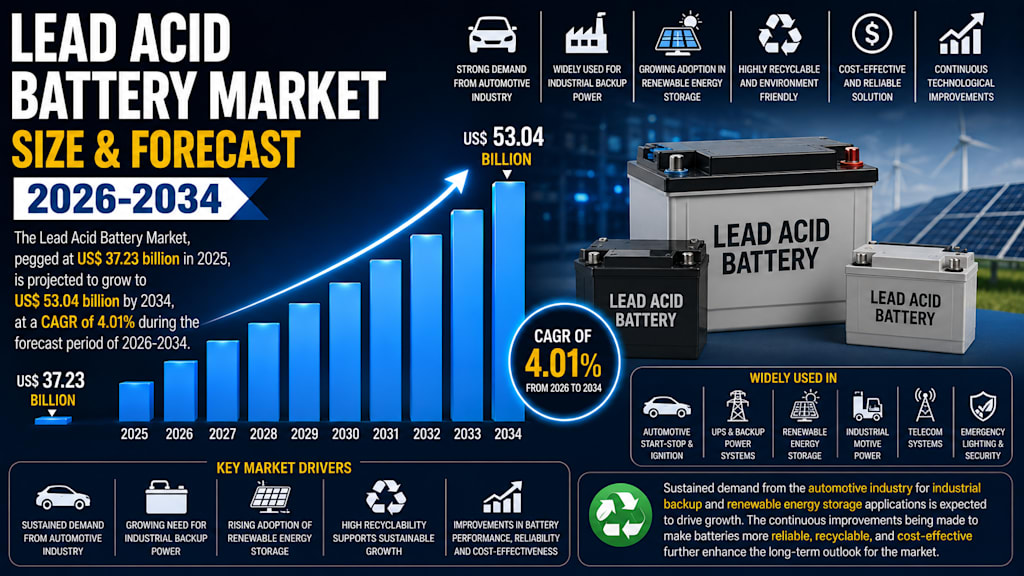
While many assume lead acid technology is becoming obsolete, market data suggests otherwise. According to Renub Research, the global Lead Acid Battery Market is expected to grow from US$ 37.23 billion in 2025 to US$ 53.04 billion by 2034, registering a compound annual growth rate (CAGR) of 4.01% between 2026 and 2034. This steady expansion highlights the continuing importance of a technology that has remained relevant for more than a century.
Far from disappearing, lead acid batteries continue to serve as a backbone for multiple industries where dependability, affordability, and recyclability matter more than cutting-edge innovation.

The Technology That Refuses to Fade Away
Lead acid batteries were first introduced in the nineteenth century, making them one of the oldest rechargeable battery technologies still in widespread commercial use today.
The technology operates using lead dioxide as the positive electrode, sponge lead as the negative electrode, and sulfuric acid as the electrolyte. While the design may seem simple compared to modern battery systems, simplicity has become one of its greatest strengths.
Over decades of development, manufacturers have refined lead acid batteries to become highly reliable, durable, and cost-effective energy storage solutions.
Unlike many newer technologies that require expensive materials or complex manufacturing processes, lead acid batteries can be produced at scale with well-established supply chains and proven recycling systems.
As a result, they remain a preferred option for countless applications around the world.
The Automotive Industry Remains a Major Growth Engine
One of the biggest reasons lead acid batteries continue to thrive is their deep connection with the automotive industry.
Most conventional internal combustion engine vehicles rely on lead acid batteries for Starting, Lighting, and Ignition (SLI) functions. These batteries provide the powerful surge current necessary to start engines quickly and reliably.
Even as electric vehicles gain momentum globally, traditional vehicles continue to dominate roads in many countries.
Millions of passenger vehicles, commercial trucks, buses, motorcycles, agricultural equipment, and construction machines still depend on lead acid batteries every day.
Furthermore, batteries eventually wear out and require replacement. This creates a recurring aftermarket opportunity that supports continuous demand.
Emerging economies in Asia, Africa, Latin America, and parts of the Middle East are witnessing growing vehicle ownership rates, further strengthening the replacement battery market.
Interestingly, even hybrid vehicles often incorporate lead acid batteries alongside advanced battery systems, ensuring continued relevance within evolving transportation ecosystems.
The Hidden Backbone of Backup Power Systems
Most consumers rarely think about backup power systems until an outage occurs.
However, hospitals, data centers, telecommunications networks, airports, financial institutions, and industrial facilities cannot afford interruptions.
In these environments, dependable backup power is essential.
Lead acid batteries play a critical role in uninterruptible power supply (UPS) systems that protect infrastructure during blackouts and power fluctuations.
As businesses become increasingly digital, the demand for reliable energy storage continues to grow.
Data centers, in particular, have emerged as significant consumers of backup battery systems. With cloud computing, artificial intelligence, and digital services expanding rapidly worldwide, operators require dependable solutions capable of delivering immediate power during emergencies.
Lead acid batteries remain attractive because they are affordable, proven, and scalable.
For many stationary backup applications, they continue to provide an excellent balance between performance and cost.
Telecommunications Expansion Is Driving Demand
Global connectivity has never been more important.
Mobile networks, internet infrastructure, and communication systems support everything from remote work to online education and digital commerce.
Telecommunication providers depend heavily on backup energy systems to ensure uninterrupted service.
Lead acid batteries are commonly deployed in telecom towers and communication facilities because of their reliability and relatively low operating costs.
This demand is particularly strong in developing regions where power interruptions remain common.
As governments and private companies continue investing in telecommunications infrastructure, battery storage requirements are expected to increase significantly.
The rollout of advanced wireless technologies and expanded rural connectivity programs will likely provide additional growth opportunities for lead acid battery manufacturers throughout the forecast period.
Renewable Energy Is Creating New Opportunities
Renewable energy adoption is accelerating globally.
Solar and wind installations are becoming increasingly common as countries seek cleaner and more sustainable energy sources.
However, renewable energy generation is inherently variable.
The sun does not always shine, and the wind does not always blow.
This challenge creates a growing need for energy storage solutions capable of balancing supply and demand.
Although lithium-ion batteries dominate many large-scale energy storage discussions, lead acid batteries continue to play an important role in smaller and cost-sensitive renewable energy projects.
Their affordability makes them particularly attractive in developing markets where infrastructure budgets may be limited.
For residential solar systems, rural electrification projects, and community energy storage applications, lead acid batteries often provide a practical and economically viable solution.
Recycling Gives Lead Acid Batteries a Powerful Advantage
Perhaps the strongest competitive advantage enjoyed by lead acid batteries is recyclability.
Few technologies can match the industry's circular economy model.
Lead acid batteries boast one of the highest recycling rates of any consumer or industrial product worldwide.
In many markets, more than 95 percent of battery materials can be recovered and reused.
Lead, plastic components, and other materials are routinely recycled and reintroduced into manufacturing processes.
This closed-loop system offers several benefits.
First, it reduces dependence on newly mined raw materials.
Second, it lowers manufacturing costs.
Third, it minimizes environmental waste.
As governments and businesses place greater emphasis on sustainability, the recycling capabilities of lead acid batteries become increasingly valuable.
The industry continues investing in advanced recycling technologies that improve efficiency and reduce environmental impact.
These improvements strengthen the long-term outlook for the market.
Challenges Are Becoming More Difficult to Ignore
Despite its strengths, the lead acid battery industry faces significant challenges.
The most prominent threat comes from lithium-ion technology.
Lithium-ion batteries offer higher energy density, lighter weight, longer cycle life, and improved charging performance.
As production scales up globally, lithium-ion costs continue to decline.
These advantages make lithium-ion batteries increasingly attractive for electric vehicles, renewable energy storage, portable electronics, and numerous industrial applications.
Competition is also emerging from newer technologies, including sodium-ion batteries and nickel-based chemistries.
Manufacturers of lead acid batteries must therefore focus on innovation, cost optimization, and specialized market segments where their products maintain clear advantages.
The industry is unlikely to disappear, but competitive pressure will continue increasing throughout the coming decade.
Environmental Concerns Remain a Critical Issue
Lead is a hazardous material.
Improper handling, disposal, or recycling can create serious environmental and health risks.
Governments around the world have implemented strict regulations governing the production, transportation, and recycling of lead acid batteries.
Compliance with these standards increases operational costs for manufacturers.
In regions where recycling infrastructure remains underdeveloped, concerns about environmental contamination can hinder market growth.
The future success of the industry will depend heavily on maintaining safe and responsible recycling practices.
Companies that invest in cleaner production methods and advanced recycling technologies will likely gain competitive advantages as sustainability expectations continue rising.
Regional Markets Shaping Future Growth
The United States remains one of the largest and most mature lead acid battery markets globally.
Strong automotive demand, extensive industrial infrastructure, and widespread use of UPS systems support consistent consumption. The country's advanced recycling ecosystem also contributes to sustainable production and supply chain stability.
India represents one of the fastest-growing opportunities in the sector.
Rapid urbanization, increasing vehicle ownership, telecom expansion, and ongoing demand for backup power solutions are driving significant market growth. Cost-effectiveness remains a major advantage in a price-sensitive market where reliable energy storage is essential.
The United Kingdom continues generating demand through automotive replacement batteries, industrial backup systems, and renewable energy applications. Strong recycling regulations further support long-term market sustainability.
Saudi Arabia is also emerging as an important market due to expanding infrastructure investments, telecommunications growth, and rising demand for industrial backup power. Harsh environmental conditions contribute to frequent automotive battery replacement cycles, supporting ongoing demand.
Innovation Is Keeping the Industry Competitive
Contrary to popular belief, lead acid battery technology is not standing still.
Manufacturers continue introducing improvements in battery life, charging performance, efficiency, and recyclability.
Advanced valve-regulated lead acid (VRLA) batteries offer improved maintenance characteristics and enhanced reliability.
New recycling technologies are helping recover valuable materials more efficiently while reducing environmental impact.
Industry leaders are also exploring hybrid solutions that combine traditional battery strengths with modern energy management systems.
These innovations help ensure that lead acid batteries remain competitive in applications where reliability and affordability outweigh the need for maximum energy density.
Looking Ahead to 2034
The global energy landscape is changing rapidly.
Electric vehicles, renewable energy systems, artificial intelligence, and digital infrastructure are transforming how societies consume and store power.
Yet this transformation does not necessarily signal the end of lead acid batteries.
Instead, it highlights the importance of matching battery technologies to specific use cases.
Lead acid batteries continue to excel in automotive starting systems, backup power applications, telecommunications infrastructure, industrial equipment, and cost-sensitive energy storage projects.
As long as these markets remain significant, demand for lead acid batteries is likely to persist.
The projected market growth to more than US$53 billion by 2034 reflects this enduring relevance.
Final Thoughts
Lead acid batteries may not receive the same attention as lithium-ion breakthroughs or next-generation energy storage technologies, but their impact on modern society remains enormous.
They start vehicles, support hospitals, power telecom networks, protect data centers, and provide backup energy when reliability matters most.
Their affordability, durability, and exceptional recyclability continue to make them indispensable across numerous industries.
While competition from newer battery technologies will undoubtedly intensify, lead acid batteries have repeatedly demonstrated their ability to adapt and survive.
The coming decade will likely see continued innovation, stronger recycling ecosystems, and expanding applications that reinforce their role within the global energy market.
For a technology that has been around for more than 160 years, the future still looks surprisingly bright.
About the Creator
Enjoyed the story? Support the Creator.
Subscribe for free to receive all their stories in your feed.
Comments
There are no comments for this story
Be the first to respond and start the conversation.