
Lead Acid Battery Market Maintains Steady Growth as Automotive Demand and Backup Power Needs Sustain Adoption
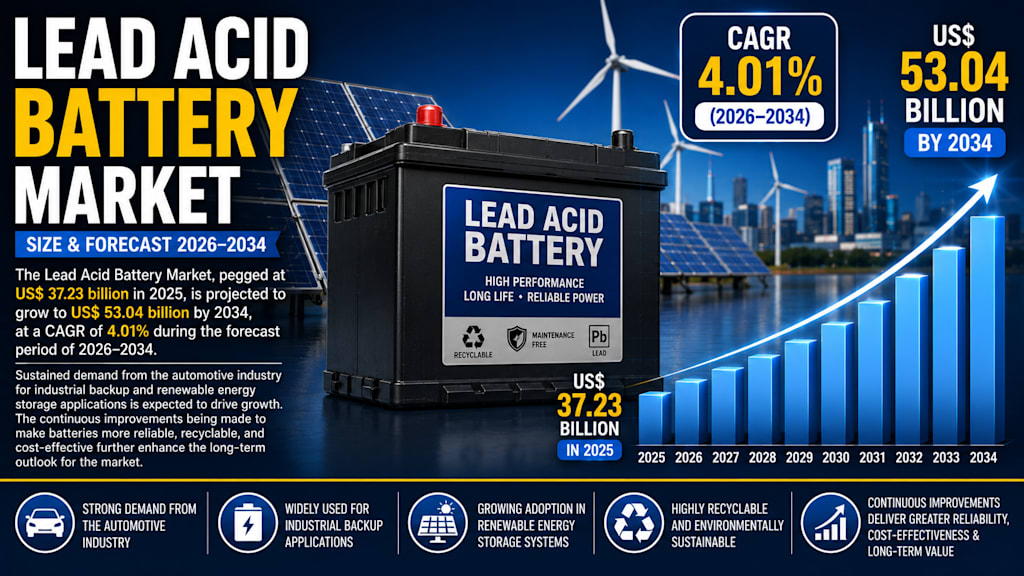
Strong demand from automotive applications, industrial backup systems, and high recyclability is driving the lead acid battery market toward US$ 53.04 billion by 2034 at a CAGR of 4.01%.

Lead Acid Battery Market Overview
The global lead acid battery market continues to demonstrate steady growth despite the emergence of advanced battery technologies. Known for their reliability, affordability, and established recycling infrastructure, lead acid batteries remain widely used across automotive, industrial, and backup power applications.
According to Renub Research, the market is projected to grow from US$ 37.23 billion in 2025 to US$ 53.04 billion by 2034, registering a CAGR of 4.01% during 2026–2034.
Lead acid batteries are one of the oldest rechargeable battery technologies, using lead dioxide and sponge lead electrodes with sulfuric acid as an electrolyte. Their ability to deliver high surge currents makes them ideal for starting, lighting, and ignition (SLI) applications in vehicles, as well as for uninterruptible power supplies (UPS) and industrial backup systems.
Despite increasing competition from lithium-ion batteries, lead acid batteries continue to hold a significant share in cost-sensitive and infrastructure-heavy applications, especially in developing economies.
Key Growth Drivers in the Lead Acid Battery Market
Strong Demand from Automotive and Transportation Sector
The automotive sector remains the backbone of the lead acid battery market. These batteries are widely used in internal combustion engine (ICE) vehicles for starting, lighting, and ignition functions due to their ability to provide high burst currents at a low cost.
Even with the rapid growth of electric vehicles (EVs), lead acid batteries continue to be used in hybrid vehicles, commercial fleets, two-wheelers, and off-road vehicles. The growing global vehicle fleet, particularly in emerging markets, is also driving replacement demand.
Increasing Use in Backup Power and Industrial Applications
Lead acid batteries play a crucial role in providing reliable backup power for industries, telecommunications, data centers, and healthcare facilities. As digital infrastructure expands globally, the need for uninterrupted power supply systems is increasing.
These batteries offer a cost-effective and scalable solution for energy storage, particularly in stationary applications. Their durability and ease of maintenance make them a preferred choice for backup power systems in both urban and rural areas.
High Recyclability and Sustainability Advantages
One of the key strengths of lead acid batteries is their high recyclability. A significant portion of the materials used in these batteries, including lead and plastic components, can be recovered and reused.
This closed-loop recycling system reduces environmental impact and production costs, making lead acid batteries one of the most sustainable battery technologies available. Governments and regulatory bodies also support recycling initiatives, further strengthening the market’s long-term outlook.
Innovations in recycling technologies, such as advanced material recovery systems, are improving efficiency and preserving valuable materials, enhancing the sustainability of the industry.
Challenges in the Lead Acid Battery Market
Competition from Advanced Battery Technologies
The increasing adoption of lithium-ion and other advanced battery technologies is a major challenge for the lead acid battery market. These alternatives offer higher energy density, longer lifespan, and lighter weight, making them more suitable for applications such as electric vehicles and renewable energy storage.
As the cost of lithium-ion batteries continues to decline, their adoption is expanding into areas traditionally dominated by lead acid batteries, creating competitive pressure on the market.
Environmental and Health Concerns
Lead is a toxic material, and improper handling or recycling can pose significant environmental and health risks. Strict regulations governing manufacturing, transportation, and recycling processes increase compliance costs for manufacturers.
In regions with inadequate recycling infrastructure, environmental concerns can limit market growth and lead to stricter regulatory controls.
Segment Insights in Lead Acid Battery Market
SLI (Starting, Lighting, and Ignition) Batteries
The SLI segment is a key component of the automotive industry, providing the high burst current required to start engines. This segment remains one of the largest contributors to market revenue.
Flooded Lead Acid Batteries
Flooded batteries are widely used in automotive and industrial applications due to their low cost and durability. They are particularly suitable for heavy-duty applications and environments where maintenance is manageable.
OEM Lead Acid Batteries
OEM batteries are supplied directly to vehicle manufacturers for installation in new vehicles. Strong partnerships between battery manufacturers and automakers ensure consistent demand in this segment.
Automotive Lead Acid Batteries
This segment includes batteries used in passenger cars, commercial vehicles, and two-wheelers. High replacement rates and growing vehicle ownership contribute significantly to market growth.
Telecom Lead Acid Batteries
Telecommunication infrastructure relies heavily on lead acid batteries for backup power. As connectivity expands globally, especially in developing regions, demand for telecom batteries continues to rise.
United States Lead Acid Battery Market
The United States is a mature market with strong demand from automotive, industrial, and backup power sectors. A large vehicle fleet drives consistent replacement demand, while data centers and healthcare facilities rely on lead acid batteries for uninterrupted power supply.
High recycling rates and strict environmental regulations support sustainable production and usage. Despite growing adoption of alternative technologies, lead acid batteries remain widely used due to their cost advantages.
United Kingdom Lead Acid Battery Market
The UK market is driven by automotive replacement demand and industrial backup power applications. Strict recycling regulations ensure environmental compliance, while ongoing investments in energy storage and electric mobility influence market dynamics.
Although electric vehicle adoption poses long-term challenges, lead acid batteries continue to play a role in start-stop systems and backup power solutions.
India Lead Acid Battery Market
India is one of the fastest-growing markets, supported by rapid urbanization, expanding automotive production, and increasing demand for backup power solutions. Frequent power outages and growing telecom infrastructure further boost demand.
The affordability and availability of lead acid batteries make them a preferred choice in residential, commercial, and industrial applications.
Saudi Arabia Lead Acid Battery Market
Saudi Arabia’s market is driven by demand from automotive, telecom, and industrial sectors. Harsh climatic conditions increase replacement rates for automotive batteries, while infrastructure development and connectivity expansion support demand for backup power solutions.
Despite interest in advanced battery technologies, lead acid batteries remain widely used due to their cost-effectiveness and reliability.
Market Segmentation
The lead acid battery market is segmented by product type, construction method, sales channel, application, and geography. Products include SLI, stationary, and motive batteries, while construction methods include flooded and valve-regulated sealed batteries.
Applications span automotive, UPS, telecom, and other sectors, with markets distributed across North America, Europe, Asia-Pacific, Latin America, and the Middle East & Africa.
Key Companies in the Lead Acid Battery Market
Leading players include EnerSys, Exide Industries Limited, GS Yuasa Corporation, HBL Power Systems Limited, Leoch International Technology Limited, Panasonic Holdings Corporation, and Teledyne Technologies Incorporated. These companies are focusing on improving efficiency, sustainability, and cost-effectiveness to remain competitive.
Final Thoughts
The lead acid battery market continues to play a vital role in global energy storage and automotive applications. Its reliability, affordability, and well-established recycling ecosystem ensure its relevance despite growing competition from advanced technologies.
While challenges such as environmental concerns and technological competition persist, ongoing innovation and strong demand from key industries position the market for steady growth in the coming years.
About the Creator
Enjoyed the story? Support the Creator.
Subscribe for free to receive all their stories in your feed.
Comments
There are no comments for this story
Be the first to respond and start the conversation.