
Japan Watch Market Expected to Reach US$ 7.55 Million by 2034 as Technological Innovation and Strong Domestic Brands Drive Stable Growth
Rising Demand for Functional Timepieces, Minimalist Designs, and Smart-Enabled Features Is Reshaping Japan’s Watch Industry

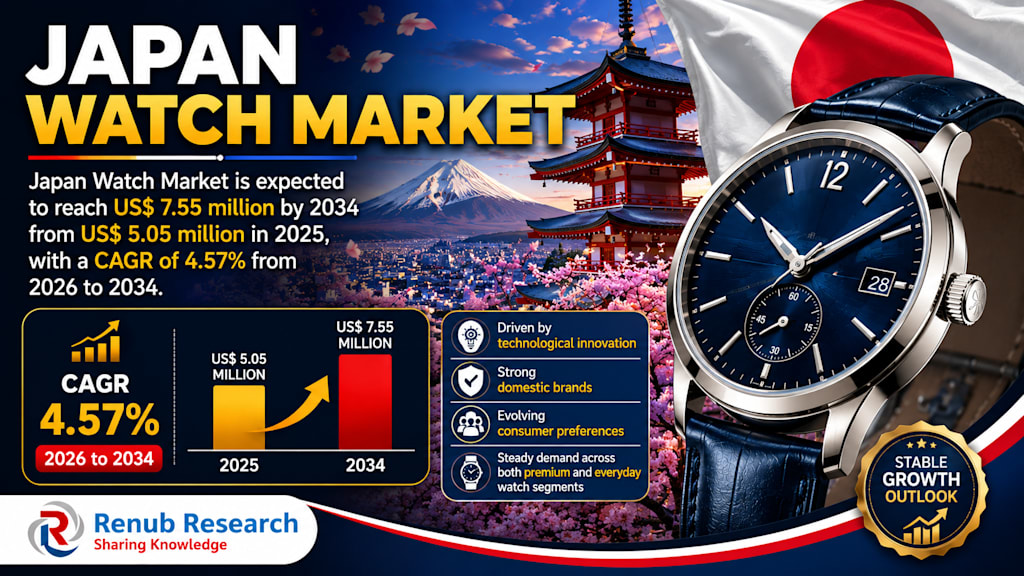
The Japan watch market continues to hold a globally respected position, driven by the country’s long-standing reputation for precision engineering, technological innovation, and reliable craftsmanship. From affordable quartz watches and multifunctional electronic models to premium luxury timepieces, Japan’s watch industry remains one of the most influential and technologically advanced markets in the world.
According to Renub Research, the Japan watch market is projected to grow from US$ 5.05 million in 2025 to US$ 7.55 million by 2034, expanding at a CAGR of 4.57% between 2026 and 2034. Stable growth is expected to be supported by technological leadership, strong domestic brand loyalty, evolving consumer preferences, and steady demand across both premium and everyday watch categories.
Japan has long been recognized as a pioneer in quartz and electronic watchmaking technologies that transformed the global timepiece industry. Today, the market balances tradition with innovation, offering consumers a wide range of products that combine functionality, minimalist aesthetics, and advanced engineering.
Domestic brands continue enjoying strong consumer trust, while international luxury labels maintain a notable presence, creating a highly competitive but quality-focused marketplace.
As digitalization, lifestyle changes, and technological integration continue evolving, Japan’s watch industry is adapting to meet modern consumer expectations while preserving its heritage of craftsmanship and reliability.
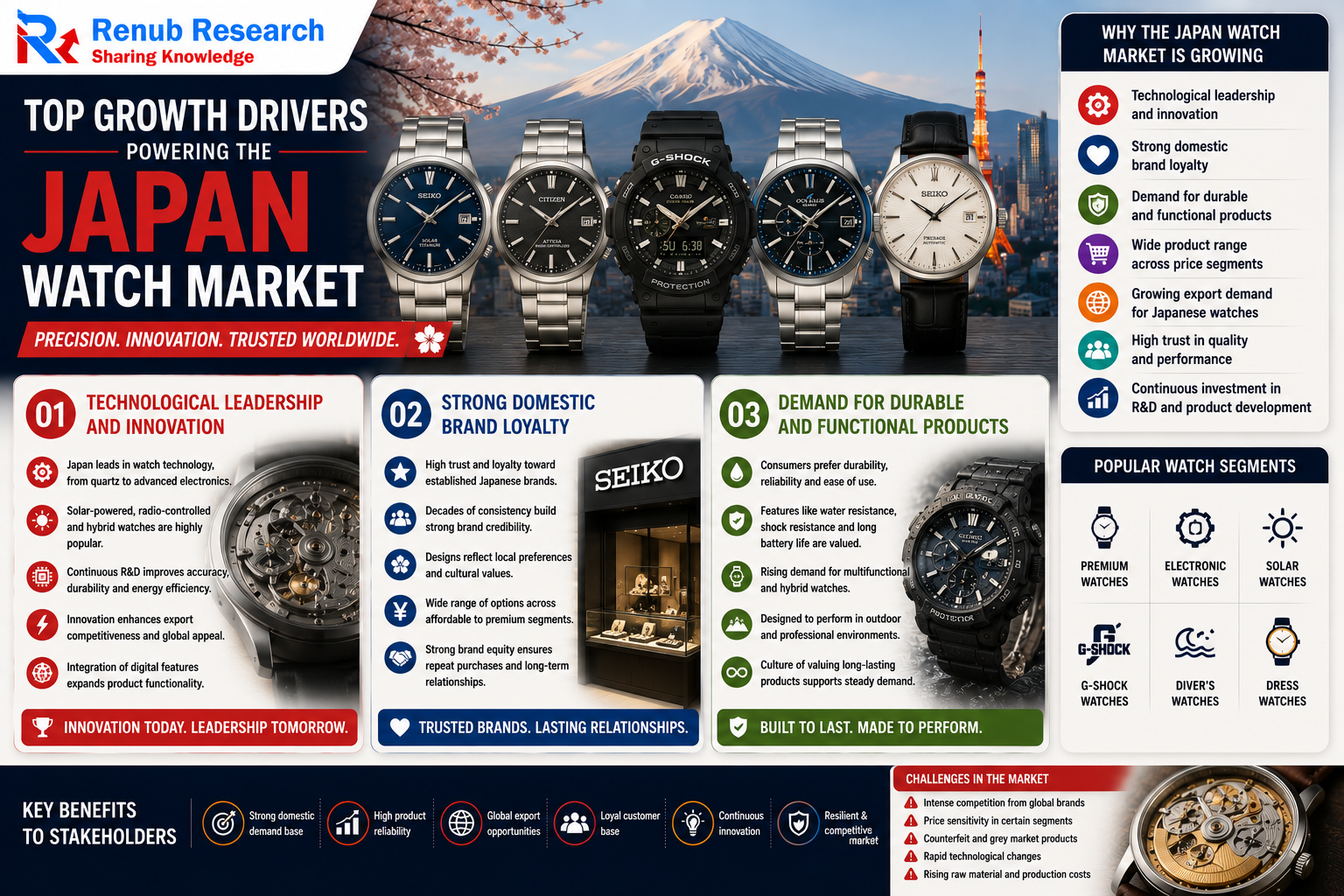
Technological Leadership Continues Driving Market Growth
One of the strongest growth drivers behind Japan’s watch market is the country’s global leadership in watch technology and innovation.
Japanese manufacturers have consistently invested in research and development to improve:
- Accuracy
- Durability
- Energy efficiency
- Functionality
- Lightweight construction
- Product longevity
Japan’s legacy in quartz and electronic watchmaking continues influencing modern product development across the industry.
Consumers strongly associate Japanese watches with reliability and advanced engineering, which supports both domestic demand and international competitiveness.
Features such as:
- Solar-powered mechanisms
- Radio-controlled timekeeping
- Hybrid technologies
- Energy-efficient systems
- Multifunctional capabilities
have become increasingly popular among consumers seeking convenience and dependable performance.
Manufacturers are also gradually integrating digital and smart-enabled features into traditional watch designs to remain competitive within a rapidly evolving consumer electronics landscape.
This continuous focus on innovation ensures the Japanese watch industry remains relevant in an increasingly technology-driven global market.
Strong Domestic Brand Loyalty Supports Stable Demand
Japanese consumers continue demonstrating strong loyalty toward domestic watch brands.
Long-established companies have built reputations over decades by consistently delivering quality, durability, and value.
This trust significantly influences purchasing decisions, particularly among middle-aged and older consumers who prioritize reliability and craftsmanship.
Domestic brands are especially successful because they understand local consumer preferences and cultural aesthetics.
Manufacturers frequently emphasize:
- Precision craftsmanship
- Heritage and reputation
- Functional excellence
- Minimalist design philosophy
- Long product life cycles
These qualities strongly resonate with Japanese consumers who often prioritize practicality and product longevity over trend-driven consumption.
Domestic companies also benefit from offering products across multiple price segments, allowing them to appeal to a broad consumer base ranging from students and professionals to affluent luxury buyers.
This widespread acceptance helps strengthen their competitive position against international brands operating within Japan.
Functional and Durable Products Remain Highly Preferred
Practicality and functionality remain central to consumer preferences within the Japanese watch market.
Unlike some fashion-driven markets where aesthetics dominate purchasing decisions, Japanese consumers often prioritize watches that deliver dependable long-term performance.
Consumers strongly value features such as:
- Water resistance
- Shock resistance
- Long battery life
- Lightweight materials
- Precision timekeeping
- Ease of use
This strong focus on reliability has encouraged manufacturers to produce watches suitable for professional, outdoor, and everyday environments.
Multifunctional watches with electronic or hybrid capabilities are also gaining popularity as consumers seek products that combine convenience with modern functionality.
The cultural preference for long-lasting products further supports demand for high-quality timepieces that offer durability and extended usability.
This emphasis on practicality continues contributing to stable and consistent market growth across multiple watch categories.
Smartwatch Adoption Continues Challenging Traditional Segments
Despite stable growth, the Japan watch market faces increasing pressure from the rapid adoption of smartwatches and wearable devices.
Younger consumers are increasingly attracted to devices that provide:
- Health monitoring
- Fitness tracking
- Smartphone connectivity
- Notifications
- Multifunctional convenience
This shift has significantly impacted demand for conventional watches, particularly in lower and mid-range categories.
As smart devices continue advancing technologically, they increasingly replace traditional timekeeping functions for many consumers.
Traditional watch manufacturers are responding by:
- Integrating digital features
- Developing hybrid products
- Repositioning watches as lifestyle accessories
- Emphasizing craftsmanship and luxury appeal
However, adapting to rapid technological change requires substantial investment and can challenge long-standing brand identities rooted in traditional watchmaking.
Without effective innovation strategies, some traditional segments may face long-term demand pressure.
Market Saturation and Demographic Challenges Remain Concerns
Japan’s mature consumer economy also creates structural challenges for the watch industry.
The country’s relatively slow population growth and aging demographics limit opportunities for rapid market expansion.
Additionally, Japan’s watch market is highly saturated, with consumers already having access to a wide range of products across all price segments.
Many consumers already own multiple watches, reducing replacement frequency and limiting volume growth opportunities.
This saturation intensifies competition among brands and increases the importance of differentiation through:
- Innovation
- Branding
- Design specialization
- Niche targeting
- Value-added functionality
Changing consumer habits and cautious spending behavior also influence purchasing decisions, particularly during periods of economic uncertainty.
To sustain long-term growth, manufacturers must continue finding ways to create unique value propositions within a highly mature marketplace.
Quartz Watches Continue Dominating Everyday Demand
Quartz watches remain one of the most important segments within Japan’s watch industry.
Japan’s historical leadership in quartz technology continues supporting strong consumer confidence in this category.
Quartz watches are widely preferred because they offer:
- High precision
- Low maintenance requirements
- Affordable pricing
- Dependable everyday performance
Professionals, older consumers, and mainstream buyers particularly appreciate the simplicity and reliability of quartz models.
Manufacturers continue improving quartz technology through enhanced energy efficiency, lightweight materials, and refined aesthetics.
Despite increasing competition from smartwatches and multifunctional wearables, quartz watches continue maintaining stable demand because of their practicality and cost-effectiveness.
Electronic Watches Continue Expanding Through Innovation
Electronic watches represent another highly important and evolving segment within Japan’s market.
These products combine traditional watchmaking with advanced digital functionality, appealing especially to younger and technology-oriented consumers.
Popular features within this segment include:
- Digital displays
- Alarms and timers
- Multifunctional capabilities
- Energy-efficient systems
- Durable construction
Manufacturers continue focusing on combining functionality with sleek and modern design aesthetics to broaden consumer appeal.
Electronic watches also increasingly overlap with smart-enabled products, helping bridge the gap between traditional watches and fully connected wearable devices.
Strong brand recognition and competitive pricing continue supporting steady growth within this category.
Unisex Watches Are Becoming Increasingly Popular
The unisex watch segment is gaining strong momentum in Japan as consumer preferences shift toward versatility and minimalist design.
Consumers increasingly prefer neutral aesthetics and flexible accessories suitable for multiple occasions and styles.
Younger demographics particularly favor:
- Minimalist designs
- Adjustable sizing
- Lightweight materials
- Clean aesthetics
- Multifunctional versatility
Manufacturers are increasingly creating gender-neutral collections designed to appeal across broader lifestyle categories.
Japan’s strong gifting culture also contributes to demand because unisex watches are suitable for a wide range of recipients and occasions.
As fashion trends continue evolving toward simplicity and inclusivity, the unisex segment is expected to maintain strong growth.
Luxury Watches Continue Attracting Affluent Buyers
Japan’s luxury watch segment remains highly influential due to strong consumer appreciation for craftsmanship, exclusivity, and precision engineering.
Luxury watches are often viewed as:
- Investment pieces
- Status symbols
- Heritage products
- Collectible assets
Consumers within this segment strongly value limited editions, bespoke craftsmanship, and premium materials.
Both domestic and international luxury brands compete aggressively within Japan’s premium market.
Luxury boutiques and department stores remain highly important retail channels because affluent consumers often prefer personalized in-store experiences and product consultations.
Despite broader economic fluctuations, demand for luxury watches remains relatively resilient due to strong brand loyalty and cultural appreciation for quality craftsmanship.
Hypermarkets and Supermarkets Continue Supporting Accessibility
Hypermarkets and supermarkets remain important retail channels within Japan’s watch market, particularly for affordable and mid-range products.
These outlets primarily serve price-sensitive consumers seeking convenient and accessible shopping experiences.
Consumers often purchase watches alongside household goods, creating strong opportunities for impulse buying.
Domestic brands dominate this segment by offering competitively priced and highly functional products designed for everyday use.
Although online retail continues growing, physical mass-market retail channels remain highly relevant due to convenience and accessibility.
E-Commerce Continues Expanding Across the Industry
Digital retail channels are becoming increasingly important within Japan’s watch market.
Consumers increasingly appreciate the convenience of online shopping, particularly for product comparison, customer reviews, and broader product accessibility.
However, physical retail continues playing a major role because many Japanese consumers still prefer evaluating watches in person before purchasing.
The coexistence of digital convenience and in-store experiences is creating a balanced omnichannel retail environment throughout the market.
Tokyo Leads the National Market
Tokyo remains Japan’s largest and most influential watch market due to its dense urban population, high consumer spending, and strong fashion culture.
The city supports strong demand across both luxury and functional watch categories.
Consumers in Tokyo are highly receptive to technological innovation, fashion-oriented collections, and premium craftsmanship.
Kansai, Aichi, and Kanagawa Continue Supporting Demand
The Kansai region remains an important market due to its large urban population and strong retail infrastructure.
Aichi and Kanagawa also contribute significantly through steady demand for reliable, practical, and technologically advanced watches among professionals and middle-income consumers.
These regions continue benefiting from stable economic activity and strong consumer trust in domestic brands.
Major Companies Continue Competing Through Innovation
Leading companies competing within Japan’s watch market include:
- Seiko Holdings Corporation
- Casio Computer Co. Ltd
- Timex Group
- Rolex SA
Compagnie Financière Richemont S.A
- The Swatch Group Ltd
- Citizen Watch Co. Ltd.
- Fossil Group Inc.
- Google LLC
Competition increasingly centers around technological innovation, durability, sustainability, and multifunctional product development.
The Future of the Japan Watch Market
The future of the Japan watch market appears stable and innovation-driven as consumers continue valuing precision, durability, and technological sophistication.
Quartz leadership, electronic innovation, luxury craftsmanship, and hybrid watch technologies are expected to remain major long-term growth drivers.
At the same time, manufacturers capable of balancing traditional craftsmanship with evolving digital expectations are likely to maintain strong competitive positions.
As Japan continues combining heritage watchmaking with advanced technological innovation, the country’s watch market is expected to maintain steady growth through 2034.
Final Thoughts
The Japan watch market continues evolving as consumers increasingly seek products that combine functionality, reliability, craftsmanship, and modern innovation. Watches in Japan are valued not only as practical tools but also as lifestyle accessories reflecting quality and personal identity.
Although smartwatch adoption and demographic challenges remain important concerns, strong domestic brand loyalty, technological leadership, and continued innovation continue positioning the industry for stable long-term growth.
About the Creator
Enjoyed the story? Support the Creator.
Subscribe for free to receive all their stories in your feed.
Comments
There are no comments for this story
Be the first to respond and start the conversation.