
Japan Retinal Surgery Device Market Outlook 2025–2033: How Advanced Ophthalmic Technologies Are Transforming Vision Care
An aging population, rising retinal disease cases, and rapid innovation in surgical technologies are driving strong growth in Japan's retinal surgery device market.

Japan has long been recognized as one of the world's leaders in healthcare innovation and medical technology. As the country's population continues to age, the demand for advanced healthcare services has expanded across numerous specialties, including ophthalmology. Eye health has become an increasingly important focus area, particularly because age-related vision disorders can significantly affect quality of life, independence, and overall well-being.
Among the various ophthalmic conditions affecting Japanese patients, retinal diseases have emerged as a major healthcare concern. Disorders such as diabetic retinopathy, age-related macular degeneration, retinal detachment, epiretinal membranes, and macular holes are becoming increasingly common as the population grows older and chronic diseases become more prevalent.
To address these challenges, healthcare providers are increasingly relying on advanced retinal surgery devices that improve surgical precision, reduce recovery times, and enhance patient outcomes. Continuous innovation in microsurgical instruments, imaging systems, vitrectomy platforms, and laser technologies is transforming the way retinal procedures are performed throughout Japan.
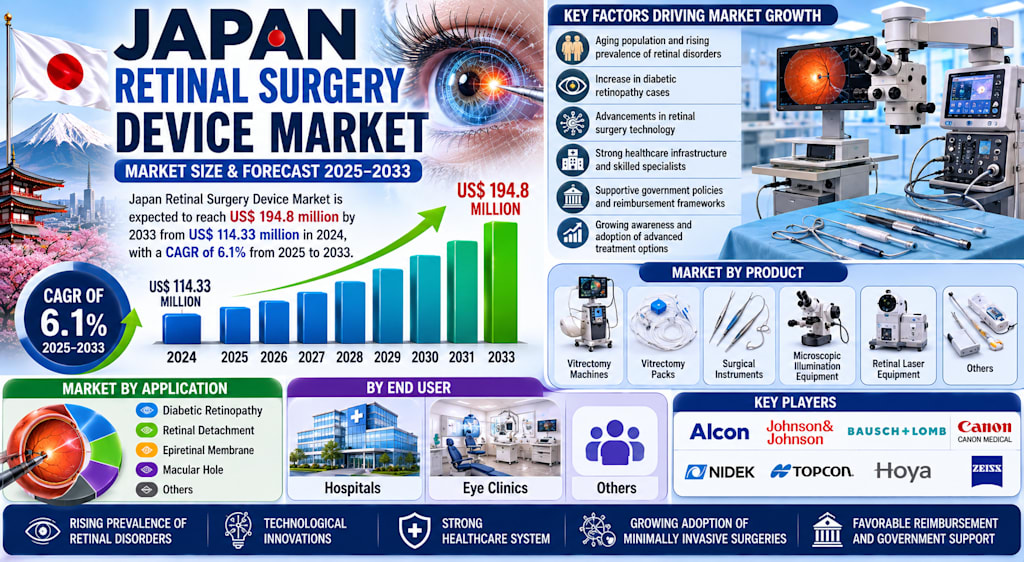
According to Renub Research, the Japan Retinal Surgery Device Market is expected to grow from US$ 114.33 million in 2024 to US$ 194.8 million by 2033, registering a compound annual growth rate (CAGR) of 6.1% from 2025 to 2033.
As technological advancements continue accelerating and demand for specialized eye care rises, retinal surgery devices are expected to play an increasingly critical role in Japan's healthcare system.
Understanding Retinal Surgery Devices
Retinal surgery devices are specialized medical instruments and equipment used to diagnose, treat, and manage diseases affecting the retina, the light-sensitive tissue located at the back of the eye.
The retina plays a vital role in vision by converting light into signals that are transmitted to the brain. Damage to this delicate structure can lead to severe visual impairment or blindness if left untreated.
Modern retinal surgery requires highly precise instruments capable of operating within extremely small anatomical spaces. Common retinal surgery devices include vitrectomy machines, surgical instruments, retinal laser systems, microscopic illumination equipment, and specialized surgical packs.
These technologies enable ophthalmic surgeons to treat a wide range of retinal disorders while minimizing tissue damage and improving surgical outcomes.
Advancements in imaging, visualization, and microsurgical techniques have significantly enhanced the effectiveness of retinal procedures, making treatment safer and more accessible for patients.
As retinal diseases continue becoming more prevalent, demand for advanced surgical technologies is expected to rise steadily across Japan.
Aging Population Is Driving Market Growth
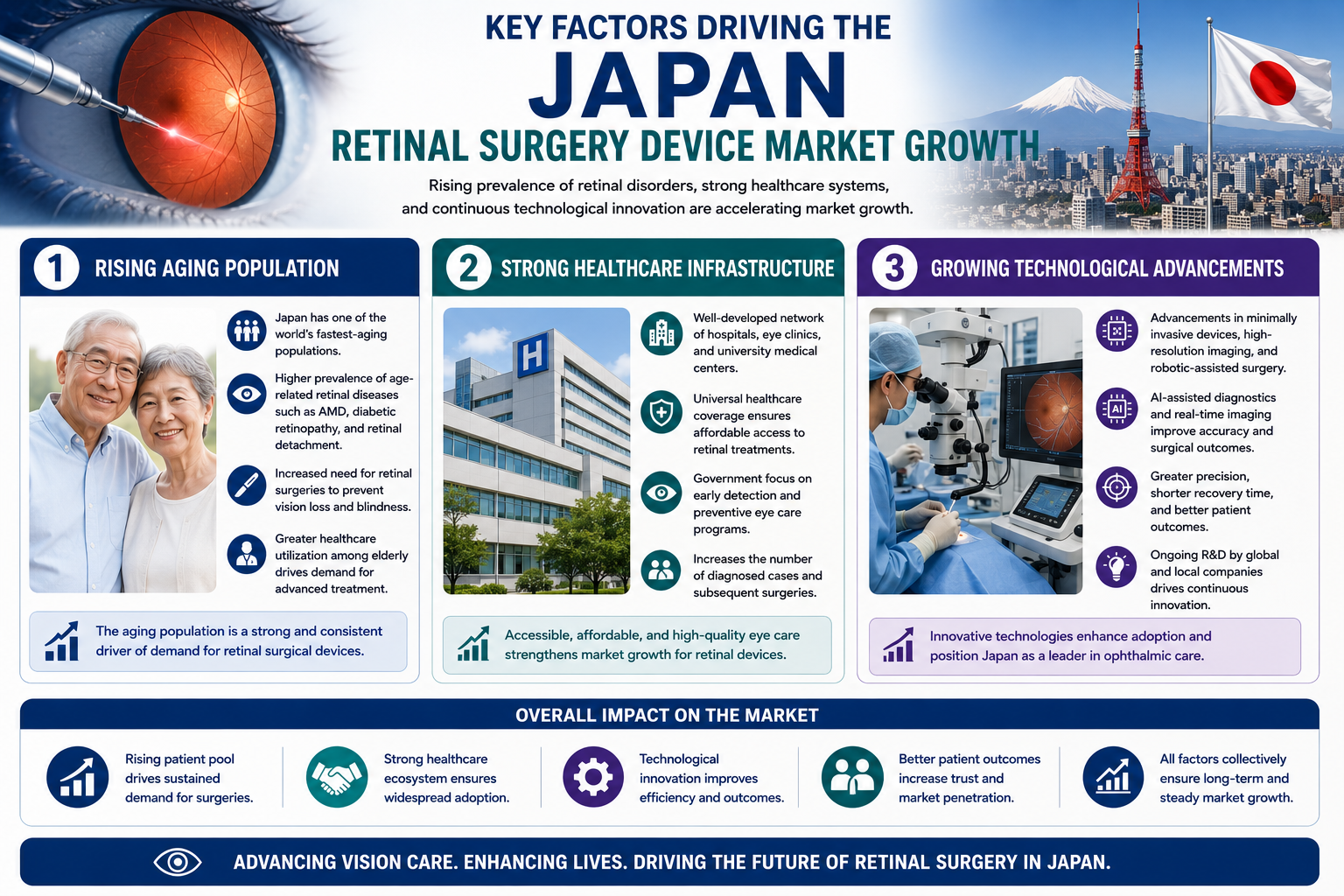
One of the most significant factors supporting growth in Japan's retinal surgery device market is the country's rapidly aging population.
Japan has one of the highest life expectancies in the world, resulting in a steadily growing elderly population. While longer life expectancy is a positive achievement, it also increases the prevalence of age-related health conditions, including retinal disorders.
Diseases such as age-related macular degeneration, retinal detachment, and diabetic retinopathy occur more frequently among older adults and often require specialized surgical intervention.
As the number of elderly patients increases, healthcare providers are witnessing rising demand for retinal diagnostic and treatment services.
Many older individuals actively seek medical care to preserve vision and maintain independence, further contributing to demand for advanced ophthalmic procedures.
The growing need for age-related eye care is expected to remain one of the strongest long-term drivers of market expansion.
Rising Cases of Diabetic Retinopathy Are Increasing Demand
Diabetes continues to represent a major public health concern in Japan, contributing significantly to the incidence of diabetic retinopathy.
Diabetic retinopathy develops when prolonged high blood sugar levels damage blood vessels within the retina, potentially leading to vision loss if untreated.
As diabetes prevalence increases due to changing lifestyles, urbanization, and demographic factors, the number of patients requiring retinal treatment is also growing.
Early diagnosis and timely surgical intervention are critical for preserving vision and preventing complications.
Retinal surgery devices play an essential role in treating advanced diabetic retinopathy cases through procedures such as vitrectomy and laser therapy.
Healthcare providers increasingly rely on advanced surgical technologies to improve outcomes and reduce the risk of permanent blindness.
As awareness regarding diabetes management and eye health continues improving, demand for retinal surgery equipment is expected to remain strong.
Strong Healthcare Infrastructure Supports Market Development
Japan's highly developed healthcare system provides a solid foundation for the growth of the retinal surgery device market.
The country benefits from an extensive network of hospitals, university medical centers, specialized eye clinics, and research institutions that provide advanced ophthalmic care.
Universal healthcare coverage ensures that a large proportion of the population can access diagnostic services, surgical procedures, and specialist consultations.
Government support for preventive healthcare and early disease detection has encouraged routine eye examinations and retinal screenings.
As retinal conditions are increasingly identified at earlier stages, demand for both diagnostic and surgical interventions continues rising.
Healthcare providers are also investing in modern equipment and advanced surgical platforms to maintain high standards of patient care.
This robust healthcare infrastructure remains a major advantage for the continued expansion of Japan's retinal surgery device industry.
Technological Innovation Is Transforming Retinal Surgery
Rapid technological advancement is one of the most exciting developments within the retinal surgery device market.
Modern retinal procedures now benefit from innovations in imaging systems, laser technologies, microsurgical instruments, and robotic-assisted surgical platforms.
High-resolution imaging technologies enable surgeons to visualize retinal structures with remarkable accuracy, improving diagnosis and treatment planning.
Advanced vitrectomy systems allow surgeons to perform delicate procedures more efficiently while reducing trauma to surrounding tissues.
Microscopic illumination technologies provide enhanced visibility during surgery, improving procedural precision and safety.
Artificial intelligence and real-time imaging integration are also beginning to influence ophthalmic surgery by supporting decision-making and workflow optimization.
These innovations contribute to better clinical outcomes, shorter recovery periods, and increased patient satisfaction.
As research and development efforts continue expanding, the market is expected to benefit from a steady stream of technological breakthroughs.
Vitrectomy Machines Remain Essential
Vitrectomy machines represent one of the most important product segments within the retinal surgery device market.
Vitrectomy is a surgical procedure that involves removing the vitreous gel from the eye to access and treat retinal conditions.
This procedure is commonly performed for retinal detachment, diabetic retinopathy, macular holes, and epiretinal membranes.
Modern vitrectomy systems offer enhanced fluid control, improved cutting speeds, and greater surgical precision.
Technological improvements have made these procedures safer and more effective, reducing complication rates and improving patient outcomes.
As the number of retinal surgeries continues increasing, demand for advanced vitrectomy equipment is expected to remain strong throughout the forecast period.
Retinal Laser Equipment Continues Expanding Applications
Retinal laser systems remain a cornerstone of modern ophthalmic treatment.
Laser technology is widely used to treat diabetic retinopathy, retinal tears, vascular abnormalities, and other retinal disorders.
Compared to traditional surgical approaches, laser procedures often provide minimally invasive treatment options with shorter recovery times.
Advances in laser technology have improved treatment precision while minimizing damage to surrounding tissues.
Patients increasingly benefit from outpatient procedures that offer effective treatment with reduced discomfort and faster recovery.
As laser systems become more sophisticated, their applications within retinal care continue expanding.
The growing preference for minimally invasive therapies is expected to support ongoing demand for retinal laser equipment across Japan.
Hospitals Continue Dominating Market Demand
Hospitals remain the largest end-user segment within the retinal surgery device market.
Large hospitals typically possess the specialized infrastructure, surgical expertise, and advanced equipment required for complex retinal procedures.
Many patients are referred to hospital-based ophthalmology departments for diagnosis, treatment, and surgical management of retinal disorders.
Hospitals also serve as important centers for medical education, research, and clinical innovation.
Investments in advanced ophthalmic technologies continue strengthening hospital demand for modern retinal surgery devices.
As healthcare institutions focus on improving treatment outcomes and operational efficiency, hospitals are expected to remain the dominant consumers of retinal surgical equipment.
Eye Clinics Are Becoming Increasingly Important
Specialized eye clinics are playing a growing role in Japan's ophthalmic healthcare landscape.
These facilities offer focused eye care services, often providing faster access to consultations, diagnostics, and treatment than larger hospitals.
Many clinics are investing in advanced retinal imaging systems, laser equipment, and surgical technologies to expand service offerings.
Patients increasingly appreciate the convenience and personalized care available through specialized ophthalmology practices.
As awareness regarding retinal disease and preventive eye care continues increasing, demand for services provided by eye clinics is expected to grow steadily.
This trend is creating additional opportunities for manufacturers of retinal surgery devices.
High Device Costs Remain a Challenge
Despite strong growth prospects, the market faces several challenges.
One of the most significant obstacles is the high cost associated with advanced retinal surgical equipment.
Sophisticated technologies such as robotic-assisted surgical systems, high-resolution imaging platforms, and premium laser devices require substantial financial investment.
Large hospitals may be able to absorb these costs, but smaller clinics and regional healthcare facilities often face budget limitations.
Additional expenses related to maintenance, training, software upgrades, and equipment integration can further increase financial burdens.
These cost considerations may slow adoption rates in certain healthcare settings despite the clear clinical benefits offered by advanced technologies.
Shortage of Specialized Retinal Surgeons
Another challenge affecting market growth is the shortage of highly specialized ophthalmic surgeons trained in advanced retinal procedures.
Retinal surgery requires extensive expertise, precision, and familiarity with complex technologies.
Training new specialists requires significant time and resources, contributing to workforce limitations in some regions.
Outside major urban centers, access to experienced retinal surgeons can be limited, resulting in treatment delays and reduced utilization of advanced surgical equipment.
Even when sophisticated technologies are available, a shortage of qualified professionals may prevent healthcare facilities from fully leveraging their capabilities.
Addressing workforce development remains an important priority for the long-term growth of Japan's retinal surgery market.
Competitive Landscape
The Japan retinal surgery device market features strong competition among leading global and regional medical technology companies.
Major industry participants include Topcon Corporation, Alcon AG, Carl Zeiss, Bausch Health Companies Inc., Iridex Corporation, Escalon Medicals, Quantel Medical, and Rhein Medical Inc.
These companies continue investing heavily in product innovation, imaging technologies, laser systems, and surgical precision tools to strengthen their market positions.
Strategic partnerships, research collaborations, and new product launches remain important competitive strategies as companies seek to address evolving clinical needs.
Continuous investment in research and development is expected to drive future innovation throughout the industry.
Final Thoughts
Japan's retinal surgery device market is entering a period of sustained growth driven by demographic changes, rising retinal disease prevalence, advanced healthcare infrastructure, and continuous technological innovation. As vision-related disorders become increasingly common among aging populations, the demand for effective and precise retinal treatment solutions continues to rise.
Advancements in vitrectomy systems, laser technologies, imaging platforms, and microsurgical instruments are improving patient outcomes while expanding treatment possibilities for complex retinal conditions.
With the market projected to grow from US$ 114.33 million in 2024 to US$ 194.8 million by 2033, retinal surgery devices will remain an essential component of Japan's ophthalmic healthcare ecosystem. As innovation and accessibility continue improving, these technologies are expected to play a vital role in preserving vision and enhancing quality of life for millions of patients across the country.
About the Creator
Enjoyed the story? Support the Creator.
Subscribe for free to receive all their stories in your feed.
Comments
There are no comments for this story
Be the first to respond and start the conversation.