
Japan Isn't Losing to India. It's Losing to Itself.
The IMF says Japan will fall to sixth place by 2027. India's rise is real. Britain's is a currency trick. And Japan's problem isn't the ranking at all.
The IMF's latest World Economic Outlook has produced a headline eye-catching enough: Japan's nominal GDP will be overtaken by both India and the United Kingdom in 2027, falling from fourth globally to sixth. Japanese media framed it as "the continued decline of Japan's status as an economic power," and most market attention landed on "Japan has dropped another place."
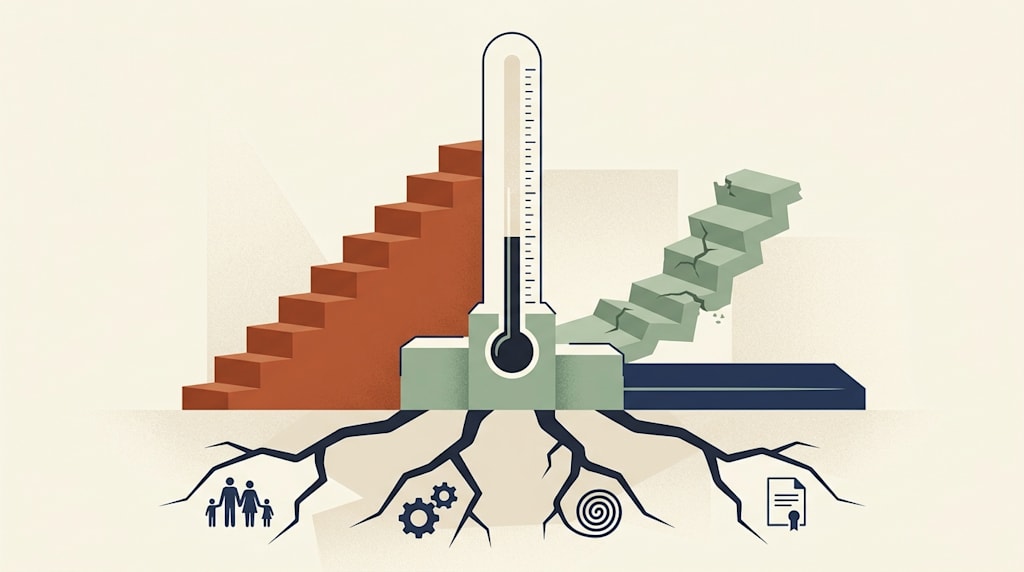
But putting the three countries into the same ranking obscures a key fact: India overtaking Japan and the UK overtaking Japan are two different things. The former is driven by endogenous growth momentum and carries high certainty. The latter is supported by exchange-rate fluctuations and could be reversed at any time. And Japan's problem is not who overtakes it. Nominal GDP ranking is merely a thermometer. The fever it reads has had its underlying causes buried for twenty years.
Japan: The Exchange Rate Is the Thermometer; Structure Is the Chronic Disease
Yen depreciation is the most direct mechanism behind Japan's ranking decline. GDP denominated in dollars shrinks passively when the yen weakens. In 2026, the dollar-yen rate hovered for a long period between 159 and 160, while purchasing-power-parity estimates put the yen's fair exchange rate far higher. The yen is severely undervalued, meaning Japan's dollar-denominated GDP is being systematically compressed. In July 2026, Japanese and US monetary authorities conducted their first joint yen-buying intervention in about 28 years, but the depreciation trend was not reversed. A considerable part of Japan's ranking decline is an accounting effect from exchange-rate conversion, not a sudden deterioration of the Japanese economy between 2026 and 2027.
Why has the yen remained this weak? The answer points to a set of mutually reinforcing structural chronic diseases.
First, the negative loop of demographics. Japan's working-age population fell from 85.9 million in 1990 to 72.92 million in 2020, and the Ministry of Health, Labour and Welfare forecasts it will fall further to 55.4 million by 2050, only about 70% of the 2020 level. Labor input's contribution to growth has already turned negative, and the trend is irreversible. In an economy with a continuously shrinking labor force, potential growth is systematically suppressed, and the currency's medium- and long-term support weakens accordingly.
Second, the stalling of productivity growth. Japan's potential growth rate is currently only about 0.4% annually, and total factor productivity growth hovers around 0.5%. Over the past five years, Japan has grown at an average annual rate of 0.4%, compared with 2.5% in the United States and 1.1% in the euro area. Successive "growth strategies" have not produced visible improvement in potential growth. The population is shrinking, and productivity has failed to take over, so the arithmetic space for economic growth is squeezed from both ends.
Third, path dependence in industrial competitiveness. Japan once built enviable advantages in traditional tracks such as automobiles and electronics, but that very success became a resistance to transformation. Japan's share of global patent applications has shrunk from 25% to 8% over the past two decades or so, and its presence in new tracks such as generative AI is weak. The IMF's Asia-Pacific department head said bluntly that, compared with countries such as South Korea, "Japan is benefiting much less from the AI boom." Old advantages are being diverted, and new pillars have yet to take shape.
Fourth, the continuous narrowing of fiscal space. Japan's government debt-to-GDP ratio is close to 230%, the highest among advanced economies. Debt interest payments expand with changes in the interest-rate environment, crowding out spending on social security, public works, and education that could otherwise support long-term growth. Population aging pushes up social-security spending, social-security spending crowds out growth-oriented investment, and weak growth in turn makes debt harder to digest. This is a closed loop.
These four forces together mean that Japan's nominal ranking decline is not a "2027 event" but the cross-section of a structure that has been operating for a considerable time. The exchange rate has merely made it appear earlier and more concentrated on a dollar-denominated leaderboard.
India: Not "About to Overtake" but "Pulling Away"
In contrast with Japan, India's overtaking of Japan is almost without suspense. In October 2026, the IMF raised its growth forecasts for India for both 2026 and 2027 to 7%, citing strong domestic demand that allows India to "stand out" amid a global slowdown. The World Bank and the Reserve Bank of India forecast 7.1% and 7.1% for the same year. An economy expanding at a real growth rate of around 7% overtaking an economy with a potential growth rate of only 0.4% is, on current trends, a question of timing rather than direction.
The first pillar of India's growth is the "consumption-investment" twin engine. Private consumption as a share of GDP rose to 61.5% in fiscal 2025/2026, the highest since fiscal 2011/2012, and private consumption growth accelerated from 5.8% in the previous fiscal year to 7.7%. In the same period, gross fixed capital formation rose to 34.3% of GDP, up from 31.4% a year earlier. The growth is broad-based: in the April-June quarter of 2026, private consumption grew 7.1%, fixed capital formation 11.9%, manufacturing 9.2%, and exports about 12%. Households are spending, firms are investing, and exports are seeking demand. Growth does not depend on government spending or the boom in a single industry.
The second pillar is the parallel expansion of manufacturing and services. Manufacturing GVA achieved a compound annual growth rate of 10.88% between 2022-23 and 2025-26. Mobile-phone production increased about 32-fold over roughly a decade, and India has become the world's second-largest mobile-phone manufacturer; automobile production reached 31.03 million units, up about 33% from 2014-15. Services still account for about 55% of GVA, IT services exports approached $200 billion in 2024, and the pharmaceutical industry ranks third globally by output. Manufacturing is creating output and jobs, while services are providing foreign exchange and high-end positions; the two reinforce each other.
The third pillar is the relay between infrastructure and the investment cycle. Central government annual capital expenditure has increased nearly sixfold since 2014-15. The construction of roads, railways, ports, and power networks not only directly constitutes demand but also, over the long term, reduces logistics costs and attracts private capital. AI-related data-center and computing-power investment is forming a new capital-expenditure cycle as well; Amazon has announced an additional $13 billion investment in India's AI and cloud infrastructure, bringing its total commitment to $48 billion. Infrastructure solves the question of "whether production is possible," while private investment solves the question of "whether firms are willing to expand production." When both improve simultaneously, 7% growth is no longer a purely cyclical phenomenon.
India's economy certainly has shortcomings: per capita GDP remains low, the pressure of agricultural labor transfer is enormous, and energy prices and external shocks always pose risks. But overtaking Japan does not require India to be perfect, only to stay on its current growth track. This is a trend that has already established stable expectations, not an accidental jump within a forecast window.
The UK: An "Overtaking" Manufactured by Exchange Rates, and Its Fragility
The UK case must be strictly distinguished from India's. The UK's nominal GDP forecast for 2027 is $4.4889 trillion, and Japan's is $4.4676 trillion, a gap of only about 0.5%. Against the error range of macroeconomic forecasts, a 0.5% gap hardly carries the statistical meaning of an "overtaking." A reverse swing in the yen exchange rate, or a downward revision of UK economic data, would be enough to flip the ranking back.
What is more telling is the speed at which the forecast itself has changed. In April 2026, the IMF still believed the UK would not overtake Japan until 2029; only half a year later, it moved the date forward by two years. The driver of a forecast shifted so sharply within six months is not a structural leap in UK growth but the speed and magnitude of yen depreciation exceeding previous assumptions. The UK's own growth forecasts for 2026 and 2027 are not high, far from India-style expansion. The UK "overtaking" Japan is a change in relative nominal ranking between two weak-growth economies, determined by exchange-rate movements. It can happen, and it can disappear with the next exchange-rate swing.
The Noise of Rankings and the Problem That Matters
The three countries together make the pattern plain. India overtaking Japan is growth overtaking stagnation, a high-certainty trend driven jointly by consumption, investment, manufacturing, and services. Even if the timing of the nominal ranking shifts somewhat because of statistical rules or exchange rates, the direction will not change. The UK overtaking Japan is an exchange-rate game. The gap falls within the error range, the forecast itself is repeatedly adjusted with exchange-rate expectations, and the ranking carries very little information.
The problem Japan needs to face is not on the leaderboard. For an economy with potential growth of 0.4%, TFP growth of 0.5%, a continuously shrinking working-age population, a debt ratio close to 230%, and a shrinking share in the new round of technological competition, the decline in nominal ranking is merely the accounting expression of these deeper variables. Even if the yen appreciates tomorrow and the ranking temporarily recovers, these structural constraints will not disappear.
Nominal GDP ranking is a thermometer. The number it reads can jump because of exchange rates, but the illness behind the temperature will not be cured by a change in the thermometer's scale. For Japan, being overtaken by India is the confirmation of a trend, and being overtaken by the UK is exchange-rate noise. The worry is that when both happen at the same time, the forces inside the Japanese economy that have made 0.4% the norm have still not been touched.
About the Creator
Jin
Writer of reamstories
https://reamstories.com/jin
Enjoyed the story? Support the Creator.
Subscribe for free to receive all their stories in your feed. You could also become a paid subscriber, letting them know you appreciate their work.
Comments
There are no comments for this story
Be the first to respond and start the conversation.