
Janitorial Service Market Set for Strong Growth as Hygiene Standards and Smart Cleaning Transform Facility Management
From Office Towers to Hospitals, Professional Cleaning Services Are Becoming Essential to Modern Business Operations

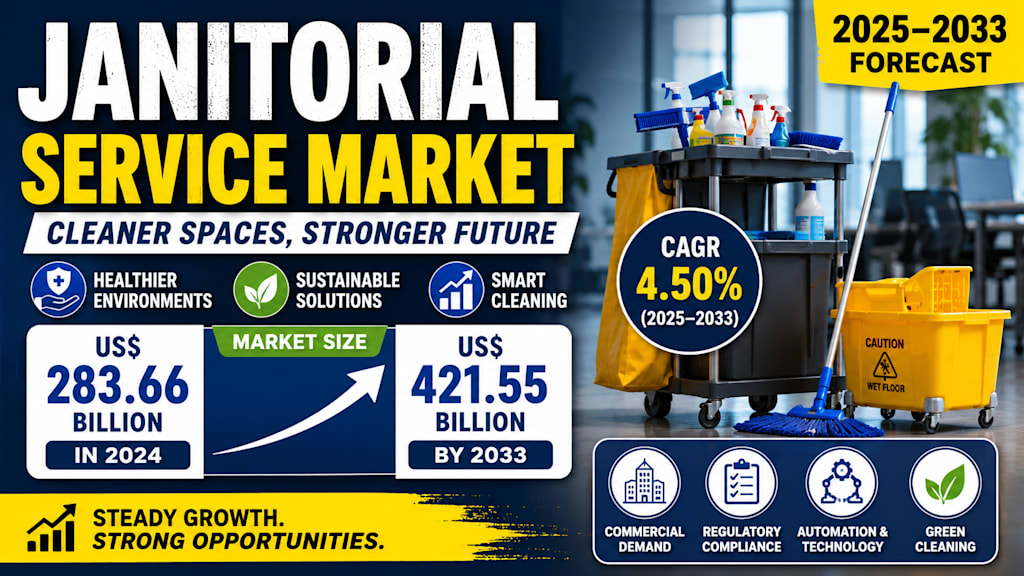
Janitorial Service Market Forecast to Reach US$ 421.55 Billion by 2033
The global janitorial service market is entering a new phase of growth as businesses, institutions, and governments place greater emphasis on workplace hygiene, employee well-being, regulatory compliance, and sustainable facility management practices.
According to Renub Research, the Janitorial Service Market was valued at US$ 283.66 billion in 2024 and is projected to reach US$ 421.55 billion by 2033, expanding at a CAGR of 4.50% during 2025–2033.
What was once viewed as a routine maintenance function has evolved into a strategic business necessity. Today, professional cleaning services are helping organizations improve employee productivity, meet health regulations, protect brand reputation, and create safer environments for customers and staff.
As commercial buildings become smarter and hygiene expectations continue to rise, janitorial service providers are transforming through automation, sustainability initiatives, and data-driven cleaning solutions.
Why Janitorial Services Matter More Than Ever
The cleaning industry experienced unprecedented visibility following global health emergencies. Organizations across sectors realized that cleanliness directly impacts public health, operational continuity, and customer confidence.
Professional janitorial services now extend far beyond basic sweeping and mopping. Modern service providers offer:
Sanitization and disinfection
Floor maintenance
Window cleaning
Waste management
Air-quality improvement services
Restroom sanitation
Damage restoration cleaning
Smart facility monitoring
Businesses increasingly recognize that maintaining a clean environment influences employee morale, customer satisfaction, and overall productivity.
As a result, outsourcing cleaning operations to professional service providers has become the preferred strategy for many organizations worldwide.
Rising Hygiene Awareness Continues to Fuel Market Expansion
One of the strongest drivers of market growth is the growing global awareness regarding hygiene and sanitation.
Consumers today expect visibly clean environments whether they visit:
Hospitals
Airports
Hotels
Shopping malls
Educational institutions
Corporate offices
Restaurants
Organizations are investing heavily in professional cleaning services to ensure facilities remain safe and compliant with health standards.
The increased focus on infection prevention has significantly expanded demand for routine disinfection programs and specialized cleaning solutions.
This trend is particularly strong in healthcare facilities, where cleanliness directly affects patient outcomes and regulatory compliance.
Regulatory Compliance Is Creating New Opportunities
Many industries operate under strict sanitation and cleanliness regulations.
Healthcare facilities, food processing plants, hospitality establishments, pharmaceutical companies, and educational institutions must meet specific cleanliness standards.
Failure to comply can result in:
Financial penalties
Operational disruptions
Reputational damage
Legal consequences
Professional janitorial companies help organizations maintain compliance while reducing operational risks.
As regulations become more stringent worldwide, demand for experienced cleaning providers continues to rise.
Clean Workplaces Drive Employee Productivity
Workplace cleanliness is increasingly linked to employee performance.
Numerous studies indicate that organized and hygienic environments contribute to:
Reduced absenteeism
Higher employee satisfaction
Improved concentration
Better workplace morale
Enhanced productivity
Businesses now view janitorial services as an investment rather than an operational expense.
A clean workplace demonstrates organizational commitment toward employee well-being while supporting long-term business performance.
This shift in perception is encouraging organizations to allocate larger budgets toward facility maintenance and cleaning programs.
Sustainability Is Reshaping the Cleaning Industry
Environmental responsibility is becoming a major competitive differentiator in the janitorial services market.
Many organizations now prefer service providers that utilize:
Green-certified cleaning products
Low-emission equipment
Water-efficient cleaning methods
Recyclable packaging
Sustainable waste management systems
Governments and corporate sustainability initiatives are accelerating the transition toward environmentally responsible cleaning practices.
Service providers adopting green cleaning technologies are gaining significant advantages when competing for large corporate and government contracts.
As ESG (Environmental, Social, and Governance) priorities become mainstream, sustainability will continue to influence purchasing decisions.
Smart Cleaning Technologies Are Revolutionizing Operations
Technology is rapidly transforming traditional janitorial services.
Innovations such as:
Autonomous floor-cleaning robots
IoT-enabled sensors
AI-powered scheduling software
Predictive maintenance systems
Digital quality-control platforms
are helping companies improve operational efficiency and service consistency.
Smart cleaning solutions allow facility managers to monitor cleaning performance in real time, optimize labor allocation, and reduce operational costs.
The integration of technology is creating a more data-driven and transparent cleaning ecosystem that benefits both service providers and clients.
Commercial Segment Dominates Global Demand
The commercial sector remains the largest revenue contributor to the janitorial service market.
Major demand comes from:
Corporate offices
Hospitals
Hotels
Airports
Educational institutions
Manufacturing facilities
Retail centers
Large commercial facilities require regular cleaning and sanitation programs to maintain safety and operational efficiency.
As commercial real estate continues to expand globally, demand for professional janitorial services is expected to grow steadily.
The rise of hybrid work models has also increased expectations for workplace cleanliness, further supporting market expansion.
Labor Challenges Continue to Impact Service Providers
Despite positive growth prospects, the industry faces several operational challenges.
Labor shortages remain a significant concern across many regions.
Janitorial services are labor-intensive, and recruiting and retaining skilled workers has become increasingly difficult due to:
Rising wage expectations
High employee turnover
Competitive labor markets
Training requirements
Companies must balance labor costs with customer expectations while maintaining profitability.
To address these challenges, many providers are investing in automation and workforce management technologies.
Cost Pressures Are Squeezing Profit Margins
The industry also faces mounting cost pressures.
Operating expenses continue to rise due to:
Higher labor costs
Equipment maintenance expenses
Regulatory compliance requirements
Insurance costs
Sustainable product adoption
At the same time, clients often prioritize competitive pricing, creating pressure on service providers to maintain thin profit margins.
Success increasingly depends on operational efficiency, technological innovation, and service differentiation.
Regional Market Highlights
United States
The United States remains one of the world's largest janitorial service markets.
Growing demand for commercial cleaning, sustainability initiatives, and advanced facility management technologies are driving growth.
Major industry players are focusing on automation and digital transformation to improve service delivery and operational performance.
Germany
Germany's mature cleaning services industry continues to expand steadily.
Rising hygiene awareness, sustainability requirements, and urbanization trends are supporting market growth.
Corporate offices, healthcare institutions, and educational facilities remain key demand generators.
India
India represents one of the fastest-growing janitorial service markets globally.
Rapid urbanization, expanding commercial infrastructure, and increased awareness of hygiene are fueling demand.
Government sanitation initiatives and the growing adoption of professional facility management services are creating significant opportunities for service providers.
Saudi Arabia
Saudi Arabia's Vision 2030 development strategy is generating strong demand for professional cleaning services.
Large-scale investments in tourism, commercial infrastructure, hospitality, and smart cities are supporting market expansion.
The country's focus on sustainability and modern urban development is expected to create long-term opportunities for janitorial service providers.
10 Recent Developments Shaping the Janitorial Service Industry
1. ABM Industries Expands Sports Venue Partnership
In March 2024, ABM Industries secured a multi-year agreement with the Arizona Diamondbacks and Chase Field to provide housekeeping and event staffing services.
2. ServiceMaster Clean Partners with Aspire Software
ServiceMaster Clean announced a partnership with Aspire Software in March 2024 to strengthen commercial cleaning business management capabilities.
3. ISS A/S Extends Nordea Contract
ISS A/S renewed its partnership with Nordea through a five-year agreement covering cleaning, security, technical services, and workplace management.
4. Mitie Group Accelerates Digital Cleaning Programs
Mitie continues expanding technology-enabled facility services through data-driven cleaning and workplace optimization initiatives.
5. Aramark Enhances Sustainable Cleaning Solutions
Aramark has expanded its sustainability-focused cleaning programs to help clients meet ESG objectives.
6. Coverall Strengthens Health-Based Cleaning Systems
Coverall continues investing in advanced disinfection protocols and health-focused cleaning methodologies.
7. Jani-King Expands Franchise Operations
Jani-King is broadening its commercial cleaning network across multiple regions to address growing demand.
8. Jan-Pro Introduces Advanced Cleaning Standards
Jan-Pro continues implementing enhanced cleaning technologies and quality-control programs across franchise locations.
9. Anago Cleaning Systems Focuses on Smart Facility Services
Anago is expanding technology-driven facility management solutions to improve operational efficiency.
10. Pritchard Industries Strengthens Integrated Facility Services
Pritchard Industries continues expanding comprehensive facility maintenance solutions for commercial clients.
Competitive Landscape
The global janitorial service market remains highly competitive, featuring both multinational corporations and regional service providers.
Major companies include:
Coverall Health-Based Cleaning System
ABM Industries Inc.
Pritchard Industries, Inc.
Aeon Delight Co., Ltd.
Anago Cleaning Systems
Aramark
Bonus Building Care
Mitie Group plc
Jani-King International, Inc.
Jan-Pro Franchising, Inc.
These companies are investing in digital technologies, workforce training, sustainability programs, and strategic partnerships to strengthen their market positions.
Final Thoughts
The janitorial service industry is no longer simply about cleaning buildings—it has become a critical component of workplace safety, public health, customer satisfaction, and operational excellence.
As organizations place greater emphasis on hygiene, sustainability, and employee well-being, professional cleaning services are becoming an indispensable business function.
With the market expected to grow from US$ 283.66 billion in 2024 to US$ 421.55 billion by 2033, the sector offers significant opportunities for service providers that embrace innovation, green cleaning practices, and smart facility management technologies.
The future of janitorial services will be defined by a combination of cleanliness, sustainability, automation, and customer-centric solutions—creating a cleaner, healthier, and more efficient world for businesses and communities alike.
About the Creator
Enjoyed the story? Support the Creator.
Subscribe for free to receive all their stories in your feed.
Comments
There are no comments for this story
Be the first to respond and start the conversation.