
Is Day Trading Profitable in India: Reality & Risks Explained
What Determines Day Trading Success in India's Financial Markets?
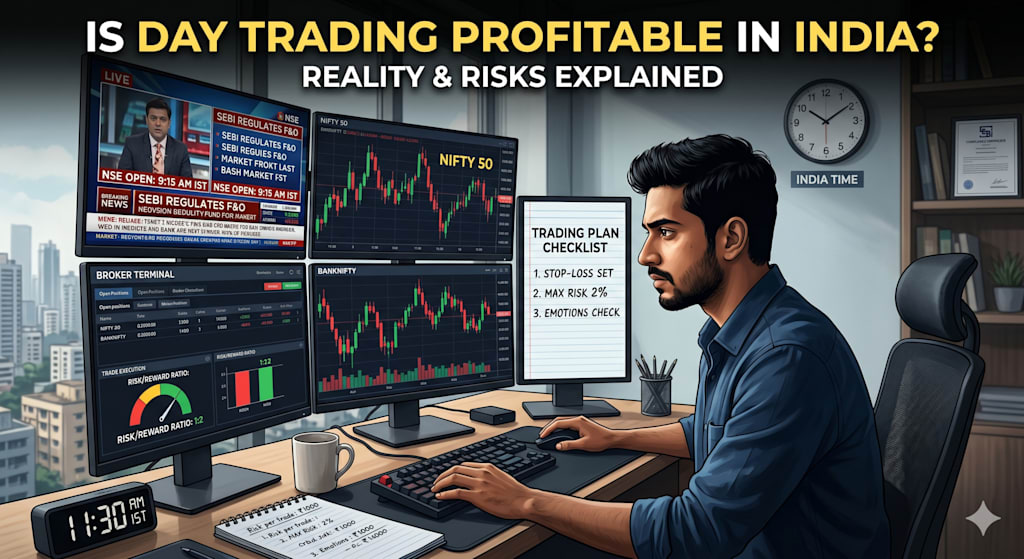
Day trading can be profitable in India, but success depends on skill, risk management, discipline, and trading costs. Indian markets operate under SEBI regulations on the NSE and BSE from 9:15 AM to 3:30 PM IST. Traders participate across equities, futures, and options (F&O), currencies, and commodities, each with its own cost structure and risk profile.
What Is Day Trading?
Day trading involves buying and selling financial instruments within the same trading day to capture short-term price movements. All positions are typically closed before the market closes, keeping all positions within the same session while focusing on price movements within the session across stocks, derivatives, currencies, or commodities.
Day trading in India takes place within a regulated market environment overseen by the Securities and Exchange Board of India (SEBI), which regulates the country's securities markets and market participants. Indian equity markets on the National Stock Exchange (NSE) and Bombay Stock Exchange (BSE) typically operate from 9:15 AM to 3:30 PM IST on trading days.
Day traders commonly participate in:
- Equity shares
- Futures and options (F&O)
- Currency markets
- Commodity markets
Because day trading involves opening and closing positions within the same session, most brokers automatically close any remaining intraday positions shortly before the market closes if you have not exited them manually. This automatic closing process is commonly known as auto square-off.
Why Is Day Trading Profitability Different for Every Trader?
Profitability varies because traders use different strategies, risk management approaches, capital levels, experience, and execution quality. Even in the same market, outcomes differ because each trader interprets setups differently, manages risk differently, and reacts differently to changing conditions.
To improve consistency, traders need a structured approach that includes testing strategies, understanding market behavior, and following a predefined plan instead of making emotional or reactive decisions. Market conditions also play a major role, as no single strategy performs equally well in all environments.
Risk Management and Position Sizing
Successful traders focus on protecting their capital before trying to grow it. This starts with defining a risk per trade, which is the maximum amount of money you are willing to lose if a trade does not work as planned. To keep that risk under control, traders use a stop-loss, an order that automatically closes a position when the market reaches the price level defined before the trade was placed. They then use position sizing to determine how many shares, contracts, or lots can be traded while staying within their risk limit.
For example, if you decide to risk ₹1,000 on a trade and your stop-loss is ₹10 away from your entry price, your position size should be adjusted so that the total potential loss remains close to ₹1,000. This helps create consistency and keeps each trade's effect on the account within the range you planned for.
Many Indian brokers also offer intraday margin, which allows you to control a larger position with a smaller amount of your own capital. While margin can increase potential returns, it also means each price movement has a proportionally larger effect on the account, which is why disciplined risk management matters more when using leverage.
Trading Costs
Profitability is not determined solely by winning trades. Your actual results are affected by the costs of doing business in the market. Indian day traders may encounter brokerage charges, Securities Transaction Tax (STT), GST, SEBI turnover fees, stamp duty, and other transaction-related expenses. In addition, slippage can occur when an order is executed at a slightly different price than expected, particularly during fast-moving market conditions.
When evaluating a strategy, you should account for all trading costs because results that appear profitable before expenses may look very different after fees, taxes, and slippage are deducted. Traders should also remember that intraday trading profits are generally treated as speculative business income, the tax classification applied to intraday equity trading profits in India under the Income Tax Act, taxed at the trader's applicable income slab rate rather than at capital gains rates, and requiring separate recordkeeping from other income. This makes tax planning an important consideration.
Market Conditions
Market conditions play an important role in day trading results because the market does not move the same way every day. Sometimes prices move in clear trends, sometimes they move very fast with high volatility, and other times they stay in a narrow range with little direction. A strategy that works well in a trending market may not perform the same way when the market is slow or sideways.
Because of this, traders need to first understand what type of market is active before placing trades. This helps in choosing the right strategy, setting realistic expectations, and avoiding unnecessary trades when conditions are not suitable.
Execution Quality
Even when a trading idea is correct, the final result can still change based on how the trade is executed. Execution quality refers to how efficiently trades are entered and exited in the market, and small delays or price differences can affect overall performance over time.
Key factors that affect execution quality include:
- Platform speed – how quickly your trading platform processes and places orders, especially during fast-moving markets.
- Market liquidity – how easily a trade can be filled at the expected price without causing large price changes.
- Volatility – sudden price movements that can lead to slightly different entry or exit prices than expected.
While each of these factors may seem minor on a single trade, their combined effect can become meaningful over many trades. Maintaining consistent execution habits helps ensure that your actual results stay as close as possible to the trading strategy you intended to follow.
Does Day Trading Require Risk Management to Be Profitable?
Yes. Risk management is essential because profitability depends not only on generating winning trades but also on controlling losses. Techniques such as stop-loss placement, capital preservation, and disciplined decision-making are essential for traders to remain active long enough to benefit from future opportunities.
Not every trade will reach its target, which is why a consistent risk framework matters more than any individual result. Long-term results often depend on how effectively you manage losses and protect capital during difficult periods.
A structured risk-management approach may include:
- Defining risk before entering each trade.
- Using stop-loss orders consistently.
- Returning to the trading plan as the basis for every decision, regardless of the previous trade's result.
- Keeping position sizing consistent with the plan rather than adjusting it based on recent results.
- Evaluating performance across a series of trades rather than reacting to any individual session result.
Another useful concept is the risk-to-reward ratio, which compares a trade's potential profit with its potential loss. For example, risking ₹1,000 to pursue a ₹2,000 gain creates a 1:2 risk-to-reward ratio. While no ratio guarantees profitability, it provides a structured way to evaluate whether a trading opportunity offers sufficient potential reward relative to the risk being taken.
Developing Trading Skills Before Increasing Risk
Building trading skills gradually can help traders gain experience before committing larger amounts of capital. Several Indian brokers and trading platforms offer paper trading features that allow you to practice strategies, learn platform functionality, and gain experience without using large real capital. These environments can help traders understand order execution, test strategies, and gain familiarity with market behavior before transitioning to live trading.
Combining simulation practice with educational resources and market analysis can accelerate the learning process and help traders develop a more structured approach.
Some traders also choose to participate in evaluation-based environments offered by proprietary trading firms. Programs such as Apex Trader Funding require traders to demonstrate consistency and risk management under predefined rules, providing a structured framework for developing trading discipline before risking larger amounts of personal capital.
Conclusion
Day trading can be profitable in India, but profitability is built through preparation, discipline, and risk management rather than market participation alone. Understanding trading costs, market conditions, performance metrics, and risk-management principles can help traders make more informed decisions and develop a sustainable approach over time.
Risk Disclosure: Day trading involves substantial risk of loss and is not suitable for all traders. Past performance is not indicative of future results. Only risk capital should be used.
About the Creator
Enjoyed the story? Support the Creator.
Subscribe for free to receive all their stories in your feed.
Comments
There are no comments for this story
Be the first to respond and start the conversation.