
Is a Global Food Crisis Already Here?
JPMorgan warns of 5% food inflation by 2027—but Chinese agricultural stocks won’t save you. Here’s why.
I. A Report and a Time Lag
On August 15, 2026, JPMorgan Chase published a research report titled Food Security as National Security: A Perfect Storm.
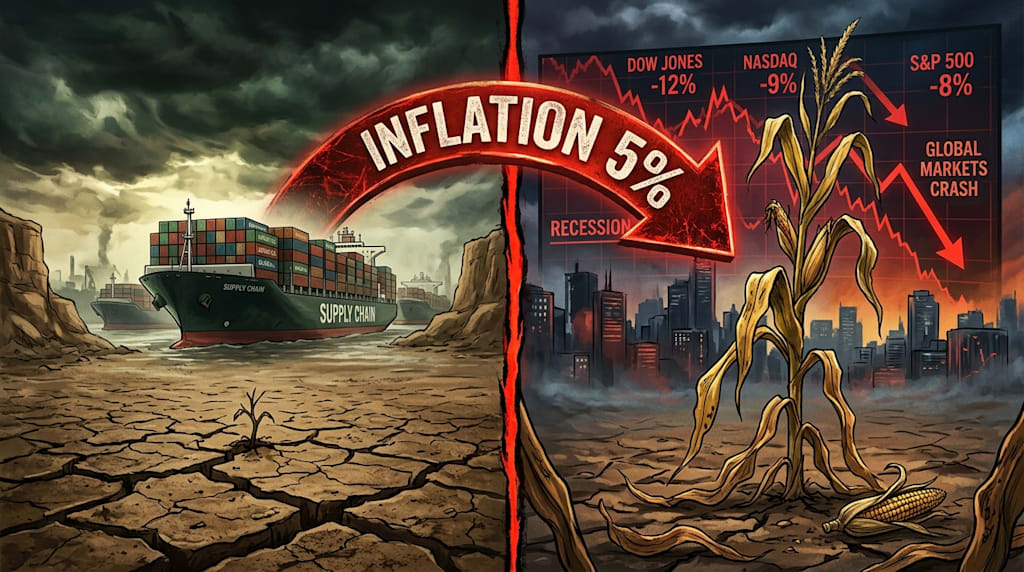
The report gave two numbers: global food inflation stood at 2.8% in the first half of 2026; by the first half of 2027, that figure is expected to reach 5%.
The author, Nora Szentivanyi, a senior global economist at the bank's London office, described the situation as "not a short-lived shock."
Markets have heard such language before. Over the past five years, warnings of a food crisis have come and gone—COVID-19, the Russia-Ukraine war, India's wheat export ban, Red Sea shipping disruptions. Each came with the word "unprecedented."
This time, a closer look at the report's numbers shows something structural has indeed changed.
International urea prices surged from roughly $400 per ton at the start of 2026 to more than $850 by April. That is a 110% increase.
The reason is straightforward. After the Persian Gulf conflict escalated in February 2026, traffic through the Strait of Hormuz dropped sharply. About one-third of global urea shipments pass through that waterway. Fertilizer vessel traffic fell to near zero.
Urea is the core raw material for nitrogen fertilizer. Nitrogen fertilizer is essential for corn and wheat during their critical growth stages. When fertilizer prices double, Brazilian soybean production costs rise by at least 15%. U.S. corn faces similar cost pressure.
How does this cost increase reach final grain prices? The path is simple: farmers either use less fertilizer, which lowers yields, or they pay the higher price and pass it on to buyers. Either way, prices go up.
Meanwhile, another timeline is quietly unfolding.
The El Niño that formed during the 2025–2026 winter has been rated by NOAA as one of the strongest since 1950. The impact of El Niño on agricultural output has a six- to twelve-month lag. That means 2026 harvest data reflects the climate of 2025, while the climate anomalies of 2025–2026 will show up in 2027 production figures.
In August 2026, the International Grains Council cut its global corn production forecast for 2026/27 by 12 million metric tons and soybean production by 8 million tons.
Fertilizer supply disruption and climate-driven yield losses are tightening at the same time. JPMorgan's 5% inflation forecast rests on the assumption that these two factors overlap.
II. Five Pressures and One Transmission Chain
The report summarizes the drivers of the current food crisis as the "five Ws": War, Weather, Warehousing, Water, and Waste.
The first two are the most urgent short-term catalysts. The latter three are long-term structural constraints.
The fertilizer disruption has direct effects. Natural gas is a key input for nitrogen fertilizer production, and the Middle East conflict has both blocked shipping lanes and pushed up gas prices. The disruption of global fertilizer trade means that major producers—Brazil, the United States, India—face cost shocks at the same time. These costs do not stay at the farm gate. They pass through export prices, freight rates, and currency fluctuations to the landed prices of importing countries.
El Niño's impact is more insidious. It is not a single visible disaster like a typhoon or flood. It is a long-term shift in precipitation patterns that affects planting area, pollination rates, and moisture during grain-filling. This effect shows up as a lag in the data and as a slow decline in per-hectare yields in the field.
Add to that the global grain stock-to-use ratio, which has fallen to 28.5%—the lowest level since 2013. The buffer is thinner than at any point in the past decade.
The end point of this transmission chain is household food expenditure.
But the intensity, speed, and destination of transmission vary widely. They depend on each country's food self-sufficiency rate, reserve systems, and import structure. For Egypt, Turkey, and parts of Southeast Asia, the shock is direct and severe. For the United States, the European Union, and China, the impact is more concentrated on feed grains and vegetable oils, while staple food prices remain relatively stable.
This is why the same alert triggers completely different reactions in different markets.
III. China's Three Layers of Transmission
In China, the impact of higher international grain prices is not uniform. It breaks down into three layers.
Layer one: staple grains—rice and wheat. Self-sufficiency is 100%. The stock-to-use ratios for wheat and rice are 120% and 85%, respectively. The state has direct tools to control retail prices: reserve releases, import quota adjustments, and minimum purchase price policies. A surge in international staple grain prices can almost never reach China's retail counters.
Layer two: feed grains—soybeans and corn. This is where pressure concentrates. China's soybean import dependency is 82%, with imports exceeding 96 million tons in 2025. Corn still requires 20 to 30 million tons of imports each year for feed and industrial processing. Higher international soybean and corn prices directly raise China's import costs. These costs then move through the feed sector to hog and poultry farming, eventually showing up in pork, chicken, and egg prices.
Huatai Securities' mid-2026 strategy report estimates that El Niño-related production cuts in South American soybeans and U.S. corn, combined with higher fertilizer costs, could raise China's landed soybean import prices by 20% to 25% between Q4 2026 and Q2 2027. Corn import prices could rise 15% to 18%.
Feed accounts for about 70% of livestock production costs. This increase will put upward pressure on the food component of the CPI, but the effect will be partly absorbed by domestic corn reserve stocks and wheat substitution.
Layer three: production costs for farmers. China has its own urea production capacity, but raw material natural gas and coal prices follow international trends, so domestic fertilizer prices have risen as well. In May 2026, domestic urea prices were up about 35% year-on-year. The central government has added a one-time grain planting subsidy, but it cannot fully cover the cost increase.
Among these three layers, the first is secure, the second is under pressure, and the third is gradual. To conflate all three would lead to the false conclusion of a "China food crisis." To separate them completely would underestimate the real pull of imported inflation on the CPI.
IV. The Three Mountains Blocking A-Share Agricultural Stocks
Whenever headlines about surging global grain prices appear, the A-share agricultural sector tends to spike.
On August 17, 2026, Jinnong Seed and Nongfa Seed hit the daily limit, while the agriculture ETF jumped 3.61%. This market reaction was no different from previous food-crisis hype cycles.
But investors who chase the rally soon face a structural question: if international grain prices are rising, why do A-share agricultural companies so consistently fail to deliver earnings growth?
Mountain one: the price premium does not reach the profit side.
Domestic grain prices are not international prices. The state uses reserve releases and import adjustments to keep retail staple prices within a reasonable range. Even if corn and soybean spot prices rise, the increases are smaller than abroad.
More importantly, most A-share agricultural companies sit in the middle or downstream of the value chain. Feed processors bear the brunt of rising raw material costs. Livestock farmers see losses widen as feed prices rise. The number of upstream farming companies that genuinely benefit from higher grain prices is small, and their land rental income is not fully linked to grain prices.
Mountain two: company-specific risks cannot be hedged by macro logic.
In July 2026, Beidahuang was required to pay back taxes on historical land contract taxation issues. Its share price hit the daily limit down.
This event had nothing to do with El Niño, fertilizer prices, or global grain supply and demand. It was purely a corporate governance and tax policy issue. Yet it could destroy, in a single day, an entire investment thesis built on the idea that "rising grain prices benefit agricultural producers."
The "scallops running away" saga at Zoneco is often treated as a market joke, but it reflects a real structural problem: the biological assets and inventories of agricultural companies are difficult to audit accurately. Disease, natural disasters, subsidy changes, tax assessment revisions—any one of these variables can bypass industry-level logic and directly hit individual stock performance.
Mountain three: short hype cycles and heavy speculative trading.
The agricultural sector has long been a hotspot for thematic speculation. Every time the "No. 1 Central Document," droughts, or rising hog prices make the news, the sector spikes. But lacking sustained earnings support, it typically retreats after a short run. The same pattern occurred during the COVID-19 outbreak in early 2020; most names gave back their gains afterward.
The time lag between anticipated gains and fundamental reality is the primary source of trading friction.
V. Policy Tools in Place
China is not limited to releasing reserves when facing imported grain price pressure. A timeline of measures:
Short-term: Diversify soybean and corn import sources by signing long-term agreements with Brazil, Argentina, and Russia. Increase the frequency of corn reserve auctions. If necessary, use wheat as a substitute for corn in feed.
Medium-term: Offer electricity and natural gas price concessions to domestic fertilizer producers. Restrict fertilizer exports to prioritize domestic supply.
Long-term: Accelerate the commercial adoption of genetically modified corn and soybean varieties to raise yields. Implement a new round of high-standard farmland construction to improve water resource efficiency.
These measures can smooth the pass-through from international to domestic prices. The food component of China's CPI is expected to stay within 6% year-on-year in 2027, below the global rate.
But smoothing does not mean elimination. The transmission from feed prices to meat, poultry, and dairy products will still occur. Consumers in 2027 are likely to feel moderate but persistent price changes at the dinner table.
VI. Back to Investing
For those trading on the food-crisis theme, three approaches are more practical than simply buying agricultural stocks.
First, distinguish thematic speculation from value investing. The agricultural sector's short-term volatility on news stimuli may offer trading opportunities. But without fundamental earnings support, treat these as tactical trades, not long-term holdings.
Second, prefer ETFs over individual names. Using grain or agriculture ETFs diversifies company-specific risks and avoids irreversible losses from a Beidahuang-style black swan.
Third, wait for trading volume to steadily expand and for marginal earnings improvements in leading companies before entering. Do not chase on the first day of a headline.
The global food system is indeed facing unprecedented challenges. Each supply shock tests national reserve systems, production efficiency, and trade networks.
For China, however, the staple food security line still holds, while feed-grain price pressure has already arrived. The two are not the same issue, and they should not be traded as one.
About the Creator
Jin
Writer of reamstories
https://reamstories.com/jin
Enjoyed the story? Support the Creator.
Subscribe for free to receive all their stories in your feed. You could also become a paid subscriber, letting them know you appreciate their work.
Comments
There are no comments for this story
Be the first to respond and start the conversation.