
Interactive Whiteboard Market Expands as Digital Learning and Hybrid Collaboration Redefine Education and Workplaces
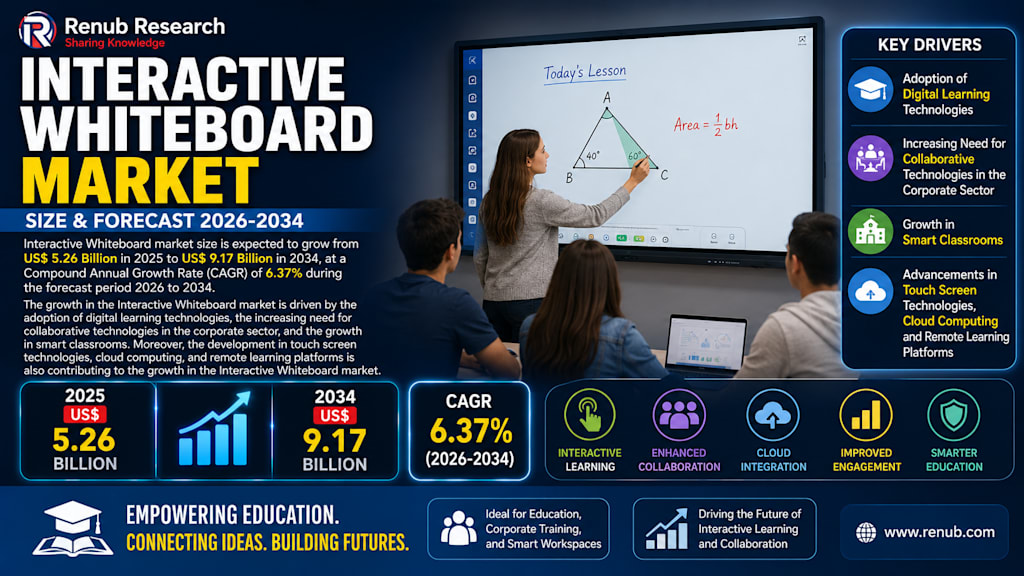
Renub Research forecasts the Interactive Whiteboard Market to grow from US$ 5.26 billion in 2025 to US$ 9.17 billion by 2034, driven by smart classrooms, collaborative technologies, and advances in touchscreen connectivity.

Interactive Whiteboards Are Transforming Modern Communication
The rise of digital education, remote collaboration, and smart workplaces is rapidly changing how people learn, communicate, and share ideas. Across schools, universities, corporate offices, and training centers, interactive whiteboards are becoming central tools for collaboration and engagement.
What was once a simple classroom board has evolved into a sophisticated digital communication platform powered by touchscreen technology, cloud connectivity, multimedia integration, and collaborative software tools. Interactive whiteboards are now helping teachers create immersive learning environments while enabling businesses to improve teamwork and productivity in increasingly hybrid work settings.
According to the uploaded Renub Research report, the Interactive Whiteboard Market is expected to grow from US$ 5.26 billion in 2025 to US$ 9.17 billion by 2034, expanding at a CAGR of 6.37% during 2026–2034. The report attributes this growth to increasing adoption of digital learning technologies, smart classroom development, collaborative workplace tools, and advances in touchscreen and cloud-based technologies.
As digital transformation continues accelerating across both education and business sectors, interactive whiteboards are becoming essential tools for communication and engagement.
What Is an Interactive Whiteboard?
An interactive whiteboard (IWB) is an electronic display system that allows users to interact with digital content using touch, stylus pens, or other input devices. These systems are usually connected to computers and projectors and enable users to write, draw, move objects, display videos, and access cloud-based information directly from the screen.
Interactive whiteboards support a wide range of multimedia tools including:
- Presentations
- Videos
- Animations
- Educational software
- Collaborative applications
- Cloud-based content sharing
One of their key advantages is the ability to save and distribute digital content easily, making collaboration and knowledge sharing significantly more efficient than traditional presentation methods.
The report explains that interactive whiteboards are increasingly being adopted worldwide in educational institutions and corporate environments where effective communication and interactive collaboration are becoming increasingly important.
Smart Classrooms and Digital Learning Are Fueling Demand
One of the biggest drivers behind the interactive whiteboard market is the global shift toward digital learning and smart classroom technologies.
Educational institutions worldwide are increasingly replacing conventional teaching methods with more engaging and technology-driven learning environments. Interactive whiteboards help teachers deliver lessons through multimedia presentations, animations, diagrams, videos, and interactive educational tools that improve student participation and comprehension.
Students can also actively participate by writing on screens, solving problems collaboratively, or interacting directly with learning materials.
Governments and educational institutions are heavily investing in digital infrastructure to modernize classrooms and improve learning outcomes. The increasing availability of educational software platforms compatible with interactive whiteboards is also improving their functionality and adoption rates.
The report cites data from the International Telecommunication Union (ITU), which reported that approximately 67% of the global population, or 5.4 billion people, were using the internet in 2023. This growing digital connectivity is helping accelerate the adoption of technology-based education systems globally.
As schools continue embracing hybrid and technology-enabled education models, demand for interactive whiteboards is expected to grow steadily.
Hybrid Workplaces Are Increasing Corporate Adoption
The corporate sector is also becoming a major contributor to market growth as businesses seek better collaboration tools for modern workplaces.
Interactive whiteboards allow multiple users to collaborate on the same screen during meetings, brainstorming sessions, presentations, and training programs. These systems improve communication efficiency while enabling teams to share ideas more dynamically.
The rise of remote and hybrid work environments has further strengthened the need for advanced collaboration technologies capable of connecting employees across different locations.
Interactive whiteboards support:
- Real-time collaboration
- Cloud-based content sharing
- Remote presentations
- Video conferencing integration
- Multi-user interaction
These capabilities are becoming increasingly valuable for organizations adapting to flexible workplace models and digital collaboration trends.
As businesses continue investing in productivity-enhancing technologies, interactive whiteboards are expected to remain important components of modern meeting rooms and collaborative workspaces.
Touchscreen Innovation Is Improving User Experience
Technological advancements in touchscreen technology and wireless connectivity are also playing a major role in expanding the interactive whiteboard market.
Modern interactive whiteboards now feature:
- High-resolution displays
- Multi-touch support
- Faster response times
- Simultaneous user interaction
- Wireless device connectivity
- Cloud integration
- AI-powered collaboration features
These improvements are creating smoother and more intuitive user experiences across both educational and business applications.
The report highlights Samsung’s September 2025 announcement regarding the launch of advanced interactive displays for educational institutions. These systems include enhanced touch display technologies and collaborative software solutions designed specifically for modern digital learning environments.
Interactive whiteboards are also increasingly compatible with smartphones, tablets, and laptops, making it easier for users to share and access information seamlessly across devices.
As touchscreen and AI technologies continue evolving, interactive whiteboards are becoming more intelligent, responsive, and collaborative.
Education Remains the Largest Market Segment
The education sector continues dominating the interactive whiteboard market globally.
Schools, colleges, universities, and training institutions increasingly use interactive whiteboards to create engaging classroom experiences that improve student participation and retention. Teachers can combine text, graphics, video, and digital tools into interactive lessons that support different learning styles.
Interactive whiteboards also support digital note storage and content sharing, allowing students to revisit lessons after class and making learning more accessible.
Governments worldwide are actively promoting smart classroom initiatives and digital education infrastructure, which is significantly boosting market demand.
As educational institutions continue modernizing learning environments, interactive whiteboards are expected to remain one of the most important tools in digital education ecosystems.
Fixed Interactive Whiteboards Continue Seeing Strong Demand
Fixed interactive whiteboards represent one of the largest segments within the market.
These systems are permanently installed in classrooms, conference rooms, and training facilities where continuous access to presentation technology is required. Fixed interactive whiteboards provide stable performance, strong integration with networking systems, and compatibility with additional technologies such as projectors and audio equipment.
Educational institutions particularly favor fixed systems because they support consistent daily use and long-term infrastructure planning.
Corporate environments also rely heavily on fixed interactive whiteboards in conference rooms and collaborative meeting spaces.
As organizations increasingly invest in permanent digital communication infrastructure, fixed interactive whiteboards are expected to maintain strong market demand.
Infrared and Electromagnetic Technologies Are Expanding
Different touchscreen technologies are shaping the evolution of interactive whiteboards.
Infrared interactive whiteboards use crisscross infrared beams to detect user input when fingers, pens, or pointers interrupt the sensor grid. These systems are durable, cost-effective, and support multi-user interaction, making them highly popular across educational and corporate environments.
Electromagnetic interactive whiteboards use specialized pens and electromagnetic grids to provide highly precise writing and drawing capabilities. These systems are particularly valuable in engineering, technical training, and environments requiring detailed digital annotation.
The report notes that electromagnetic systems help prevent accidental touch inputs while supporting accurate note-taking and cloud-based content sharing.
As digital collaboration becomes more sophisticated, these technologies are helping interactive whiteboards evolve into highly specialized communication platforms.
Mid-Sized Interactive Whiteboards Are Highly Popular
The 50-inch to 70-inch size segment remains one of the most popular categories within the market because it balances display visibility with practical installation requirements.
These systems are large enough to support presentations, collaboration, and classroom interaction while still fitting comfortably into meeting rooms and educational environments.
Features commonly found in this segment include:
- High-definition displays
- Wireless connectivity
- Multi-touch interaction
- Smartphone and laptop compatibility
As organizations and schools increasingly seek collaborative technologies that fit standard classroom and office environments, demand for mid-sized interactive whiteboards is expected to remain strong.
High Costs Continue Limiting Wider Adoption
Despite growing demand, cost remains one of the biggest challenges facing the interactive whiteboard market.
Interactive whiteboards often require additional infrastructure such as projectors, specialized software, computers, internet access, and power systems. This significantly increases the total cost of ownership, especially for schools and organizations with limited budgets.
The report notes that schools in developing countries may face difficulty allocating sufficient resources for installation and maintenance despite the long-term educational benefits.
Although prices for technology products continue declining gradually, affordability remains an important issue in many regions.
Technical Complexity and Training Requirements Create Barriers
Another challenge affecting market growth is the technical complexity associated with advanced interactive whiteboard systems.
Teachers, trainers, and corporate employees may require specialized training to use these systems effectively, particularly when transitioning from traditional teaching or presentation methods.
Organizations often need to invest in:
- Staff training
- Technical support
- System maintenance
- Software updates
These additional operational requirements can discourage adoption among budget-conscious institutions.
Simplifying user interfaces and improving ease of use will remain important priorities for manufacturers seeking broader market expansion.
The United States Continues Leading Innovation
The United States remains one of the largest and most technologically advanced interactive whiteboard markets worldwide.
Educational institutions and corporations across the country continue adopting interactive display technologies to improve collaboration, digital learning, and workplace communication.
The report highlights Sharp Imaging and Information Company of America’s January 2024 launch of its AQUOS BOARD interactive display series designed for enterprise customers seeking enhanced performance, sustainability, and security.
The country’s strong technology ecosystem, hybrid work trends, and advanced digital infrastructure continue supporting market growth.
India Is Emerging as a Major Growth Market
India’s interactive whiteboard market is expanding rapidly as the country invests heavily in digital education and smart classroom development.
Government initiatives promoting digital learning, combined with growing private education infrastructure, are driving strong demand for interactive teaching technologies.
Corporate adoption is also increasing as businesses use interactive whiteboards for presentations, collaboration, and employee training.
The report highlights iSLate’s March 2026 launch of India’s first Android 16 Interactive Flat Panel designed specifically for modern smart classroom environments with AI-ready features and advanced collaboration capabilities.
As internet connectivity improves and digital transformation accelerates, India is expected to become one of the most important emerging markets for interactive whiteboards.
Saudi Arabia Continues Advancing Digital Education
Saudi Arabia’s interactive whiteboard market is growing steadily as the country modernizes its education system and technological infrastructure.
Educational institutions are increasingly adopting interactive display systems to support modern teaching methodologies and improve student engagement.
Government initiatives supporting smart schools, digital learning, and advanced educational technologies are expected to further accelerate market growth in the region.
Corporate adoption is also expected to rise as businesses increasingly invest in collaborative technologies and modern workplace solutions.
Final Thoughts
The interactive whiteboard market is evolving rapidly as digital transformation reshapes education, communication, and workplace collaboration worldwide.
Driven by smart classrooms, hybrid work environments, cloud connectivity, and touchscreen innovation, interactive whiteboards are becoming far more than presentation tools. They are emerging as central platforms for engagement, creativity, teamwork, and digital learning.
While challenges related to affordability, infrastructure requirements, and user training remain important, continuous advances in technology are steadily improving usability and accessibility.
According to the Renub Research forecast, interactive whiteboards are set to play an increasingly important role in the future of education, business communication, and collaborative digital environments worldwide.
About the Creator
Enjoyed the story? Support the Creator.
Subscribe for free to receive all their stories in your feed.
Comments
There are no comments for this story
Be the first to respond and start the conversation.