
Intel’s Q4 Guide Broke the AI Trade
The selloff in Intel, Samsung, Google, and Korean tech is a cash-flow warning, not an AI demand collapse.
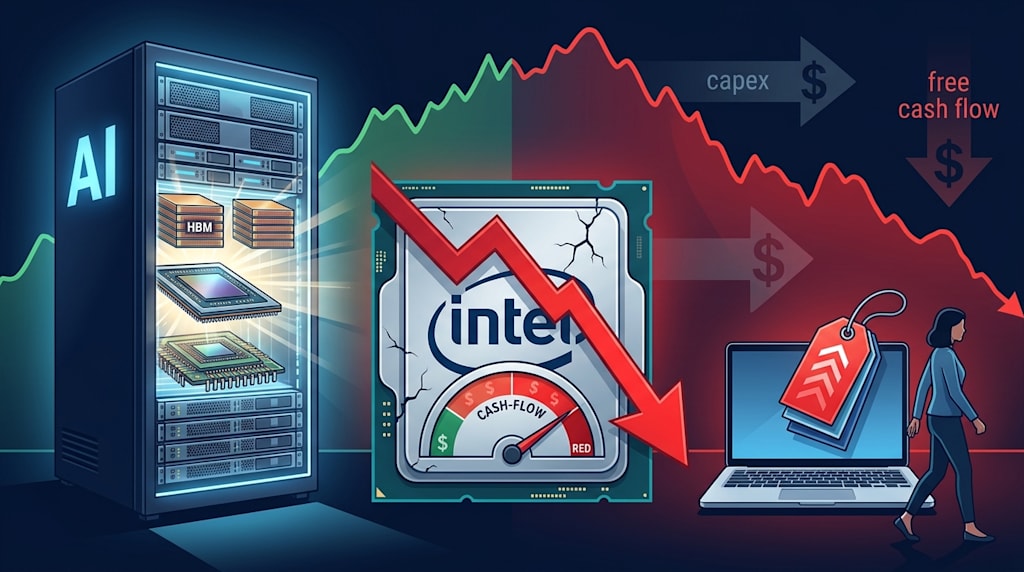
The Asian session opened with a familiar excuse. Intel, Samsung, Google, and the Korean secondary-market heavyweights all arrived with a selloff story, and the story was quickly dressed up as an “AI-wide earnings reversal” in Q3 2026. That label is too broad. The numbers point to a narrower problem: AI demand is still there, but the ability to turn that demand into revenue, profit, and free cash flow is splitting the supply chain into winners and debt-funded spenders.
Intel is the clearest case.
Intel: Q3 was fine. Q4 was the problem.
Intel’s Q3 looked respectable: revenue of $16.51 billion, up 21% year on year; non-GAAP EPS of $0.52 against a $0.40 consensus. In a quarter where several AI-linked giants were already cracking, that was not the weak spot.
The weak spot was the next quarter. Intel guided Q4 revenue to $15–16 billion, below the $17.07 billion consensus. Adjusted EPS was guided to $0.25, below the $0.43 consensus. The after-hours stock fell more than 20%.
The market had been pricing Intel as a continuing high-growth AI infrastructure beneficiary. Management delivered a different mix: slower growth, constrained supply, and pressure on profitability. Q3 was the past. The Q4 guide was the future, and the future was cut.
DCAI is strong. The PC base is still heavy.
Intel’s brightest Q3 number came from Data Center and AI. DCAI revenue reached $7.3 billion, up 78% year on year. The logic is straightforward: AI training runs on GPU clusters, but inference deployment, data scheduling, network connection, storage management, and enterprise applications still need CPUs. As AI moves from concentrated training to scaled inference, server CPUs regain importance. Intel gets high-end incremental demand.
Intel is not a pure AI company. Client Computing and Physical AI revenue was $8.1 billion, down 5% year on year. The business mix is shifting: traditional PC processors are under pressure, while server CPUs benefit from AI data-center buildout. When the traditional base is still large and the PC cycle is turning down, AI growth gets diluted.
The PC side has its own cost shock. AI data centers pull HBM, high-performance DRAM, and enterprise SSDs toward higher-margin products. Supply for traditional storage products tightens. Storage prices rise. PC makers pass the cost into notebook and desktop prices. Enterprise AI infrastructure buyers treat spending as strategic investment; ordinary PC buyers treat it as a replacement-cycle decision. When prices rise, they postpone.
On the supplied scenario numbers, Counterpoint Research put Q3 2026 global PC shipments at 57 million units, down 21% year on year, with Q4 possibly down 27%. Intel management expected PC weakness to last at least through the first half of 2027. That is the drag: DCAI grows fast, but the client base is still large enough to pull the consolidated growth rate down.
Supply constraints: demand does not equal recognized revenue
Intel’s second problem is supply. The scenario material points to advanced packaging capacity limits, especially organic substrates, alongside long-term contracts that support pricing. Intel is not alone here. Across Western AI leaders, advanced packaging, substrates, HBM, and enterprise SSD capacity can bottleneck revenue recognition.
Demand growth does not automatically become revenue. A server CPU order, an advanced packaging slot, a substrate supply line, any one of them can delay recognition. Intel has demand-side logic in AI data centers. Its supply-side execution is weaker than TSMC’s or SK Hynix’s. The market pays for demand stories, but it eventually prices the full chain: supply, revenue, profit, cash flow.
The hard problem: capex and free cash flow
The deeper issue is cash. Intel is trying to do three expensive things at once: own CPUs, build GPUs, and run a foundry business that challenges TSMC. R&D, advanced process, packaging, and fab expansion all consume capital. Three-front spending dilutes return on capital, and the market’s patience for heavy-asset transformation is shorter than it was.
On the scenario numbers, Intel raised its 2026 capex budget from $18 billion to $20 billion and expected 2027 capex to rise significantly. Q3 operating cash flow was $5.082 billion. Plant and equipment spending was $4.219 billion. After partner contributions and other items, adjusted free cash flow was $1.639 billion.
That $1.639 billion does not fund the plan. Intel had already raised about $23 billion through equity issuance and still needs substantial external capital for its strategic transition. If it needs another $20 billion, the question is whether the return on invested capital can cover the cost of that debt. In the current rate and credit environment, a borrowing cost above 10% is not a rhetorical question.
Intel’s spending is not the issue. The missing cash-return path is. That is the shift from “compute expansion pricing” to “capital-return pricing.”
The comparison: AI demand did not vanish. The profit pool moved.
TSMC: advanced process demand remains strong. On the scenario numbers, Q3 2026 revenue was NT$1.494 trillion, up 50.9% year on year; net profit rose 68.7%. Q4 revenue was guided to $52.3–54.3 billion. The core AI chip manufacturing link has not shown an order collapse. Advanced process remains one of the strongest bargaining positions in the chain.
SK Hynix: AI memory remains in a high-cycle phase. The supplied scenario puts Q3 revenue at KRW104.62 trillion, up 328% year on year and 32% quarter on quarter; operating profit at KRW83.33 trillion, up 632%; operating margin at 80%. HBM4 is ramping, and more than half of 2027–2028 capacity is locked through long-term agreements. The margin figures are extreme and need filing-level verification, but the direction is clear: AI server demand for high-bandwidth memory is still expanding.
Samsung: semiconductors strong, consumer electronics weak. Q3 revenue was KRW195.3 trillion; operating profit was KRW107.4 trillion. The semiconductor division had revenue of KRW147.1 trillion and operating profit of KRW106.5 trillion. The DX division, which houses consumer electronics and mobile terminals, posted an operating loss of KRW0.8 trillion. Q3 capex was KRW29 trillion; nine-month capex reached KRW56.9 trillion; full-year capex was expected at about KRW84.4 trillion. The same split as Intel: AI infrastructure investment and traditional consumer demand are on different cycles.
Google: a harder problem than Intel. Alphabet fell 12.6% on October 29, the largest one-day drop in more than 20 years, wiping out about $500 billion in market value. Search advertising revenue grew 12%, below expectations and the slowest pace in five quarters. AI search improves user experience, but AI Mode queries monetize worse than traditional search. Q3 capex was $51.36 billion. Free cash flow turned negative at $9.07 billion. The company expected 2027 capex to rise again. Earnings missed; EPS fell year on year; equity investment losses added pressure. Google Cloud revenue grew 103%, so AI demand had not disappeared. The market was pricing the gap between AI spending and AI monetization in the core advertising business.
The downstream cloud giants: revenue grows, cash flow does not
Microsoft’s FY2026 first quarter, corresponding to calendar Q3, had revenue of $92.3 billion, up 19%; Azure revenue up 48%; Microsoft Cloud revenue up 30%. Amazon’s Q3 AWS revenue was $46 billion, up 39.3%, the fastest growth in nearly five years. Downstream cloud and AI infrastructure demand is still strong.
Cash flow tells a different story. On the scenario numbers, Google’s nine-month capex reached $132 billion, against $63.6 billion a year earlier, and Q3 free cash flow was negative. Amazon’s trailing-twelve-month operating cash flow was $168.3 billion, but net equipment purchases were $210.7 billion. Free cash flow swung from positive $14.8 billion a year earlier to negative $42.4 billion.
Revenue can grow fast and capex can grow faster. The difference lands on shareholders. That is why the next stage of AI investment logic is not “who spends the most on compute.” It is “who converts compute into return on investment.”
What to watch in Intel
Short term, three items:
The Q4 guide. Revenue of $15–16 billion and EPS of $0.25 are the earnings gap. If supply and PC demand worsen, the estimate can be cut again.
Advanced packaging and substrate capacity. DCAI demand is strong. If packaging and substrate supply do not ramp, revenue recognition slips.
Capex and funding. The $20 billion capex plan and the free-cash-flow gap need funding. Debt cost, equity dilution, and CDS spreads will price the stock before the revenue recovery does.
Medium term, two items:
External foundry customers. Intel’s foundry challenge to TSMC is the most capital-intensive and slowest-return part of the story. Internal orders alone will not cover the capital cost.
Server CPU share in the inference era. AI inference needs CPUs, but GPU clusters still dominate. Intel has to show that DCAI is a durable profit contributor, not a supporting beneficiary whose gains are offset by client weakness and capex.
Intel has an AI logic. The logic is squeezed by the traditional PC cycle, supply bottlenecks, and the capital-spending gap. The market is repricing the chain from compute expansion to capital return and free cash flow. For Intel, Q3 revenue beating consensus is no longer the story. The Q4 guide, the substrate and packaging ramp, and the 2027 capex and funding plan are.
About the Creator
Jin
Writer of reamstories
https://reamstories.com/jin
Enjoyed the story? Support the Creator.
Subscribe for free to receive all their stories in your feed. You could also become a paid subscriber, letting them know you appreciate their work.
Comments
There are no comments for this story
Be the first to respond and start the conversation.