
India Watch Market Expected to Reach US$ 5.35 Billion by 2034 as Smartwatches, Fashion Trends, and Premium Timepieces Drive Growth
Rising Disposable Income, Expanding E-Commerce, and Growing Demand for Stylish and Technologically Advanced Watches Are Transforming India’s Watch Industry

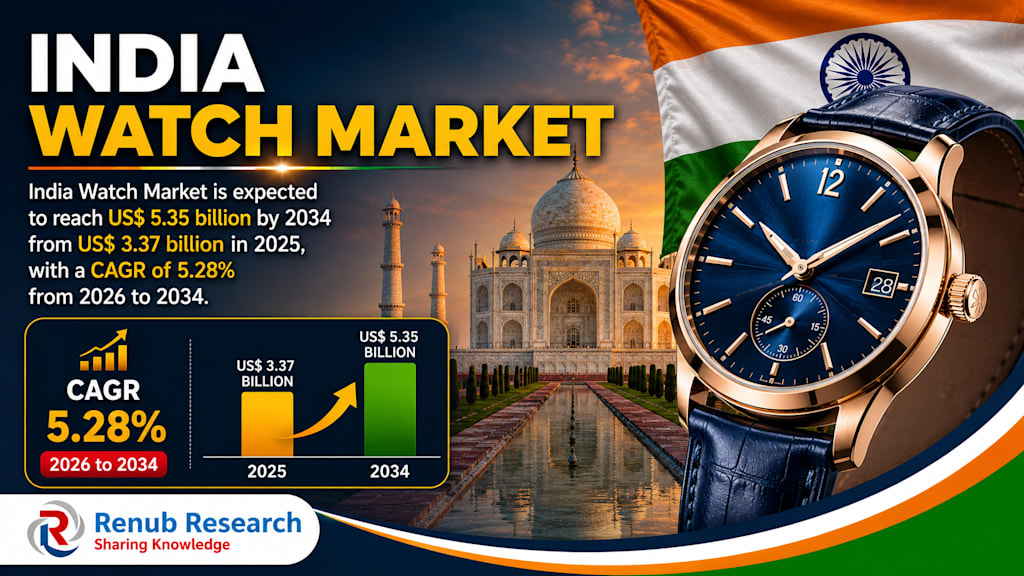
The India watch market is undergoing rapid transformation as consumers increasingly view watches as lifestyle accessories, fashion statements, and multifunctional wearable devices rather than simple timekeeping tools. From affordable smartwatches and stylish analog models to luxury mechanical timepieces, the industry is evolving quickly alongside changing consumer preferences and rising digital adoption.
According to Renub Research, the India watch market is projected to grow from US$ 3.37 billion in 2025 to US$ 5.35 billion by 2034, expanding at a CAGR of 5.28% between 2026 and 2034. Rising demand for luxury and smartwatches, expanding e-commerce penetration, increasing fashion consciousness, and strong domestic manufacturing growth are expected to continue driving long-term market expansion throughout India.
The Indian watch industry today spans a broad range of categories including mechanical, quartz, digital, automatic, and smartwatch products. Watches are increasingly valued not only for functionality but also for craftsmanship, status, technology integration, and personal style.
As urbanization, disposable incomes, and digital lifestyles continue evolving, India’s watch market is entering a new phase of modernization and diversification.
Young Consumers and Fashion Awareness Are Fueling Demand
One of the biggest growth drivers behind the India watch market is the rising influence of younger consumers and fashion-focused purchasing behavior.
India’s large Gen Z population is heavily influenced by:
- Social media trends
- Digital communities
- Influencer culture
- Brand collaborations
- Experiential marketing campaigns
Younger consumers increasingly seek watches that reflect individuality, lifestyle identity, and fashion sensibilities rather than simply serving practical purposes.
Brands are actively leveraging digital-first marketing strategies to connect emotionally with younger audiences.
Homegrown watch company Sylvi, for example, has successfully attracted younger consumers through limited-edition launches and social-media-driven campaigns featuring affordable products priced below INR 2,000.
Experiential marketing campaigns by brands such as Timex Group and Fire-Boltt have also demonstrated how music festivals, digital engagement, and lifestyle storytelling increasingly outperform traditional celebrity endorsements.
This trend is pushing companies to accelerate design innovation and launch more personalized collections featuring customizable colors, interchangeable straps, and lifestyle-oriented aesthetics.
As fashion awareness continues rising among younger demographics, watches are increasingly becoming style accessories integrated into broader lifestyle culture.
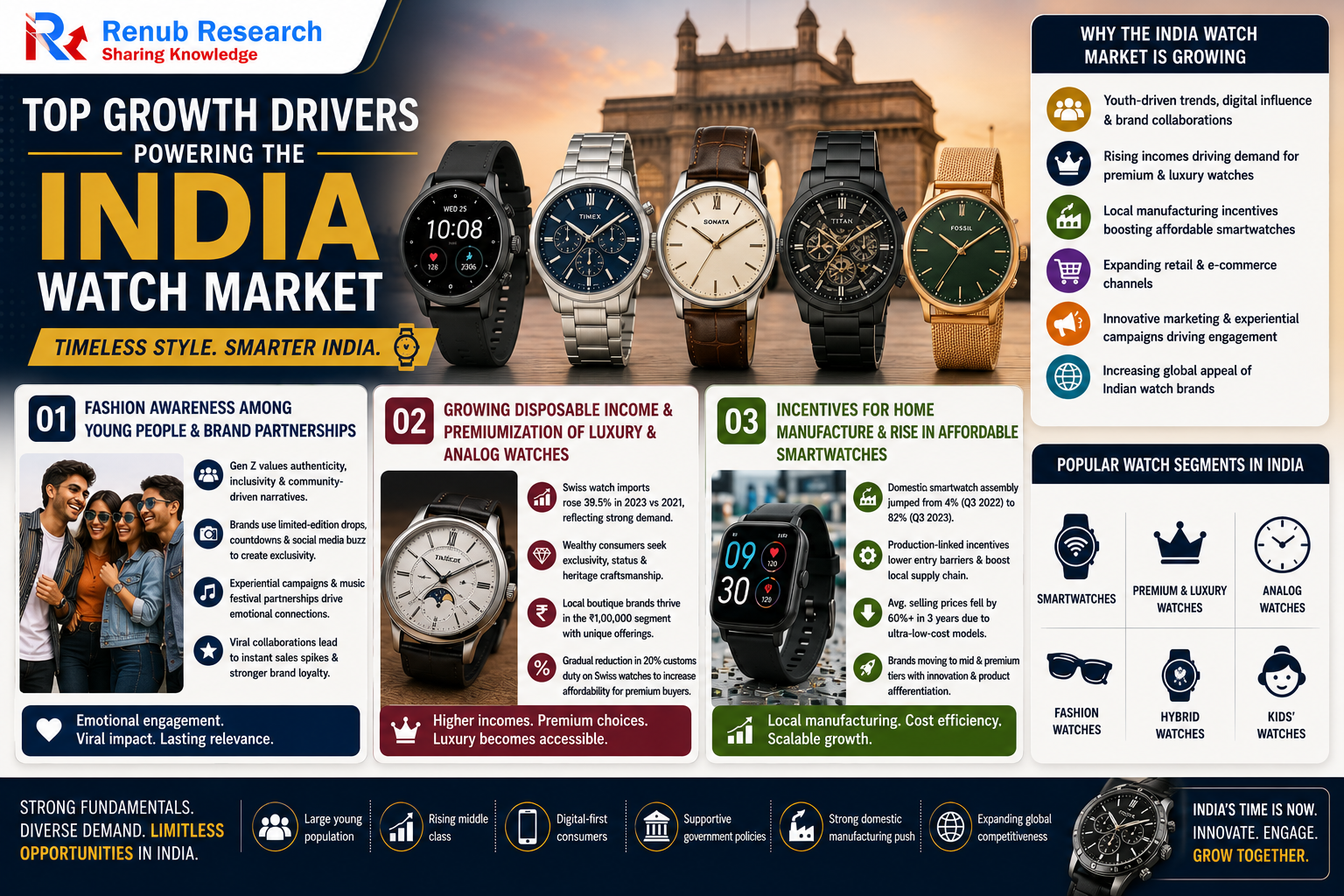
Rising Disposable Income Is Supporting Premiumization
Growing household incomes and increasing aspirational spending are significantly supporting demand for premium and luxury watches in India.
Consumers in metro cities and Tier-I urban centers are increasingly purchasing high-end analog and hybrid watches as symbols of exclusivity, status, and success.
India’s affluent consumer segment is showing stronger interest in:
- Swiss luxury watches
- Premium mechanical timepieces
- Boutique watch brands
- Limited-edition collections
- Hybrid luxury designs
Swiss watch imports reportedly increased by nearly 39.5% in 2023 compared to 2021, highlighting rising consumer demand for luxury timepieces.
At the same time, boutique Indian brands are gaining traction by blending traditional craftsmanship with modern mechanics and contemporary aesthetics.
The gradual reduction of customs tariffs on Swiss watches over the next several years is also expected to improve affordability and expand access to luxury products for upper-middle-class consumers.
This premiumization trend is expected to remain one of the most important long-term growth drivers within the Indian watch market.
Smartwatch Adoption Continues Accelerating
India has emerged as one of the fastest-growing smartwatch markets globally.
Consumers increasingly prioritize multifunctional wearable devices that combine timekeeping with:
- Health monitoring
- Fitness tracking
- Smartphone connectivity
- GPS capabilities
- Notifications and messaging
- AI-driven wellness insights
The growing focus on health, wellness, and connected lifestyles has significantly increased smartwatch adoption among younger urban consumers.
Manufacturers are aggressively launching feature-rich devices across multiple price segments.
In July 2025, CMF introduced the Watch 3 Pro featuring a 1.43-inch AMOLED display, dual-band GPS, AI-powered workout insights, and integrated ChatGPT support.
Similarly, Samsung launched the Galaxy Watch 8 in July 2025 with enhanced Galaxy AI features and more durable construction.
In September 2024, Apple Inc. introduced the Apple Watch Series 10 and Apple Watch SE with advanced capabilities including sleep apnea detection, improved health analytics, faster charging, and enhanced water-tracking features.
These developments highlight how smartwatch manufacturers continue expanding the functionality of wearable devices beyond basic fitness tracking.
As Indian consumers increasingly adopt digital ecosystems and health-focused lifestyles, smartwatch demand is expected to remain exceptionally strong.
Domestic Manufacturing Incentives Are Strengthening the Industry
Government incentives and localized manufacturing initiatives are significantly reshaping India’s smartwatch and wearable ecosystem.
Production-linked incentive programs have encouraged substantial growth in domestic smartwatch assembly operations.
According to Renub Research, domestic smartwatch assembly increased dramatically from approximately 4% of shipments in Q3 2022 to nearly 82% in Q3 2023.
These policies have encouraged investment in local production of:
- Printed circuit boards
- Screens
- Battery packs
- Components and accessories
Domestic manufacturing expansion has helped improve scale, cost efficiency, and supply-chain development across the industry.
Local brands such as boAt, Noise, and Fire-Boltt have successfully maintained strong volume leadership through local production partnerships while also moving toward higher-margin premium products.
This shift is helping India become increasingly attractive to international component suppliers and global manufacturing partnerships.
E-Commerce Is Transforming Watch Retail
The rapid expansion of e-commerce is dramatically changing how watches are purchased across India.
Consumers increasingly rely on online platforms because they provide:
- Product comparisons
- Competitive pricing
- Wider product variety
- Customer reviews
- Convenient delivery services
- Access to international brands
Omnichannel retail strategies are also helping brands improve accessibility and customer engagement.
Online retail has become especially important for smartwatch and mid-range watch categories where younger consumers prefer digital-first shopping experiences.
Festive sales events, influencer marketing campaigns, and social commerce platforms continue generating substantial sales volumes throughout the year.
Meanwhile, physical retail stores, malls, airport outlets, and luxury boutiques remain highly important for premium and luxury purchases where consumers often prefer in-person product experiences.
The combination of digital convenience and offline retail experiences is creating a highly dynamic and competitive marketplace.
Intense Competition Continues Challenging Brands
Despite strong growth opportunities, India’s watch market remains highly competitive.
Both domestic and international companies compete aggressively across multiple price segments, creating pricing pressure and reducing differentiation opportunities.
The rapid rise of smartwatches has further intensified competition within the broader watch industry.
Traditional analog and digital watch manufacturers increasingly struggle to maintain relevance among younger consumers who prioritize connectivity and multifunctionality.
To remain competitive, companies must continuously invest in:
- Product innovation
- Brand marketing
- Design differentiation
- Technology integration
- Distribution expansion
- Influencer engagement
Smaller players often face challenges establishing visibility and maintaining profitability within such a crowded marketplace.
Changing Consumer Preferences Continue Disrupting Traditional Segments
Changing consumer behavior is also creating long-term challenges for conventional watch categories.
Many younger consumers now prioritize multifunctional wearable devices over traditional analog or basic digital watches.
This shift has reduced demand for entry-level conventional watches, particularly among urban consumers.
Additionally, smart devices typically have shorter product lifecycles compared to traditional watches, creating additional pressure around:
- Inventory management
- Product refresh cycles
- Technology upgrades
- R&D investment requirements
Manufacturers that fail to integrate digital innovation or reposition products effectively may struggle to retain long-term relevance.
Maharashtra Leads the Indian Watch Market
Maharashtra remains one of India’s largest watch markets due to strong urbanization and high purchasing power in cities such as Mumbai and Pune.
Consumers in Maharashtra show strong preference for:
- Branded watches
- Luxury timepieces
- Smartwatches
- Corporate and lifestyle accessories
The state’s advanced retail infrastructure and strong e-commerce adoption continue supporting market expansion.
Karnataka Benefits From Tech-Savvy Consumers
Karnataka, particularly Bengaluru, represents one of India’s most technology-oriented watch markets.
The city’s young and affluent workforce strongly favors smartwatches and premium wearable products.
High disposable incomes and exposure to global technology trends continue accelerating demand for multifunctional and fitness-focused devices.
Tamil Nadu and Gujarat Continue Expanding
Tamil Nadu remains an important market due to strong demand from urban consumers in Chennai and surrounding industrial centers.
Consumers increasingly seek durable, functional, and technologically advanced watches.
Meanwhile, Gujarat’s business-oriented consumer culture supports steady demand for premium and status-oriented watches, especially during festivals and gifting occasions.
Quartz and Mechanical Watches Continue Maintaining Relevance
Despite rapid smartwatch adoption, quartz and mechanical watches continue serving important segments within the Indian market.
Quartz watches remain highly popular because of their:
- Affordability
- Accuracy
- Everyday practicality
- Low maintenance requirements
Mechanical watches continue attracting luxury buyers who value craftsmanship, prestige, and heritage-oriented products.
These traditional segments remain relevant because many consumers still appreciate watches as fashion accessories and symbols of status rather than purely technological devices.
Major Companies Continue Competing Through Innovation
Leading companies competing within the India watch market include:
- Seiko Holdings Corporation
- Casio Computer Co. Ltd
- Timex Group
- Rolex SA
- Compagnie Financière Richemont S.A
- The Swatch Group Ltd
- Citizen Watch Co. Ltd.
- Fossil Group Inc.
- Google LLC
Competition increasingly focuses on technology integration, affordability, lifestyle branding, and digital engagement.
The Future of the India Watch Market
The future of the India watch market appears highly promising as rising disposable incomes, digital lifestyles, and fashion consciousness continue reshaping consumer demand.
Smartwatches, premium analog products, localized manufacturing, and omnichannel retail strategies are expected to remain major long-term growth drivers.
At the same time, companies capable of balancing affordability, innovation, fashion appeal, and advanced functionality are likely to emerge as market leaders.
As watches continue evolving into multifunctional lifestyle accessories, India’s watch market is expected to maintain strong and stable growth through 2034.
Final Thoughts
The India watch market is rapidly evolving as consumers increasingly seek products that combine style, technology, status, and functionality. Watches are no longer viewed merely as tools for telling time—they are becoming fashion-forward wearable devices deeply integrated into modern lifestyles.
Although intense competition and shifting consumer preferences continue creating challenges, strong digital growth, rising smartwatch adoption, and increasing premiumization continue positioning the Indian watch industry for substantial long-term expansion.
About the Creator
Enjoyed the story? Support the Creator.
Subscribe for free to receive all their stories in your feed.
Comments
There are no comments for this story
Be the first to respond and start the conversation.