
India's Epoxy Resin Market Enters a New Era as Infrastructure, Manufacturing, and Sustainability Drive Growth
How India's Industrial Expansion Is Creating New Opportunities for the Epoxy Resin Industry Through 2033

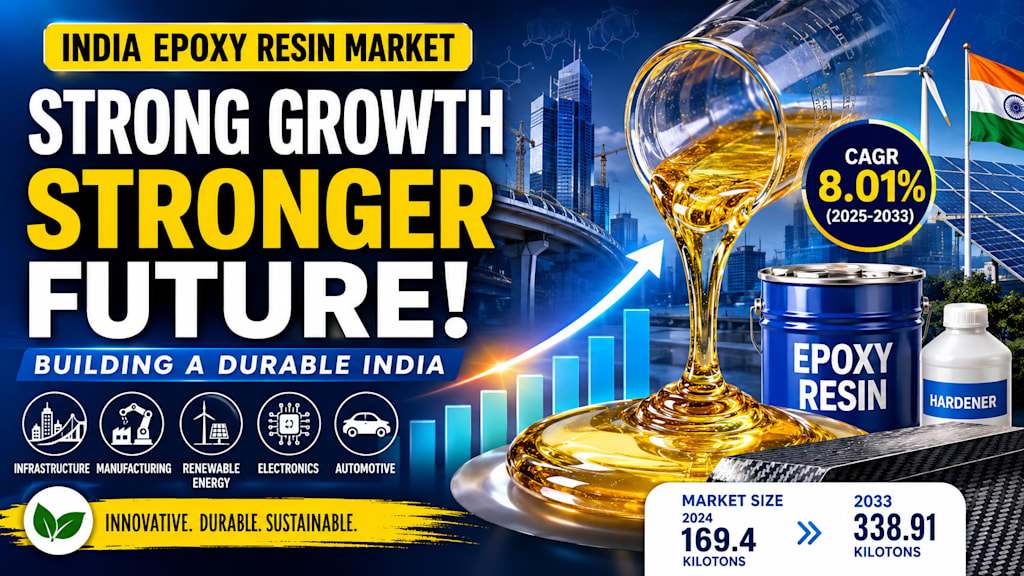
India's industrial transformation is creating opportunities across multiple sectors, and one of the beneficiaries of this growth is the epoxy resin industry. Often overlooked by consumers, epoxy resin is a critical material used in construction, electronics, automotive manufacturing, renewable energy systems, coatings, adhesives, and industrial composites.
According to Renub Research, the India Epoxy Resin Market is projected to grow from 169.4 Kilotons in 2024 to 338.91 Kilotons by 2033, expanding at a CAGR of 8.01% during 2025–2033. This remarkable growth reflects India's broader economic ambitions, increasing infrastructure investments, rising domestic manufacturing, and growing demand for advanced industrial materials.
As the nation pursues large-scale urbanization and industrial modernization, epoxy resin is emerging as a key component supporting some of India's most important development initiatives.
Why Epoxy Resin Matters More Than Ever
Epoxy resins are high-performance polymers known for their exceptional durability, strong adhesive properties, chemical resistance, and electrical insulation capabilities. These characteristics make them suitable for a wide range of industrial and commercial applications.
From coating bridges and industrial facilities to protecting electronic circuits and manufacturing wind turbine components, epoxy resins play a vital role in modern infrastructure and technology.
India's growing economy is creating a strong demand for these materials as industries seek products that offer durability, efficiency, and long-term performance.
Infrastructure Development Creates Strong Market Momentum
One of the biggest factors fueling growth in the epoxy resin market is India's aggressive infrastructure development strategy.
The government continues to invest heavily in roads, highways, airports, rail networks, industrial corridors, and urban development projects. Programs such as Smart Cities Mission, Housing for All, and various industrial expansion initiatives are creating significant demand for epoxy-based coatings, flooring systems, adhesives, and structural composites.
Construction companies increasingly rely on epoxy solutions because they offer:
Superior durability
Excellent waterproofing capabilities
Strong bonding strength
Corrosion resistance
Long service life
As India moves toward becoming one of the world's largest construction markets, demand for epoxy-based products is expected to accelerate further.
Manufacturing Expansion Strengthens Demand
India's manufacturing ambitions are creating another major growth avenue for epoxy resin producers.
Government initiatives such as "Make in India" and "Aatma Nirbhar Bharat" aim to boost domestic production across industries including automotive, electronics, defense, chemicals, and renewable energy.
As manufacturing activity expands, epoxy resins are becoming increasingly important in production processes. Their versatility allows them to be used in protective coatings, composite materials, adhesives, electrical insulation systems, and industrial equipment.
The government's vision of expanding manufacturing exports and strengthening domestic supply chains is expected to create long-term demand for epoxy resin products throughout the decade.
Electronics Industry Becomes a Key Consumer
India's rapidly growing electronics sector represents another significant opportunity for epoxy resin manufacturers.
Electronic devices require materials capable of protecting sensitive components from heat, moisture, vibration, and electrical interference. Epoxy resins are widely used in:
Printed circuit boards
Semiconductor encapsulation
Electrical insulators
Consumer electronics
Industrial electronic equipment
As India strengthens its position in electronics manufacturing and semiconductor development, demand for specialized epoxy formulations is expected to increase substantially.
The growth of smartphones, consumer electronics, industrial automation, and electric vehicles is creating a strong foundation for future market expansion.
Automotive Industry Embraces Advanced Materials
The automotive sector is increasingly turning to epoxy-based materials to improve vehicle performance and efficiency.
Manufacturers are using epoxy resins in lightweight composites, adhesives, coatings, and structural components to reduce vehicle weight while maintaining strength and durability.
This trend is particularly important as automakers focus on fuel efficiency and electric vehicle production.
Electric vehicles require advanced materials that can support battery systems, electrical components, and lightweight structures. Epoxy resins provide an ideal solution for many of these applications.
As India's automotive sector continues to evolve, epoxy resin consumption is expected to rise significantly.
Renewable Energy Adds New Growth Opportunities
India's commitment to renewable energy is opening additional opportunities for epoxy resin manufacturers.
Wind energy applications represent one of the fastest-growing segments within the market. Wind turbine blades require high-performance epoxy composites capable of withstanding extreme environmental conditions while maintaining structural integrity.
With India aggressively expanding renewable energy capacity, demand for epoxy-based composites is expected to increase over the coming years.
Solar energy infrastructure and power transmission systems also create opportunities for epoxy resin applications in protective coatings and electrical insulation.
Sustainability Becomes a Competitive Advantage
Environmental concerns are reshaping the global chemical industry, and the epoxy resin market is no exception.
Manufacturers are increasingly investing in:
Bio-based epoxy formulations
Low-VOC products
Solvent-free solutions
Environmentally responsible manufacturing practices
These innovations help companies comply with environmental regulations while meeting customer demand for sustainable products.
As environmental awareness grows among businesses and consumers, eco-friendly epoxy solutions are becoming an important competitive differentiator.
Companies that successfully combine performance with sustainability are likely to gain significant market advantages in the years ahead.
Challenges Facing the Industry
Despite its strong growth outlook, the epoxy resin industry faces several challenges.
Raw Material Price Volatility
The cost of raw materials used in epoxy resin production can fluctuate significantly due to global supply chain disruptions, energy prices, and geopolitical events.
These fluctuations can impact profit margins and create uncertainty for manufacturers.
Competition from Alternative Materials
Epoxy resins compete with several alternative materials, including polyurethane systems, polyester resins, and emerging bio-based materials.
Some alternatives offer lower costs or application-specific advantages, forcing epoxy manufacturers to continually innovate.
Skills and Awareness Gap
In many regions of India, awareness regarding the benefits and proper application of epoxy products remains limited.
Improper installation can negatively impact performance, creating a need for industry training, technical support, and educational initiatives.
Addressing these challenges will be essential for sustaining long-term market growth.
Regional Dynamics Shape Market Development
West India Leads the Market
West India remains the largest and most mature regional market for epoxy resins.
States such as Maharashtra and Gujarat serve as major industrial and manufacturing hubs, supporting strong demand from automotive, chemical, electronics, and construction sectors.
The presence of industrial corridors, ports, and large-scale manufacturing facilities strengthens the region's market position.
East India Shows Emerging Potential
East India is becoming an increasingly important growth region.
Infrastructure projects, mining activities, industrial development, and urban expansion across states such as West Bengal, Odisha, and Jharkhand are driving demand for epoxy-based products.
As investment continues to flow into the region, epoxy resin consumption is expected to rise steadily.
North and South India Continue Expanding
North India benefits from ongoing infrastructure development, industrial projects, and urban construction.
South India remains a key center for electronics manufacturing, automotive production, and technology-driven industries, creating substantial demand for epoxy solutions.
Together, these regions contribute to a balanced and diversified growth landscape.
10 Recent Developments Among Leading Industry Players
1. 3M
Expanded its advanced industrial adhesive portfolio to improve bonding performance across automotive and manufacturing applications.
2. Aditya Birla Chemicals
Continued investments in specialty chemical capabilities to strengthen its epoxy resin offerings for industrial customers.
3. Atul Ltd
Enhanced production efficiencies and expanded specialty resin solutions targeting coatings and composite applications.
4. BASF SE
Accelerated sustainability initiatives focused on reducing emissions and developing environmentally responsible resin technologies.
5. Daicel Corporation
Strengthened research activities aimed at advanced resin formulations for high-performance industrial applications.
6. DuPont
Expanded material innovation programs supporting electronics, semiconductor, and advanced manufacturing industries.
7. KUKDO CHEMICAL CO., LTD.
Focused on increasing production capacity and developing specialized epoxy solutions for global markets.
8. Huntsman International LLC
Introduced new high-performance resin technologies designed for infrastructure and industrial applications.
9. NAN YA PLASTICS CORPORATION
Continued investments in advanced epoxy manufacturing processes and product diversification initiatives.
10. Olin Corporation / Westlake (Hexion)
Strengthened innovation efforts around sustainable epoxy technologies and next-generation industrial materials.
Competitive Landscape
The India epoxy resin market remains highly competitive, featuring a mix of multinational corporations and domestic manufacturers.
Major participants are focusing on:
Product innovation
Capacity expansion
Sustainable manufacturing
Strategic partnerships
Regional market penetration
Research and development investments
Companies capable of delivering high-performance, cost-effective, and environmentally responsible solutions are expected to capture significant growth opportunities.
The Road Ahead
India's economic transformation is creating a favorable environment for the epoxy resin industry. Rising industrial activity, infrastructure development, renewable energy investments, and manufacturing expansion are all contributing to sustained market growth.
While challenges such as raw material volatility and competitive pressures remain, the industry's long-term outlook remains highly positive.
The increasing emphasis on sustainability, technological innovation, and domestic manufacturing is expected to further strengthen demand across multiple end-use sectors.
Final Thoughts
The India Epoxy Resin Market is entering a period of sustained expansion driven by some of the country's most important economic priorities. As infrastructure projects accelerate, manufacturing output increases, and renewable energy investments rise, epoxy resins are becoming essential materials supporting India's industrial future.
With the market projected to grow from 169.4 Kilotons in 2024 to 338.91 Kilotons by 2033, businesses operating in this sector have a significant opportunity to capitalize on one of India's most promising industrial growth stories. Companies that invest in innovation, sustainability, and customer-focused solutions will likely emerge as leaders in the next chapter of India's epoxy resin journey.
About the Creator
Enjoyed the story? Support the Creator.
Subscribe for free to receive all their stories in your feed.
Comments
There are no comments for this story
Be the first to respond and start the conversation.