
India Ophthalmology Devices Market Expands as Rising Eye Disorders and Medical Innovation Drive Demand
Growing awareness about eye health, advanced surgical technology, and expanding healthcare infrastructure are transforming India’s ophthalmology devices industry.

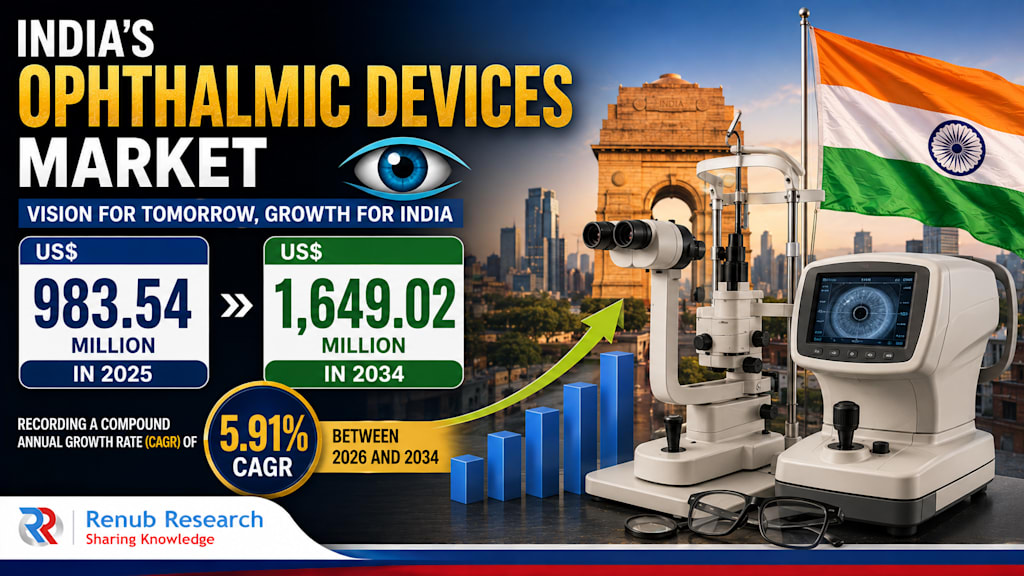
India’s ophthalmology devices market is entering a major growth phase as rising cases of eye disorders, increasing healthcare awareness, and rapid technological innovation reshape the country’s eye care ecosystem.
From cataract surgeries and glaucoma treatments to AI-powered diagnostics and portable screening devices, ophthalmology technology is becoming increasingly important in India’s healthcare sector.
According to Renub Research, the India ophthalmology devices market is projected to grow from US$ 983.54 million in 2025 to US$ 1,649.02 million by 2034, expanding at a compound annual growth rate (CAGR) of 5.91% during 2026–2034.
The market’s growth is being fueled by multiple factors including the increasing prevalence of eye diseases, a rapidly aging population, improvements in healthcare infrastructure, and growing adoption of advanced ophthalmic equipment across hospitals and specialty eye clinics.
At the same time, government initiatives focused on blindness prevention, telemedicine-based eye care programs, and rising investments in modern diagnostic technologies are accelerating the industry’s transformation.
As India’s healthcare system modernizes, ophthalmology devices are becoming essential tools in protecting vision and improving quality of life for millions of patients.

Rising Eye Disorders Are Increasing Demand for Ophthalmology Devices
The growing burden of eye disorders remains one of the strongest drivers behind India’s ophthalmology devices market.
Eye diseases such as:
- Cataracts
- Glaucoma
- Diabetic retinopathy
- Refractive errors
- Myopia
- Age-related vision impairment
are becoming increasingly common across India.
Lifestyle changes, growing screen time, urbanization, diabetes prevalence, and population aging are all contributing to this trend.
According to an analysis published in the Indian Journal of Ophthalmology in April 2024, refractive errors affect nearly 20% of Indian children aged 7–15 years by the time they reach 16 years old.
This growing patient population is creating strong demand for diagnostic and surgical ophthalmology devices capable of detecting and treating eye disorders at earlier stages.
Healthcare providers increasingly rely on advanced technologies to improve diagnostic precision and treatment outcomes.
Commonly used ophthalmology devices include:
- Slit lamps
- Optical coherence tomography (OCT) scanners
- Ophthalmoscopes
- Laser surgical systems
- Phacoemulsification machines
- Intraocular lenses (IOLs)
Timely diagnosis and intervention are especially important because many eye diseases can lead to permanent vision loss if left untreated.
As awareness about preventive eye care continues growing, hospitals and eye clinics are investing heavily in advanced ophthalmic equipment.
Aging Population Is Driving Long-Term Market Growth
India’s rapidly aging population is another major factor contributing to increased ophthalmology device demand.
Older adults are more vulnerable to vision-related disorders such as cataracts, glaucoma, and retinal diseases.
As life expectancy improves across India, the number of elderly patients requiring ophthalmic treatment is expected to rise significantly over the next decade.
Cataracts remain one of the leading causes of blindness in India.
This has created enormous demand for cataract surgeries and related technologies including:
- Intraocular lenses
- Laser-assisted surgical systems
- Phacoemulsification equipment
- Microsurgical ophthalmic devices
Eye care providers are increasingly focusing on minimally invasive procedures that offer:
- Faster recovery
- Better precision
- Improved patient safety
- Reduced surgical complications
The combination of aging demographics and rising healthcare awareness is expected to create sustained long-term growth opportunities for the ophthalmology devices market.
Technological Advancements Are Revolutionizing Eye Care
Technological innovation is rapidly transforming ophthalmology treatment and diagnostics across India.
Modern ophthalmic devices now provide significantly improved accuracy, efficiency, and patient outcomes compared to older systems.
Technologies gaining strong adoption include:
- Optical coherence tomography (OCT)
- AI-powered diagnostics
- Femtosecond laser systems
- Digital ophthalmoscopes
- Tele-ophthalmology platforms
- Minimally invasive surgical technologies
These innovations allow healthcare professionals to diagnose eye disorders earlier and perform surgeries with greater precision.
AI integration is becoming especially important.
Artificial intelligence systems can now assist in detecting conditions such as diabetic retinopathy and glaucoma through advanced image analysis and automated screening processes.
Telemedicine is also expanding rapidly within India’s eye care sector.
Remote eye examinations and AI-assisted screening programs are helping improve healthcare access in underserved and rural regions.
In June 2024, C3 Med-Tech secured investment support for introducing AI-based ophthalmic screening devices and telemedicine-enabled eye diagnostic technologies across India.
These innovations are expected to significantly improve early disease detection and accessibility.
Government Programs Are Expanding Access to Eye Care
Government healthcare initiatives are playing a major role in strengthening India’s ophthalmology infrastructure.
Programs focused on blindness prevention and affordable eye care services are increasing public awareness while improving access to treatment.
One major initiative involves collaboration between the Centre for Cellular and Molecular Platforms, Karnataka Health & Family Welfare Department, and ACT for Health to launch a comprehensive eye care program in Karnataka.
The initiative received approximately INR 5.7 crore in funding for 2024 and is expected to benefit nearly 8–9 lakh residents across multiple districts.
The program aligns with India’s NPCBVI (National Programme for Control of Blindness and Visual Impairment) under the National Health Mission.
Government-supported eye camps, mobile diagnostic programs, and telemedicine initiatives are particularly important in rural regions where healthcare infrastructure remains limited.
These programs are increasing the need for portable and affordable ophthalmic devices.
Intraocular Lenses Are Witnessing Strong Growth
The intraocular lenses (IOLs) segment remains one of the most important categories within India’s ophthalmology devices market.
IOLs are artificial lenses implanted during cataract surgery to replace damaged natural lenses and restore vision.
The increasing number of cataract procedures performed annually in India is fueling strong demand for advanced IOL technologies.
Premium IOL categories gaining popularity include:
- Multifocal lenses
- Toric lenses
- Monofocal lenses
- Extended depth-of-focus lenses
These products help improve visual correction while reducing dependence on spectacles after surgery.
Domestic manufacturing is also helping improve affordability.
In 2024, several Indian manufacturers expanded production capacity for premium multifocal IOLs while introducing advanced optical technologies aimed at reducing treatment costs.
The combination of technological innovation and cost accessibility is expected to support continued growth within the segment.
Laser-Based Ophthalmology Devices Are Expanding Rapidly
Laser technology has become increasingly important in India’s ophthalmology sector.
Laser systems are widely used in procedures such as:
- LASIK surgery
- PRK procedures
- Cataract surgery
- Glaucoma treatment
- Retinal disorder management
Femtosecond laser technology is especially gaining popularity because of its precision and minimally invasive nature.
Patients increasingly prefer laser-assisted procedures because they offer:
- Faster recovery times
- Improved surgical accuracy
- Reduced discomfort
- Better long-term outcomes
Specialized eye hospitals across India continue investing in advanced laser systems.
In 2023, several Indian eye hospital chains introduced new femtosecond laser technologies to expand refractive surgery capabilities.
Although equipment costs remain high, growing demand for premium eye care services continues supporting adoption.
Portable Ophthalmoscopes Are Improving Rural Screening
Portable and digital ophthalmoscopes are becoming increasingly important in India’s rural healthcare ecosystem.
Ophthalmoscopes are used to examine the retina and optic nerve, helping diagnose diseases such as:
- Diabetic retinopathy
- Glaucoma
- Retinal damage
- Hypertension-related eye conditions
Mobile eye screening programs and rural healthcare initiatives are driving strong demand for portable diagnostic devices.
In 2024, smartphone-based ophthalmoscope tools became increasingly common during eye screening campaigns in rural India.
These technologies allow healthcare workers to conduct eye examinations even in remote areas with limited infrastructure.
The growing use of portable devices reflects India’s broader shift toward decentralized healthcare delivery models.
Corneal Topography Systems Support Refractive Surgery Growth
Corneal topography systems are gaining popularity in India due to the rising demand for LASIK and refractive surgeries.
These systems generate detailed maps of the cornea, helping ophthalmologists diagnose conditions such as:
- Keratoconus
- Corneal irregularities
- Dry eye syndrome
Corneal mapping is also essential for planning refractive procedures accurately.
AI integration is improving the effectiveness of these systems by enhancing diagnostic accuracy and treatment planning.
Indian eye centers launched several AI-powered corneal topography systems during 2023, reflecting increasing technological sophistication within the market.
Contact Lens Market Continues Expanding
India’s contact lens market is also growing rapidly due to changing consumer lifestyles and increasing demand for non-surgical vision correction.
Factors driving demand include:
- Urbanization
- Fashion consciousness
- Rising disposable incomes
- Growing incidence of myopia and astigmatism
Consumers increasingly prefer modern contact lens technologies such as:
- Silicone hydrogel lenses
- Daily disposable lenses
- Colored cosmetic lenses
- Moisture-retaining contact lenses
In 2024, leading contact lens brands introduced next-generation daily disposable products designed for greater comfort and hydration.
Younger urban consumers remain the strongest customer segment for contact lenses.
Maharashtra Leads India’s Ophthalmology Devices Market
Maharashtra remains one of India’s most advanced ophthalmology device markets due to its strong healthcare infrastructure and concentration of specialty eye hospitals.
Cities such as Mumbai and Pune host numerous advanced eye care institutions equipped with modern surgical and diagnostic technologies.
Medical tourism also contributes significantly to demand for premium ophthalmic equipment in the state.
In April 2025, Aditya Jyot Eye Hospital in Mumbai — part of Dr. Agarwals Eye Hospital network — reopened after major renovation with upgraded eye treatment infrastructure.
The state’s strong private healthcare ecosystem continues supporting rapid technological adoption.
Uttar Pradesh Emerges as a High-Growth Market
Uttar Pradesh is becoming one of India’s fastest-growing ophthalmology device markets due to its large population and rising healthcare demand.
The state faces high prevalence of cataracts, refractive errors, and vision impairment, particularly in rural areas.
Portable and affordable diagnostic devices are becoming increasingly important for improving healthcare accessibility.
In April 2025, Centre For Sight opened a modern super-specialty eye hospital in Prayagraj, expanding access to advanced ophthalmic treatments across the region.
Government healthcare programs and NGO partnerships continue supporting eye care outreach initiatives throughout the state.
Major Challenges Still Affect the Industry
Despite strong growth prospects, India’s ophthalmology devices market faces several important challenges.
One major issue is the high cost of advanced equipment.
Technologies such as:
- OCT systems
- Laser surgical devices
- Premium intraocular lenses
- AI-powered diagnostic tools
require significant investment, making them difficult for smaller clinics and rural healthcare centers to afford.
Limited affordability also affects patients from lower-income communities.
Another major challenge is the shortage of skilled ophthalmologists and trained technicians.
Operating sophisticated ophthalmic equipment requires specialized expertise, which remains concentrated mainly in metropolitan hospitals.
Rural regions continue facing shortages of both healthcare infrastructure and trained professionals.
The Future of India’s Ophthalmology Devices Market
The future of India’s ophthalmology devices market appears highly promising.
Future growth is expected to focus on:
- AI-powered diagnostics
- Portable screening devices
- Tele-ophthalmology services
- Minimally invasive surgery
- Affordable ophthalmic technologies
- Rural healthcare outreach
- Premium vision correction solutions
As healthcare awareness increases and technology becomes more accessible, ophthalmology devices are expected to play an even greater role in India’s healthcare system.
Final Thoughts
India’s ophthalmology devices market is rapidly evolving into one of the country’s most important healthcare technology sectors.
According to Renub Research, the market’s projected growth from US$ 983.54 million in 2025 to US$ 1,649.02 million by 2034 highlights the enormous opportunities emerging across diagnostics, surgery, and vision correction technologies.
Rising eye disorders, aging populations, government healthcare initiatives, and rapid technological innovation are all reshaping the future of eye care in India.
From AI-powered diagnostics and portable screening tools to advanced cataract surgery systems and premium contact lenses, ophthalmology technology is becoming increasingly critical in preserving vision and improving patient outcomes.
As India continues modernizing its healthcare infrastructure, the ophthalmology devices industry is expected to remain on a strong upward growth path for years to come.
About the Creator
Enjoyed the story? Support the Creator.
Subscribe for free to receive all their stories in your feed.
Comments
There are no comments for this story
Be the first to respond and start the conversation.