
India Industrial Automation Market: Industry 4.0, AI, and Smart Manufacturing Are Powering a High-Growth Transformation
Projected to surge from US$ 3.64 billion in 2025 to US$ 13.65 billion by 2034, India’s industrial automation market is accelerating rapidly with a CAGR of 15.82%.

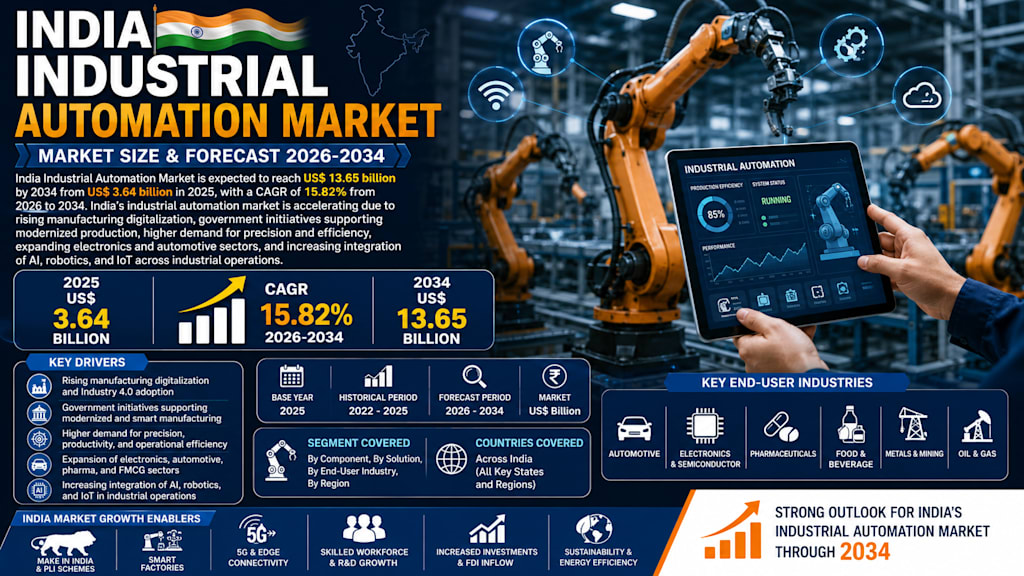
India’s Manufacturing Revolution Is Becoming Digital
India’s industrial landscape is undergoing one of the most significant transformations in its history. The shift from manual processes to automated, intelligent systems is reshaping how factories operate, compete, and scale globally. Industrial automation is no longer a luxury—it is becoming a necessity.
According to the latest data, the India industrial automation market is expected to grow from US$ 3.64 billion in 2025 to US$ 13.65 billion by 2034, expanding at a strong CAGR of 15.82% between 2026 and 2034.
This rapid growth reflects the increasing adoption of Industry 4.0 technologies, government-backed manufacturing initiatives, and rising demand for efficiency, precision, and sustainability across industries.
Industry Overview: What Industrial Automation Means for India
Industrial automation refers to the use of advanced technologies such as robotics, industrial IoT (IIoT), artificial intelligence (AI), sensors, and software systems to automate production processes. These technologies reduce human intervention while improving accuracy, speed, and consistency.
In India, automation is being widely adopted across industries including automotive, pharmaceuticals, FMCG, chemicals, electronics, and heavy engineering. Factories are evolving into smart manufacturing units equipped with real-time monitoring, predictive analytics, and cloud-connected systems.
Key technologies shaping this transformation include:
Robotics for assembly and material handling
AI-driven control systems for decision-making
Smart sensors for real-time data collection
Digital twins for simulation and optimization
Cloud platforms for remote monitoring and analytics
Government initiatives such as “Make in India” and Production Linked Incentive (PLI) schemes are further accelerating automation adoption, strengthening India’s position as a global manufacturing hub.
Semiconductor and Electronics Boom Is Fueling Automation
One of the most powerful growth drivers for India’s automation market is the rapid expansion of semiconductor and electronics manufacturing.
As production becomes more advanced and precision-intensive, manufacturers require automated systems to maintain quality and efficiency. Robotics, cleanroom automation, and advanced process control systems are essential for handling sensitive components and ensuring consistent output.
A major milestone came in May 2025, when the Indian government approved a new semiconductor facility under the India Semiconductor Mission. This large-scale project highlights the increasing reliance on automation in high-tech manufacturing environments.
As India builds its semiconductor ecosystem, demand for automation solutions is expected to rise across the entire value chain—from fabrication to assembly and testing.
Shift Toward Open and Software-Driven Automation
Another major trend shaping the market is the transition toward open, software-defined automation systems.
Traditional automation systems often rely on proprietary hardware and closed architectures, which limit flexibility and increase costs. In contrast, modern systems emphasize interoperability, scalability, and modular design.
In May 2025, Schneider Electric introduced the Open Automation Movement, promoting vendor-neutral, plug-and-play systems that enable seamless integration across different technologies.
This shift offers several benefits:
Faster system upgrades and deployment
Reduced integration complexity
Lower lifecycle costs
Improved data flow and analytics capabilities
As Indian industries embrace digital transformation, open automation is becoming a key enabler of innovation and efficiency.
Sustainability and Digital Transformation Are Converging
Sustainability is no longer optional—it is becoming a central pillar of industrial strategy. Automation plays a critical role in helping companies achieve environmental, social, and governance (ESG) goals.
Automated systems enable:
Real-time energy monitoring
Reduced waste and emissions
Optimized resource utilization
Improved workplace safety
In December 2024, ABB India partnered with PwC to support manufacturers in integrating automation with sustainability initiatives. This reflects a growing trend where digital transformation and environmental responsibility go hand in hand.
As global supply chains demand greater transparency and sustainability, Indian manufacturers are investing in automation technologies that enhance both efficiency and environmental performance.
Challenges: Cost Barriers and Skill Gaps
Despite strong growth, the industrial automation market in India faces significant challenges.
One of the biggest barriers is the high cost of implementation. Advanced automation systems require substantial investment in hardware, software, and infrastructure. For small and medium enterprises (SMEs), which form a large part of India’s industrial base, these costs can be prohibitive.
In addition, ongoing expenses related to maintenance, training, and cybersecurity add to the financial burden. Many SMEs remain hesitant to adopt automation due to uncertainty about return on investment.
Another critical challenge is the shortage of skilled workforce. Automation technologies require expertise in robotics, AI, data analytics, and system integration. However, there is a gap between industry requirements and available talent.
Limited training facilities and insufficient industry-academia collaboration further exacerbate this issue. Without addressing these skill gaps, the full potential of automation may not be realized.
Regional Insights: Key Industrial Hubs Driving Growth
India’s industrial automation market is not uniform—it is driven by key states with strong industrial ecosystems.
Maharashtra is a leading hub, with cities like Mumbai and Pune driving adoption across automotive, pharmaceuticals, and manufacturing sectors. The state’s advanced infrastructure and industrial corridors support rapid automation growth.
Tamil Nadu is another major contributor, particularly in automotive and electronics manufacturing. Chennai and surrounding regions are adopting robotics and high-speed automation systems to enhance productivity.
Karnataka, led by Bengaluru, benefits from a strong technology ecosystem. Industries are integrating AI, IoT, and digital twins to improve efficiency and innovation.
Uttar Pradesh is emerging as a fast-growing market, supported by industrial corridors and electronics manufacturing clusters in Noida and Greater Noida.
These regional hubs highlight the diverse and expanding nature of India’s automation landscape.
Recent Developments Show Strong Industry Momentum
Recent developments in the market underscore the rapid pace of innovation and investment.
In September 2025, Schneider Electric acquired full ownership of its India operations, strengthening its position in the automation market.
Sonepar India partnered with Siemens to expand distribution of automation solutions across Tier-2 and Tier-3 cities, improving accessibility.
ABB expanded its capabilities through strategic acquisitions, while Rockwell Automation announced plans to make India a global manufacturing hub.
Honeywell and Chevron collaborated on AI-driven refinery optimization, and Delta Electronics introduced advanced smart building automation solutions.
These developments reflect a growing ecosystem of partnerships, innovation, and strategic expansion.
Market Segmentation: A Comprehensive Ecosystem
The India industrial automation market is segmented across components, technologies, and end-user industries.
Components include:
Hardware (sensors, robots, control systems)
Software (MES, SCADA, PLC, analytics platforms)
Services (installation, maintenance, consulting)
End-user industries include:
Manufacturing
Automotive
Food & beverage
Healthcare
Energy & utilities
Chemicals and heavy industries
This diverse segmentation highlights the widespread applicability of automation across sectors.
The Future Outlook: Toward Smart, Connected Factories
The future of industrial automation in India is closely tied to the broader adoption of Industry 4.0 technologies. Smart factories, powered by AI, IoT, and real-time analytics, will become the norm rather than the exception.
Key trends shaping the future include:
Increased use of digital twins and predictive maintenance
Expansion of cloud-based monitoring systems
Greater integration of AI and machine learning
Growth of modular and scalable automation solutions
As global competition intensifies, Indian manufacturers must adopt automation to remain competitive. The focus will shift from cost reduction to value creation, innovation, and sustainability.
Final Thoughts
India’s industrial automation market is entering a high-growth phase, driven by digital transformation, government support, and evolving industrial needs. With projections rising from US$ 3.64 billion in 2025 to US$ 13.65 billion by 2034, the sector is poised for a powerful expansion.
Automation is not just transforming factories—it is redefining India’s role in the global manufacturing ecosystem. For businesses, it offers a path to efficiency, scalability, and competitiveness. For the economy, it represents a step toward technological leadership.
About the Creator
Enjoyed the story? Support the Creator.
Subscribe for free to receive all their stories in your feed.
Comments
There are no comments for this story
Be the first to respond and start the conversation.