
India Frozen Paratha Market to Reach US$352.91 Million by 2034 as Convenience Foods Transform Modern Indian Kitchens
Rapid urbanization, changing lifestyles, expanding cold chain infrastructure, and the growing popularity of ready-to-cook ethnic foods are fueling remarkable growth in India's frozen paratha market.

Frozen Parathas Are Bringing Traditional Indian Flavors to Modern Lifestyles
India's food industry is evolving rapidly as changing lifestyles reshape the way consumers prepare and enjoy meals. While homemade food continues to remain central to Indian culture, busy work schedules, urban living, and smaller family structures have significantly increased demand for convenient meal solutions that do not compromise on traditional taste.
Among the fastest-growing categories is the frozen paratha market. Ready-to-cook frozen parathas offer consumers the convenience of preparing authentic Indian flatbreads within minutes while preserving their familiar taste, texture, and aroma. Available in multiple varieties such as aloo, paneer, Malabar, lachha, and multigrain options, frozen parathas have become increasingly popular among working professionals, students, and nuclear families.
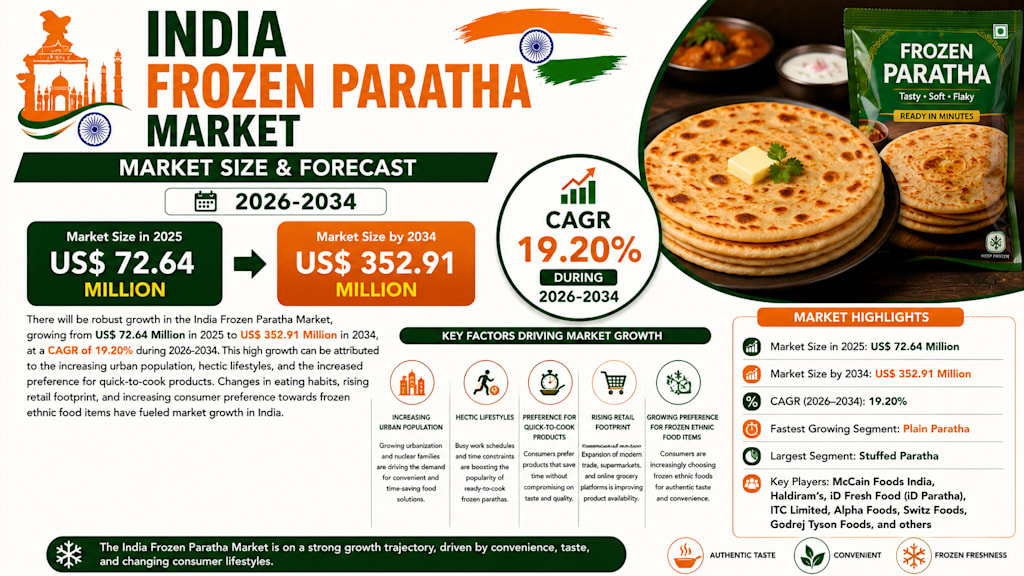
According to the latest market outlook, the India Frozen Paratha Market is projected to grow from US$72.64 million in 2025 to US$352.91 million by 2034, registering an impressive compound annual growth rate (CAGR) of 19.20% during 2026–2034. Rising urbanization, growing retail penetration, expanding cold chain infrastructure, and increasing consumer preference for ready-to-cook ethnic foods continue driving this exceptional market growth.
Frozen Parathas Combine Convenience with Traditional Taste
Frozen parathas are partially cooked Indian flatbreads that are frozen immediately after production to preserve freshness and flavor.
Manufactured primarily using wheat flour, these products are available in numerous varieties including aloo paratha, paneer paratha, onion paratha, mixed vegetable paratha, Malabar paratha, lachha paratha, and whole wheat options.
Consumers simply heat the frozen product on a tawa or frying pan for a few minutes before serving.
The ability to enjoy authentic homemade-style parathas without lengthy preparation has made frozen parathas increasingly attractive for modern households.
Rapid Urbanization Continues Driving Market Growth
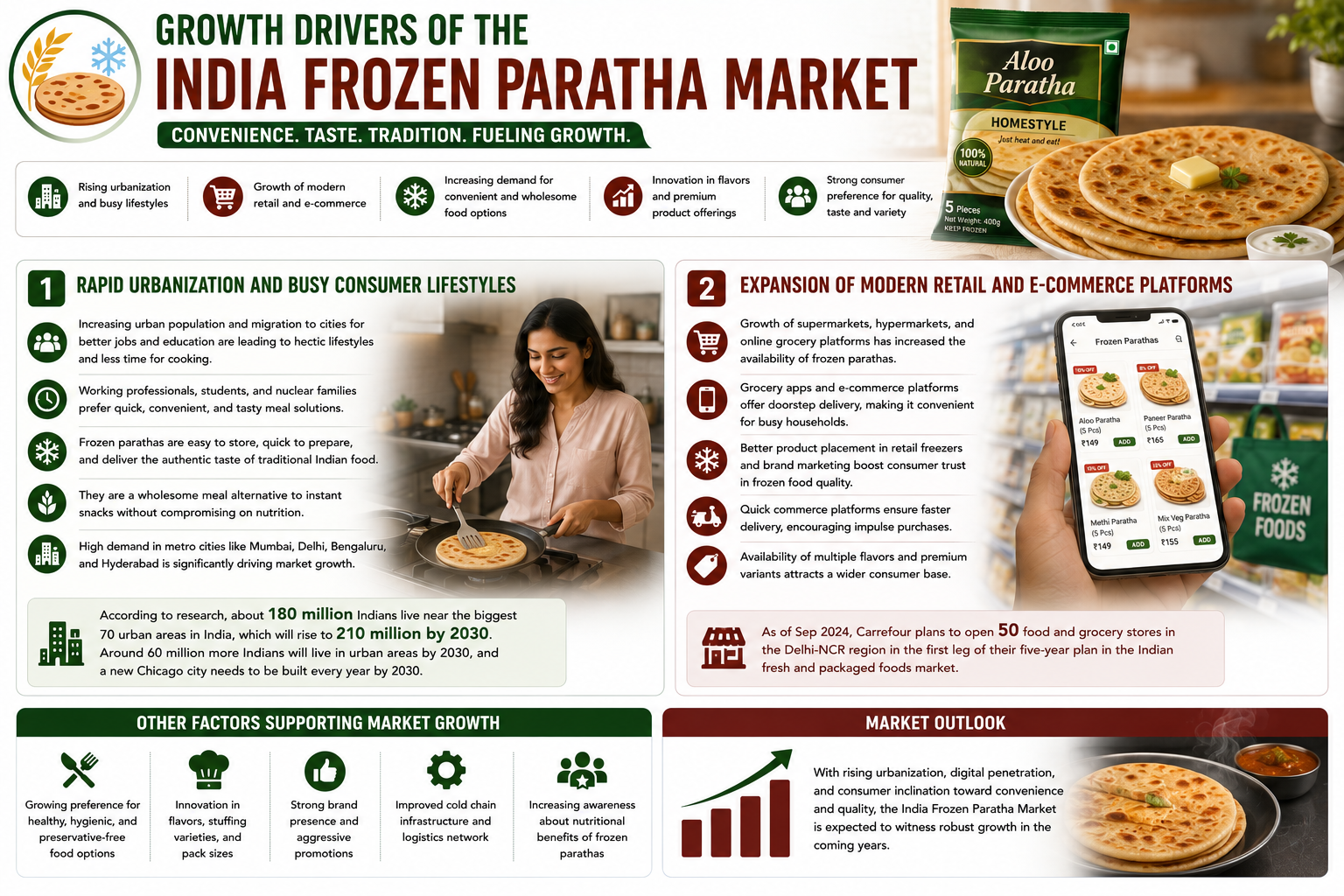
Urbanization remains one of the strongest growth drivers for India's frozen paratha industry.
As millions of people migrate to cities for employment and education, increasingly busy lifestyles leave less time for preparing traditional meals from scratch.
Working professionals, students, and nuclear families seek convenient meal options that can be prepared quickly while maintaining authentic Indian flavors.
Frozen parathas provide a practical solution by combining convenience with familiar taste and nutritional value.
Growing demand across metropolitan cities including Mumbai, Delhi, Bengaluru, Hyderabad, and Pune continues supporting market expansion.
Modern Retail and E-Commerce Expand Consumer Access
The rapid expansion of supermarkets, hypermarkets, organized retail, and online grocery platforms has significantly improved product availability.
Consumers now purchase frozen parathas through neighborhood supermarkets, quick commerce applications, food delivery platforms, and e-commerce websites offering convenient doorstep delivery.
Improved product visibility within freezer sections has increased consumer awareness while encouraging trial purchases.
The rise of quick-commerce services delivering groceries within minutes has further strengthened impulse buying of frozen foods.
Retail expansion continues enabling manufacturers to reach consumers across urban as well as semi-urban markets.
Cold Chain Improvements Strengthen Distribution
The development of India's cold chain infrastructure has transformed the frozen food industry.
Historically, limited refrigeration facilities restricted frozen food availability primarily to major metropolitan areas.
Today, investments in refrigerated transportation, warehouse facilities, cold storage systems, and improved packaging technologies have expanded product distribution into Tier II and Tier III cities.
Enhanced cold chain capabilities also improve product freshness, extend shelf life, and strengthen consumer confidence regarding quality and food safety.
These infrastructure improvements remain essential for sustaining long-term market growth.
Product Innovation Increases Consumer Choice
Manufacturers continue introducing innovative frozen paratha products to satisfy changing consumer preferences.
Traditional varieties remain highly popular, while companies increasingly offer healthier alternatives including multigrain parathas, low-oil formulations, preservative-free products, high-fiber options, and premium stuffed varieties.
Product innovation enables manufacturers to address growing consumer interest in healthier convenience foods without sacrificing traditional taste.
Continuous investment in research and development continues expanding product portfolios while strengthening market competitiveness.
Malabar Paratha Continues Gaining Popularity
Malabar paratha has emerged as one of the fastest-growing product segments within India's frozen paratha market.
Recognized for its soft, flaky texture and multiple delicate layers, Malabar paratha has traditionally been associated with South Indian cuisine but now enjoys nationwide popularity.
Restaurants, hotels, cloud kitchens, and households increasingly purchase frozen Malabar parathas because they offer restaurant-style quality with minimal preparation time.
Growing demand for authentic regional cuisines continues supporting this segment's rapid expansion.
Lacha Paratha Benefits from Restaurant Demand
Lacha paratha continues experiencing steady growth because of its popularity within North Indian cuisine.
Its crispy layered texture makes it an ideal accompaniment to paneer dishes, curries, kebabs, and restaurant meals.
The increasing number of hotels, restaurants, quick-service restaurants, and catering businesses has substantially increased commercial demand.
Frozen ready-to-cook lachha parathas also appeal to busy households seeking restaurant-quality meals prepared conveniently at home.
Paneer Paratha Appeals to Health-Conscious Consumers
Paneer paratha has become increasingly popular among consumers seeking nutritious and satisfying meal options.
Rich in protein and widely consumed during breakfast, paneer paratha appeals particularly to children, fitness-conscious individuals, and working professionals.
Manufacturers continue introducing premium versions featuring whole wheat flour, reduced oil content, and preservative-free ingredients.
Growing awareness regarding balanced nutrition continues strengthening demand within this product category.
Offline Retail Remains the Largest Distribution Channel
Despite rapid e-commerce growth, offline retail continues dominating frozen paratha sales.
Consumers often prefer purchasing frozen foods from supermarkets, hypermarkets, neighborhood grocery stores, and convenience stores where they can personally inspect product quality, packaging, and freshness.
Well-organized freezer displays encourage impulse purchases while promotional campaigns strengthen brand visibility.
Wholesale distribution to restaurants, hotels, caterers, and institutional buyers also contributes significantly to offline sales volumes.
Consumer Preferences Remain a Key Challenge
Although market growth remains impressive, many Indian consumers continue preferring freshly prepared homemade meals.
Traditional perceptions regarding freshness, nutrition, and taste often discourage consumers from regularly purchasing frozen food products.
Some households also believe homemade parathas are more economical than packaged alternatives.
Manufacturers therefore continue investing in consumer education, product sampling, quality improvements, and transparent labeling to strengthen market acceptance.
Cold Storage Costs Affect Profitability
Frozen paratha manufacturers depend heavily on efficient cold chain logistics.
Maintaining refrigerated storage throughout manufacturing, transportation, distribution, and retail requires substantial investment.
Electricity costs, cold storage infrastructure, transportation expenses, and refrigeration maintenance contribute significantly to operational costs.
Limited cold chain availability within certain rural regions also restricts broader market penetration.
Improving logistics efficiency remains essential for supporting future market expansion.
Regional Markets Continue Supporting Growth
Maharashtra remains one of India's largest frozen paratha markets, supported by rapid urbanization, organized retail growth, strong foodservice demand, and expanding quick-commerce services.
Uttar Pradesh continues witnessing rising demand as urban households increasingly adopt ready-to-cook traditional foods while improvements in retail infrastructure enhance product availability.
West Bengal demonstrates steady market growth driven by growing acceptance of packaged ethnic foods, expanding supermarkets, and rising demand among working professionals.
Andhra Pradesh continues strengthening market demand through increasing urbanization, expanding restaurant networks, and growing consumer preference for convenient meal solutions.
Together, these states continue driving nationwide market expansion.
The Future of India's Frozen Paratha Market
The future of the frozen paratha industry will be shaped by healthier ingredients, premium product innovation, digital retail, and continued investment in cold chain infrastructure.
Manufacturers are expected to introduce organic products, millet-based parathas, high-protein formulations, preservative-free options, and region-specific flavors designed to satisfy increasingly health-conscious consumers.
Artificial intelligence and consumer analytics will also support product development by helping manufacturers better understand evolving purchasing behavior.
As convenience foods continue becoming part of modern Indian lifestyles, frozen parathas are expected to achieve even broader consumer acceptance.
Final Thoughts
India's frozen paratha market is experiencing exceptional growth as consumers increasingly seek convenient meal solutions that preserve authentic Indian flavors.
The projected expansion from US$72.64 million in 2025 to US$352.91 million by 2034, supported by an impressive 19.20% CAGR, reflects rising urbanization, expanding organized retail, improving cold chain infrastructure, and growing demand for ready-to-cook ethnic foods.
Although consumer preference for freshly prepared meals and cold storage costs remain important challenges, continuous innovation, healthier product offerings, expanding e-commerce, and stronger distribution networks position India's frozen paratha industry for outstanding long-term growth. As convenience and tradition continue to merge, frozen parathas are expected to become an increasingly important part of India's evolving food landscape.
About the Creator
Enjoyed the story? Support the Creator.
Subscribe for free to receive all their stories in your feed.
Comments
There are no comments for this story
Be the first to respond and start the conversation.