
India Consumer Electronics Market Set to Double by 2034 as Smart Living Fuels Digital Revolution
From smartphones and laptops to smart TVs and wearables, India’s consumer electronics industry is entering a golden decade of growth.


India’s consumer electronics market is heading toward a remarkable transformation. Once driven mainly by televisions and mobile phones, the sector now includes a vast ecosystem of connected products—from AI-powered appliances and gaming laptops to fitness wearables and smart home systems.
According to Renub Research, the India Consumer Electronics Market is projected to grow from US$ 49.26 billion in 2025 to US$ 99.29 billion by 2034, expanding at a CAGR of 8.10% between 2026 and 2034. This powerful growth reflects India’s changing lifestyle patterns, rising income levels, rapid urbanization, and a strong appetite for digital technology.
As more households embrace modern living, consumer electronics are no longer considered luxury products—they have become daily essentials.
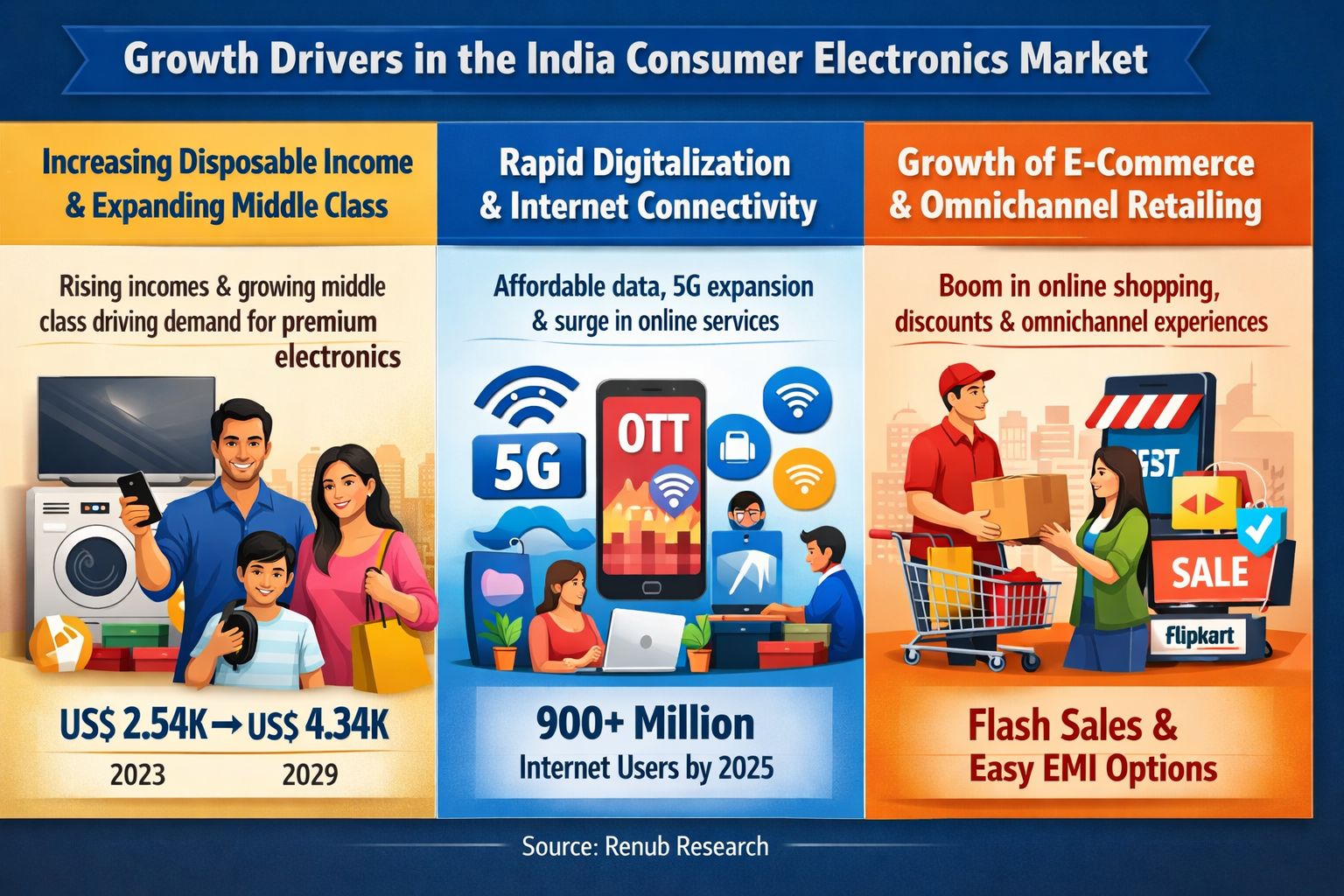
Why India’s Consumer Electronics Market Is Growing So Fast
India has one of the youngest and most tech-driven populations in the world. Millions of consumers are upgrading their homes, workspaces, and entertainment setups every year.
From smart TVs in metro cities to budget smartphones in rural towns, demand is rising across income groups.
Several long-term factors are driving this expansion:
Increasing disposable income
Expanding middle-class population
Affordable internet access
E-commerce growth
Hybrid work culture
Online education
Smart home adoption
Government manufacturing incentives
These trends are reshaping how Indians live, work, learn, and shop.
Disposable Income Is Creating a New Generation of Buyers
One of the biggest reasons for the market boom is the increase in household purchasing power.
As salaries rise and the middle class expands, consumers are moving beyond basic products and choosing premium electronics with advanced features.
Families are increasingly investing in:
Larger smart TVs
Inverter refrigerators
High-performance laptops
Premium smartphones
Air purifiers
Wearables and smartwatches
Renub Research notes that India’s per capita disposable income rose from US$ 2.11 thousand in 2019 to US$ 2.54 thousand in 2023, and is expected to reach US$ 4.34 thousand by 2029.
This means millions of consumers will have more money available for lifestyle upgrades.
Smartphones Continue to Dominate the Market
If one product defines India’s electronics revolution, it is the smartphone.
India remains one of the world’s largest smartphone markets thanks to:
Affordable Android models
4G and 5G expansion
Online shopping discounts
Mobile gaming growth
Social media usage
Digital payments adoption
Young buyers now seek advanced features such as:
High-refresh displays
AI cameras
Fast charging
Better processors
Long battery life
Meanwhile, rural consumers are shifting from feature phones to smartphones, adding millions of new users each year.
Laptops and Tablets Gain Momentum in the Hybrid Era
The pandemic permanently changed how India works and studies.
Today, remote jobs, hybrid offices, online learning, and freelancing culture continue to support strong demand for laptops and tablets.
Students need devices for:
Virtual classes
Coding and projects
Research work
Exam preparation
Professionals need machines for:
Video meetings
Graphic design
Data analysis
Content creation
Business operations
Gaming laptops are also growing rapidly due to esports and streaming trends.
Consumers increasingly prefer slim, SSD-powered, lightweight laptops with longer battery life.
Smart TVs and Home Entertainment Are Booming
Indian households are upgrading their entertainment experience.
With OTT platforms becoming mainstream, families are investing in:
4K Smart TVs
Soundbars
Streaming devices
Home projectors
Gaming consoles
Large-screen televisions are no longer limited to premium buyers. Competitive pricing and festive sales have made them accessible to middle-income households.
As internet speeds improve, demand for connected entertainment systems will continue rising.
Wearables and Smart Devices Become Everyday Essentials
Fitness bands, smartwatches, wireless earbuds, and smart speakers are now part of urban lifestyles.
Consumers use wearables for:
Health tracking
Sleep monitoring
Notifications
Music control
Contactless communication
Meanwhile, smart homes are gaining popularity through products like:
Smart lights
Voice assistants
Security cameras
Smart plugs
Robot cleaners
India’s growing interest in convenience and wellness is pushing these categories into the mainstream.
E-Commerce Is Changing How India Buys Electronics
Online retail has transformed the electronics buying experience.
Consumers now compare products instantly, read reviews, watch demos, and order devices from anywhere.
Major platforms have helped electronics reach Tier-2 and Tier-3 cities where offline options were once limited.
Popular buying triggers include:
Flash sales
Festival discounts
Cashback offers
Exchange deals
No-cost EMI options
Omnichannel retail is also growing, where customers browse online and purchase in stores—or vice versa.
This flexible buying journey builds trust and convenience.
Top Regional Markets Leading Growth
Maharashtra
Cities like Mumbai and Pune drive premium demand for smart TVs, flagship smartphones, gaming systems, and work devices. Strong retail infrastructure and high incomes make Maharashtra a leading market.
Uttar Pradesh
As India’s most populous state, Uttar Pradesh offers huge demand potential. Cities like Noida, Lucknow, and Ghaziabad are key growth centers.
Andhra Pradesh
Improving digital infrastructure, retail growth, and rising incomes are boosting demand across urban and semi-urban districts.
West Bengal, Karnataka, Tamil Nadu, Gujarat, Telangana
These states continue to contribute strongly due to urbanization, education growth, and rising tech adoption.
Challenges the Industry Must Overcome
Despite strong growth prospects, the market faces real hurdles.
1. Price Sensitivity
Indian buyers remain highly value-conscious. Brands must balance affordability with innovation.
2. Fierce Competition
Domestic and international players compete aggressively on pricing and features.
3. Supply Chain Dependence
Many key components such as semiconductors and display panels are imported, making costs vulnerable to global disruptions.
4. Rural Infrastructure Gaps
In some areas, power supply, logistics, and internet quality still limit demand.
5. Counterfeit Products
Grey-market devices and fake accessories create pricing pressure and reduce consumer trust.
Make in India Is Strengthening the Future
Government initiatives such as Digital India and Make in India are helping local electronics manufacturing grow.
India is increasingly assembling and producing:
Smartphones
Consumer appliances
Components
Accessories
IT hardware
As manufacturing ecosystems improve, India may become not only a large consumer market—but also a global export hub.
This could reduce import dependence and improve affordability over time.
What Happens by 2034?
By 2034, Indian homes may look dramatically different from today.
Common household electronics could include:
AI refrigerators
Smart kitchens
Connected air conditioners
Voice-controlled lighting
Wearable health devices
Immersive gaming systems
Advanced home offices
Technology will become more integrated into daily routines than ever before.
And as incomes rise further, premiumization will accelerate across categories.
Final Thoughts
India’s consumer electronics industry is entering one of the most exciting growth phases in its history.
With the market expected to jump from US$ 49.26 billion in 2025 to US$ 99.29 billion by 2034, the country is becoming one of the world’s most important destinations for electronics brands, investors, retailers, and manufacturers.
About the Creator
Enjoyed the story? Support the Creator.
Subscribe for free to receive all their stories in your feed.
Comments
There are no comments for this story
Be the first to respond and start the conversation.