
India Biodiesel Market Forecast 2026–2034: Renewable Fuel Demand Gains Momentum Across the Country
Government Biofuel Policies, Energy Security Goals, and Sustainability Targets Are Driving Rapid Biodiesel Market Expansion in India

India’s renewable energy transition is accelerating rapidly, and biodiesel is emerging as one of the country’s most important alternative fuel solutions. Rising energy demand, increasing crude oil imports, environmental concerns, and strong government support for clean fuels are all contributing to the growing importance of biodiesel in India’s energy ecosystem.
As India works toward reducing dependence on fossil fuels while strengthening domestic energy security, biodiesel is gaining recognition as a practical and scalable renewable fuel alternative for transportation, agriculture, and power generation.
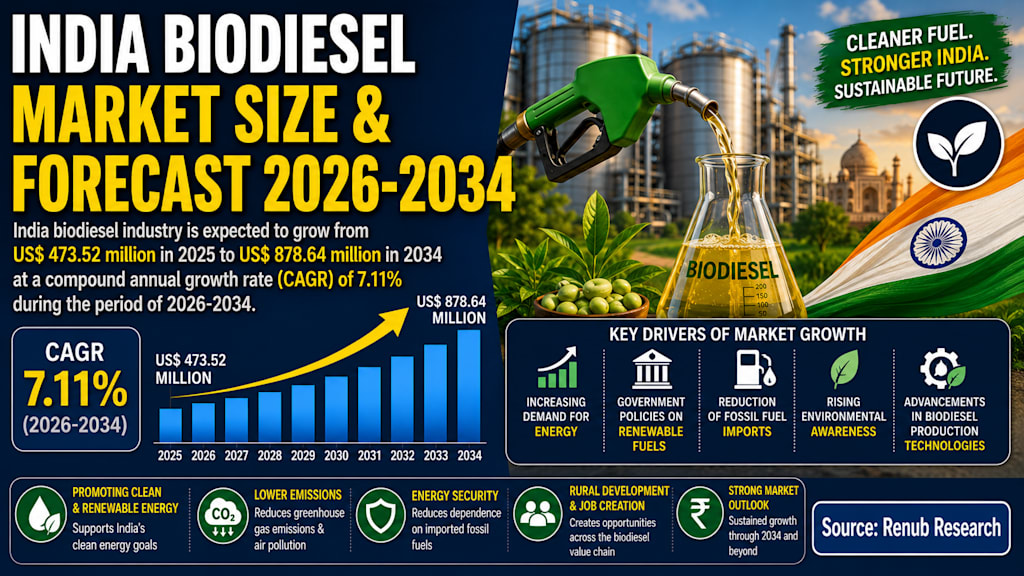
According to Renub Research, the India Biodiesel Market is projected to grow from US$ 473.52 million in 2025 to US$ 878.64 million by 2034, expanding at a compound annual growth rate (CAGR) of 7.11% during 2026–2034. The growth is primarily fueled by government support for renewable fuels, rising energy demand, technological advancements in biofuel production, and increasing awareness regarding environmental sustainability.
Biodiesel Is Becoming an Important Part of India’s Renewable Energy Vision
Biodiesel is a renewable, biodegradable, and clean-burning fuel derived from vegetable oils, animal fats, and waste cooking oils. Produced through transesterification, biodiesel can either be blended with conventional diesel or used independently as an alternative fuel source.
Compared with petroleum diesel, biodiesel generates lower greenhouse gas emissions and fewer harmful pollutants, making it an environmentally preferable option.
India’s growing interest in biodiesel is closely linked to the country’s long-term sustainability objectives and efforts to reduce expensive crude oil imports. With rising fuel prices and increasing environmental awareness, biodiesel is gradually becoming an integral part of India’s renewable energy framework.
Strong Government Policies Are Powering Market Growth
One of the most important drivers of India’s biodiesel industry is strong policy support from the government.
The uploaded report highlights several national biofuel initiatives designed to promote renewable energy production and reduce dependence on imported fossil fuels. Government-backed programs encouraging the use of waste cooking oil, agricultural waste, and non-edible oilseeds are helping create a supportive ecosystem for biodiesel development.
The report also notes that the PM JI-VAN Yojana was amended in 2024 to provide financial support for advanced bioethanol projects using renewable resources. More than US$ 106.7 million (Rs. 908 crore) has been approved for commercial-scale bioethanol projects, including facilities in Haryana.
Additionally, the Oilfields (Regulation and Development) Amendment Bill, 2024 aims to attract investment into domestic hydrocarbon production while supporting cleaner energy transitions.
These initiatives demonstrate India’s long-term commitment to renewable fuels and sustainable energy infrastructure.
Energy Security Concerns Are Increasing the Importance of Biodiesel
India’s rapidly growing population and expanding economy are significantly increasing national energy consumption. At the same time, heavy dependence on imported fossil fuels creates long-term economic and geopolitical risks.
Biodiesel offers an opportunity to reduce this dependency by utilizing locally available feedstocks and agricultural resources.
One of biodiesel’s biggest advantages is its compatibility with existing diesel engines, eliminating the need for major modifications. This makes it particularly attractive for:
- Commercial transportation
- Agriculture equipment
- Rural energy systems
- Diesel generators
- Industrial operations
The report also points to India’s broader renewable energy ambitions, including initiatives such as:
- National Bio Energy Mission
- National Green Hydrogen Mission
- PM-KUSUM
- PM Surya Ghar Muft Bijli Yojana
As of January 2025, India’s total non-fossil fuel-based energy capacity stood at 217.62 GW, reflecting the country’s accelerating transition toward cleaner energy systems.
Environmental Awareness Is Strengthening Biodiesel Adoption
Environmental concerns are becoming increasingly important across India due to rising pollution levels and climate-related challenges.
The report highlights that biodiesel produces fewer greenhouse gas emissions than conventional diesel, making it an important tool in India’s sustainability strategy.
India’s government has established ambitious carbon reduction goals and is promoting biofuels as part of a broader five-pronged energy strategy that includes:
- Increasing domestic production
- Expanding renewable energy
- Improving refinery efficiency
- Promoting biofuels
- Reducing fossil fuel dependence
The government is targeting 20% ethanol blending in petrol and 5% biodiesel blending in diesel by 2030, highlighting biodiesel’s strategic role in India’s future energy mix.
Feedstock Availability Remains a Major Industry Challenge
Despite strong growth potential, feedstock supply remains one of the biggest challenges affecting India’s biodiesel industry.
The production of biodiesel depends heavily on vegetable oils, waste cooking oil, and animal fats, but these resources are not always available in sufficient quantities.
The use of edible oils also creates concerns regarding food security and inflation in food prices. In addition, India still lacks a fully organized collection and supply-chain system for waste cooking oil and alternative biodiesel feedstocks.
As a result, production costs remain relatively high and large-scale commercialization becomes more difficult.
Industry participants are increasingly focusing on non-edible oils such as:
- Jatropha
- Pongamia
- Agricultural residues
- Algae-based feedstocks
However, scaling these alternatives remains a significant challenge.
High Production Costs and Infrastructure Gaps Continue to Impact Growth
Another important challenge is the high cost of biodiesel production compared with subsidized conventional diesel fuels.
The report notes that India still faces infrastructure limitations related to biodiesel production, storage, and distribution.
- Investment in:
- Processing plants
- Distribution networks
- Storage systems
- Advanced production technologies
will be critical for supporting future market expansion.
Without large-scale infrastructure upgrades, biodiesel penetration may remain limited despite favorable policy support.
Biodiesel Fuel Applications Continue to Lead Market Demand
Fuel applications remain the dominant segment within India’s biodiesel market.
The transportation sector, particularly commercial vehicles and agricultural machinery, presents one of the largest opportunities for biodiesel adoption.
Rising fuel prices and growing pressure to reduce emissions are encouraging industries to explore biodiesel blends as practical alternatives to traditional diesel fuels.
The ability to use biodiesel in conventional engines without significant modifications remains one of the strongest advantages supporting fuel-market growth.
Biodiesel Power Generation Is Expanding in Rural India
India’s power generation sector is also emerging as a key growth area for biodiesel adoption.
Diesel generators powered by biodiesel are increasingly being used in rural and off-grid areas where stable electricity access remains limited.
Industries and institutions are also adopting biodiesel generators to support sustainability targets and reduce emissions during power generation.
The government’s push for decentralized renewable energy solutions is expected to further strengthen this segment in the coming years.
Vegetable Oil Feedstocks Continue to Dominate Production
The vegetable oil biodiesel segment remains a major component of India’s biodiesel ecosystem.
Non-edible oils such as jatropha and pongamia are especially attractive because they avoid direct competition with food crops.
The government has encouraged cultivation of these crops on wasteland areas, although inconsistent supply and yield variability continue to affect production volumes.
As agricultural technology improves, this segment is expected to gain further momentum.
Animal Fat Biodiesel Is Supporting Circular Economy Goals
Animal-fat biodiesel is gradually developing into a sustainable waste-management solution within India’s renewable energy landscape.
The use of meat-processing by-products and tallow for fuel production supports waste utilization while reducing emissions.
Although collection and processing challenges remain, increasing awareness regarding sustainability and waste reduction is expected to strengthen this segment over time.
Maharashtra, Karnataka, and Uttar Pradesh Are Emerging as Key Regional Markets
Several Indian states are becoming important biodiesel growth hubs due to industrialization, agricultural activity, and government initiatives.
Maharashtra
Maharashtra remains one of India’s strongest biodiesel markets because of high industrial activity, urbanization, and waste cooking oil collection initiatives in cities such as Mumbai and Pune.
Uttar Pradesh
Uttar Pradesh is benefiting from strong agricultural resources, high energy demand, and increasing awareness about clean energy adoption in rural regions.
Madhya Pradesh
Madhya Pradesh is leveraging agricultural land availability and growing interest in non-edible oilseed cultivation to support biodiesel production.
Karnataka
Karnataka is seeing strong biodiesel growth due to government support, urban fuel demand, and collaboration between private companies and renewable energy initiatives.
Recent Developments in India’s Biodiesel Industry
India amended the PM JI-VAN Yojana in 2024 to strengthen support for advanced biofuel production projects.
More than Rs. 908 crore was approved for commercial-scale bioethanol projects, including facilities in Haryana.
India introduced the Oilfields Regulation Amendment Bill 2024 to improve domestic energy production and attract investment.
India’s non-fossil fuel energy capacity reached 217.62 GW by January 2025, strengthening renewable energy momentum.
The Indian government reaffirmed targets of 20% ethanol blending and 5% biodiesel blending by 2030, reinforcing biofuel demand.
Shell expanded renewable fuel initiatives in India, focusing on cleaner transportation energy solutions.
Neste strengthened sustainable fuel partnerships across Asia-Pacific, including biodiesel supply-chain collaborations in India.
Wilmar increased focus on waste-based biodiesel feedstock opportunities within India’s agricultural ecosystem.
Bunge Global expanded sustainable oilseed sourcing programs supporting renewable fuel production.
Renewable Energy Group accelerated advanced biodiesel technology investments aimed at improving production efficiency and scalability.
Final Thoughts
India’s biodiesel market is steadily evolving into a critical pillar of the country’s renewable energy transition.
Strong government backing, increasing energy demand, environmental concerns, and the need for energy security are all creating favorable conditions for long-term market growth. At the same time, biodiesel’s compatibility with existing diesel infrastructure makes it one of the most practical renewable fuel alternatives currently available.
Although feedstock limitations, high production costs, and infrastructure gaps remain key obstacles, continued investment and policy support are expected to strengthen the market significantly over the next decade.
With the market projected to reach US$ 878.64 million by 2034, biodiesel is poised to play a major role in India’s cleaner, more sustainable energy future.
About the Creator
Enjoyed the story? Support the Creator.
Subscribe for free to receive all their stories in your feed.
Comments
There are no comments for this story
Be the first to respond and start the conversation.