
India Aquafeed Market to Reach US$ 5.92 Billion by 2033 as Scientific Aquaculture Transforms Fisheries Industry
Rising seafood consumption, expanding aquaculture operations, and advanced feed technologies are reshaping India's aquafeed landscape through 2033.

India Aquafeed Market Outlook
India's aquaculture sector has emerged as one of the most dynamic segments of the country's agriculture and food production ecosystem. As fish and shrimp farming become increasingly commercialized, the demand for nutritionally balanced and scientifically formulated aquafeed continues to accelerate. The industry is witnessing a major transformation driven by changing consumer preferences, growing seafood exports, technological advancements, and government support for fisheries development.
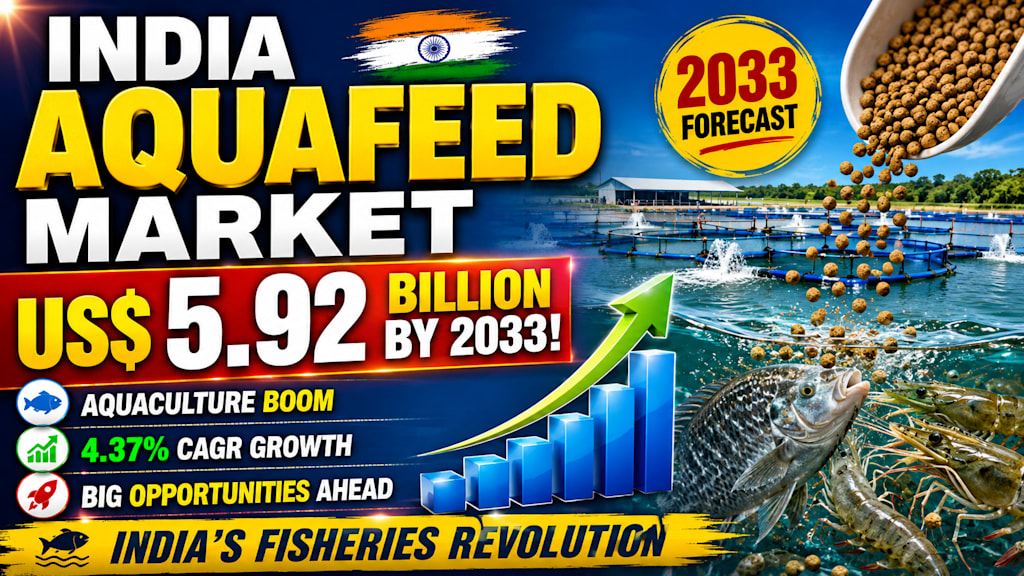
According to Renub Research, the India Aquafeed Market is projected to grow from US$ 4.03 billion in 2024 to US$ 5.92 billion by 2033, registering a CAGR of 4.37% during 2025–2033.
The increasing shift in seafood purchasing patterns from traditional wet markets to organized retail channels such as supermarkets and hypermarkets is significantly influencing the industry. Consumers today are more health-conscious and seek high-quality seafood products, encouraging fish and shrimp farmers to adopt better feeding practices that enhance productivity and product quality.
As India strengthens its position as one of the world's largest aquaculture producers, aquafeed is becoming a crucial component in ensuring sustainable and profitable fish farming operations.
Aquaculture Expansion Creates Strong Demand for Commercial Feed
India ranks among the leading aquaculture-producing nations globally. The country's vast freshwater resources, favorable climatic conditions, and long coastline have created ideal conditions for fish and shrimp cultivation.
Over the past decade, traditional fish farming methods have gradually evolved into semi-intensive and intensive aquaculture systems. These modern production techniques require carefully formulated feed to maximize growth rates, improve feed conversion efficiency, and reduce mortality.
The rapid growth of shrimp farming in states such as Andhra Pradesh, Tamil Nadu, Gujarat, and Odisha has particularly boosted demand for premium aquafeed products. Export-oriented shrimp producers increasingly rely on specialized feed formulations that help meet international quality standards.
Similarly, freshwater aquaculture involving species such as rohu, catla, mrigal, pangasius, and tilapia continues to expand across multiple states, creating sustained demand for species-specific feeds.
As aquaculture production scales up, feed manufacturers are investing heavily in production capacity, logistics infrastructure, and research initiatives to cater to the growing market.
Rising Seafood Consumption Supports Industry Growth
India's growing middle class and increasing awareness of the nutritional benefits of seafood are creating favorable conditions for aquafeed market expansion.
Fish is widely recognized as an excellent source of protein, omega-3 fatty acids, vitamins, and minerals. As disposable incomes rise, consumers are increasingly incorporating seafood into their regular diets.
Urbanization has further accelerated demand. Organized retail chains, e-commerce grocery platforms, and improved cold-chain networks have enhanced seafood accessibility across metropolitan and tier-two cities.
This growing appetite for seafood directly influences aquaculture production volumes, which in turn drives the need for high-quality feed products capable of supporting efficient farming operations.
Export demand also remains a critical growth driver. India continues to be one of the world's leading exporters of shrimp and seafood products. Meeting international quality requirements requires farmers to use nutritionally balanced feed solutions, further supporting aquafeed demand.
Scientific Feeding Practices Gain Momentum
One of the most significant developments within India's aquaculture sector is the increasing adoption of scientific feeding practices.
Historically, many small-scale fish farmers relied on farm-made feed or agricultural by-products. While inexpensive, these feeding methods often resulted in inconsistent growth rates and lower productivity.
Today, awareness campaigns, training programs, and extension services are educating farmers about the benefits of commercial aquafeed. Producers now better understand the relationship between feed quality and farm profitability.
Commercial feed offers numerous advantages:
Improved growth performance
Better disease resistance
Higher survival rates
Reduced feed wastage
Enhanced feed conversion ratios
Improved water quality management
As knowledge spreads across farming communities, the transition toward professionally formulated feed continues to accelerate, creating long-term opportunities for manufacturers.
Technological Innovations Reshape Feed Manufacturing
Innovation has become a key competitive differentiator within India's aquafeed industry.
Leading manufacturers are investing heavily in research and development to create feed products tailored to specific species, growth stages, and farming environments.
Several technological advancements are transforming the sector:
Advanced Pellet Technologies
Floating and sinking pellet feeds are increasingly replacing traditional feed varieties. These products improve feed efficiency while allowing farmers to monitor consumption more effectively.
Probiotic-Enriched Feed
Modern feed formulations increasingly incorporate probiotics that support gut health, enhance immunity, and improve nutrient absorption among aquatic species.
Feed Enzymes and Functional Ingredients
Manufacturers are using specialized enzymes and additives to improve digestibility and maximize nutrient utilization.
Sustainable Feed Solutions
Environmental sustainability is becoming a major focus area. Companies are exploring alternative protein sources and environmentally friendly formulations that reduce dependence on traditional marine ingredients.
These innovations are helping farmers improve productivity while addressing growing concerns related to environmental impact and resource efficiency.
Raw Material Volatility Remains a Key Challenge
Despite strong growth prospects, the industry faces several operational challenges.
Among the most significant concerns is the fluctuating cost and availability of raw materials. Aquafeed production relies heavily on ingredients such as:
Soybean meal
Corn
Fish meal
Fish oil
Nutritional additives
Prices for these commodities often fluctuate due to weather conditions, global supply disruptions, import regulations, and changing agricultural production patterns.
Fish meal, in particular, remains vulnerable to international market dynamics. Any disruption in global supply chains can significantly affect production costs for feed manufacturers.
These fluctuations create pricing challenges for producers and can reduce profitability for both feed companies and aquaculture farmers.
Knowledge Gaps Continue to Impact Adoption
Another challenge facing the industry is limited technical awareness among smaller fish farmers.
Although commercial feed adoption is increasing, many rural and small-scale producers still depend on traditional feeding methods due to:
Limited training opportunities
Cost sensitivity
Lack of technical support
Restricted access to quality feed products
In several remote aquaculture regions, distribution infrastructure remains underdeveloped, limiting the availability of premium feed products.
Addressing these challenges through education, extension services, and stronger rural distribution networks will be critical for sustaining long-term industry growth.
Regional Analysis of India's Aquafeed Market
Maharashtra
Maharashtra's aquafeed market continues to expand alongside the state's growing inland aquaculture activities. Farmers are increasingly adopting scientific fish farming techniques, creating stronger demand for nutritionally balanced feed products.
Government support programs and expanding private-sector distribution networks are improving feed accessibility across rural regions.
Tamil Nadu
Tamil Nadu remains one of India's most important aquaculture hubs. Strong shrimp farming activity, extensive coastal resources, and robust infrastructure support significant feed consumption.
The presence of multiple feed manufacturers and research institutions further strengthens the state's position in the national aquafeed market.
Gujarat
Gujarat's aquafeed industry benefits from the rapid growth of shrimp aquaculture along its extensive coastline.
Investments in hatcheries, cold storage facilities, and fisheries infrastructure are supporting increased adoption of commercial feed products across the state.
West Bengal
West Bengal is a major freshwater aquaculture producer, particularly for species such as rohu, catla, and mrigal.
Government initiatives promoting scientific aquaculture are encouraging farmers to shift toward commercial feed, creating substantial growth opportunities for manufacturers.
Competitive Landscape
India's aquafeed market is becoming increasingly competitive as domestic and international companies expand their presence.
Major players are focusing on:
Product innovation
Capacity expansion
Strategic partnerships
Farmer education programs
Sustainability initiatives
Distribution network enhancement
The industry is gradually moving toward consolidation, with larger companies leveraging technological expertise and economies of scale to strengthen market positions.
Key companies operating in the market include:
Alltech Biotechnology Pvt. Ltd. (Alltech Inc.)
Avanti Feeds Limited
Cargill India Private Limited
Godrej Agrovet Limited
Growel Feeds Private Limited
IB Group
Skretting Aquaculture India Private Limited
UNO Feeds
10 Recent Developments Among Leading Aquafeed Companies
1. Avanti Feeds Expands Shrimp Feed Capacity
Avanti Feeds has continued investing in manufacturing infrastructure to meet rising domestic and export-driven shrimp feed demand across coastal states.
2. Cargill Enhances Digital Farmer Support Programs
Cargill has expanded digital advisory services designed to help aquaculture farmers improve feed management and farm productivity.
3. Godrej Agrovet Strengthens Animal Nutrition Portfolio
Godrej Agrovet has increased focus on advanced nutrition solutions aimed at improving feed efficiency and sustainable aquaculture practices.
4. Skretting Advances Sustainable Feed Research
Skretting continues developing environmentally responsible feed formulations that improve performance while reducing ecological impact.
5. Alltech Promotes Probiotic-Based Feed Solutions
Alltech has expanded research efforts focused on gut health and probiotic technologies for aquaculture applications.
6. Growel Feeds Expands Regional Distribution
Growel Feeds has strengthened its distribution network in key aquaculture regions to improve farmer access to premium feed products.
7. UNO Feeds Introduces Enhanced Nutritional Formulations
UNO Feeds continues developing species-specific feed products designed to improve growth rates and feed conversion efficiency.
8. IB Group Increases Aquaculture Business Investments
IB Group has expanded investments in fisheries and aquaculture-related operations to capitalize on growing market opportunities.
9. Feed Manufacturers Adopt Precision Nutrition Strategies
Leading companies across the sector are increasingly utilizing data-driven nutritional formulations to optimize performance for specific species and farming conditions.
10. Industry Focuses on Alternative Protein Sources
Multiple aquafeed producers are actively researching alternative ingredients to reduce dependence on fish meal and enhance long-term sustainability.
Future Outlook
India's aquafeed industry is entering a new phase of development characterized by modernization, technological innovation, and sustainability.
Several factors will shape the market through 2033:
Rising seafood consumption
Expansion of shrimp exports
Growth of intensive aquaculture systems
Increasing adoption of commercial feed
Government support for fisheries development
Technological advances in feed formulation
Greater focus on environmental sustainability
As farmers increasingly recognize the economic benefits of high-quality feed, commercial aquafeed adoption is expected to accelerate across both freshwater and marine aquaculture sectors.
Manufacturers that successfully combine innovation, affordability, farmer education, and sustainable production practices will be best positioned to capitalize on the next wave of growth.
Final Thoughts
The India Aquafeed Market stands at the intersection of food security, rural development, and export-driven economic growth. With the market projected to reach US$ 5.92 billion by 2033, opportunities remain abundant for feed manufacturers, aquaculture producers, investors, and policymakers alike.
While challenges such as raw material price volatility and farmer awareness gaps persist, the industry's long-term fundamentals remain highly favorable. Rising seafood demand, expanding aquaculture operations, and continuous technological innovation are creating a strong foundation for sustained growth.
As India continues strengthening its position as a global aquaculture powerhouse, aquafeed will remain one of the most critical drivers of productivity, profitability, and sustainability across the fisheries value chain.
About the Creator
Enjoyed the story? Support the Creator.
Subscribe for free to receive all their stories in your feed.
Comments
There are no comments for this story
Be the first to respond and start the conversation.