
Image-guided Therapy Systems Market to Surpass US$ 8.42 Billion by 2033 as Precision Medicine and Minimally Invasive Surgeries Gain Momentum
Advanced Imaging Technologies and Rising Chronic Disease Burden Are Accelerating Global Demand for Image-guided Therapy Systems

The global healthcare industry is undergoing a remarkable transformation as precision medicine, minimally invasive surgeries, and advanced diagnostic technologies continue reshaping patient care. Among the most influential innovations driving this transition is the growing adoption of image-guided therapy systems. These systems are rapidly becoming essential tools for healthcare providers worldwide, enabling surgeons and clinicians to perform complex procedures with enhanced accuracy, reduced risk, and improved patient outcomes.
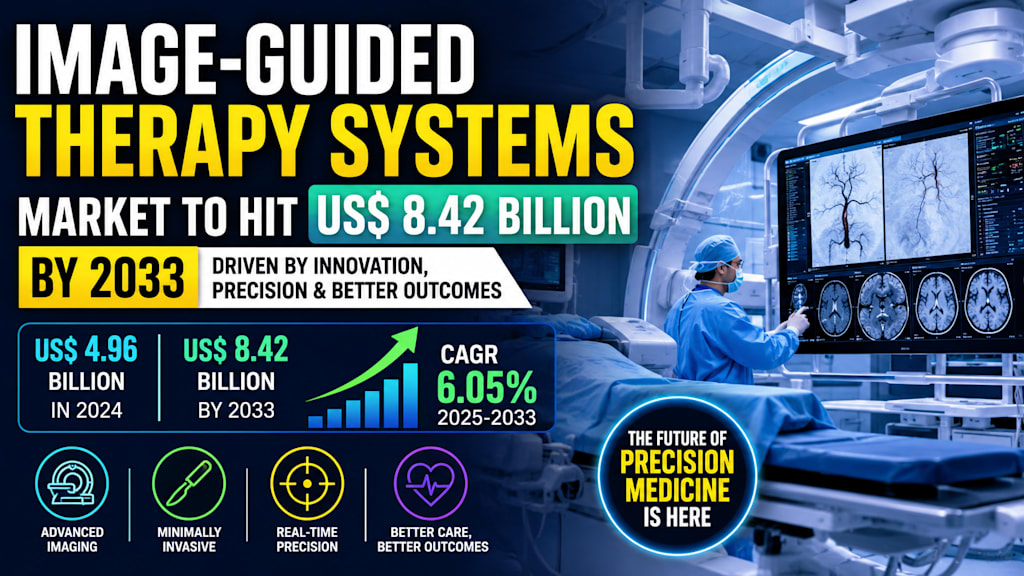
According to Renub Research, the global Image-guided Therapy Systems Market is projected to grow from US$ 4.96 billion in 2024 to US$ 8.42 billion by 2033, expanding at a CAGR of 6.05% during the forecast period from 2025 to 2033.
Image-guided therapy systems combine real-time imaging technologies with advanced navigation and therapeutic tools to support planning, execution, and monitoring during medical procedures. These systems are extensively utilized across specialties such as cardiology, oncology, neurosurgery, orthopedics, and gastroenterology.
The increasing prevalence of chronic diseases, rising demand for minimally invasive surgeries, and continuous improvements in imaging technologies are among the major factors fueling the expansion of this market globally.
Growing Preference for Minimally Invasive Procedures Drives Market Expansion
One of the strongest drivers of the image-guided therapy systems market is the increasing global preference for minimally invasive surgeries (MIS). Patients and healthcare providers are actively shifting toward procedures that minimize trauma, shorten recovery periods, reduce hospital stays, and lower the risk of post-operative complications.
Image-guided systems play a crucial role in enabling minimally invasive procedures by offering surgeons high-resolution, real-time visualization of internal anatomy. This guidance allows clinicians to perform interventions with exceptional precision while minimizing damage to surrounding healthy tissues.
Procedures such as interventional cardiology, neurosurgery, laparoscopic surgeries, and oncology treatments heavily rely on image-guided technologies for accurate navigation and improved procedural safety. As hospitals continue prioritizing patient-centered care, the demand for these advanced systems is expected to rise significantly over the coming years.
Technological Advancements in Imaging Systems Strengthen Market Growth
Rapid advancements in imaging technologies are transforming the capabilities of image-guided therapy systems. Modern systems now integrate advanced imaging modalities such as magnetic resonance imaging (MRI), computed tomography (CT), ultrasound, fluoroscopy, and positron emission tomography (PET) to deliver detailed real-time visualization during surgical and therapeutic procedures.
Artificial intelligence (AI) and machine learning technologies are further enhancing these systems by improving image interpretation, predictive diagnostics, workflow automation, and decision-making during surgeries.
AI-powered imaging solutions can assist clinicians in detecting abnormalities more accurately, optimizing procedural planning, and reducing human error. These innovations improve procedural consistency and efficiency while enabling healthcare professionals to achieve superior clinical outcomes.
Additionally, ongoing investments in digital healthcare infrastructure and smart operating rooms are accelerating the adoption of integrated image-guided systems across hospitals and specialty clinics.
Rising Global Burden of Chronic Diseases Creates Strong Demand
The increasing prevalence of chronic illnesses such as cancer, cardiovascular diseases, neurological disorders, and orthopedic conditions is significantly contributing to market growth. These diseases often require precise diagnosis and highly targeted treatment approaches, making image-guided therapy systems increasingly important in modern medicine.
Cancer remains one of the leading contributors to market demand. According to the American Cancer Society, nearly 20 million new cancer cases were diagnosed globally in 2022, while approximately 9.7 million deaths were reported worldwide. The number of cases is projected to reach 35 million by 2050 due to population growth and aging demographics.
Image-guided therapies enable physicians to target tumors with greater precision while minimizing exposure to healthy tissues. This improves treatment effectiveness, reduces complications, and enhances patient recovery.
Similarly, cardiovascular and neurological disorders increasingly require advanced image-guided interventions to improve surgical precision and reduce procedural risks. As chronic disease incidence continues rising globally, healthcare systems are expected to expand investments in these technologies.
Hospitals Remain the Largest End-use Segment
Hospitals continue to dominate the image-guided therapy systems market due to their large patient volumes, advanced surgical infrastructure, and strong financial capabilities. Major hospitals worldwide are heavily investing in hybrid operating rooms and advanced imaging technologies to support precision-based surgical procedures.
The integration of imaging systems with electronic health records (EHRs), surgical navigation software, and robotic-assisted technologies is further improving workflow efficiency in hospital environments.
Additionally, the growing number of specialty clinics and ambulatory surgical centers is creating new opportunities for market expansion. These facilities are increasingly adopting compact and cost-effective image-guided systems to provide minimally invasive procedures outside traditional hospital settings.
Research and academic institutions are also contributing to market growth through ongoing innovation, clinical trials, and training initiatives focused on next-generation imaging technologies.
Product Segment Analysis
The image-guided therapy systems market includes several important product categories such as endoscopes, MRI systems, CT scanners, ultrasound systems, fluoroscopy systems, SPECT systems, and PET systems.
Among these, MRI and CT-based systems hold significant market share due to their superior imaging accuracy and widespread application across complex surgical procedures.
Ultrasound-guided systems are also witnessing strong demand because they offer real-time imaging without radiation exposure. These systems are commonly used in cardiology, obstetrics, oncology, and interventional radiology.
Fluoroscopy and PET systems continue gaining traction in oncology and cardiovascular procedures, where accurate real-time visualization is critical for treatment success.
Meanwhile, endoscopy-based image-guided therapies are becoming increasingly popular due to their minimally invasive nature and ability to improve diagnostic and therapeutic precision.
North America Maintains Market Leadership
North America currently represents the largest market for image-guided therapy systems due to advanced healthcare infrastructure, high healthcare spending, and strong adoption of cutting-edge medical technologies.
The United States remains a dominant contributor to regional growth. Hospitals and surgical centers across the country are rapidly implementing image-guided technologies to enhance treatment precision and support minimally invasive interventions.
Favorable reimbursement policies, increasing investments in healthcare modernization, and growing awareness regarding advanced therapeutic procedures are also supporting market growth across the region.
The presence of major medical technology companies and strong research ecosystems further strengthens North America’s leadership position in the global market.
Europe Experiences Strong Adoption of Advanced Imaging Technologies
Europe continues to emerge as a major growth region for image-guided therapy systems, with countries such as Germany, France, and the United Kingdom leading adoption.
Germany, in particular, is witnessing steady growth due to its advanced healthcare infrastructure and strong focus on medical innovation. The country has become a hub for cutting-edge imaging technologies and minimally invasive surgical procedures.
The growing collaboration between healthcare providers, academic institutions, and medical device manufacturers is accelerating the development and implementation of next-generation image-guided systems across Europe.
Moreover, increasing healthcare investments and aging populations are expected to further stimulate regional market demand.
Asia-Pacific Emerges as a Fast-growing Regional Market
The Asia-Pacific region is projected to witness substantial market growth during the forecast period due to rising healthcare expenditures, expanding medical infrastructure, and increasing awareness regarding advanced treatment technologies.
Countries such as China, Japan, and India are rapidly adopting image-guided systems across hospitals and specialty centers.
Japan remains a key market due to its technologically advanced healthcare system and aging population. The country is heavily investing in precision medicine and minimally invasive procedures, driving the adoption of advanced image-guided technologies.
India and China are also experiencing growing demand due to increasing chronic disease prevalence, expanding healthcare access, and ongoing investments in modern surgical technologies.
Challenges Continue to Impact Market Development
Despite strong growth prospects, the image-guided therapy systems market faces several operational and financial challenges.
One of the primary concerns is the high cost associated with advanced imaging systems and integrated surgical platforms. Smaller healthcare facilities, particularly in developing economies, often struggle to afford these technologies.
Complex integration with existing hospital infrastructure also presents a significant challenge. Healthcare providers must ensure seamless connectivity between imaging systems, electronic health records, PACS platforms, and surgical navigation software.
Another major concern involves radiation exposure associated with CT and fluoroscopy-based procedures. Prolonged exposure to ionizing radiation may increase health risks for both patients and medical professionals. Consequently, regulatory agencies are encouraging the development of lower-dose imaging technologies and stricter safety protocols.
Competitive Landscape Intensifies
The global image-guided therapy systems market remains highly competitive, with major players focusing on product innovation, partnerships, acquisitions, and AI integration to strengthen their market presence.
Leading companies operating in the market include:
Siemens Healthineers
Koninklijke Philips
General Electric Company
Brainlab
Medtronic Plc
Olympus Corporation
KARL STORZ SE & Co. KG
Stryker Corporation
These companies are increasingly investing in AI-enabled imaging technologies, robotic-assisted surgeries, and real-time navigation systems to improve clinical efficiency and expand their global market share.
10 Recent Developments in the Image-guided Therapy Systems Industry
In November 2024, Koninklijke Philips introduced the advanced Azurion image-guided therapy platform in India to improve cardiovascular and neurovascular treatment efficiency.
Philips integrated AI-powered remote monitoring capabilities into its Azurion platform to enhance predictive maintenance and operational performance.
In October 2024, Philips partnered with Medtronic Neurovascular to improve global stroke care access and awareness initiatives.
Siemens Healthineers expanded its AI-driven imaging portfolio to support precision-guided interventions in oncology and neurosurgery.
Brainlab strengthened its surgical navigation software capabilities for minimally invasive cranial procedures.
Medtronic continued expanding its neurovascular intervention technologies integrated with image-guided platforms.
GE Healthcare accelerated development of intelligent imaging systems focused on workflow optimization and enhanced visualization.
Olympus Corporation increased investments in advanced endoscopic imaging technologies for minimally invasive gastrointestinal procedures.
Stryker Corporation expanded its surgical imaging solutions portfolio to support orthopedic and spinal interventions.
KARL STORZ continued enhancing visualization technologies for image-guided laparoscopic and robotic-assisted surgeries.
Future Outlook
The future of the image-guided therapy systems market appears highly promising as healthcare providers increasingly prioritize precision medicine, minimally invasive surgeries, and patient-centered care.
The integration of artificial intelligence, robotic-assisted surgeries, real-time navigation systems, and advanced imaging modalities will continue reshaping the healthcare landscape over the next decade.
Emerging economies are expected to create substantial growth opportunities due to expanding healthcare infrastructure and increasing demand for advanced surgical technologies.
As innovation accelerates and healthcare systems continue modernizing worldwide, image-guided therapy systems are likely to become an indispensable component of modern clinical practice.
Final Thoughts
The global image-guided therapy systems market is entering a transformative growth phase fueled by technological innovation, rising chronic disease prevalence, and the growing adoption of minimally invasive procedures.
With the market forecast to reach US$ 8.42 billion by 2033, industry stakeholders are expected to witness significant opportunities across hospitals, specialty clinics, and research institutions worldwide.
As medical imaging technologies continue advancing and AI integration becomes more sophisticated, image-guided therapy systems will play a crucial role in improving treatment precision, enhancing patient safety, and shaping the future of modern healthcare.
About the Creator
Enjoyed the story? Support the Creator.
Subscribe for free to receive all their stories in your feed.
Comments
There are no comments for this story
Be the first to respond and start the conversation.