
I Watched My Family’s Factory Bet on Temu. Then the Global Shopping Cart Changed.
From Yiwu batteries to Brazilian tops to Indonesian ring lights, Chinese e-commerce platforms are rewriting what the world buys—one thin margin at a time.
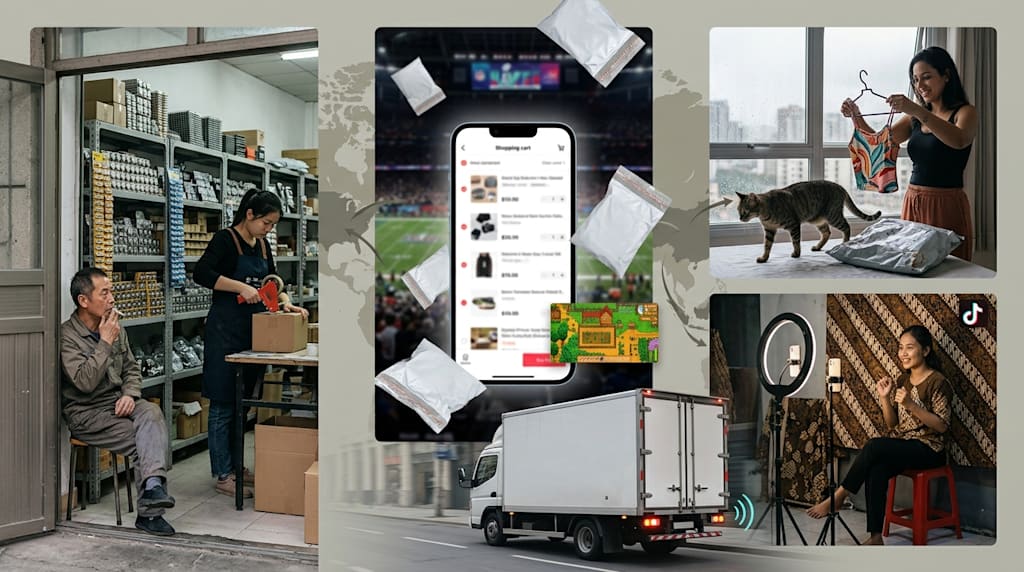
Yiwu’s Batteries, Brazil’s Tops, Indonesia’s Ring Light
In the fall of 2022, Huang Qianqian put her phone on the dining table. The screen was on Temu’s seller registration page. Her father picked up some greens with his chopsticks and said nothing. Her mother asked who paid for shipping. Huang Qianqian said the platform subsidized it. Her father put down his bowl and said, “Let’s try it. Anyway, inquiries on 1688 are fewer by the day.”
The factory was in Yiwu and had made button cell batteries for thirty years. Watches, small electronic devices. Customers came to the store, and also online. After Covid, orders thinned. Huang Qianqian was 28. She quit her job at a tech company and went home to help. A friend told her Temu had just launched in the U.S. Its parent company was PDD Holdings, which also owned Pinduoduo. She did the math: China was hard; overseas might have an opening. She didn’t tell her parents about “brands going global.” She only said “more channels.”
In December, Yiheng Battery went live. In the first week, the numbers on the backend jumped. About a hundred orders a day. She printed the orders and taped them to the wall. There wasn’t enough tape; she used a strip of clear tape, and the corner curled up.
Margins were thin. Later she said prices were pressed hard. She didn’t say “involution.” She only said, “After the math, not much is left.” She had already started looking at pet products on TikTok Shop. She heard that two or three people running one could make several million yuan a year. She wrote that line in her phone’s notes app, without punctuation.
In February 2023, the Super Bowl ad. Temu told viewers to “shop like a billionaire.” That weekend, U.S. downloads hit 426,000. The number came from Sensor Tower. By September, Temu had 61 million monthly active users in the U.S. and sold in 48 countries. It copied Pinduoduo’s games: virtual farms, raising virtual fish, inviting friends. Maddie Young, 24, is a care worker. She played the farm game and won a unicorn backpack and a coffee machine. She bought clothes for her three children. She said Temu and Amazon sell the same things, but Temu is cheaper and has free shipping. She didn’t mention tariffs, or how the packages got there.
Temu’s goods come from Chinese factories. In Yiwu’s wholesale markets, suppliers watch the new platform. Huang Qianqian said it used to be Amazon, Taobao, Pinduoduo; now a lot of people want to get on Temu. Her parents’ generation treated the factory as a supplier. Her generation wanted to reach consumers directly. She didn’t say “value chain.” She only said, “Before, we could only wait for orders. Now we can watch the backend.”
Shein was founded in Nanjing in 2008 and targeted overseas from the start. During the pandemic, #sheinhaul videos took off. Some people tried on more than a hundred items at once. Shein’s global sales rose from a reported $4 billion in 2019 to $23 billion in 2022. It listed thousands of new styles every day. Its supply chain sourced from Chinese garment factories and adjusted styles based on data. A comparison of listed prices found Shein’s women’s fashion was on average 39% to 60% cheaper than H&M’s.
Juliana Silva, a hospital psychologist in São Paulo, saw an ad for plus-size clothing on Instagram and ordered. She walked into Renner or Riachuelo, flipped a price tag, and put the item down. She said the same top was much cheaper on Shein. At home, she opened the package and dropped the bag on the floor. The cat walked over it; the plastic bag rustled. She held the top up to the window and looked at the stitching. In 2023, Shein opened a marketplace selling electronics, DIY tools, and appliances. In August, the Brazilian government changed its tax rules, adding taxes on imported packages under $50. Shein’s Brazil PR said it welcomed the new tax and was subsidizing users’ tariffs. Juliana didn’t read the statement. She looked at the cart total.
In April 2021, TikTok Shop entered Indonesia. It did $2.5 billion in sales in its first year. Then Singapore, Malaysia, the Philippines, Vietnam, and Thailand. Thesa, 28, in Yogyakarta, sold clothes made from traditional fabric with her fiancé. They paid to push their livestreams into For You feeds. Orders rose. They hired eight people: sewing, livestreaming, packing. In September 2023, they made about 90 million rupiah, or $5,730. In the corner of the warehouse was a ring light, with a piece of batik cloth as the backdrop. The tube got hot after being on for a while.
On October 3, the email came. TikTok said it was closing TikTok Shop in Indonesia. She read it and turned off the light. She sat on a plastic stool for a while. On the wall, the order sheet still had September’s numbers in that column. She later went to livestream on Shopee. Her income fell by more than half. TikTok Indonesia said it would work with authorities to find a path forward. Bhima Yudhistira Adhinegara, executive director of the Jakarta-based Center of Economic and Law Studies, said the ban’s impact would be limited and sellers would migrate. In October, Malaysia hinted it was considering a similar policy; the communications and digital minister said he had received complaints from local businesses and was worried about predatory pricing. Thesa didn’t pay attention to that. She reset the light, adjusted the angle, and tested the microphone.
Queenie Zhang in Shenzhen sells home goods. She joined Temu, then quit. In July, she wrote on social media: the product cost us $12.30 to make, Temu offered $11.30. She wrote that they couldn’t accept it and could only give up selling the product. She didn’t say “platform hegemony.” She posted the cost sheet. In Yiwu, Huang Qianqian had about a hundred orders a day, with very thin margins. Lin Qianran, who runs a lighting business in Zhongshan, said Temu’s margins were about half of Amazon’s, but it was less work. She opened a Shein store this year. She said Amazon and Taobao are like malls, while Temu and Shein are like supermarkets. You supply unbranded goods and let the platform handle the rest. Zhang Zhouping, a cross-border e-commerce researcher at Hangzhou-based 100ec.cn, said sellers faced a dilemma: lower margins for higher sales, or be left out. The lowest price always wins. Queenie put that line in her post. Then she closed the backend.
A June report by a U.S. House committee: H&M paid $205 million in import duties in 2022; Gap paid $700 million. The vast majority of Shein and Temu’s direct-to-customer packages paid nothing. The report listed numbers, no adjectives. In July, Shein executive chairman Donald Tang said the duty-free policy for imports under $800 needed to change, to give retailers a fair playing field. Shein said in an emailed response that it respected human rights, provided a safe and fair work environment, and protected intellectual property. TikTok referred Rest of World to its previous statements. Temu did not respond. Brazil raised taxes in August. U.S. lawmakers considered changing de minimis. Rafaella Torneri, who co-owns Guardaroba in São Paulo, said it used to be easier; now it was hard. She hung a locally made top back on the rack, tag facing out.
Temu subsidized shipping and spent heavily on marketing. 36Kr, citing people familiar with the matter, estimated Temu lost $40 for every $100 in sales. On an August earnings call, Liu Jun, vice president of finance at Temu’s parent PDD Holdings, said Temu was still in its “learning phase” and not yet focused on monetization. Sharon Gai, former head of global key accounts at Alibaba, said Temu used small, low-priced items to rapidly grow its user base and might later scale back free shipping. Black Friday came. TikTok subsidized discounts of up to 50%. Temu advertised up to 90% off. Shein ran 11.11. On Instagram it wrote: Self-control can wait; we’re having a self-care moment. Huang Qianqian looked at the campaigns and did the math on her batteries. She didn’t join Black Friday. She looked at pet toys.
In the Yiwu warehouse, there were still three boxes of button cell batteries. Her father smoked at the door. Huang Qianqian moved one box onto a cart. The wheels pressed over the concrete, creaking. Her phone screen was on, showing the TikTok Shop backend; pet toys ranked third in its category. She filled out half the form and closed it. She walked to the door. Her father crushed the cigarette under his foot. She said, “I’ll do it tomorrow.” Her father said, “Ship this box first.” She bent down and tore off a strip of tape. The tape stuck to her finger; she shook it. Outside the warehouse, a delivery truck reversed, beeping. She didn’t look up.
About the Creator
Jin
Writer of reamstories
https://reamstories.com/jin
Enjoyed the story? Support the Creator.
Subscribe for free to receive all their stories in your feed. You could also become a paid subscriber, letting them know you appreciate their work.
Comments
There are no comments for this story
Be the first to respond and start the conversation.