
I Compared a Walk-Up, a 2016 High-Rise, and a New Build. The Gap Is Bigger Than the Floor Plan.
New homes are better. The sales pitch still hides four area numbers, and location still sets the price.
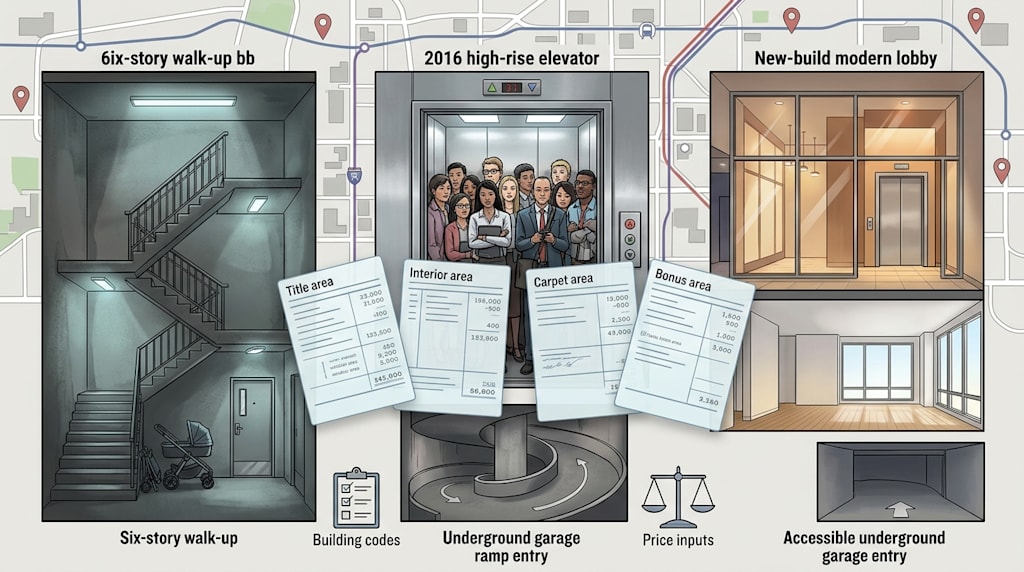
Look at three homes and the gap is easy to see.
The first is a six-story walk-up. The stairwell light is voice-activated. You stomp, it comes on for three seconds. By the fourth-and-a-half floor it goes out, and you stomp again. A stroller does not fit through the unit door. You fold it, carry it in one hand, hold the child in the other, and listen to the door-access system beep.
The second is a high-rise from around 2016, two elevators for six units per floor. At 7:50 a.m., you get into the elevator with twelve people. It stops three times on the way down. Every time the door opens, someone outside says, “Can’t fit. I’ll wait for the next one.” The ramp into the underground garage is narrow. When two cars meet, one has to back up.
The third is a current new-standard project. The floor height is over three meters. One elevator serves one unit. When the door opens, you are in your own lobby. The garage connects to the home. On a rainy day, you push the stroller from the garage into the elevator, press your floor, and reach the door without getting wet. The living room is five meters wide, four bays face south, and the south frontage runs more than fifteen meters.
The difference is easy to see. It is also easy to overstate.
The usable-area number needs four ledgers
Sales material says property-title area 118, actual apartment 134, carpet area 118, and the private elevator lobby can serve as an entryway. Those numbers sound strong. They also describe four different measurements.
Property-title area is what the deed says. Transactions, mortgages, and taxes follow it. If the deed says 118, it is 118.
Interior floor area is the space inside the walls. It is smaller than the title area.
Carpet area is what remains after you deduct walls. A claim of 118 means thin walls and generous bonus space have pushed carpet area up to the title number.
Bonus area covers balconies, bay windows, equipment platforms, and entry gardens. It can be half-given or fully given. So-called negative common area usually means bonus space has offset the shared area.
Each number has a job. The apartment may feel comfortable. When the home is resold, the buyer and the bank look at the deed. They do not price the sales-office number. Rules on enclosing a bonus balcony, converting an equipment platform, or later calling a bonus space illegal vary by city. New-standard homes can be good. Keep the sales-office definition separate from the deed definition.
The point is practical. A high usable-area ratio is an advantage. You still need to know whether it comes from design, bonus rules, or a different way of counting.
Old housing is priced by more than a floor plan
People dislike old walk-ups for the stairwell, the missing elevator, the pipes, and the parking. The price of those homes has never come from the floor plan alone.
A core-area walk-up can sit three minutes from a subway entrance, next to a wet market, across from a community hospital, with a school district that has not been redrawn. A new build cannot supply those things when the land is already built out. In the same total-price bracket, the new build may sit in the suburbs and the old home in the city. Buyers count commuting time, school access, and total price. Floor-plan taste comes after those.
Non-core old walk-ups are a different market. In the same location and the same price bracket, a new build beats an old home on product quality. The old home can only cut its price. That split is already here. The phrase “price crushing” needs limits. It is clear in non-core areas, at the same total price, and in the same location. Supply in core areas is fixed. The building can be old. The location cannot be copied.
Concrete has not changed much. Codes have.
Cement, gravel, sand, and rebar have not seen a disruptive change in decades. Old buildings may even have used more material. Their concealed work may not have been cut as aggressively as in recent rush-to-build years.
A house is more than its frame. Seismic rules, fire evacuation, energy standards, sound insulation, pipe capacity, accessibility, elevator provision, and exterior-window airtightness have all been revised. Solid old materials do not replace code compliance. Buying a whole old building and knocking out non-load-bearing walls sounds simple. In practice it runs into load-bearing walls, pipe replacement, fire evacuation, facade approval, unified ownership, and neighbor consent. A renovated old core-area building in Beijing that sells for 100,000 yuan per square meter is priced for its location. The old building’s product quality is not doing the work.
Renovation can fix the interior look. It cannot fix aging building systems.
The car comparison breaks on location
Homes do iterate. A new home is easier to live in than an old one, just as a new car drives better than an old one.
A car can be replaced. Its location does not matter. A home is tied to land and public services. Location cannot be copied. A new car becomes an old car after five years. A new home after twenty years will face elevator aging, exterior-wall shedding, pipe corrosion, and maintenance fees that are hard to raise. Product iteration is real. Old does not mean zero. A well-maintained old home in a good location at the right price will still find a buyer. A new home with weak property management will decay too.
Supply and demand set prices. Both need splitting.
Supply is not only new homes. Land supply is set by planning. Old-housing renewal is set by ownership and capital. Demand is not only product quality. Upgraders care about product quality. First-time buyers care about total price and commuting.
The original piece mentions a Beijing project that bought old homes, renovated them, and sold them at 100,000 yuan per square meter. It also mentions a developer that sold second-hand homes as off-plan units, collected tens of millions per unit, moved the money, and left the renovation unfinished. These cases show two things. Core-location old housing is priced by location. Pre-sale fund supervision and transaction structure are separate from whether a building is old or new. Selling second-hand housing as off-plan and ending with an unfinished renovation is a financial-regulation problem. It is not a product-iteration problem.
Closing
New-standard homes do show a clear step forward. An elderly person pushing a stroller from the garage into the home is living a different daily routine from someone carrying the stroller up six flights. A high usable-area ratio, a wide living room, and a private elevator lobby make a difference once you live there.
Price still comes from several inputs. Location, title, total price, maintenance, and expectations each take a share. The market is more likely to split between central assets with good products and non-core old housing. It is not likely to crush every old home in one move.
When you look at a home, check the elevator and the garage first. Then read the floor plan. Then turn to the deed page and see how much area is actually written there.
About the Creator
Jin
Writer of reamstories
https://reamstories.com/jin
Enjoyed the story? Support the Creator.
Subscribe for free to receive all their stories in your feed. You could also become a paid subscriber, letting them know you appreciate their work.
Comments
There are no comments for this story
Be the first to respond and start the conversation.