
Hydroponics Market Set for Rapid Growth as Sustainable Farming Reshapes Global Food Production
Rising demand for resource-efficient agriculture, urban farming expansion, and technological innovation are accelerating the adoption of hydroponics worldwide.

The global agricultural industry is facing unprecedented challenges. Growing populations, shrinking arable land, water scarcity, climate change, and rising food security concerns are forcing governments, businesses, and farmers to rethink traditional farming methods.
In response, innovative agricultural technologies are rapidly gaining momentum, and few solutions have attracted as much attention as hydroponics. Once considered a niche farming technique, hydroponics is now emerging as one of the most promising approaches to modern food production.
By enabling crops to grow without soil while using significantly less water and space, hydroponics offers a practical solution to some of the most pressing agricultural challenges facing the world today. From urban rooftops and vertical farms to large-scale commercial greenhouses, hydroponic systems are transforming how food is produced and distributed.
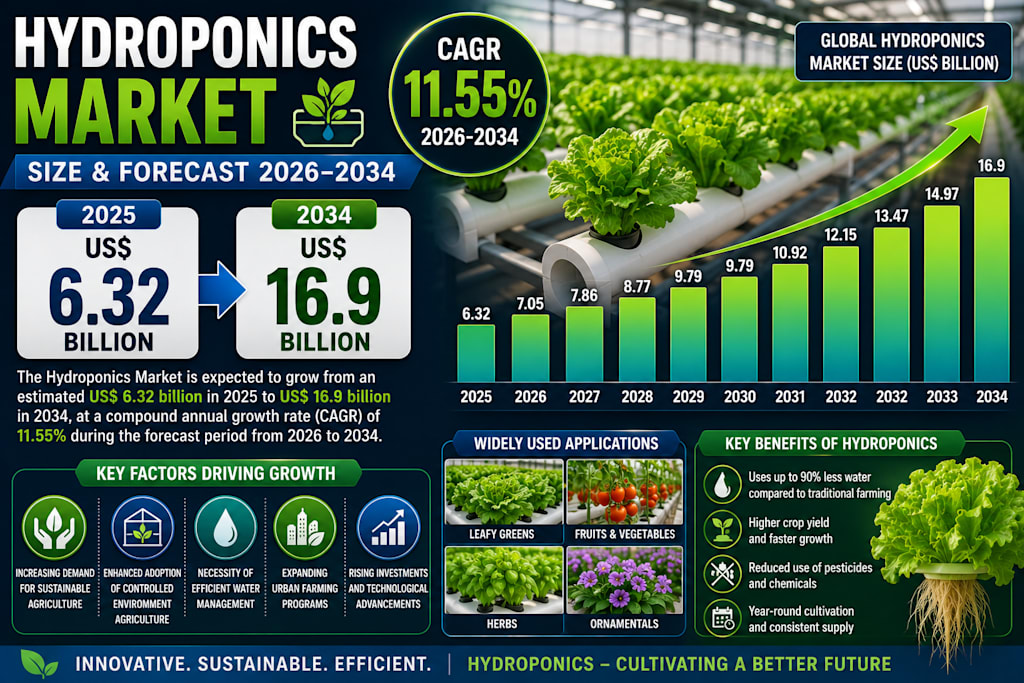
According to Renub Research, the Global Hydroponics Market is projected to grow from US$6.32 billion in 2025 to US$16.9 billion by 2034, registering an impressive compound annual growth rate (CAGR) of 11.55% between 2026 and 2034. This strong growth reflects increasing demand for sustainable agriculture, efficient water management, controlled-environment farming, and locally produced food.
What Is Hydroponics and Why Is It Gaining Attention?
Hydroponics is an advanced farming method that allows plants to grow without soil.
Instead of obtaining nutrients from the ground, plants receive essential minerals through nutrient-rich water solutions. The roots are either submerged directly in water or supported by inert growing materials such as coco coir, perlite, vermiculite, or rockwool.
This controlled growing environment enables farmers to precisely manage nutrients, water, light, temperature, and humidity.
As a result, hydroponic crops often grow faster, produce higher yields, and require fewer resources than conventionally cultivated crops.
Hydroponics is commonly used to grow vegetables, herbs, fruits, and specialty crops, making it a versatile solution for modern agriculture.
Its ability to deliver consistent production regardless of soil quality or weather conditions has made it increasingly attractive worldwide.
Sustainability Is Driving Market Growth
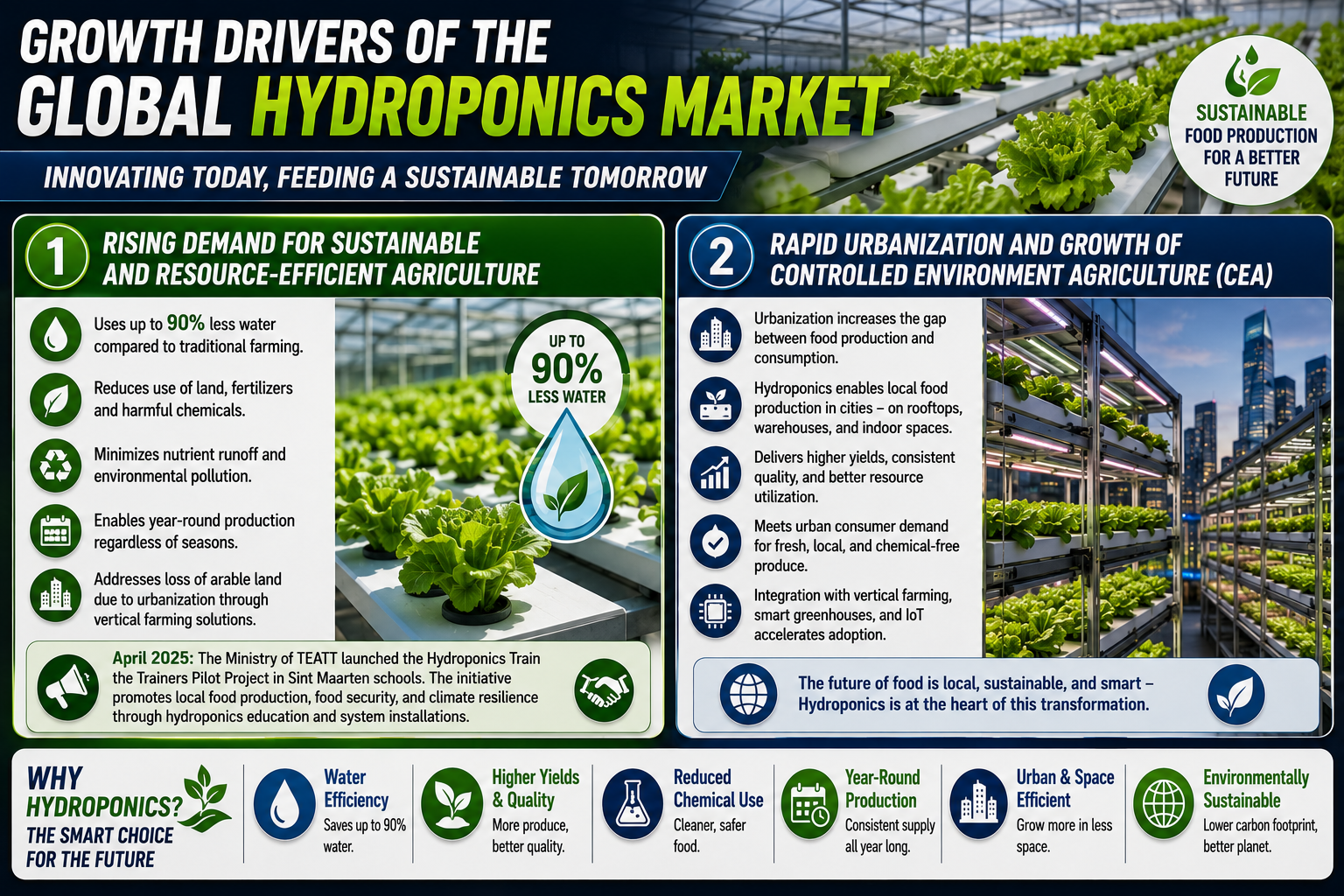
One of the most important factors fueling hydroponics adoption is the growing demand for sustainable agriculture.
Traditional farming methods consume large amounts of water, land, fertilizers, and pesticides. Hydroponic systems address many of these challenges by dramatically improving resource efficiency.
In many cases, hydroponics can reduce water consumption by up to 90% compared to conventional farming methods. This advantage is particularly valuable as water scarcity becomes an increasingly serious global concern.
Additionally, hydroponic systems minimize nutrient runoff, reducing environmental pollution and supporting more sustainable food production practices.
As governments, corporations, and consumers prioritize environmental responsibility, hydroponics is becoming a preferred solution for future agricultural development.
Food Security Concerns Support Adoption
Food security remains a growing concern across many regions of the world.
Rapid population growth continues to increase demand for food, while climate change and land degradation threaten traditional agricultural productivity.
Hydroponics offers a compelling solution because it allows crops to be produced in controlled environments regardless of external weather conditions.
By enabling year-round cultivation, hydroponics reduces dependence on seasonal growing cycles and helps stabilize food supplies.
This capability is especially valuable in regions facing extreme weather conditions, limited agricultural land, or dependence on food imports.
As governments seek innovative ways to strengthen domestic food production, hydroponics is emerging as a key component of long-term food security strategies.
Urban Farming Is Creating New Opportunities
Urbanization is transforming agricultural production worldwide.
As cities continue expanding, the distance between food production and consumption is increasing. At the same time, available farmland near urban centers is becoming increasingly scarce.
Hydroponics addresses these challenges by enabling food production in locations where traditional farming would be impossible.
Urban farmers are successfully using hydroponic systems in warehouses, rooftops, commercial buildings, shipping containers, and indoor facilities.
This localized production model reduces transportation requirements, shortens supply chains, and provides consumers with fresher produce.
The integration of hydroponics with vertical farming has further expanded opportunities for urban agriculture, allowing producers to maximize output within limited spaces.
As urban populations continue growing, hydroponics is expected to play an increasingly important role in feeding cities sustainably.
Consumers Want Fresh and Pesticide-Free Produce
Consumer preferences are evolving rapidly.
Modern shoppers are increasingly seeking fresh, locally produced, pesticide-free foods that align with healthier lifestyles and sustainability goals.
Hydroponically grown crops often meet these expectations exceptionally well.
Because hydroponic systems operate within controlled environments, producers can significantly reduce or eliminate pesticide use while maintaining consistent crop quality.
Consumers also appreciate the freshness associated with locally grown hydroponic produce, which often reaches store shelves faster than conventionally farmed products transported over long distances.
The growing emphasis on food quality, transparency, and sustainability continues to support hydroponics market growth.
Technology Is Revolutionizing Hydroponic Farming
Technological innovation is one of the strongest growth drivers in the hydroponics industry.
Modern hydroponic systems increasingly incorporate advanced technologies such as automation, artificial intelligence, sensors, data analytics, and climate-control systems.
Farmers can monitor nutrient levels, pH balance, temperature, humidity, and crop performance in real time, enabling highly efficient production management.
Automated systems reduce labor requirements while minimizing human error, helping improve consistency and profitability.
Artificial intelligence and predictive analytics are also helping growers optimize crop yields, resource utilization, and operational efficiency.
As these technologies become more affordable and accessible, hydroponics is becoming increasingly attractive to both commercial operators and smaller-scale producers.
LED Lighting Is Expanding Production Possibilities
The development of advanced LED grow lighting has significantly enhanced hydroponic farming capabilities.
LED technology allows producers to provide crops with precise light wavelengths needed for optimal growth while minimizing energy consumption.
Unlike traditional lighting systems, modern LEDs offer higher efficiency, longer lifespans, and greater control over growing conditions.
This technology has been particularly important for indoor farms and vertical agriculture operations where natural sunlight may be limited.
By enabling year-round production regardless of geographic location or weather conditions, LED lighting has become a cornerstone of modern hydroponic farming.
As lighting technology continues improving, production efficiency is expected to increase further.
Aggregate Systems Remain Popular
Aggregate hydroponic systems represent one of the most widely adopted hydroponic approaches.
These systems utilize inert growing media such as coco coir, perlite, vermiculite, and expanded clay pellets to support plant roots while delivering nutrients through water.
Aggregate systems provide excellent root support, oxygen availability, and nutrient management capabilities.
They are particularly popular for crops such as tomatoes, cucumbers, peppers, and strawberries that require stable growing environments.
Their relative simplicity also makes them attractive for beginners entering hydroponic farming.
Growing interest in sustainable growing media such as coco coir is further supporting the expansion of aggregate hydroponic systems.
Tomatoes Lead Commercial Hydroponic Production
Among hydroponically cultivated crops, tomatoes represent one of the most important market segments.
Consumer demand for fresh, high-quality tomatoes remains strong worldwide, making them highly attractive for hydroponic cultivation.
Hydroponic tomato production offers several advantages, including consistent quality, reduced water consumption, lower pest pressure, and higher yields.
Commercial greenhouse operators and vertical farming companies increasingly rely on hydroponics to produce tomatoes efficiently throughout the year.
The ability to deliver pesticide-free and locally grown tomatoes has made hydroponic production especially appealing to retailers and consumers alike.
HVAC Systems Play a Critical Role
Environmental control is essential for successful hydroponic farming.
HVAC systems help maintain optimal temperature, humidity, and airflow conditions necessary for healthy crop development.
Even small environmental fluctuations can affect plant growth, making precise climate control a critical component of hydroponic operations.
As indoor farming and vertical agriculture continue expanding, demand for advanced HVAC solutions is increasing accordingly.
Energy-efficient climate control systems equipped with sensors and automation capabilities are becoming standard features in modern hydroponic facilities.
This segment is expected to remain a major contributor to overall market growth.
Irrigation Systems Drive Efficiency
Efficient irrigation is another fundamental element of hydroponic production.
Hydroponic irrigation systems deliver water and nutrients directly to plant roots, maximizing resource utilization while minimizing waste.
Automated irrigation technologies help maintain optimal growing conditions and improve crop consistency.
As water scarcity concerns continue increasing globally, demand for highly efficient irrigation solutions is expected to grow.
These systems play a crucial role in enabling hydroponics to achieve its sustainability and productivity objectives.
The United States Leads Commercial Expansion
The United States has become one of the most advanced hydroponics markets globally.
Commercial greenhouse operators, vertical farms, and foodservice suppliers are investing heavily in controlled-environment agriculture to meet rising consumer demand for fresh produce.
Technological innovation, automation, advanced lighting systems, and retailer partnerships have accelerated industry growth.
Consumers increasingly prefer locally grown, pesticide-free vegetables and herbs, supporting further expansion of hydroponic production facilities.
While challenges such as energy costs and capital requirements remain, the U.S. market continues moving toward larger-scale operations and greater technological integration.
India Presents Significant Growth Potential
India represents one of the most promising emerging hydroponics markets.
Rapid urbanization, declining agricultural land availability, and increasing water scarcity are creating favorable conditions for hydroponic farming adoption.
Government initiatives, startup activity, educational programs, and growing consumer awareness are supporting market development.
Although high initial investment costs and technical knowledge requirements remain barriers, continued innovation and policy support are expected to accelerate growth.
Hydroponics may play a particularly important role in addressing food production challenges within rapidly expanding urban centers.
Saudi Arabia Embraces Hydroponics for Food Security
Saudi Arabia's hydroponics market is expanding rapidly as the country seeks solutions to its agricultural and water challenges.
The kingdom's harsh climate, limited arable land, and water scarcity make traditional farming difficult.
Hydroponic systems offer a practical alternative by enabling efficient food production while minimizing water consumption.
Government-backed initiatives and private-sector investments are supporting the development of hydroponic greenhouses and controlled-environment agriculture projects.
These efforts align closely with broader food security and sustainability goals.
Challenges Still Need to Be Addressed
Despite strong growth prospects, hydroponics faces several important challenges.
One of the most significant barriers is the high initial investment required to establish commercial operations. Infrastructure, equipment, climate control systems, lighting, and automation technologies can be expensive, particularly for smaller producers.
Operational costs, including electricity consumption, can also affect profitability.
Additionally, hydroponics requires specialized technical knowledge regarding nutrient management, system maintenance, and environmental control.
The shortage of skilled personnel remains a challenge in many regions.
Addressing these issues through education, training, financing, and technological innovation will be essential for sustained market expansion.
Final Thoughts
The hydroponics market is rapidly evolving from a niche agricultural practice into a mainstream solution for sustainable food production.
As concerns about climate change, food security, water scarcity, and urbanization continue to intensify, hydroponics offers a compelling alternative to traditional farming methods.
Its ability to produce high-quality crops using fewer resources while supporting year-round cultivation positions it as one of the most important innovations in modern agriculture.
With the market expected to grow from US$6.32 billion in 2025 to US$16.9 billion by 2034, opportunities abound for growers, technology providers, investors, and policymakers.
While challenges related to costs and technical expertise remain, continued innovation and growing consumer demand suggest that hydroponics will play an increasingly vital role in feeding the world sustainably in the years ahead.
About the Creator
Enjoyed the story? Support the Creator.
Subscribe for free to receive all their stories in your feed.
Comments
There are no comments for this story
Be the first to respond and start the conversation.