
How to Start Day Trading in Singapore? – Step-by-Step Guide
A beginner-friendly step-by-step guide to starting day trading in Singapore with the right strategy, tools, and risk management.
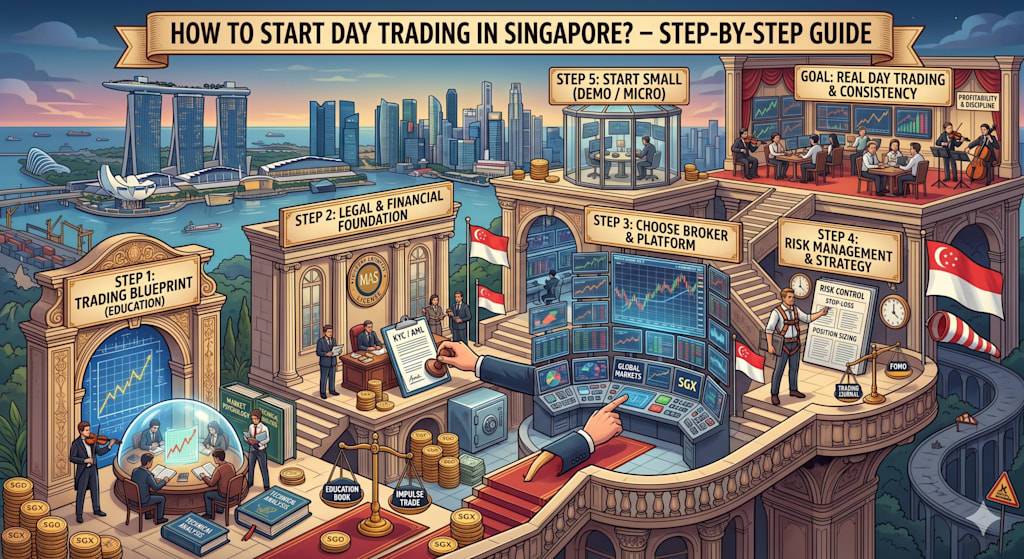
Day trading has become increasingly popular in Singapore as more retail traders gain access to global financial markets through low-cost online platforms and mobile trading apps. Whether trading U.S. stocks, forex, futures, or CFDs, Singapore traders now have access to professional-grade tools that were once reserved for institutions.
But while starting is easier than ever, succeeding in day trading remains difficult without structure, discipline, and a realistic understanding of risk.
Many beginners focus too heavily on finding the “perfect strategy” while ignoring fundamentals like risk management, psychology, and consistency. The truth is that successful day trading is less about predicting markets and more about managing uncertainty.
If you’re planning to start day trading in Singapore in 2026, here’s a practical step-by-step guide to help you begin the right way.
Step 1: Understand What Day Trading Actually Is
Day trading involves buying and selling financial instruments within the same trading session. Positions are typically closed before the market ends, meaning traders avoid overnight exposure.
Common day trading markets include:
- U.S. stocks
- Forex
- Futures
- Options
- CFDs
- Cryptocurrencies
The goal is to profit from short-term price movements rather than long-term investing.
However, day trading is not a shortcut to fast money. It requires:
- Emotional discipline
- Risk control
- Pattern recognition
- Consistent execution
Before risking real capital, understand that losses are part of the process.
Step 2: Choose Your Market
One of the biggest mistakes beginners make is trying to trade everything at once.
Instead, focus on mastering one market first.
Stocks
Good for traders who prefer structured market hours and company-driven price action.
Forex
Popular for its 24-hour availability and high liquidity.
Futures
Favored by many professional intraday traders because of leverage, liquidity, and centralized market data.
CFDs
Common among retail traders due to flexible position sizing and broad market access.
Each market behaves differently, so specialization matters.
Step 3: Learn Basic Market Structure
Before placing trades, you need to understand how markets move.
- Key concepts include:
- Support and resistance
- Trends and reversals
- Liquidity
- Volume
- Volatility
- Risk-to-reward ratios
This foundation is more important than memorizing indicators.
Many beginner traders overload charts with indicators, but experienced traders often focus on clean price action and market context instead.
Step 4: Choose a Reliable Trading Platform
Singapore traders have access to a wide range of platforms in 2026, including:
- Interactive Brokers
- Moomoo
- Tiger Brokers
- Saxo Markets
- Webull
When choosing a platform, consider:
- Fees and commissions
- Market access
- Execution speed
- Platform stability
- Charting tools
For futures traders specifically, platforms connected to Rithmic or Tradovate are increasingly popular because of their execution quality and low-latency infrastructure.
The platform should support your strategy—not complicate it.
Step 5: Start With a Demo or Simulated Account
One of the smartest ways to begin is by practicing in a simulated environment before risking real money.
A demo account helps you:
- Learn platform functionality
- Test strategies
- Understand order execution
- Build confidence
However, treat simulated trading seriously. Random trades in demo mode create bad habits that often carry into live trading.
The goal is to develop a repeatable process.
Step 6: Build a Simple Trading Plan
A trading plan is essential because emotions can quickly take over during live markets.
Your plan should define:
- What setups you trade
- Entry conditions
- Stop-loss placement
- Profit targets
- Maximum daily loss
- Risk per trade
The simpler the plan, the easier it is to follow consistently.
Many beginners fail not because their strategy is bad, but because they constantly switch systems after a few losses.
Consistency matters more than complexity.
Step 7: Focus on Risk Management First
Risk management is what keeps traders in the game long enough to improve.
A common beginner mistake is risking too much on a single trade. Even good setups fail sometimes.
Basic rules include:
- Risk only a small percentage per trade
- Use stop losses
- Avoid revenge trading
- Limit daily losses
Professional traders often think more about downside protection than profits.
That mindset shift is critical.
Step 8: Track Every Trade
Journaling is one of the fastest ways to improve as a trader.
Track:
- Entry and exit points
- Trade reasoning
- Emotional state
- Mistakes
- Market conditions
Over time, patterns become visible.
You’ll often discover that profitability depends less on finding new strategies and more on eliminating repeated errors.
Step 9: Develop Emotional Discipline
Psychology is one of the hardest parts of day trading.
Fear causes hesitation.
Greed causes overtrading.
Frustration leads to revenge trading.
Most traders know what they should do but struggle to execute consistently under pressure.
This is why discipline is more important than intelligence in trading.
Good traders focus on process rather than individual outcomes.
Step 10: Consider Structured Trading Environments
As traders gain experience, some choose to trade within evaluation-based funding programs rather than risking large personal capital upfront.
Firms like Apex Trader Funding have become increasingly popular among futures traders because they allow traders to demonstrate consistency under structured risk parameters. This environment can help newer traders focus more on discipline and execution instead of simply chasing large profits.
However, funded trading should still be approached professionally. Passing evaluations requires consistency, patience, and strong risk management.
Common Mistakes Beginners Should Avoid
Overtrading
Taking too many trades usually leads to poor decision-making and emotional fatigue.
Ignoring Risk
One undisciplined trade can wipe out weeks of progress.
Strategy Hopping
Constantly changing systems prevents long-term improvement.
Unrealistic Expectations
Consistent profitability takes time, often much longer than social media suggests.
Trading Without a Plan
Random entries create random results.
Final Thoughts
Starting day trading in Singapore is easier than ever in 2026 thanks to modern trading platforms, global market access, and growing educational resources. But easy access does not guarantee success.
The traders who last are usually the ones who:
- Keep risk small
- Stay disciplined
- Focus on process
- Think long term
Day trading is a skill-based profession, not a shortcut to instant wealth.
Approach it with patience, structure, and realistic expectations, and you’ll give yourself a much stronger chance of long-term success.
About the Creator
Enjoyed the story? Support the Creator.
Subscribe for free to receive all their stories in your feed.
Comments
There are no comments for this story
Be the first to respond and start the conversation.