
How RFID Technology Is Quietly Transforming the Modern World
From smart retail shelves and automated warehouses to secure access systems and connected cities, RFID is becoming one of the most important technologies behind today's digital economy.

Whether tracking a package online, entering a secure office building, checking inventory in a retail store, or using a contactless access card, RFID technology often works silently in the background. While it may not receive the same attention as artificial intelligence, cloud computing, or robotics, RFID has become one of the foundational technologies driving digital transformation across industries.
Businesses today operate in an environment where speed, visibility, and accuracy are critical. Companies need real-time information about inventory, assets, products, equipment, and people to make informed decisions. Traditional tracking systems often struggle to provide this level of visibility, especially in large and complex operations.
RFID technology addresses these challenges by enabling fast, wireless, and automated identification of objects without requiring direct line-of-sight scanning. As industries increasingly embrace automation and data-driven decision-making, RFID adoption continues to accelerate worldwide.
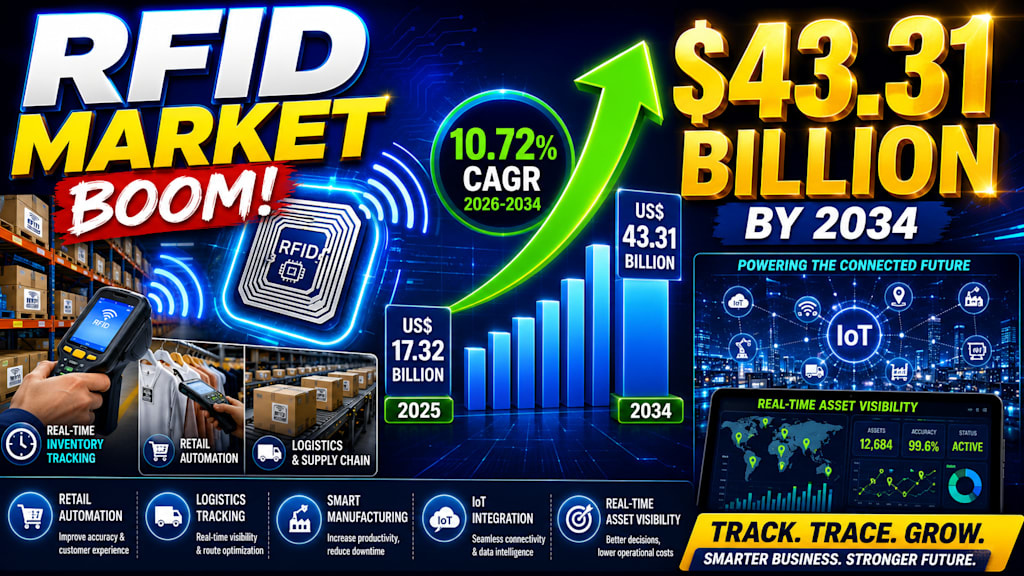
According to Renub Research, the global RFID Market is expected to grow from US$ 17.32 billion in 2025 to US$ 43.31 billion by 2034, expanding at a compound annual growth rate (CAGR) of 10.72% between 2026 and 2034. The market's growth is being fueled by increasing automation, rising demand for real-time asset visibility, falling RFID tag costs, and deeper integration with Internet of Things (IoT) ecosystems.
As businesses seek greater efficiency and operational intelligence, RFID is becoming a vital component of the connected future.
Understanding RFID and Why It Matters
At its core, RFID is a wireless identification and tracking technology.
An RFID system typically consists of three key components: tags, readers, and software. RFID tags contain electronically stored information that can be transmitted through radio waves. Readers capture this information and send it to software platforms where the data can be analyzed and utilized.
Unlike traditional barcode systems, RFID does not require direct visual scanning. Multiple tagged items can be identified simultaneously, even when they are stored inside boxes, containers, or shelving units.
This capability dramatically improves efficiency and accuracy across various industries. Businesses can quickly track thousands of products, monitor asset movement, verify inventory levels, and automate previously manual processes.
The ability to collect large amounts of real-time information makes RFID a powerful tool in today's increasingly data-driven economy.
Retail Is Leading the RFID Revolution
One of the most significant areas of RFID adoption is retail.
Retailers face constant pressure to improve inventory accuracy, reduce losses, enhance customer experiences, and support omnichannel shopping strategies. Traditional inventory management methods often struggle to keep pace with modern consumer expectations.
RFID provides retailers with near real-time visibility into inventory across stores, warehouses, and distribution centers. Products can be tracked automatically throughout their journey, helping businesses maintain accurate stock levels and reduce out-of-stock situations.
The growing popularity of services such as Buy Online, Pick Up In Store (BOPIS) has further increased demand for precise inventory management. Customers expect accurate product availability information and seamless fulfillment experiences.
Advanced RFID systems are helping retailers meet these expectations while reducing labor costs and improving operational efficiency.
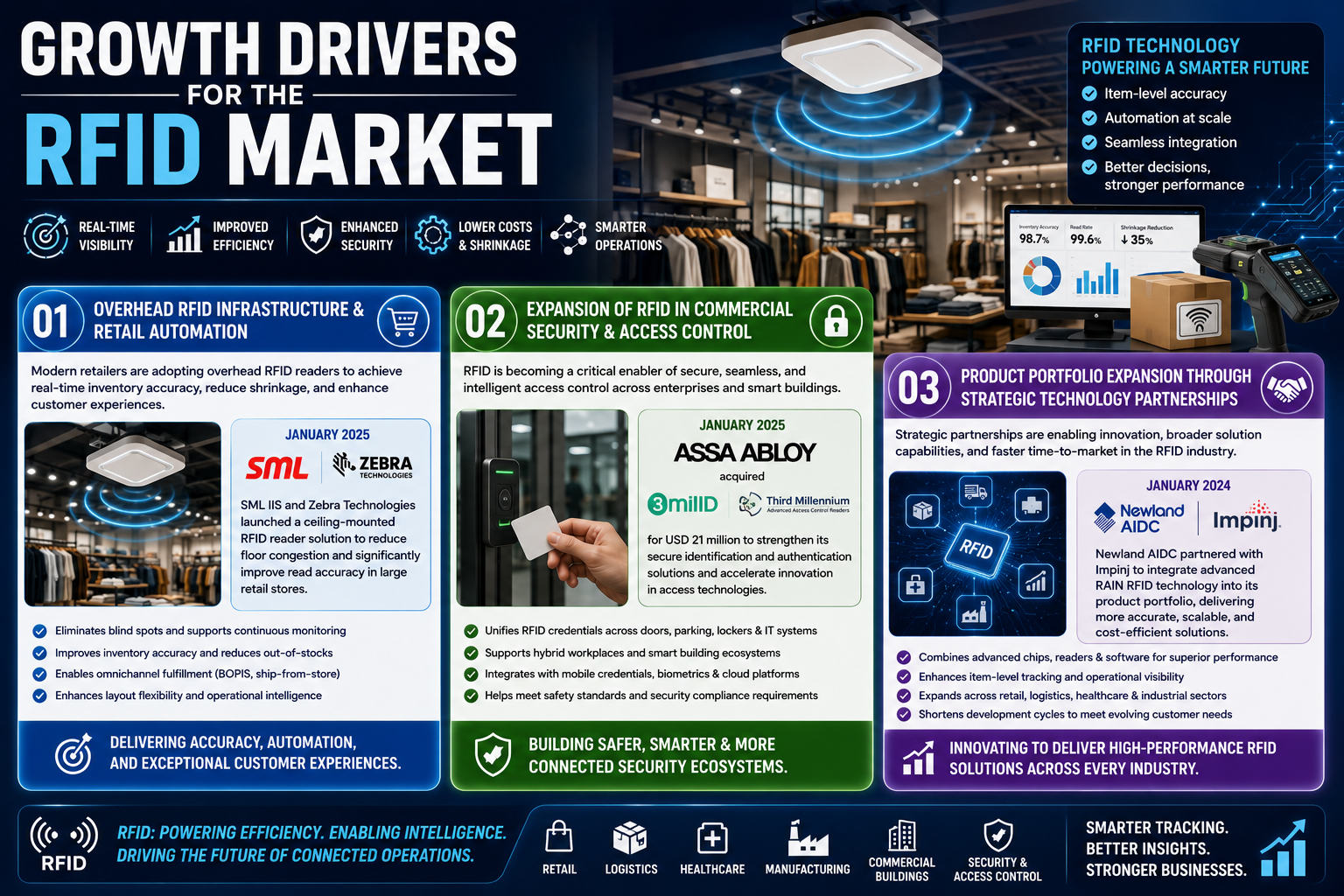
Recent innovations, including ceiling-mounted RFID reader systems, are further enhancing inventory visibility by enabling continuous monitoring throughout retail environments without disrupting customer experiences. These developments highlight how RFID is becoming central to the future of retail automation.
Logistics and Supply Chains Depend on Visibility
Global supply chains have become increasingly complex.
Manufacturers, distributors, logistics providers, and retailers must coordinate the movement of goods across multiple regions, transportation networks, and storage facilities. Delays, inaccuracies, and lost inventory can create costly disruptions.
RFID technology offers a solution by providing real-time visibility throughout the supply chain.
Organizations can track shipments, monitor inventory levels, verify deliveries, and improve warehouse operations with greater precision. Automated tracking reduces reliance on manual data entry while minimizing errors and improving overall efficiency.
As e-commerce continues to expand, the demand for accurate and scalable tracking solutions is growing rapidly. RFID helps businesses respond to this challenge by enabling faster order processing and more reliable inventory management.
For many organizations, RFID has become an essential tool for achieving supply chain resilience and operational excellence.
The Rise of Smart Security and Access Control
RFID technology is also transforming how organizations manage physical security.
Traditional keys and access cards are increasingly being replaced by RFID-enabled systems that offer greater convenience, flexibility, and security. Businesses, government institutions, healthcare facilities, and educational campuses are adopting RFID-based access control solutions to manage entry permissions and monitor movement within secure environments.
Modern RFID systems can integrate with identity management platforms, mobile credentials, biometric technologies, and cloud-based security software.
This integration allows organizations to create unified security ecosystems that improve safety while simplifying user experiences.
The growing popularity of smart buildings and hybrid workplaces is accelerating adoption further. Employees increasingly expect frictionless access solutions that support both security and convenience.
As organizations invest in digital infrastructure, RFID is becoming a key component of modern access control strategies.
RFID and the Internet of Things Are Becoming Closely Connected
The Internet of Things has transformed how businesses collect and utilize data.
Connected devices generate continuous streams of information that help organizations optimize operations, predict maintenance needs, and improve decision-making. RFID technology plays an important role within these ecosystems by providing accurate identification and tracking capabilities.
When integrated with IoT platforms, RFID systems can deliver real-time insights into asset locations, equipment usage, inventory movement, and operational performance.
Businesses can leverage this data to automate workflows, improve resource allocation, and identify opportunities for efficiency improvements.
As IoT adoption continues to expand across industries, RFID is increasingly serving as the bridge between physical assets and digital intelligence.
Healthcare Is Discovering New Applications
Healthcare organizations are increasingly turning to RFID technology to improve patient safety and operational efficiency.
Hospitals use RFID systems to track medical equipment, monitor pharmaceutical inventories, and manage critical assets. These capabilities help reduce equipment loss, improve resource utilization, and ensure essential supplies are available when needed.
RFID can also support patient identification and workflow management, helping healthcare providers deliver safer and more efficient care.
As healthcare systems continue embracing digital transformation, RFID solutions are expected to play a growing role in supporting quality outcomes and operational excellence.
Regional Markets Continue to Expand
The United States remains one of the largest RFID markets globally.
Strong adoption across retail, logistics, healthcare, government, and defense sectors continues to drive growth. The country's advanced technology ecosystem and investment in automation provide favorable conditions for RFID deployment.
Germany is another key market where RFID adoption is closely linked to industrial automation and Industry 4.0 initiatives. Manufacturers increasingly rely on RFID for production tracking, logistics optimization, and quality control processes.
China represents one of the fastest-growing RFID markets in the world. Massive manufacturing operations, expanding e-commerce activity, and government-backed digitalization programs are accelerating adoption across multiple sectors.
Saudi Arabia is also experiencing significant growth as part of its Vision 2030 modernization efforts. Investments in smart cities, transportation infrastructure, healthcare, and logistics are creating strong demand for RFID technologies.
These regional developments demonstrate the widespread importance of RFID in supporting economic modernization and digital transformation.
Challenges Remain Despite Strong Growth
Although RFID offers substantial benefits, adoption is not without challenges.
Large-scale implementations often require significant upfront investments in tags, readers, software, and integration services. For smaller businesses, these costs can create barriers to entry.
System integration presents another challenge. Organizations frequently need to connect RFID platforms with existing enterprise systems such as warehouse management software, inventory platforms, and enterprise resource planning systems.
Privacy and data security concerns also remain important considerations.
Because RFID systems generate large volumes of data, organizations must implement strong security measures to protect sensitive information and prevent unauthorized access. Regulatory requirements related to data protection vary across regions, adding additional complexity.
Despite these challenges, ongoing technological advancements and falling hardware costs continue to improve the overall value proposition of RFID solutions.
Innovation Is Accelerating Market Growth
The RFID industry continues to evolve rapidly through technological innovation and strategic partnerships.
Manufacturers are developing more sensitive tags, longer read-range capabilities, improved analytics platforms, and cloud-connected solutions that enhance system performance.
Partnerships between technology providers are accelerating product development and expanding RFID capabilities across new use cases.
As organizations pursue automation, digital transformation, and operational intelligence initiatives, demand for advanced RFID solutions is expected to increase significantly.
The technology is no longer limited to inventory tracking. It is becoming a critical enabler of connected operations, intelligent decision-making, and real-time business visibility.
Looking Ahead to 2034
The future of the RFID market appears exceptionally strong.
Businesses worldwide are prioritizing efficiency, automation, and real-time data access. RFID directly supports these objectives by providing accurate, scalable, and cost-effective identification and tracking capabilities.
As technologies such as IoT, artificial intelligence, cloud computing, and smart infrastructure continue to expand, RFID will become even more deeply integrated into business operations.
Organizations that successfully leverage RFID technologies will be better positioned to improve productivity, reduce costs, enhance customer experiences, and remain competitive in an increasingly digital world.
Final Thoughts
RFID technology may operate quietly behind the scenes, but its impact on modern business is becoming impossible to ignore.
From retail stores and logistics networks to hospitals, factories, and smart buildings, RFID is helping organizations achieve unprecedented levels of visibility, efficiency, and automation. As digital transformation continues to reshape industries worldwide, RFID is emerging as one of the most valuable technologies supporting that evolution.
With the global RFID Market projected to reach US$ 43.31 billion by 2034, the industry's future looks exceptionally promising. As adoption expands and technology continues to advance, RFID will remain a critical driver of innovation in the connected economy.
In a world where information moves faster than ever, knowing exactly where assets, products, and resources are located can be a powerful advantage—and RFID is making that possible.
About the Creator
Enjoyed the story? Support the Creator.
Subscribe for free to receive all their stories in your feed.
Comments
There are no comments for this story
Be the first to respond and start the conversation.